
105 mm Howitzer M3
The 105 mm Howitzer M3 was a U.S. light howitzer designed for use by airborne troops. The gun utilized the barrel of the 105 mm Howitzer M2, shortened and fitted to a slightly modified split trail carriage of the 75 mm pack howitzer. The howitzer was used by the U.S. Army during World War II. It was issued to airborne units and the cannon companies of infantry regiments.
Also recorded as 105mm Howitzer M3
105 mm Howitzer M3
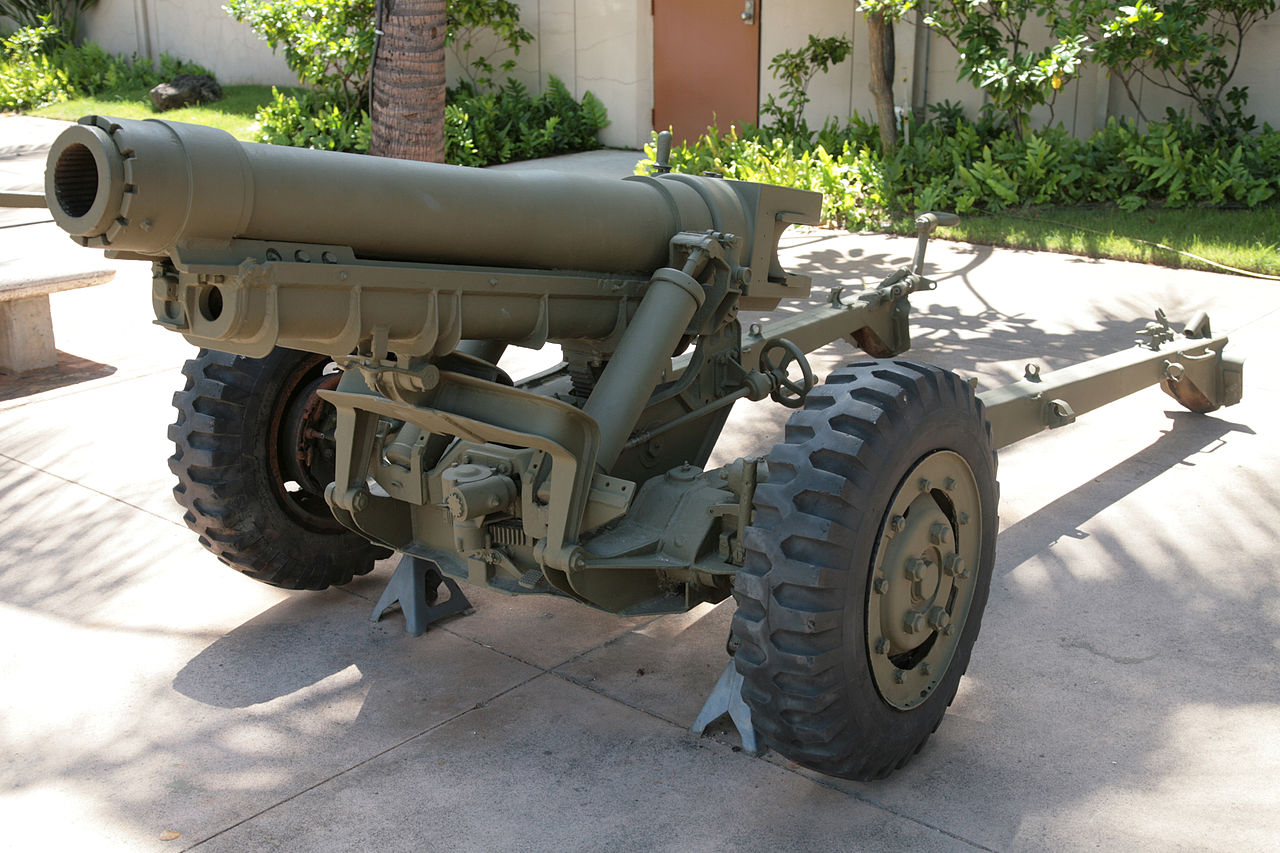
Max Smith · Self-photographed · Public domain
- Name
- 105 mm Howitzer M3
- Field
- field howitzer · howitzer
- Region
- United States
VALÉORINE Encyclopedia
VALÉORINE documentary reading
Documentary summary
The 105 mm Howitzer M3 was a U.S. light howitzer designed for use by airborne troops. The gun utilized the barrel of the 105 mm Howitzer M2, shortened and fitted to a slightly modified split trail carriage of the 75 mm pack howitzer. The howitzer was used by the U.S. Army during World War II. It was issued to airborne units and the cannon companies of infantry regiments.
Admitted source layer · organised and presented by VALÉORINE
Note VALÉORINE
No house-authored Note is published until its assertions and sources pass the VALÉORINE evidence contract. The documentary article remains available in full while that enrichment is being consolidated.
Documentary enrichment in progress · no unsupported statement published
Reference Check
Propose documentary evidence for 105 mm Howitzer M3. A contribution is never written directly as fact: identity, source, rights and evidence gates still decide.
Sign in to contribute
World of VALÉORINE
Documentary connections
Only confirmed graph relationships appear here. Images are shown only when their identity and reuse rights both pass the documentary gate.

Documentary evidence
Evidence Panel
not yet certified
- Identity
- resolved
- Independent source families
- 0
- Admitted assertions
- 0
- Open conflicts
- 0
Authority files
wikidata · Q5353654
In this article
Key facts
Key facts
• Name — 105 mm Howitzer M3 • Origin — United States • Type — Light Howitzer • Is Ranged — 1 • Is Artillery — 1 • Service — 1943–present • Used By — United States • Wars — * World War II • First Indochina War • Korean War • Design Date — 1941 • Production Date — 1943–1945 • Number — 2,580 • Weight — 2,495 lb (1,130 kg) • Length — 12 ft • Part Length — Overall: 6 ft L/17.9 Bore: 5 ft L/16 • Width — 5 ft • Height — 4 ft • Crew — 10 • Cartridge — 105 × 372 mm R • Cartridge Weight — 16.6-19.6 kg • Caliber — 105 mm • Rate — Burst: 4 rpm Sustained: 2 rpm • Velocity — 1,020 ft/s (311 m/s) • Max Range — HE: 8,300 yd (7,600 m) • Breech — Horizontal-block • Recoil — Hydro-pneumatic, constant • Carriage — Split trail • Elevation — −9° to 30° • Traverse — 45°
Development and production
Development and production
The process of building airborne forces in 1941 led to a requirement for an air-portable 105 mm howitzer. The weapon, initially designated T7, featured a barrel from the 105mm Howitzer M2, shortened by 27 in and combined with the recoil system and carriage from the 75 mm pack howitzer. A prototype reached trials at Aberdeen Proving Ground in March 1942. The howitzer was designed to fire the same ammunition as the M2 howitzer, however, it was found that the shorter barrel resulted in incomplete burning of the propelling charge. The problem could be solved by use of faster-burning powder, and otherwise, the design was considered acceptable and was standardized as the 105 mm Howitzer M3 on Carriage M3. The carriage was soon succeeded by the M3A1, which had trails made from thicker steel plate. Even stronger tubular trails were designed, but never reached production. Production started in February 1943 and continued until May 1944; an additional batch was produced from April to June 1945. Production of М3, pcs. • Year — 1943 — 1944 — 1945 — Total • Produced, pcs. — 1,965 — 410 — 205 — 2,580
Service
Service
Even though the M3 was not mentioned in the February 1944 T/O&E, shortly before the Normandy airdrops some airborne divisions received a 105 mm glider field artillery battalion equipped with them as a supplement to their existing three 75 mm howitzer battalions (designated the M1A1 during World War II). 1/4 ton jeeps were used as prime movers. Later increased to four battalions, one, between 1943 and 1945, was converted to 105mm M3. The weapon was finally authorized as an option by the December 1944 TO&E, and by 1945 was employed by all airborne divisions in the European Theater. The initial production of the M3 was adequate to equip the cannon companies of the three hundred infantry regiments that had been forecast in the initial war plans. The M3 was the primary weapon of these companies, and appeared in the table of organization and equipment (T/O&E) from early 1944 (six, in three platoons of two) Often the cannon companies were integrated into the division artillery. The infantry used 1½ ton cargo trucks as the prime mover. In an assessment written after the war "The cannon company of 1943-45 failed to live up to the expectations of the force designers of 1942. The main problem was the substitution of towed low-velocity howitzers for the self-propelled versions as originally intended. This howitzer, the M3, had a shorter barrel than the regular 105-mm howitzer M2, possessed no ballistic shield, and had an effective range of only 7,250 yd as compared to 12,500 yd for the M2." A small number of M3s were supplied via lend lease channels to France (94), United Kingdom (2) and countries of Latin America (18). They were used early in the Korean War as ROK divisional artillery.
Operators
Operators
* * * * * • Philippines •: The Armed Forces received 98 M3s from the U.S. in 1948. • South Vietnam: 11 in 1953 * *
Variants
Variants
• Illustration — M3 near Carentan, France, 11 July 1944. Gun variants: • T7, standardized as M3. • T10 - variant with elevation increased to 65 degrees. Carriage variants: • M3 - based on M3A1 carriage for the 75 mm field howitzer. • M3A1 - had stronger trails, made from 1/8 in plate instead of 3/32 in. • M3A2 - was fitted with shield.
Self-propelled mounts
Self-propelled mounts
There were two proposals for a self-propelled artillery piece armed with the M3. Neither reached mass production. • 105 mm Howitzer Motor Carriage T38 - based on the M3 halftrack, never built. • 105 mm Howitzer Motor Carriage T82 (M3 in mount M3A1) - based on the Light Tank M5A1 chassis. Two pilots were built. The project was cancelled in June 1945 due to lack of requirement.
Ammunition
Ammunition
The gun fired semi-fixed ammunition, similar to the ammunition of the M2; it used the same projectiles and the same 105 mm Cartridge Case M14, but with different propelling charge. The latter used faster burning powder to avoid incomplete burning; it consisted of a base charge and four increments, forming five charges from 1 (the smallest) to 5 (the largest). In an emergency, gunners were authorized to fire M1 HE rounds prepared for the Howitzer M2, but only with charges from 1 to 3. M1 HE rounds for the M3 could be fired from an M2 with any charge. HEAT M67 Shell had non-adjustable propelling charge. For blank ammunition, a shorter Cartridge Case M15 with black powder charge was used. • Available ammunition • Type — Model — Weight (round/projectile) — Filler — Muzzle velocity — Range • HE — HE M1 Shell — 18.35 kg / 14.97 kg — 50/50 TNT or amatol, 2.18 kg — 311 m/s — 7,585 m • HEAT-T — HEAT M67 Shell — 16.62 kg / 13.25 kg — 311 m/s — 7,760 m • Smoke — WP M60 Shell — 18.97 kg / 15.56 kg — White Phosphorus, 1.84 kg — 311 m/s — 7,585 m • Smoke — FS M60 Shell — 19.65 kg / — Sulfur trioxide in Chlorosulfonic acid, 2.09 kg • Smoke — HC BE M84 Shell — 18.29 kg / 14.91 kg — Zinc chloride — 311 m/s — 7,585 m • Drill — Drill Cartridge M14 — - — - • Blank — - — -: • Armor penetration, mm • Ammunition \ Distance, m — 0 — 457 mm — 914 mm — 1,828 mm • HEAT M67 Shell (meet angle 0°) — 102 mm • Concrete penetration, mm • HE M1 Shell (meet angle 0°) — 305 mm — 274 mm — 244 mm — 213 mm • Different methods of measurement were used in different countries / periods. Therefore, direct comparison is often impossible.
Places
Named by the record
Places
Only places the record itself states, plotted where the house gazetteer settles their coordinates. Nothing is inferred from a name or a nationality.
- United States
Named but not plotted · 1
105 mm Howitzer M3 is associated with United States.
Country
Literature
Scholarly footprint
A count of publications is evidence of attention, not of standing, and is given here only as a measure.
Notes from the source article
Cited by Wikipedia
Notes from the source article
These works are cited by the source article, in its own numbering. They are recorded as its citations, not as sources VALÉORINE has verified.
- 1.Zaloga - US Field Artillery of World War II, p 13-14.
- 2.Zaloga - US Field Artillery of World War II, p 9.
- 3.Zaloga - US Airborne Divisions in the ETO 1944-45, p 37.
- 4.T/O&E 7-14 Infantry Cannon Company (26 February 1944).
- 5.THE CANNON COMPANY - A WORLD WAR II SOLUTION TO THE CLOSE SUPPORT PROBLEM OF THE 1990s A Monograph By Major John H. McDonald, Jr. Field Artillery.
- 6.Zaloga - US Field Artillery of World War II, p 37.
- 7.M3 (105mm Howitzer M3) - 105mm Towed Artillery System - Page 2 of 2. www.militaryfactory.com.
- 8.Philippine army 105mm M3 howitzer. 19 March 2008.
- 9.Bak, Dongchan. Korean War : Weapons of the United Nations. Ministry of Defense Institute for Military History. 99–101. March 2021. 979-11-5598-079-8.
- 10.Phạm Văn Sơn, ARVN military history, vol.4, 1972, p.364
- 11.Hunnicutt - Half-Track: A History of American Semi-Tracked Vehicles, p 121.
- 12.Hunnicutt - Stuart: A History of the American Light Tank, p 332-333, 504.
- 13.Technical Manual TM 9-1901, Artillery Ammunition, p 167-178
- 14.Technical Manual TM 9-1904, Ammunition Inspection Guide, p 471-484.
- 15.Hunnicutt - Stuart: A History of the American Light Tank, p 504.
References
Citations
References
Each reference names the institution holding it, so a reader may go to the document itself.
authority record
Unverified
The Encyclopedia exists whether or not anything is for sale. Corrections are recorded rather than overwritten, and every version of this record is kept. Published 14 August 2026.
Elsewhere in Militaria
6,095 published records in this field, each with its sources named.
- 100 mm field gun M1944Terminology
- 100 mm vz. 53Terminology
- 102 mm 60 caliber Pattern 1911Terminology
- 105 mm Cannon Model 1913 SchneiderTerminology
- 105 mm MÁVAG 40/43MTerminology
- 105 mm Modèle F1Terminology
- 105/14 Model 18Terminology
- 105mm Gun T8Terminology
Best supported in this field
For owners
Own an object connected with 105 mm Howitzer M3?
A specialist will read what you send and tell you what the house can establish, what it cannot, and whether the object is suited to sale. There is no charge and no obligation. The object stays with you throughout; nothing is shipped to us unless it is arranged in writing beforehand.