
Wu Li
Illustration — Hanging scroll painting by Wu Li: Spring Comes to the Lake, on display at the Shanghai Museum Wu Wu Li, SJ; ca. 1632-1718 was a Chinese landscape painter, Christian poet, calligrapher and Jesuit missionary priest from Jiangsu who lived during the Qing Dynasty (1644–1912). Wu converted to the Catholic Church in China, and, after being widowed, joined the Society of Jesus.
Also recorded as Qili Wu · hao Mojing Daoren · zi Yushan · Mojing Wu
Wu Li

Gleb Simonov · CC BY-SA 4.0
- Nationality
- Qing dynasty and Ming dynasty.
- Occupation
- painter, writer, poet, calligrapher, missionary and scholar.
- Fields
- shan shui.
- Teachers
- Wang Shimin.
- Languages
- Chinese.
Reference Check
Propose documentary evidence for Wu Li. A contribution is never written directly as fact: identity, source, rights and evidence gates still decide.
Sign in to contribute
In this article
Life
Life
In 1688, after seven years of education at St. Paul's College, Macau, Wu was ordained at Nanjing as one of the three first Chinese Jesuit priests, taking the name Simon-Xavier a Cunha. He spent the remaining 30 years of his life serving tirelessly as priest in rural villages.
Training under Wang Shimin is recorded. The recorded working language is Chinese. The field of work recorded is shan shui. Subjects and genres recorded for the work are landscape. Su Shi is recorded as an influence. Places of work recorded in the authority are Beijing, Macau and Nanjing. Work by Wu Li is recorded in the collections of National Gallery of Canada, Metropolitan Museum of Art, Art Gallery of New South Wales, Los Angeles County Museum of Art and Yale University Art Gallery.
Wu was born in Changzhou in the Jiangsu province of China. His style name was 'Yu Shan' and his sobriquet was 'Mojing Daoren'. Wu learned poetry from Qian Qianyi. He was taught painting by Wang Shimin and Wang Jian, and was influenced by the painters Huang Gongwang and Wang Meng. His landscapes utilized dry brush strokes and light colors. His distinctive style elevated him to where he is now identified as one of the Six Masters of the early Qing period. • Illustration — Wu Li, Boat Trip on the River Underneath a Buddhist Temple The dramatic decline and fall of the Ming Dynasty and the coming to power of the Manchu Qing Dynasty caused the crisis of a number of intellectuals, who looked for new directions for them and for the country. The philosophical and ethical teaching of the Jesuits' learned missionaries, based out of Macau, appealed to them. Several literati, steeped in Confucianism and Buddhism, sought widening religious horizons, accepting the 'Western Teaching'. Conversion to Christianity was for them the arrival point of a spiritual and personal journey toward religious fulfillment. The converts saw in the Christian teaching an opportunity to revitalize, morally and scientifically, a country in crisis. Wu often went to the Xing Fu Buddhist convent in Suzhou during his middle-age years and was a close friend of monk Mo Yong, but from 1675 on he was inclined toward Roman Catholicism through his contact with Jesuit missionaries Lu Rima (Franciscus de Rougemont), Bai Yingli (Phillippe Couplet), and others. He was converted and baptized (by?) Ximan Sawulue (Simon Xaverius). In 1681 Couplet was recalled to Europe. Wu intended to go with him, but his plans did not materialize when they reached Macau. Wu remained in Macau for five months and returned to his hometown in the summer of 1682. He returned to Macau in the winter and joined the Society of Jesus. At the age of 50, Wu Li's life took a dramatic turn. After the death of his wife and his masters, obeying to an internal quest for spiritual excellence, fascinated by the Jesuit art and architecture, and after having been a Catholic for seven years, he chose to join the Jesuit priesthood and entered St. Paul's College, Macau to pursue both the 'heavenly learning' and the Roman Catholic priesthood. There he strenuously searched 'the Western Lantern', struggling to learn a new language (Ecclesiastical Latin) and to acquire a new religious dimension, on the lines of the 'Spiritual Exercises', as a son of Saint Ignatius of Loyola. He was ordained a priest on 1 August 1688 in Nanjing by Chinese bishop Luo Wenzao. His first pastoral assignment was in Shanghai. In 1691, he was put in charge of the religious affairs of the Jiading Catholic Church. Wu Li devoted himself to the new faith and to ministry. Often disguised as a peasant or fisherman, he traveled for thirty years from village to village to evangelize. Although he had the opportunity to become a court painter, as did his friend Wang Hui, Wu Li worked in the Jiangsu countryside as an itinerant missionary priest, where he reported encountering difficulties and limited results. He ministered to peasants and described his work in terms of devotion to their spiritual welfare. The Chinese poetry he continued to write as a priest addresses themes of his faith, as well as periods of contentment and frustration. Wu Li in no way rejected his Chinese identity, as shown by the fact that his paintings maintained an autochthonous style, and he signed them with his Chinese name. The extent of Western influence in his figurative art, if any, has been discussed by scholars, with no clear consensus reached. Scholars, however, agree on the exceptionally important value of Wu Li's personal experience. Wu Li was a man of rare qualities: a fine Chinese intellectual, a remarkable artist, a Jesuit, a missionary and a priest totally devoted to his flock. Wu died at age 86 after serving 30 years as a priest. He composed many poems reflecting his own preaching career and religious feelings, which are collected in an anthology, San Yi Ji. His sermons from 15 August 1696 to 25 December 1697 and other religious activities were compiled by Zhao Lun, a convert in Jiading, in a book, Kou Duo (Record of Word and Deeds), the first collection of sermons by a Chinese priest.
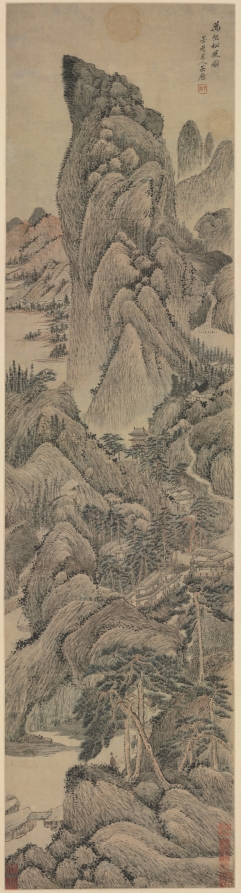
Pine Wind from Myriad Villages, late 1600s–1718, by Wu Li
Wu Li · The Cleveland Museum of Art · John L. Severance Fund
Life and career
Dated record
Life and career
The full dated record · 2 entries
1632
Wu Li born at Changshu.
1718
Wu Li died at Shanghai.
Places
Named by the record
Places
Only places the record itself states, plotted where the house gazetteer settles their coordinates. Nothing is inferred from a name or a nationality.
Changshu.
Birth place
Shanghai.
Death place
Text attribution
Licensing
Text attribution
Part of the biographical narrative on this page reuses licensed material. Its origin, revision and licence are recorded here.
The biographical narrative on this page is based on the Wikipedia article Wu Li, revision 1360521161 (EN edition), by its contributors. VALÉORINE has edited that text and built its own documentary record around it. The reused material is available under CC BY-SA 4.0, and this page's reuse of it is offered under the same licence. Everything else on this page — the chronology, the holdings, the evidence, the plates and the connections — is VALÉORINE's own record. Sources and licences.
Notes from the source article
Cited by Wikipedia
Notes from the source article
These works are cited by the source article, in its own numbering. They are recorded as its citations, not as sources VALÉORINE has verified.
Further particulars
Held on the record
Further particulars
Open the remaining particulars
The authorities additionally record the headings Qili Wu, hao Mojing Daoren, zi Yushan, Mojing Wu and Mojing Daoren. His recorded language was Chinese. His recorded confession was Catholic Church. Li worked in shan shui. He belonged to Six Masters of the early Qing period and Society of Jesus. He worked at Beijing, Macau and Nanjing.
Identity and origins
Career and activity
The Encyclopedia exists whether or not anything is for sale. Corrections are recorded rather than overwritten, and every version of this record is kept. Published 17 August 2026.
Elsewhere in Books
39,529 published records in this field, each with its sources named.
- Wu ChengAuthor
- Wu Cheng'enAuthor
- Wu HanAuthor
- Wu JingziAuthor
- Wu MingyiAuthor
- Wu RenbiAuthor
- Wu SansiAuthor
- Wu Te-kungAuthor
Best supported in this field
For owners
Own a work by Wu Li?
A specialist will read what you send and tell you what the house can establish, what it cannot, and whether the object is suited to sale. There is no charge and no obligation. The object stays with you throughout; nothing is shipped to us unless it is arranged in writing beforehand.