
Wind God and Thunder God
Shihon Kinji Chakushoku Fūjin Raijin-zu is a painting on a pair of two-folded byōbu (folding screens) by Rinpa artist Ogata Kōrin, a replica of a similar work by Tawaraya Sōtatsu, depicting Raijin, the god of lightning, thunder and storms in the Shinto religion and in Japanese mythology, and Fūjin, the god of wind. Ogata Kōrin (1658–1716) was a major Japanese painter, lacquerer and designer, and an important member of the Rinpa school, particularly famous for his byōbu screens, his paintings on ceramics and lacquerware produced by his brother Ogata Kenzan, and for consolidating the style of the founding Rinpa master, Kōetsu and Sōtatsu. One of his most important works (although not as famous as his Irises and Red and White Plum Blossoms screens), Wind God and Thunder God consists of a pair of two-folded byōbu folding screens painted with ink and color on gold-foiled paper, measuring 421.6 by 464.8 centimetres (166.0 in × 183.0 in) each.
Also recorded as Wind God and Thunder God (Kōrin)
Wind God and Thunder God
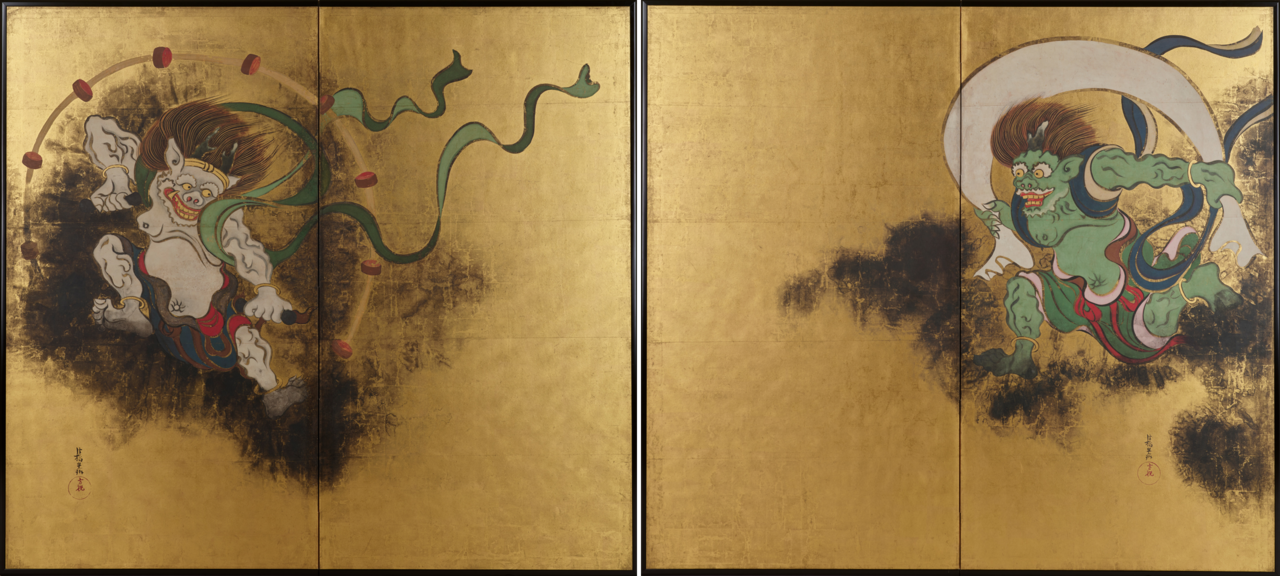
尾形光琳 (Ogata Korin) (1658-1716) · [1] [2] · Public domain
- Period
- 1800
- Region
- Japan
VALÉORINE Encyclopedia
VALÉORINE documentary reading
Documentary summary
Shihon Kinji Chakushoku Fūjin Raijin-zu is a painting on a pair of two-folded byōbu (folding screens) by Rinpa artist Ogata Kōrin, a replica of a similar work by Tawaraya Sōtatsu, depicting Raijin, the god of lightning, thunder and storms in the Shinto religion and in Japanese mythology, and Fūjin, the god of wind. Ogata Kōrin (1658–1716) was a major Japanese painter, lacquerer and designer, and an important member of the Rinpa school, particularly famous for his byōbu screens, his paintings on ceramics and lacquerware produced by his brother Ogata Kenzan, and for consolidating the style of the founding Rinpa master, Kōetsu and Sōtatsu. One of his most important works (although not as famous as his Irises and Red and White Plum Blossoms screens), Wind God and Thunder God consists of a pair of two-folded byōbu folding screens painted with ink and color on gold-foiled paper, measuring 421.6 by 464.8 centimetres (166.0 in × 183.0 in) each.
Admitted source layer · organised and presented by VALÉORINE
Reference Check
Propose documentary evidence for Wind God and Thunder God. A contribution is never written directly as fact: identity, source, rights and evidence gates still decide.
Sign in to contribute
Documentary evidence
Documentary basis
Authority files
wikidata · Q48389324 · wikipedia · Wind God and Thunder God (Kōrin)
In this article
Overview
Overview
The work dates from the early 18th century: probably circa 1700, as it is not generally considered one of Kōrin's later works, and he died in 1716. The attribution to Kōrin has not been disputed. It is designated an Important Cultural Property of Japan. At some point Sakai Hōitsu owned the painting, and in fact he painted one of his most famous works, Flowering Plants of Summer and Autumn, on the back of these screens. The monumental two-sided byōbu screens became a symbol of the Rinpa tradition, but both sides of the screens have since been separated to protect them from damage. Kōrin's painting is a close replica of an original by Tawaraya Sōtatsu, dated from the 17th century, and designated a National Treasure. In turn, Hōitsu painted a version in the 19th century. All three versions of the work were displayed together for the first time in seventy-five years in 2015, at the Kyoto National Museum exhibition "Rinpa: The Aesthetics of the Capital". An even later version of the work was created by the late Rinpa artist Suzuki Kiitsu, a student of Hōitsu. The screens are now part of the collection of the Tokyo National Museum, where they are exhibited occasionally. The last time they were on display was from May 30 to July 2, 2017, in Room 7 of the Honkan (Japanese Gallery). Previously they were on display at the Tokyo National Museum in 2008, 2012, 2013, and 2014.

Wind God and Thunder God, Korin Fujin Raijin
尾形光琳 (Ogata Korin, 1658 - 1716) · [1] at [2]
Key facts
Key facts
• Title — Wind God and Thunder God • Artist — Ogata Kōrin • Year — early 18th century (Edo period) • Catalogue — A-11189-1 (TNM catalogue) • Type — byōbu folding screens ink and color on gold-foiled paper • Height Metric — 421.6 • Width Metric — 464.8 • Metric Unit — cm • Imperial Unit — in • Designation — Important Cultural Property • City — Tokyo, Japan • Museum — Tokyo National Museum • Illustration — Tawaraya Sōtatsu’s original. 17th century
Places
Named by the record
Places
Only places the record itself states, plotted where the house gazetteer settles their coordinates. Nothing is inferred from a name or a nationality.
- Japan
References
Citations
References
Each reference names the institution holding it, so a reader may go to the document itself.
reference work
Secondary witnessreference work
Secondary witness
Further particulars
Held on the record
Further particulars
Open the remaining particulars
Wind God and Thunder God is associated with Japan. Recorded from 1800.
Wind God and Thunder God is recorded as
Tokyo National Museum
The Encyclopedia exists whether or not anything is for sale. Corrections are recorded rather than overwritten, and every version of this record is kept. Published 16 August 2026.
Elsewhere in Furniture
924 published records in this field, each with its sources named.
- Westminster RetableTerminology
- wheel chandelierTerminology
- wheelchairTerminology
- William Stromberg ClockTerminology
- window seatTerminology
- WindSeekerTerminology
- Windsor chairTerminology
- wine rackTerminology
Best supported in this field
For owners
Own an object connected with Wind God and Thunder God?
A specialist will read what you send and tell you what the house can establish, what it cannot, and whether the object is suited to sale. There is no charge and no obligation. The object stays with you throughout; nothing is shipped to us unless it is arranged in writing beforehand.