
William Pettit Griffith
William Pettit Griffith (7 July 1815 – 14 September 1884) was an English architect and antiquarian. William Pettit Griffith was born in Clerkenwell in London, he had a particular interest in the area, and much of his work of restoring and designing buildings took place there. He was a member of several learned societies.
Also recorded as William Griffith · William Pettitt Griffith
William Pettit Griffith
William Pettit Griffith · Wellcome Collection, London · Wellcome Collection · Public Domain Mark
- Born
- 1815
- Died
- 1884
- Nationality
- United Kingdom of Great Britain and Ireland
- Occupation
- architect · antiquarian
- Languages
- English
VALÉORINE Encyclopedia
VALÉORINE documentary reading
Documentary summary
William Pettit Griffith (7 July 1815 – 14 September 1884) was an English architect and antiquarian. William Pettit Griffith was born in Clerkenwell in London, he had a particular interest in the area, and much of his work of restoring and designing buildings took place there. He was a member of several learned societies.
Admitted source layer · organised and presented by VALÉORINE
Note VALÉORINE
William Pettit Griffith (1815–1884) was an antiquarian and architect, of British nationality. Languages used include English.
Composed from admitted, traceable facts · 27 September 2026
VALÉORINE
Reference Check
Propose documentary evidence for William Pettit Griffith. A contribution is never written directly as fact: identity, source, rights and evidence gates still decide.
Sign in to contribute
Documentary evidence
Documentary basis
Authority files
wikidata · Q18672765 · wikipedia · William Pettit Griffith
In this article
Life
Life
• Illustration — St John's Gate. Lithograph by R. K. Thomas after W. P. Griffith, 1845. Griffith, son of the architect John William Griffith, was born in 1815 at 9 St John's Square, Clerkenwell, where his father resided for more than half a century. He was brought up to the profession of an architect, and before he was twenty was writing notes in J. C. Loudon's Architectural Magazine. He continued these notes, under the signature "Tyro, Wilmington Square", from 1835 to 1837, besides contributing original articles and designs in 1836. In 1839 and 1840 he exhibited architectural designs in the Royal Academy, and in 1840–1–2 watercolour drawings of fonts and portions of old churches at Hendon, Broxbourne, St Albans and other places, in the galleries of the Society of British Artists. On 12 May 1842 he was elected Fellow of the Society of Antiquaries of London; and between 1856 and 1858 exhibited architectural fragments in connection with his work of restoration at St John's Gate, Clerkenwell.
Papers read to learned societies
Papers read to learned societies
He was elected FRIBA on 14 June 1847, and on that evening made some remarks as to "The Principles which guided the architects in constructing the Minsters, Cathedrals, and Churches of England". In 1855 he was awarded the institute's silver medal for an "Essay on the Principles or Laws which govern the Formation of Architectural Decorations and Ornaments"; the manuscript, illustrated by neatly executed ink and sepia drawings, is in the library of the Royal Institute of British Architects. In connection with it are four sheets of drawings, "Classification of Mediaeval Ornaments" and "Designs for Mediaeval Ornaments from the Vegetable Kingdom. Arranged geometrically and conventionalised". At the chapter meetings of the College of the Freemasons of the Church he communicated, on 12 August and 9 September 1845, papers "On the Ancient Baptismal Fonts of England" (drawings of nine ancient fonts which he had made in 1838-9 were engraved on one sheet by Webb & Son); on 10 February 1846, "On the Different Kinds of Stone employed in the Edifices of Babylon, Egypt, Greece, Rome, and Great Britain"; and 13 October 1846, "On the Hagioscope or Squint in the Ancient Parochial Churches of England". He was made an honorary member of the Bedfordshire Architectural Society in 1847, and read at Elstow on 25 May 1852 "Suggestions for a more Perfect and Beautiful Period of Gothic Architecture" (published in pamphlet form in 1855). Elected honorary member of the Liverpool Architectural Society 1849, he communicated to its meetings: 15 April 1857, "Proportion its Practical Application to Architecture and the Fine Arts"; 1860, "Of the Resources of Design in the Natural Kingdom"; 1863, "Of the Influence of Fashion in Architecture". At the Surrey Archaeological Society he read on 30 June 1854, "On the Ancient Baptismal Fonts of England": in 1856 was made an honorary member; 12 June 1856 communicated "An Architectural Notice of Archbishop Whitgift's Hospital at Croydon"; and 12 May 1858, "An Architectural Notice of the Nave of St. Saviour's Church, Southwark". Griffith died a poor man at 3 Isledon Road, Highbury, London, on 14 September 1884.
Works
Works
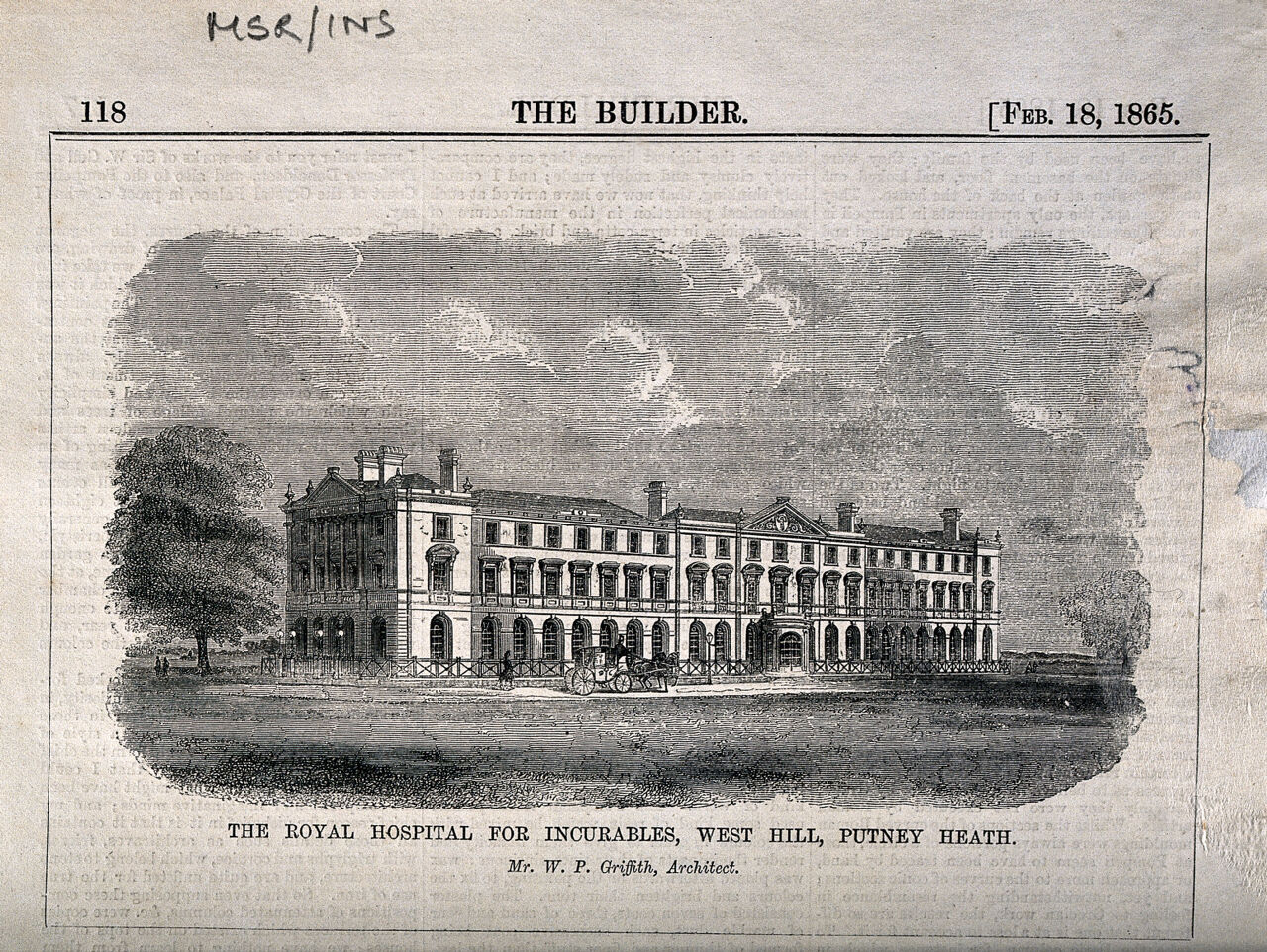
• Illustration — Monument to Vincent Figgins, by Griffith Griffith designed, about 1844, the monument to Vincent Figgins in Nunhead Cemetery (now Grade II-listed). Other works include: The restoration of St. John's Church, Clerkenwell, 1845; the restoration of St John's Gate, 1845–6; the rebuilding of the spire (1849) and the erection of a font (1851) for St James's Church, Clerkenwell. The drawing of the font was engraved. He designed the Cherry Tree Tavern, Clerkenwell, 1852; the Goldsmiths' and Jewellers' Annuity Institution Asylum, Hackney, 1853 (the exterior view engraved); planned additions and alterations to the Clerkenwell Vestry Hall, 1857; designed many parochial and ragged schools 1858–62; and adapted Melrose Hall, Putney Heath, for the Royal Hospital for Incurables 1864–5. He directed the erection of Messrs. Rivington's printing-office, St John's House, Clerkenwell, 1866, and the repairs to and partial renewal of the tower and porch of the church of St. Sepulchre, Holborn, 1873; designed the House of Detention, Kingston-on-Thames; and the repairs to the tower of Kingston Church. Griffith was keenly interested in the antiquities of Clerkenwell, made a special study of the old priory of St. John of Jerusalem, and spared no pains to avert the threatened destruction of St. John's Gate, helping to raise a public subscription for its restoration. Relics of both priory and gate, some of which he brought to light, were deposited in the Architectural Museum, and at South Kensington Museum.
Publications
Griffith published: • The Geometrical Proportion of Architecture. 1843. • The Natural System of Architecture, 1845. • Ancient Gothic Churches, 3 parts, 1847–8–52. • Architectural Botany (extracted from part iii. of Ancient Gothic Churches), 1852. • Suggestions for a more Perfect and Beautiful Period of Gothic Architecture, 1855. In his writings Griffith mainly endeavoured to show that "the geometrical proportions pervading Greek and Gothic architecture are in principle based upon nature's works" (Suggestions for a more Beautiful Period of Gothic Architecture, p. 6), and that "by the employment of regular figures and their multiples in architecture, we always ensure an equal distribution of parts, which also exists in the vegetable kingdom" (Ancient Gothic Churches, pt. ii. p. 26).
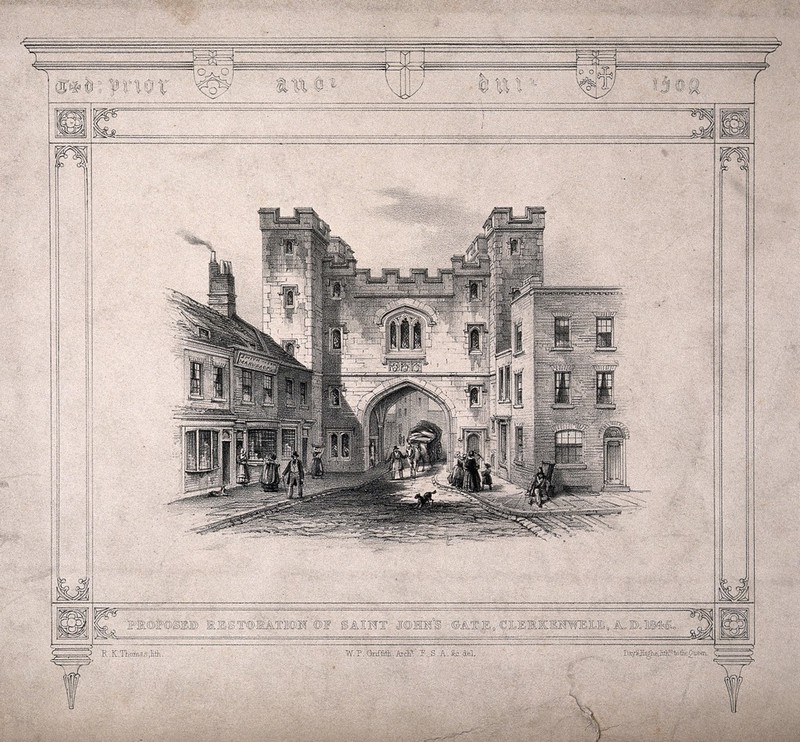
St John's Gate, Clerkenwell,
William Pettit Griffith · Wellcome Collection, London · Wellcome Collection
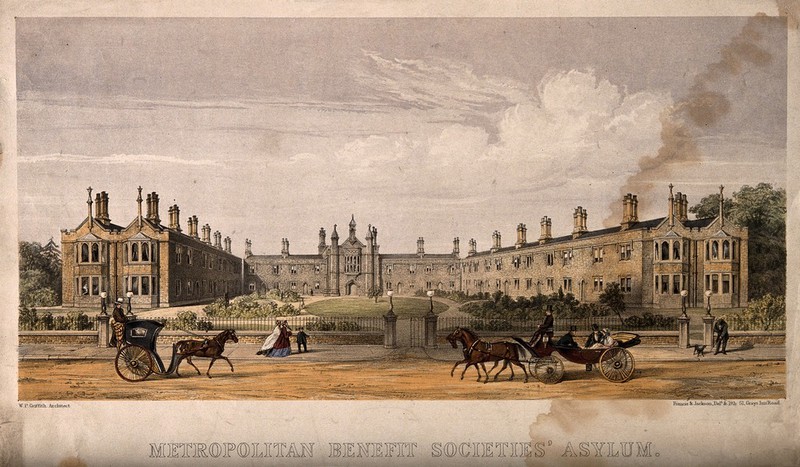
The Metropolitan Benefit Societies' Asylum, Dalston, London. Coloured lithograph by Francis and Jackson., by William Pettit Griffith
William Pettit Griffith · Wellcome Collection, London · Wellcome Collection
Primary material
Documents and archives
reference work
- “William Pettit Griffith”, English Wikipedia, consulted as further reading
Reputable secondary · Wikipedia
authority record
- Wikidata, structured authority record Q18672765: William Pettit Griffith
General reference · Wikidata
Notes from the source article
Cited by Wikipedia
Notes from the source article
These works are cited by the source article, in its own numbering. They are recorded as its citations, not as sources VALÉORINE has verified.
- 1.Porter, Bertha. 23. 241–242.
- 2.1385655. Monument to Vincent Figgins, Nunhead Cemetery.
References
Citations
References
Each reference names the institution holding it, so a reader may go to the document itself.
reference work
Secondary witnessauthority record
General reference
The Encyclopedia exists whether or not anything is for sale. Corrections are recorded rather than overwritten, and every version of this record is kept. Published 18 August 2026.
Elsewhere in Design
11,558 published records in this field, each with its sources named.
- William PaulDesigner
- William Penhallow HendersonDesigner
- William Penn CressonDesigner
- William PereiraDesigner
- William PilkingtonDesigner
- William PittDesigner
- William R. MillerDesigner
- William RailtonDesigner
Best supported in this field
For owners
Own a work by William Pettit Griffith?
A specialist will read what you send and tell you what the house can establish, what it cannot, and whether the object is suited to sale. There is no charge and no obligation. The object stays with you throughout; nothing is shipped to us unless it is arranged in writing beforehand.