
William Larkin
Illustration — Richard Sackville, 3rd Earl of Dorset by William Larkin, 1613, standing on a Lotto carpet. William Larkin (early 1580s – 1619) was an English painter active from 1609 until his death in 1619, known for his iconic portraits of members of the court of James I of England which capture in brilliant detail the opulent layering of textiles, embroidery, lace, and jewellery characteristic of fashion in the Jacobean era, as well as representing numerous fine examples of oriental carpets in Renaissance painting.
Also recorded as Master of the Curtain
William Larkin
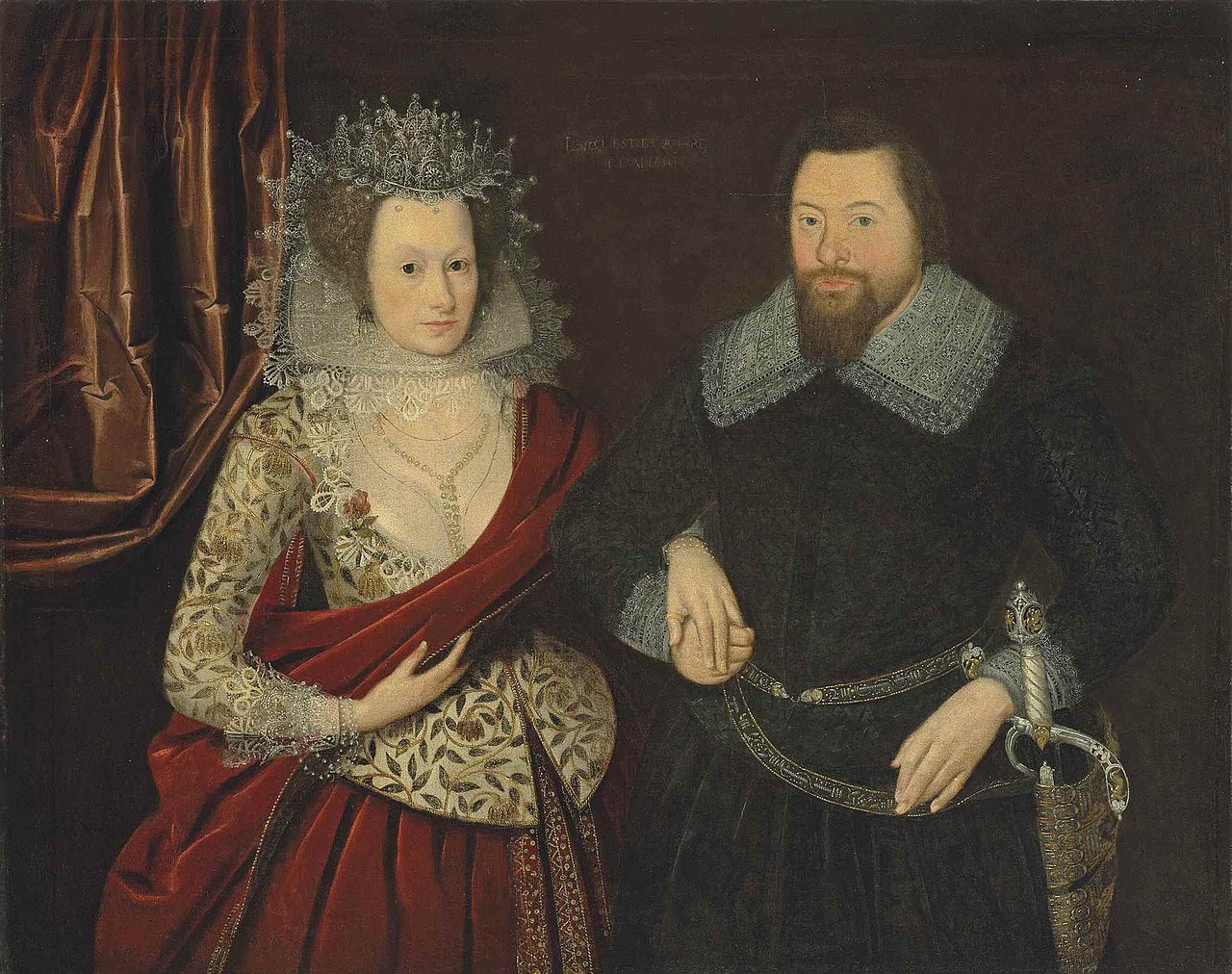
Circle of William Larkin · Christie's, LotFinder: entry 5916356 (sale 10390, lot 170, London, 10 July 2015, page no more available) · Public domain
- Born
- 1580 · London.
- Died
- 1619 · London.
- Nationality
- United Kingdom
- Occupation
- painter · artist
- Fields
- portrait
- Languages
- English
VALÉORINE Encyclopedia
VALÉORINE documentary reading
Documentary summary
Illustration — Richard Sackville, 3rd Earl of Dorset by William Larkin, 1613, standing on a Lotto carpet. William Larkin (early 1580s – 1619) was an English painter active from 1609 until his death in 1619, known for his iconic portraits of members of the court of James I of England which capture in brilliant detail the opulent layering of textiles, embroidery, lace, and jewellery characteristic of fashion in the Jacobean era, as well as representing numerous fine examples of oriental carpets in Renaissance painting.
Admitted source layer · organised and presented by VALÉORINE
Note VALÉORINE
William Larkin (1580–1619) was a British artist and painter. The artist was born and died in London. William Larkin worked in England.
Genres include portrait. Languages used include English. Works by the artist are held at Kenwood House, Museum of Fine Arts, Budapest and National Gallery of Victoria, among others.
Composed from admitted, traceable facts · 01 October 2026
VALÉORINE
Reference Check
Propose documentary evidence for William Larkin. A contribution is never written directly as fact: identity, source, rights and evidence gates still decide.
Sign in to contribute
World of VALÉORINE
Documentary connections
Only confirmed graph relationships appear here. Images are shown only when their identity and reuse rights both pass the documentary gate.
Documentary evidence
Documentary basis
Authority files
getty · 500449160 · gnd · 135681847 · wikidata · Q2662852
In this article
Life
Life
The recorded working language is English. Subjects and genres recorded for the work are portrait. Places of work recorded in the authority are England. Work by William Larkin is recorded in the collections of National Gallery of Victoria, Nationalmuseum, Kenwood House, Yale Center for British Art and National Portrait Gallery.
Larkin was born in London in the early 1580s, and lived in the parishes of St Sepulchre-without-Newgate, Holborn, and St Anne Blackfriars. He became a freeman of the Worshipful Company of Painter-Stainers on 7 July 1606 under the patronage of Lady Arbella Stuart and Edward Seymour, 1st Earl of Hertford. Married before 1612, he buried a stillborn son in that year; a son, William, in 1613; and a daughter, Mary, in January 1614/15, all at St Anne Blackfriars. Another daughter called Mary was alive at the time of his death. He died sometime between the witnessing of his will on 10 April 1619 and its proving on 14 May. The date of his burial is unknown because the parish records were destroyed in the Great Fire of London in 1666.
Works
Works
About 40 portraits by Larkin have been identified, of courtiers and gentry, but he seems never to have painted members of the royal family. A series of nine full-length portraits by Larkin formerly owned by the Earls of Suffolk and now known as the Suffolk Collection is housed in Kenwood House, London.
Rediscovery
Rediscovery
• Illustration — Edward Herbert, 1st Baron Herbert of Cherbury, 1609–10 Although Larkin's role as a portrait painter is recorded in contemporary documents, no surviving works were attributed to him until 1952, when James Lees-Milne identified Larkin as the painter of two portraits in oil on copper at Charlecote Park of Lord Herbert of Cherbury and Sir Thomas Lucy III which had formerly been assumed to be the work of Isaac Oliver. The identification was based on a reference in Herbert's autobiography to a portrait of himself ordered by Richard Sackville, 3rd Earl of Dorset, a "Coppy of a Picture which one Larkin a Painter drew for mee, the Originall whereof I intended... for Sir Thomas Lucy," Cleaning revealed portions of inscriptions that Lees-Milne suggested showed that the oval portraits had been cut down from rectangular originals. Other documentary evidence of Larkin's work is found in the Diary of Dorset's wife, Lady Anne Clifford, who sat for Larkin in 1619; in the Rutland Papers for 1617 and 1619; and in a seventeenth-century inventory of paintings at Claydon House including a portrait of Frances Carr, Countess of Somerset.
The "Curtain Master"
The "Curtain Master"
• Illustration — Philip Herbert, 4th Earl of Pembroke, c. 1615 In 1969, art historian Roy Strong identified Larkin with the artist formerly known as the "Curtain Master" based on Larkin's patronage by the Earl of Dorset. The works of the Curtain Master are characterized by identically draped, silk-fringed curtains framing the sitter, rendered in various colours, and one of several carpets on the floor. The attribution to Larkin is supported by later technical analysis comparing these portraits to the documented portrait of Lord Herbert at Charlecote Park, although various hands are identified in the backgrounds of the full-length portraits, indicating that Larkin employed assistants in his workshop or studio to paint these repetitive details, a common practice at the time.
Critical assessment
Critical assessment
Larkin's work marks the last stage in a tradition of English portraiture traceable from the later work of Hans Holbein the Younger through Nicholas Hilliard in which the sitter is painted in flat, lightly modelled fashion, surrounded by meticulously rendered wardrobe and props, with each detail of lace, embroidery, and gilding carefully delineated. Writing in 1960, Sir David Piper said of the paintings now in the Suffolk collection and their ilk "Artistically, they are a dead end, but they have a strange and fascinating splendour." The deaths of Hilliard, Larkin, and fellow-portraitist Robert Peake the Elder in 1619 mark the end of this insular tradition in British art.
Gallery
Gallery
• Illustration — Mary Curzon (1585–1645), Countess of Dorset, daughter and heiress of Sir George Curzon (d.1622) of Croxall, Derbyshire, and wife of Sir Edward Sackville • Illustration — A baby traditionally called Lady Waugh, who has yet to be "shortcoated", ca. 1615 • Illustration — Frances Carr, née Howard, Countess of Somerset, later convicted of the murder of Sir Thomas Overbury in a famous scandal, c. 1615 • Illustration — Traditionally called Dorothy Cary, later Viscountess Rochford, c. 1614–1618, but now re-identified as Elizabeth Cary (née Tanfield), Viscountess Falkland • Illustration — Isabella Rich, Mrs Rogers, 1614–18

William Larkin (c.1585-1619) - Lady Russell (1560–1616), Countess of Cumberland - T00-0037 - Abbot Hall Art Gallery
William Larkin · Art UK
Life and career
Dated record
Life and career
Explore 1580–1619
The full dated record · 7 entries
1580
William Larkin born at London.
1612
Portrait of a Lady is dated 1612.
1613
Portrait of a Gentleman is dated 1613.
1615
Portrait of Sir Thomas Pope, Later 3rd Earl of Downe is dated 1615.
1615
A Gentleman is dated 1615.
1618
Porträt der Catherine Howard, Lady Thynne is dated 1618.
1619
William Larkin died at London.
Context
Primary material
Context
The circumstances in which William Larkin stands. Recognition and collections.
Documents and archives
Primary material
Documents and archives
scholarly publication
- Larkin, William, Benezit Dictionary of Artists, 2011
Scholarly · Crossref registry · 2011
Institutional database
- Wikidata, structured authority record Q2662852: William Larkin
Scholarly · Wikimedia Foundation
Notes from the source article
Cited by Wikipedia
Notes from the source article
These works are cited by the source article, in its own numbering. They are recorded as its citations, not as sources VALÉORINE has verified.
- 1.An added inscription on this painting misidentifies the sitter as Edward Sackville, Richard's younger brother, later 4th Earl of Dorset. See Hearn, Dynasties, p. 198–199
- 2.Strong 1993, p. 66
- 3.Hearn, p. 196
- 4.Edmond, Hilliard & Oliver, 170.
- 5.Strong 1993 p. 74
- 6.Edmond, "New Light on Jacobean Painters", 74.
- 7.Thomas Lucy III (d. 1640) was the grandson of the Sir Thomas Lucy (1532–1600) who is associated with the young Shakespeare; he inherited Charlecote Park on the death of his father in 1606. Lees-Milne (1952), p. 352
- 8.The portrait of Sir Thomas Lucy III, misidentified as his grandfather, can be seen here
- 9.Lees-Milne (1952).
- 10.Strong 1969, p. 313
- 11.Strong 1993, p. 70; see also Strong 1969
- 12.Strong 1969 and 1993
- 13.Hearn, p. 198
- 14.Hearn, p. 196–199
- 15.Strong 1993
- 16.Quoted in Strong, 1993, p. 74
- 17.Your Paintings
References
Citations
References
Each reference names the institution holding it, so a reader may go to the document itself.
scholarly publication
Larkin, William, Benezit Dictionary of Artists, 2011Crossref registry
Institutional witnessInstitutional database
Wikidata, structured authority record Q2662852: William LarkinWikimedia Foundation
Institutional witness
The Encyclopedia exists whether or not anything is for sale. Corrections are recorded rather than overwritten, and every version of this record is kept. Published 18 August 2026.
Elsewhere in Paintings
19,183 published records in this field, each with its sources named.
- William Lakin TurnerArtist
- William Lamb PicknellArtist
- William Langson LathropArtist
- William LaparraArtist
- William Leighton LeitchArtist
- William LewinArtist
- William LightArtist
- William Lindsay WindusArtist
Best supported in this field
For owners
Own a work by William Larkin?
A specialist will read what you send and tell you what the house can establish, what it cannot, and whether the object is suited to sale. There is no charge and no obligation. The object stays with you throughout; nothing is shipped to us unless it is arranged in writing beforehand.