
William Channing Whitney
William Ellery Channing Whitney (April 11, 1851 – August 23, 1945) was an American architect who practiced in Minneapolis, Minnesota. He specialized primarily in domestic architecture, designing homes for many prominent Twin Cities families.
Also recorded as W. C. Whitney · William Ellery Channing Whitney
William Channing Whitney
Elkman · CC BY-SA 3.0
- Name
- William Channing Whitney
- Born
- April 11, 1851
- Birthplace
- Harvard, Massachusetts, U.S.
- Died
- August 23, 1945 April 11, 1851
- Place of death
- Minnesota, U.S.
- Education
- Massachusetts Agricultural College (B.S.)
- Nationality
- United States
- Occupation
- architect
VALÉORINE Encyclopedia
VALÉORINE documentary reading
Documentary summary
William Ellery Channing Whitney (April 11, 1851 – August 23, 1945) was an American architect who practiced in Minneapolis, Minnesota. He specialized primarily in domestic architecture, designing homes for many prominent Twin Cities families.
Admitted source layer · organised and presented by VALÉORINE
Reference Check
Propose documentary evidence for William Channing Whitney. A contribution is never written directly as fact: identity, source, rights and evidence gates still decide.
Sign in to contribute
World of VALÉORINE
Documentary connections
Only confirmed graph relationships appear here. Images are shown only when their identity and reuse rights both pass the documentary gate.
Documentary evidence
Documentary basis
Authority files
wikidata · Q8006688 · wikipedia · William Channing Whitney
In this article
Key facts
Key facts
• Name — William Channing Whitney • Born — April 11, 1851 • Birthplace — Harvard, Massachusetts, U.S. • Died — August 23, 1945 April 11, 1851 • Place of death — Minnesota, U.S. • Education — Massachusetts Agricultural College (B.S.) • Illustration — H. Alden Smith House • Illustration — William H. Hinkle-Murphy House • Illustration — Charles J. Martin House
Early life
Early life
Whitney was born in Harvard, Massachusetts on April 11, 1851. The son of Benjamin F. Whitney, he was educated at the Lawrence Academy at Groton and Massachusetts Institute of Technology. He received a Bachelor of Science from the Massachusetts Agricultural College in 1872.
Career
Career
Whitney worked in the Boston architectural office of William Ralph Emerson and Carl Fehmer for several years during the 1870s. After moving to Minneapolis in 1878, he formed an architectural partnership with James C. Plant which lasted six years. In 1885 he began to practice on his own and soon gained a reputation among the Minneapolis manufacturing and milling elite for his high-style residential designs. During his career he designed residences for Frank H. Peavey, James S. Bell, William H. Dunwoody, and others. The Saint Paul house he designed for Horace H. Irvine in 1911 is now the Minnesota Governor's Residence. Whitney was known to be very style-conscious. He is credited with introducing the neo-Georgian style of architecture to Minneapolis with his design for the William J. Hinkle House in 1886. Within the tasteful exteriors that appealed to his upper-class patrons, Whitney's houses were full of modern innovations such as central vacuum cleaning plants, electrical refrigeration, and intercom systems. This allowed his houses to retain value after household staffing became less commonplace during the mid-twentieth century. Whitney served on the board of trustees of the Minneapolis Society of Fine Arts from 1888 to 1896. As a prominent architect of Minneapolis, he was selected to design the Minnesota Building at the 1893 World's Columbian Exposition in Chicago. The structure was built under the impetus of the City Beautiful movement, whose aesthetic was expressed at the exposition's "White City." As a follower of the City Beautiful movement, Whitney was a strong proponent of city parks and ennobling urban schemes. Whitney retired from practice in 1925. In his office were trained younger architects such as C.B. Chapman, Adam L. Dorr, and Serenus Colburn. He was a member of the American Institute of Architects.
Family and personal life
Family and personal life
Whitney married Alma C. Walker on October 6, 1881. The couple had two daughters, Marion (born August 19, 1882) and Katherine (born March 16, 1888).
Notable houses
Notable houses
• Kate Dunwoody Hall, Minneapolis, 1882 or 1883. (Demolished) • Eugene A. Merrill House, Minneapolis, 1884. (National Register of Historic Places) • H. Alden Smith House, Minneapolis, 1886. (Richardsonian Romanesque; National Register of Historic Places) • William H. Hinkle House, Minneapolis, 1886-1887. (Neo-Georgian; National Register of Historic Places) • Hazen Burton "Chimo" Estate, Deephaven, 1890. (Eastlake Queen Anne) • William G. Northup "BonSyde" Estate, Wayzata, 1894. (Greek Revival; demolished 2013) • Frank H. Peavey "Highcroft" Estate, Wayzata, 1895. (Neo-Georgian; demolished 1953) • Samuel Culbertson House, Louisville, Kentucky, 1897. • Frank Heffelfinger House, Minneapolis, 1902. • Charles J. Martin House, Minneapolis, 1903. (Renaissance Revival; National Register of Historic Places) • William Dunwoody House, Minneapolis, 1905. (Demolished 1967) • Elbert L. Carpenter House, Minneapolis, 1906. (Neo-Georgian; National Register of Historic Places) • John Lind House, Minneapolis, 1907. (Neo-Georgian) • James S. Bell "Belford" Estate, Wayzata, 1908. (Mediterranean Revival) • Horace H. Irvine House, Saint Paul, 1910-1911. (English Tudor; National Register of Historic Places)
Other commissions
Other commissions
• Dyer Music Store, Minneapolis, 1884. • Minneapolis Club, Minneapolis, 1892. • Minnesota Building at the World's Columbian Exposition, Chicago, 1893. • D. R. Moon Memorial Library, Stanley, Wisconsin, 1901. • Lafayette Club, Minnetonka Beach, 1906 (burned 1922). • Handicraft Guild Building, Minneapolis, 1907.
Identity and overview
Identity and overview
The canonical record carries the following identifying particulars.

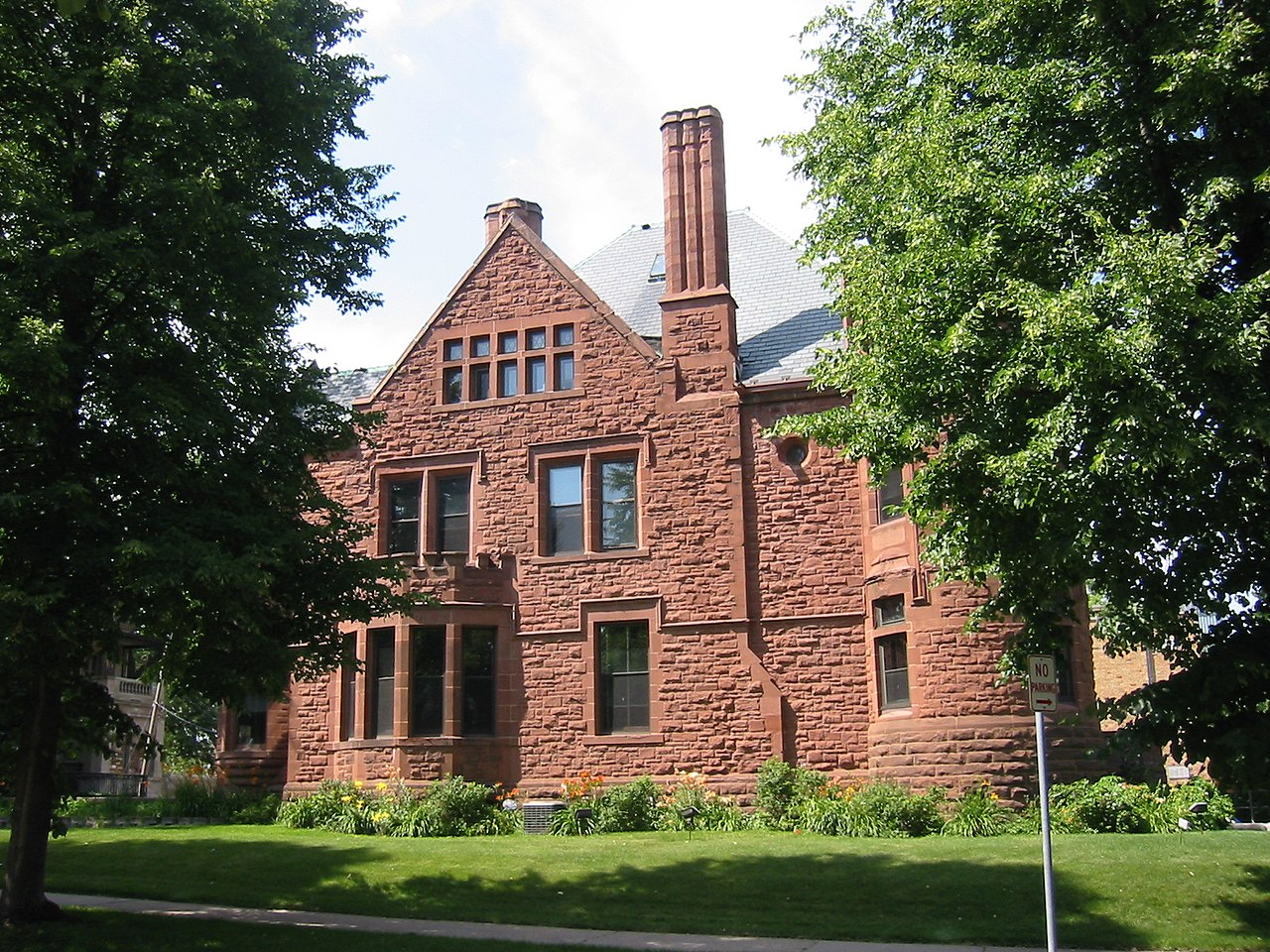
John Lind House, 1775 Colfax Ave S, Minneapolis, Minnesota, USA. Viewed from the west.
McGhiever
Places
Named by the record
Places
Only places the record itself states, plotted where the house gazetteer settles their coordinates. Nothing is inferred from a name or a nationality.
William Channing Whitney was born at Harvard.
Birthplace
Harvard.
Birth place
Collections and holdings
Where the work is held
Collections and holdings
Institutional holdings are recorded as follows.
Documents and archives
Primary material
Documents and archives
Institutional database
- Wikidata, structured authority record Q8006688: William Channing Whitney
Scholarly · Wikimedia Foundation
reference work
- “William Channing Whitney”, English Wikipedia, consulted as further reading
Reputable secondary · Wikipedia
Citations
References
Each reference names the institution holding it, so a reader may go to the document itself.
Institutional database
Wikidata, structured authority record Q8006688: William Channing WhitneyWikimedia Foundation
Institutional witnessreference work
Secondary witness
The Encyclopedia exists whether or not anything is for sale. Corrections are recorded rather than overwritten, and every version of this record is kept. Published 17 August 2026.
Elsewhere in Design
11,558 published records in this field, each with its sources named.
- William Carr CroftsDesigner
- William CatlynDesigner
- William Chadwell MylneDesigner
- William ChambersDesigner
- William ChatfieldDesigner
- William CoochDesigner
- William CoverdaleDesigner
- William CrabtreeDesigner
Best supported in this field
For owners
Own a work by William Channing Whitney?
A specialist will read what you send and tell you what the house can establish, what it cannot, and whether the object is suited to sale. There is no charge and no obligation. The object stays with you throughout; nothing is shipped to us unless it is arranged in writing beforehand.