
Willem Isaacsz Swanenburg
Illustration — The Sailing Chariot, ca. Simon Stevin's invention of the wind car • Illustration — The Judgment of Paris, c. 1609 Willem Isaacsz van Swanenburg (29 January 1580 – 31 May 1612), was a Dutch Golden Age engraver and the youngest son of Isaac van Swanenburg.
Also recorded as Willem Isaacsz. van Swanenburg · Willem Swanenburgh · Willem Isaacsz. Swanenburch · Willem Isaacz. van Swanenburg
Willem Isaacsz Swanenburg
![Adrianus Junius [Adriaen de Jonghe]. Line engraving by W. I. Swanenburg, 1609., by Willem Isaacsz Swanenburg](https://iiif.wellcomecollection.org/image/V0003152EL/full/1280,/0/default.jpg)
Willem Isaacsz Swanenburg · Wellcome Collection, London · Wellcome Collection · Public Domain Mark
- Died
- 1612 · Leiden.
- Nationality
- Dutch Republic
- Occupation
- engraver · painter · draftsperson · xylographer · artist
- Teachers
- Jan Saenredam
- Languages
- Dutch
VALÉORINE Encyclopedia
VALÉORINE documentary reading
Documentary summary
Illustration — The Sailing Chariot, ca. Simon Stevin's invention of the wind car • Illustration — The Judgment of Paris, c. 1609 Willem Isaacsz van Swanenburg (29 January 1580 – 31 May 1612), was a Dutch Golden Age engraver and the youngest son of Isaac van Swanenburg.
Admitted source layer · organised and presented by VALÉORINE
Reference Check
Propose documentary evidence for Willem Isaacsz Swanenburg. A contribution is never written directly as fact: identity, source, rights and evidence gates still decide.
Sign in to contribute
Documentary evidence
Documentary basis
Authority files
wikidata · Q1961244 · wikipedia · Willem Isaacsz. van Swanenburg
In this article
Biography
Biography
Isaac van Swanenburg raised three sons who all became artists. Isaac van Swanenburg was also an artist who painted, designed prints, and created stained glass windows. The subject matter of his art included Biblical scenes, genre scenes, and portraits. He was also an illustrator for many books during his time. • Illustration — Christ at Emmaus by Willem Isaacsz van Swanenburg
Training under Jan Saenredam is recorded. The recorded working language is Dutch. Places of work recorded in the authority are Leiden. Work by Willem Isaacsz Swanenburg is recorded in the collections of Museum Boijmans Van Beuningen, Minneapolis Institute of Art, Auckland Art Gallery, Finnish National Gallery and Vanderbilt Museum of Art.
Swanenburg was born in Leiden. He learned drawing and engraving from his father, together with his brothers Jacob (1572–1652) and Claes (1572–1652), who both became respected painters. According to Houbraken he was a respected engraver who became "Hopman" (flag-bearer) of the Leiden schutterij, but died young. Swanenburg was also active as a portrait engraver. In 1609 he produced the engravings for Icones ad vivum, a series of portraits of Leiden scholars and professors. In 1603 he engraved, after a design by Jacques de Gheyn II, a large three-sheet print depicting Simon Stevin's sailing carriage. The carriage had been used by Maurice, Prince of Orange, and his companions for a journey along the Dutch coast from Scheveningen to Petten in 1602. Among those associated with the journey were the young Hugo Grotius and the Spanish admiral Francisco de Mendoza, who was then held prisoner by the Dutch Republic. • Illustration — The anatomical theatre of Leiden University, early 17th century. Contemporary engraving by Willem Swanenburgh; drawing by Jan Cornelisz. van 't Woudt = Johannes Woudanus
Identity and origins
Identity and origins
The authorities additionally record the headings Willem Isaacsz. Van Swanenburg, Willem Swanenburgh, Willem Isaacsz. Swanenburch, Willem Isaacz. Van Swanenburg and Willem van Swanenburg. His recorded language was Dutch. He was the child of Isaac van Swanenburg.
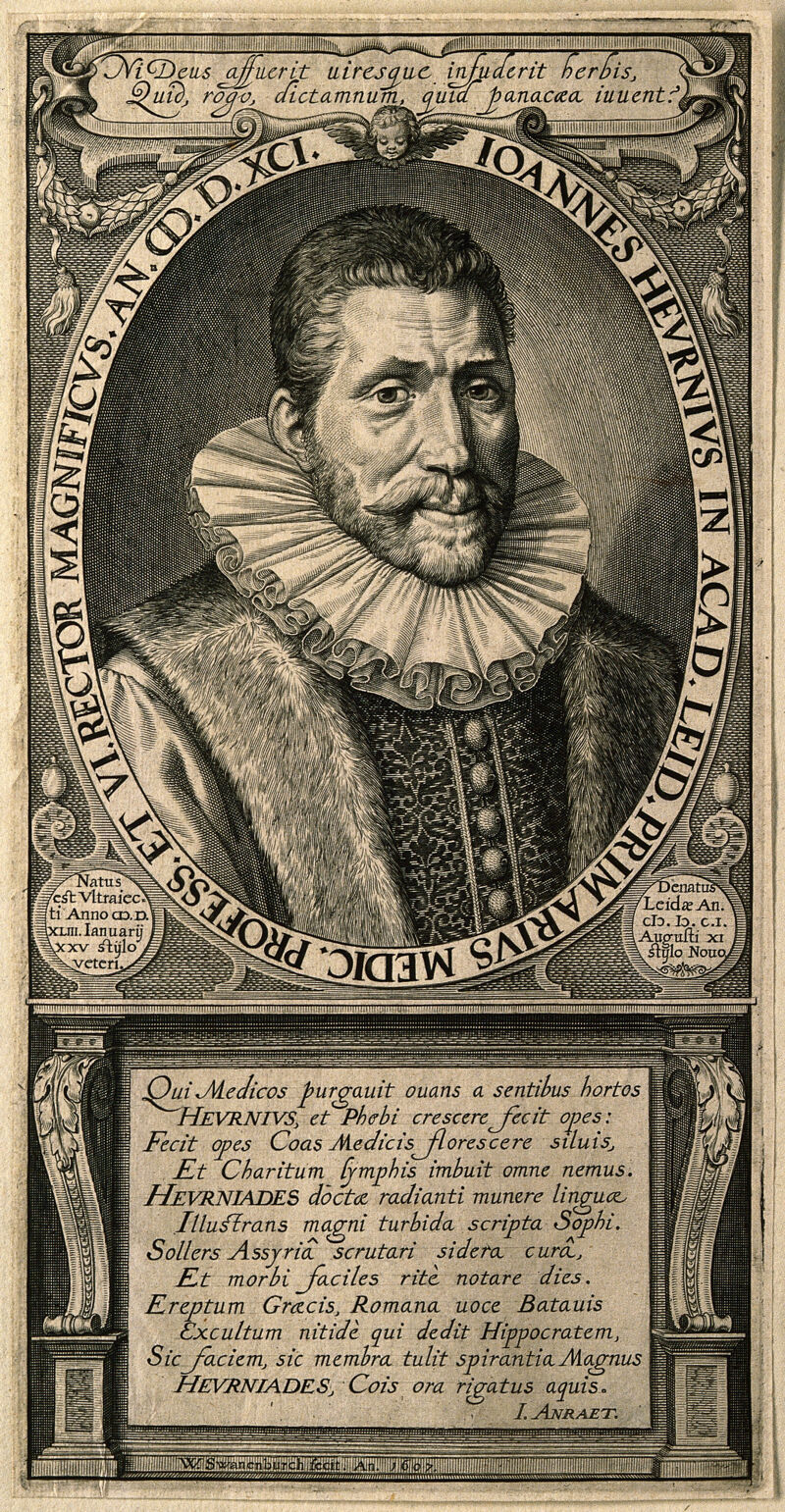
Joannes Heurnius. Line engraving by W. Swanenburg, 1607., 1607, by Willem Isaacsz Swanenburg
Willem Isaacsz Swanenburg · Wellcome Collection, London · Wellcome Collection
Life and career
Dated record
Life and career
The full dated record · 2 entries
1581
Willem Isaacsz Swanenburg born at Leiden.
1612
Willem Isaacsz Swanenburg died at Leiden.
Notes from the source article
Cited by Wikipedia
Notes from the source article
These works are cited by the source article, in its own numbering. They are recorded as its citations, not as sources VALÉORINE has verified.
- 1.Willem Isaacsz van Swanenburg in the RKD
- 2.Willem Isaacsz. van Swanenburg. FAMSF Explore the Art. 2015-05-09.
- 3.Isaak Nicolai biography in De groote schouburgh der Nederlantsche konstschilders en schilderessen (1718) by Arnold Houbraken, courtesy of the Digital library for Dutch literature
- 4.M. Tolsma, "Smoelenboek uit de zeventiende eeuw", Omslag, 2011, no. 1, pp. 14–15.
References
Citations
References
Each reference names the institution holding it, so a reader may go to the document itself.
reference work
Wikidata, structured authority record Q1961244: Willem Isaacsz SwanenburgWikimedia Foundation
Secondary witnessreference work
Secondary witness
Further particulars
Held on the record
Further particulars
Open the remaining particulars
Willem Isaacsz Swanenburg is recorded as engraver, painter, draftsperson, xylographer and artist.
Recognition and collections
Work by Willem Isaacsz Swanenburg is
Museum Boijmans Van Beuningen, Minneapolis Institute of Art, Auckland Art Gallery and Finnish National Gallery
The Encyclopedia exists whether or not anything is for sale. Corrections are recorded rather than overwritten, and every version of this record is kept. Published 16 August 2026.
Elsewhere in Prints
4,138 published records in this field, each with its sources named.
- Willem Bastiaan TholenEngraver
- Willem Danielsz van TetrodeEngraver
- Willem de HeuschEngraver
- Willem de KooningEngraver
- Willem Jacobsz DelffEngraver
- Willem Linnig the ElderEngraver
- Willem Outgertsz AkerslootEngraver
- Willem PanneelsEngraver
Best supported in this field
For owners
Own a work by Willem Isaacsz Swanenburg?
A specialist will read what you send and tell you what the house can establish, what it cannot, and whether the object is suited to sale. There is no charge and no obligation. The object stays with you throughout; nothing is shipped to us unless it is arranged in writing beforehand.