
Warren De la Rue
Warren De la Rue FRAS (18 January 181519 April 1889) was a British astronomer, chemist, and inventor, most famous for his pioneering work in astronomical photography.
Also recorded as Warren De La Rue
Warren De la Rue
Warren. De la Rue · Wellcome Collection, London · Wellcome Collection · Public Domain Mark
- Name
- Warren De la Rue
- Born
- 18 January 1815
- Birthplace
- Guernsey, Channel Islands
- Died
- 19 April 1889
- Place of death
- Marylebone, London, England
- Nationality
- United Kingdom of Great Britain and Ireland
- Occupation
- astronomer · chemist · photographer · lens designer · naturalist
- Education
- Collège Sainte-Barbe
- Honours
- Fellow of the Royal Society · Royal Medal · Gold Medal of the Royal Astronomical Society · Lalande Prize · Imperial Order of the Rose · Royal Society Bakerian Medal
- Languages
- English
VALÉORINE Encyclopedia
VALÉORINE documentary reading
Documentary summary
Warren De la Rue FRAS (18 January 181519 April 1889) was a British astronomer, chemist, and inventor, most famous for his pioneering work in astronomical photography.
Admitted source layer · organised and presented by VALÉORINE
Reference Check
Propose documentary evidence for Warren De la Rue. A contribution is never written directly as fact: identity, source, rights and evidence gates still decide.
Sign in to contribute
World of VALÉORINE
Documentary connections
Only confirmed graph relationships appear here. Images are shown only when their identity and reuse rights both pass the documentary gate.

Documentary evidence
Documentary basis
Authority files
wikidata · Q472095 · wikipedia · Warren De la Rue
In this article
Biography
Biography
Warren De la Rue studied at Collège Sainte-Barbe. The recorded working language is English. Positions recorded include President of the Royal Astronomical Society. Work by Warren De la Rue is recorded in the collections of Victoria and Albert Museum, San Francisco Museum of Modern Art, J. Paul Getty Museum and Photography Collection. Distinctions recorded are Fellow of the Royal Society, Royal Medal, Gold Medal of the Royal Astronomical Society and Lalande Prize.
Key facts
Key facts
• Name — Warren De la Rue • Honorific Suffix — FRAS • Born — 18 January 1815 • Birthplace — Guernsey, Channel Islands • Children — 5 • Died — 19 April 1889 • Place of death — Marylebone, London, England • Father — Thomas de la Rue • Illustration — Portrait of Warren de la Rue (1886)
Biography
Biography
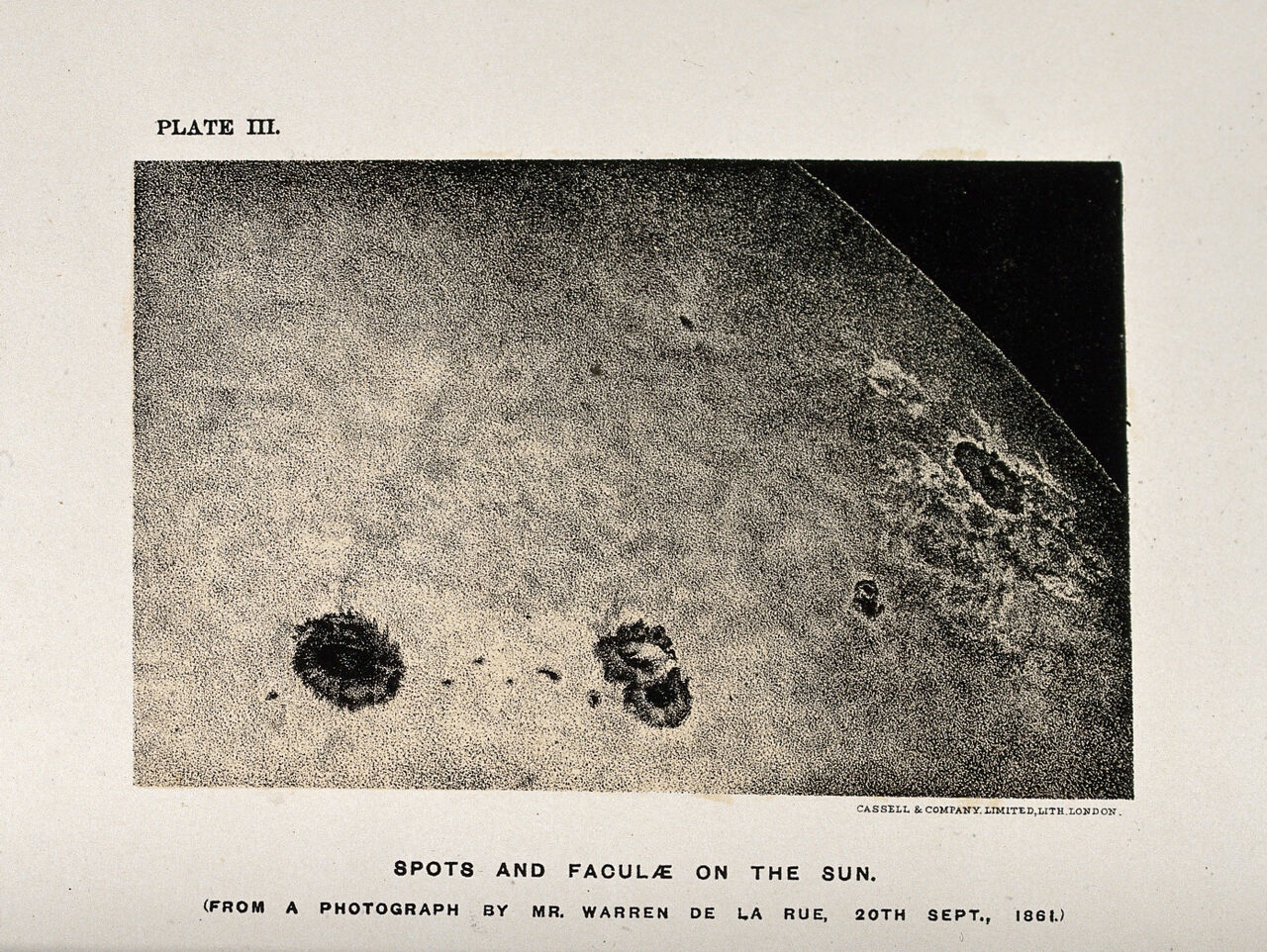
He was born in Guernsey on the Channel Islands, the son of the founder of the large firm of stationers of that name in London, Thomas de la Rue and Jane (née Warren). Having completed his education at the Collège Sainte-Barbe in Paris, he entered his father's business, but devoted his leisure hours to chemical and electrical researches, and between 1836 and 1848 published several papers on these subjects. In 1840, he enclosed a platinum coil in a vacuum tube and passed an electric current through it, thus creating one of the world's first electric light bulbs. The design was based on the concept that the high melting point of platinum would allow it to operate at high temperatures and that the evacuated chamber would contain fewer gas molecules to react with the platinum, improving its longevity. Although it was an efficient design, the cost of the platinum made it impractical for commercial use. Attracted to astronomy by the influence of James Nasmyth, he constructed in 1850 a 13-inch reflecting telescope, mounted first at Canonbury, later at Cranford, Middlesex, and with its aid executed many drawings of the celestial bodies of singular beauty and fidelity. His chief title to fame is his pioneering work in the application of the art of photography to astronomical research. In 1851 his attention was drawn to a daguerreotype of the moon by G. P. Bond, shown at the great exhibition of that year. Excited to emulate and employ the more rapid wet-collodion process, he succeeded before long in obtaining exquisitely defined lunar pictures, which remained unsurpassed until the appearance of the Lewis Morris Rutherfurd photographs in 1865. His contribution is marked by the naming of the De La Rue lunar crater. In 1854 he turned his attention to solar physics, and for the purpose of obtaining a daily photographic representation of the state of the solar surface he devised the photoheliograph, described in his report to the British Association, On Celestial Photography in England (1859), and in his Bakerian Lecture (Phil. Trans. vol. clii. pp. 333–416). Regular work with this instrument, inaugurated at Kew by De la Rue in 1858, was carried on there for fourteen years; and was continued at the Royal Observatory, Greenwich, from 1873 to 1882. The results obtained in the years 1862–1866 were discussed in two memoirs, entitled Researches on Solar Physics, published by De la Rue, in conjunction with Professor Balfour Stewart and Mr B Loewy, in the Phil. Trans. (vol. clix. pp. 1–110, and vol. clx. pp. 389–496). • Illustration — Photo of a total solar eclipse taken by De la Rue in 1860. In 1860 De la Rue took the photoheliograph to Rivabellosa, Spain, for the purpose of photographing the total solar eclipse which occurred on 18 July of that year. He established his temporary observatory in the neighboring Quintanilla de la Ribera. This expedition formed the subject of the Bakerian Lecture already referred to. The photographs obtained on that occasion proved beyond doubt the solar character of the prominences or red flames, seen around the limb of the moon during a solar eclipse. In 1873 De la Rue gave up active work in astronomy, and presented most of his astronomical instruments to the university observatory, Oxford. Subsequently, in the year 1887, he provided the same observatory with a 13-inch refractor to enable it to take part in the International Photographic Survey of the Heavens. With Dr Hugo Müller as his collaborator he published several papers of a chemical character between the years 1856 and 1862, and investigated, 1868–1883, the discharge of electricity through gases by means of a battery of 14,600 chloride of silver cells. He was twice president of the Chemical Society, and also of the Royal Astronomical Society (1864–1866) and in 1862 received the gold medal of the latter society. In June 1850 he was elected a Fellow of the Royal Society and in addition to their Bakerian Lecture in 1862 was awarded in 1864 their Royal Medal "for his observations on the 1860 total eclipse of the sun and his improvements in astronomical photography." He died in Marylebone in 1889. He had married Georgiana, the third daughter of Thomas Bowles of Guernsey; they had four sons and one daughter.
Identity and origins
Identity and origins
The authorities additionally record the heading Warren De La Rue. His recorded language was English. He was the child of Thomas de la Rue and Jane Warren. He married Georgiana Bowles. One child is recorded: Sir Thomas Andros de la Rue, 1st Bt.
Identity
Identity
Warren De la Rue is recorded as having received Fellow of the Royal Society, Royal Medal and Gold Medal of the Royal Astronomical Society.
Life and career
Dated record
Life and career
Explore 1815–1889
The full dated record · 3 entries
1815
Warren De la Rue born at Guernsey.
1858
Full Moon.
1889
Warren De la Rue died at London.
Places
Named by the record
Places
Only places the record itself states, plotted where the house gazetteer settles their coordinates. Nothing is inferred from a name or a nationality.
Guernsey.
Birth place
London.
Death place
Recognition and collections
Where the work is held
Recognition and collections
Warren De la Rue received Fellow of the Royal Society, Royal Medal, Gold Medal of the Royal Astronomical Society, Lalande Prize, Imperial Order of the Rose and Royal Society Bakerian Medal. Paul Getty Museum and Photography Collection.
Documents and archives
Primary material
Documents and archives
reference work
- Wikidata, structured authority record Q472095: Warren De la Rue
Reputable secondary · Wikimedia Foundation
- “Warren De la Rue”, English Wikipedia, consulted as further reading
Reputable secondary · Wikipedia
scholarly publication
- Rue, Warren de la, Biographical Encyclopedia of Astronomers, 2014
Scholarly · Crossref registry · 2014
Honours and awards
• Awarded the Gold Medal of the Royal Astronomical Society in 1862. • Awarded the Royal Medal from the Royal Society in 1864. • Awarded the Lalande Prize in 1866. • The crater De La Rue on the Moon is named after him. • Commander of the Legion of Honor (France). • Commander of the Order of St. Maurice and St. Lazarus (Italy). • Knight of the Imperial Order of the Rose (Brazil).
Notes from the source article
Cited by Wikipedia
Notes from the source article
These works are cited by the source article, in its own numbering. They are recorded as its citations, not as sources VALÉORINE has verified.
- 1.Hartog, Philip Joseph. 49. 387–389.
- 2.Royal Astronomical Society. Warren De la Rue (obituary). Monthly Notices of the Royal Astronomical Society. 50. 4. 155–164. 1890. 10.1093/mnras/50.4.155.
- 3.Huggins, Margaret Lindsay. Warren De La Rue (obituary). The Observatory. 12. 150. 244–250. 1889.
- 4.Warren de la Rue. Nature. 40. 1019. 26–28. 1889. 10.1038/040026a0.
- 5.Hirshfeld, Alan W. The Biographical Encyclopedia of Astronomers. Springer Publishing. 2009. 978-0-387-31022-0.
- 6.Hannavy, John. Encyclopedia of Nineteenth-century Photography. CRC Press. 1222. 2008. 978-0-415-97235-2.
- 7.Kitsinelis, Spiros. Light Sources: Technologies and Applications. Taylor & Francis US. 32. 1 November 2010. 978-1-4398-2079-7.
- 8.Levy, Joel. Really Useful: The Origins of Everyday Things. Firefly Books. 89. 1 March 2003. 978-1-55297-622-7.
- 9.Le Conte, David. Warren De La Rue–Pioneer astronomical photographer. The Antiquarian Astronomer. Society for the History of Astronomy. 5. 14–35. 2011.
- 10.Le Conte, David. Two Guernseymen and Two Eclipses. The Antiquarian Astronomer. Society for the History of Astronomy. 4. 55–68. 2008.
- 11.De La Rue, Warren. The Bakerian Lecture: On the Total Solar Eclipse of July 18th, 1860. Philosophical Transactions of the Royal Society of London. 152. 333–416. 1862.
- 12.The Royal Society. Proceedings of the Royal Society of London. 5. 954. 1851.
- 13.ONS. Index entry. FreeBMD.
- 14.gpn 1440 De La Rue access-date=2026-07-30
- 15.Burke, Sir Bernard The general armory of England, Scotland, Ireland, and wales, 1884
- 16.Footnotes: *Monthly Notices Roy. Astr. Soc. 1. 155 *Journ. Chem. Soc. lvii. 441 *Nature, xl. 26 *The Times (22 April 1889) *Royal Society, Catalogue of Scientific Papers.
- 17.Obituary. The Telegraphic Journal and Electrical Review. 483.
- 18.Peterson, Elizabeth. Who invented the lightbulb?. Live Science. 2022-11-03.
Bibliography printed in the source article · 1
- Hartog, P. J. Rue, Warren de la (1815–1889). 2011.
References
Citations
References
Each reference names the institution holding it, so a reader may go to the document itself.
scholarly publication
Rue, Warren de la, Biographical Encyclopedia of Astronomers, 2014Crossref registry
Institutional witnessreference work
Wikidata, structured authority record Q472095: Warren De la RueWikimedia Foundation
Secondary witnessreference work
Secondary witness
The Encyclopedia exists whether or not anything is for sale. Corrections are recorded rather than overwritten, and every version of this record is kept. Published 16 August 2026.
Elsewhere in Photography
11,392 published records in this field, each with its sources named.
- Wang JianweiPhotographer
- Wang QingsongPhotographer
- Wang WushengPhotographer
- Ward MuirPhotographer
- Warren FaidleyPhotographer
- Warren NeidichPhotographer
- Warren T. ThompsonPhotographer
- Warwick SaintPhotographer
Best supported in this field
For owners
Own a work by Warren De la Rue?
A specialist will read what you send and tell you what the house can establish, what it cannot, and whether the object is suited to sale. There is no charge and no obligation. The object stays with you throughout; nothing is shipped to us unless it is arranged in writing beforehand.