
University of Salamanca
The University of Salamanca (Spanish: Universidad de Salamanca) is a public research university in Salamanca, Spain. Founded in 1218 by King Alfonso IX, it is the oldest university in the Hispanic world and the fourth oldest in the world in continuous operation. It has over 30,000 students from 50 nationalities.
Also recorded as Universidad de Salamanca · Salamanca University · Salamanca, University of · usal.es
University of Salamanca
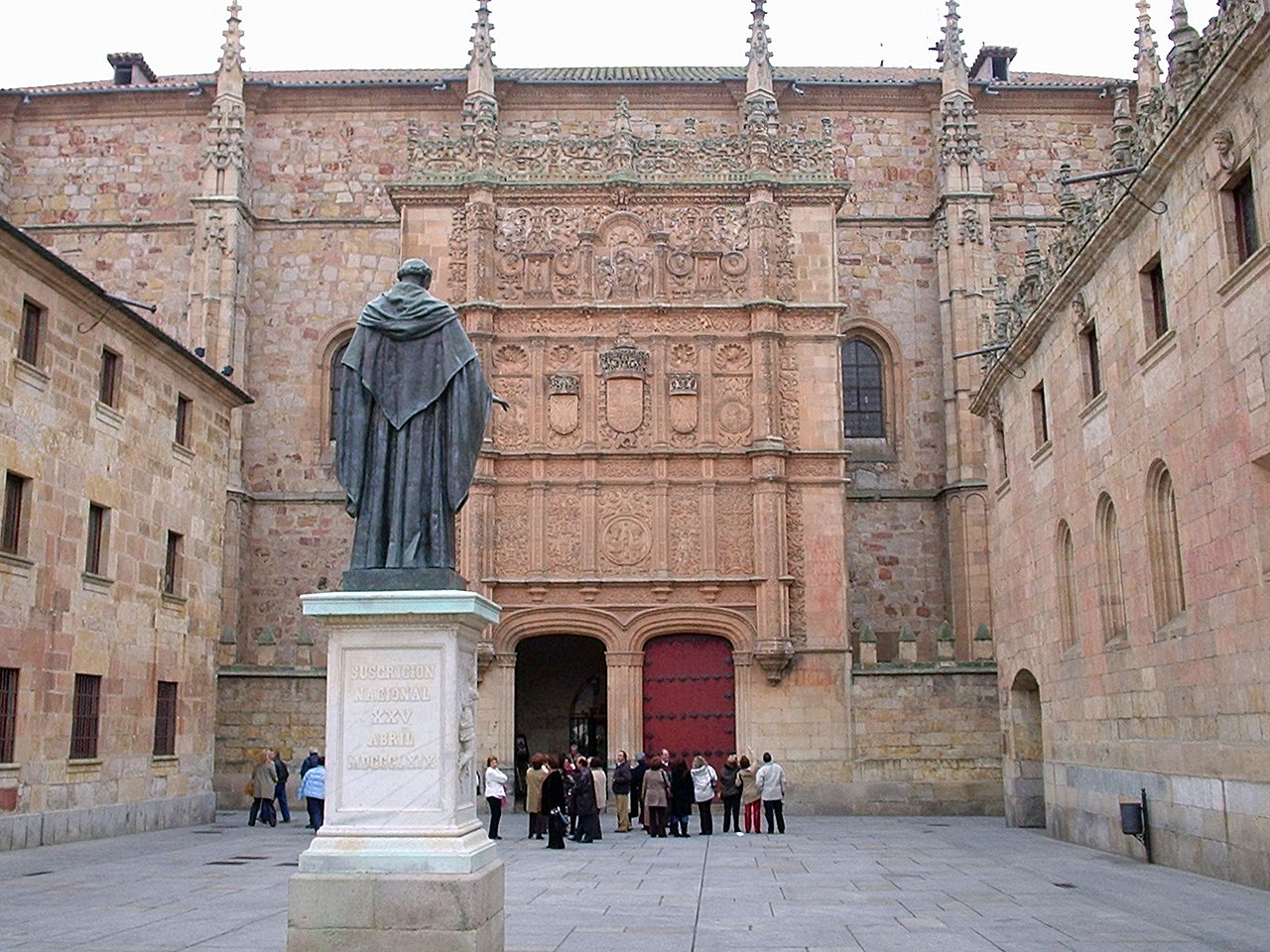
Victoria Rachitzky · originally posted to Flickr as Salamanca · CC BY 2.0
- Founded
- 1218.
- Headquarters
- Salamanca.
VALÉORINE Encyclopedia
VALÉORINE documentary reading
Documentary summary
The University of Salamanca (Spanish: Universidad de Salamanca) is a public research university in Salamanca, Spain. Founded in 1218 by King Alfonso IX, it is the oldest university in the Hispanic world and the fourth oldest in the world in continuous operation. It has over 30,000 students from 50 nationalities.
Admitted source layer · organised and presented by VALÉORINE
Note VALÉORINE
No house-authored Note is published until its assertions and sources pass the VALÉORINE evidence contract. The documentary article remains available in full while that enrichment is being consolidated.
Documentary enrichment in progress · no unsupported statement published
Reference Check
Propose documentary evidence for University of Salamanca. A contribution is never written directly as fact: identity, source, rights and evidence gates still decide.
Sign in to contribute
Documentary evidence
Evidence Panel
not yet certified
- Identity
- resolved
- Independent source families
- 0
- Admitted assertions
- 0
- Open conflicts
- 0
Authority files
wikidata · Q308963 · wikipedia · University of Salamanca
In this article
History
History
Prior to the foundation of the university, Salamanca was home to a cathedral school, known to have been in existence by 1130. The university was founded as a studium generale by the Leonese king Alfonso IX in 1218 as the scholas Salamanticae, with the actual creation of the university (or the transformation of the existing school into the university) occurring between August 1218 and the following winter. A further royal charter from King Alfonso X, dated 8 May 1254, established rules for the organisation and financial endowment of the university, and referred to it for the first time by that name. A papal bull of Alexander IV in 1255 confirmed the Royal Charter of Alfonso X and granted universal recognition to the university's degrees. The historical phrases Quod natura non dat, Salmantica non praestat (what nature does not give, Salamanca does not lend, in Latin) and Multos et doctissimos Salmantica habet (many and very versed Salamanca has) give an idea of the prestige the institution rapidly acquired. In the reign of King Ferdinand II of Aragon and Queen Isabella I of Castile, the Spanish government was revamped. Contemporary with the Spanish Inquisition, the expulsion of the Jews and Muslims, and the conquest of Granada, there was a certain professionalization of the apparatus of the state. This involved the massive employment of "letrados", i.e., bureaucrats and lawyers, who were "licenciados" (university graduates), particularly, of Salamanca, and the newly founded University of Alcalá. These men staffed the various councils of state, including, eventually, the Consejo de Indias and Casa de Contratacion, the two highest bodies in metropolitan Spain for the government of the Spanish Empire in the New World. While Columbus was lobbying the King and Queen for a contract to seek out a western route to the Indies, he made his case to a council of geographers at the University of Salamanca. While the geographers were skeptical of Columbus and his voyage calculations, the University of Salamanca always defended the theory of unknown territories to the west, and supported Columbus' voyage, believing that new territories may be discovered. In the next century, the morality and laws of colonization in the Indies were debated by the School of Salamanca, along with the development of the study of science, geography and cartography of the Americas, and as well as the study of general subjects of economics, philosophy and theology. Salamanca's colleges (Colegios Mayores) were founded as charitable institutions to enable poor scholars to attend the university. By the eighteenth century they had become closed corporations controlled by the families of their founders, and dominated the university between them. Most were destroyed by Napoleon's troops. In the 19th century, the Spanish government dissolved the university's faculties of canon law and theology. They were later reestablished in the 1940s as part of the Pontifical University of Salamanca.
Sorcery
Sorcery
In popular belief, the university was associated with sorcery. A certain cave in Salamanca was considered the site of a school of black magic. In Spanish, Salamanca may mean "cave", "an evil iguana" and "hand trick" and the salamanquesa (Tarentola mauritanica, the Spanish name is also derived from "salamander") is a reptile with magical attributes in Spanish tradition. In Romanian folklore, the devil runs a school of black magic named Scholomance. The name is derived from "Salamanca" and the wise king "Solomon".
Present day
Present day
Salamanca draws undergraduate and graduate students from across Spain and the world; it is the top-ranked university in Spain based on the number of students coming from other regions. It is also known for its Spanish courses for non-native speakers, which attract more than two thousand foreign students each year. Scientific research is carried out in the university and research centers associated with it, such as at the Centro de Investigación del Cáncer [Cancer Research Centre], Instituto de Neurociencias de Castilla y León or INCyL [Institute of Neuroscience of Castile and León], Centro de Láseres Pulsados Ultracortos Ultraintensos [Ultrashort Ultraintense Pulse Lasers Centre]. It is one of only two Hispanophone universities in the world that have a MoU with the United Nations to train language professionals for the organization. In conjunction with the University of Cambridge, the University of Salamanca co-founded the Association of Language Testers in Europe (ALTE) in 1989. In 2018, the institution celebrated its eighth centennial.
Library
Library
The library holds about 906,000 volumes.
Notable staff
Notable staff
Juan de Galavís, professor of theology; later became Archbishop of Santo Domingo and Archbishop of Bogotá Francisco Elías de Tejada y Spínola, professor of Philosophy of Law and Natural Law Enrique Gil Robles, professor of Natural Law Pablo de Coronel (d.1534), professor of Hebrew Miguel de Unamuno, writer Beatriz Galindo, (d. 1534), professor of Latin and rhetoric Luisa de Medrano, (d. 1527) the first female professor at the university, teacher of Latin. The secondary school in Salamanca, IES Lucia de Medrano was named after her. García de Medrano y Álvarez de los Ríos (d. 1683) professor of Canon law, property, Sextus Decretalium and Clementines García de Medrano y Mendizábal, rector of the University of Salamanca in 1669 Juan Manuel Corchado, computer scientist and rector in 2024 who was involved in publication scandal
Institutional history
Dated record
Institutional history
Explore 1218–2003
The full dated record · 8 entries
1218
University of Salamanca established.
1218
University of Salamanca is recorded from 1218.
1218
University of Salamanca was established or created in 1218.
1993
El Hospital del Estudio: (asistencia y hospitalidad de la Universidad de Salamanca) 1413-1810 / Teresa Santander., dated 1993, held by Wellcome Collection.
1771
El reformismo de Carlos III y la Universidad de Salamanca: plan general de estudios dirigido a la Universidad de Salamanca por el Real y Supremo Consejo de Castilla en 1771 / Mariano Peset Reig y José Luis Peset Reig., dated 1969, held by Wellcome Collection.
1773
Religion a farce. In a letter to a reader at the University of Salamanca., dated 1773, held by Wellcome Collection.
1969
El reformismo de Carlos III y la Universidad de Salamanca: plan general de estudios dirigido a la Universidad de Salamanca por el Real y Supremo Consejo de Castilla en 1771 / Mariano Peset Reig y José Luis Peset Reig. (Wellcome Collection).
2003
Lorenzo Alderete y el Avicenismo en la Universidad de Salamanca / Guadalupe Albi Romero., dated 2003, held by Wellcome Collection.
Notable students
Miguel de Cervantes, author Luis de Góngora Fray Luis de León Francisco de Vitoria Pedro Calderón de la Barca Bartolomé de Las Casas Beatriz Galindo Miguel de Unamuno Bernardino de Sahagún Henry O'Neill Flora de Pablo Ana Peláez Narváez Other notable students and academic teachers include: Gustavo Petro, President of Colombia Roberto Urdaneta Arbeláez, President of Colombia Arístides Royo, President of Panama Francisco J. Ayala Susana Marcos Celestino Abraham Zacuto Ignacio Baleztena Ascárate Esteban de Bilbao Eguía Domingo de Soto Melchor Cano Francisco Suárez John of the Cross Antonio de Nebrija Gaspar de Guzmán, Count-Duke of Olivares Gaspar Sanz Pedro Gómez Labrador Cardinal Mazarin Mateo Alemán Fredrik Florén, Swedish diplomat Diego de Torres Villarroel Pedro Salinas Adolfo Suárez Juan Zarate Manuel Belgrano Luis de Onís Pedro Nunes Simón de Rojas Antonio Tovar Gaspar Cervantes de Gaeta Xavier Becerra Ángela Abós Ballarín Juan Pizarro Navarrete
Documents and archives
Primary material
Documents and archives
reference work
- “University of Salamanca”, English Wikipedia, consulted as further reading
Reputable secondary · Wikipedia
authority record
- Wikidata, structured authority record Q308963: University of Salamanca
Unverified · Wikidata
People and holdings
Knowledge graph
People and holdings
Those recorded as working within this institution, and the records it holds or is connected with.
Studied at
11- Ángel González MuñizAuthor
Established from a fact already recorded on a verified source.
- Carmen Martín GaiteAuthor
Established from a fact already recorded on a verified source.
- David AjaIllustrator
Established from a fact already recorded on a verified source.
- Dora GarcíaPhotographer
Established from a fact already recorded on a verified source.
- Émile MartelAuthor
Established from a fact already recorded on a verified source.
- Francisco de VitoriaAuthor
Established from a fact already recorded on a verified source.
Literature
Manuel Fernández Álvarez, Luis E. Rodríguez San Pedro & Julián Álvarez Villar, The University of Salamanca, Ediciones Universidad de Salamanca, 1992. ISBN 84-7481-701-3.
Related affairs
Notes from the source article
Cited by Wikipedia
Notes from the source article
These works are cited by the source article, in its own numbering. They are recorded as its citations, not as sources VALÉORINE has verified.
- 1.Álvarez Villar, Julián. La Universidad de Salamanca: arte y tradiciones. Universidad de Salamanca. 13. 1972. 847481751X.
- 2.University of Salamanca. Personal.
- 3.University of Salamanca. Estudiantes.
- 4.ARWU World University Rankings 2034. www.shanghairanking.com.
- 5.QS World University Rankings.
- 6.World University Rankings. timeshighereducation.com. 6 August 2023.
- 7.U.S. News Education: Best Global Universities 2022-23.
- 8.Caldwell, Zelda. Salamanca: The third oldest university in the world is in Spain. Aleteia. 2019-02-01.
- 9.Singh, Bhupinder. The World's Oldest Universities, Some That Have Been Around For More Than A Thousand Years. Indiatimes. 2022-11-30.
- 10.Ven a la USAL: futuros estudiantes Universidad de Salamanca. www.usal.es.
- 11.Álvarez Villar, Julián. La Universidad de Salamanca: arte y tradiciones. Universidad de Salamanca. 15. 1972. 847481751X.
- 12.University of Salamanca. Historia.
- 13.VIII Centenario de la Universidad de Salamanca - Reseña Histórica de la Universidad de Salamanca:. Centenario.usal.es. Retrieved on 2013-09-05.
- 14.Montaño Montero, Luisa, «Humanistas en la Corte de Isabel la Católica, Luisa de Medrano, ¿Primera catedrática en una universidad europea?», en Cuadernos sobre Vico 27 (2013), p. 132.
- 15.RAE-ASALE. Diccionario de la lengua española. 2020.
- 16.RAE-ASALE. Diccionario de la lengua española. 2020.
- 17.Gaster, Moses. Scholomonar, d. i. er Grabancijaš dijak nach der Voksüberlieferung er Rumänen. Archiv für slavische Philologie. VII. 288–289. 1884.
- 18.Oișteanu, Andrei. Cosmos Vs. Chaos: Myth and Magic in Romanian Traditional Culture : a Comparative Approach. Romanian Cultural Foundation Publishing House. 221. 1999. 9-789-7357-7198-0.
- 19.Archived copy.
- 20.La USAL inaugura los cursos de verano con 2.000 estudiantes extranjeros. elmundo.es. Retrieved on 2013-09-05.
- 21.Home. cicancer.org.
- 22.INCyL. INCyL. Retrieved on 2013-09-05.
- 23.United Nations. MoU Network.
- 24.VIII Centenario de la Universidad de Salamanca - VIII Centenario de la Universidad de Salamanca. Centenario.usal.es. Retrieved on 2013-09-05.
- 25.Spain – Libraries and museums
- 26.O’Grady, Cathleen. Springer Nature retracts 75 papers connected to Spanish university head. Science. American Association for the Advancement of Science. 2024-10-21. 10.1126/science.zvmx7id.
- 27.Singh Chawla, Dalmeet. The citation black market: schemes selling fake references alarm scientists. Nature. 632. 8027. 966. 2024-08-20. 10.1038/d41586-024-01672-7.
References
Citations
References
Each reference names the institution holding it, so a reader may go to the document itself.
reference work
Partially resolvedauthority record
Unverified
The Encyclopedia exists whether or not anything is for sale. Corrections are recorded rather than overwritten, and every version of this record is kept. Published 14 August 2026.
Elsewhere in Publishers and printers
5,459 published records in this field, each with its sources named.
- University of Religions and DenominationsOrganisation
- University of Rhode IslandOrganisation
- University of RijekaOrganisation
- University of RuhunaOrganisation
- University of SalentoOrganisation
- University of SalzburgOrganisation
- University of San FranciscoOrganisation
- University of San Martín de PorresOrganisation
Best supported in this field
For owners
Own an object connected with University of Salamanca?
A specialist will read what you send and tell you what the house can establish, what it cannot, and whether the object is suited to sale. There is no charge and no obligation. The object stays with you throughout; nothing is shipped to us unless it is arranged in writing beforehand.