
Type 94 37 mm Anti-Tank Gun
The Kyūyon-shiki sanjyūnana-miri sokushahō was an anti-tank gun developed by the Imperial Japanese Army. It was used in combat during the Second Sino-Japanese War and World War II. The Type 94's number was designated for the year the gun was accepted, 2594 in the Japanese imperial year calendar, or 1934 in the Gregorian calendar.
Type 94 37 mm Anti-Tank Gun
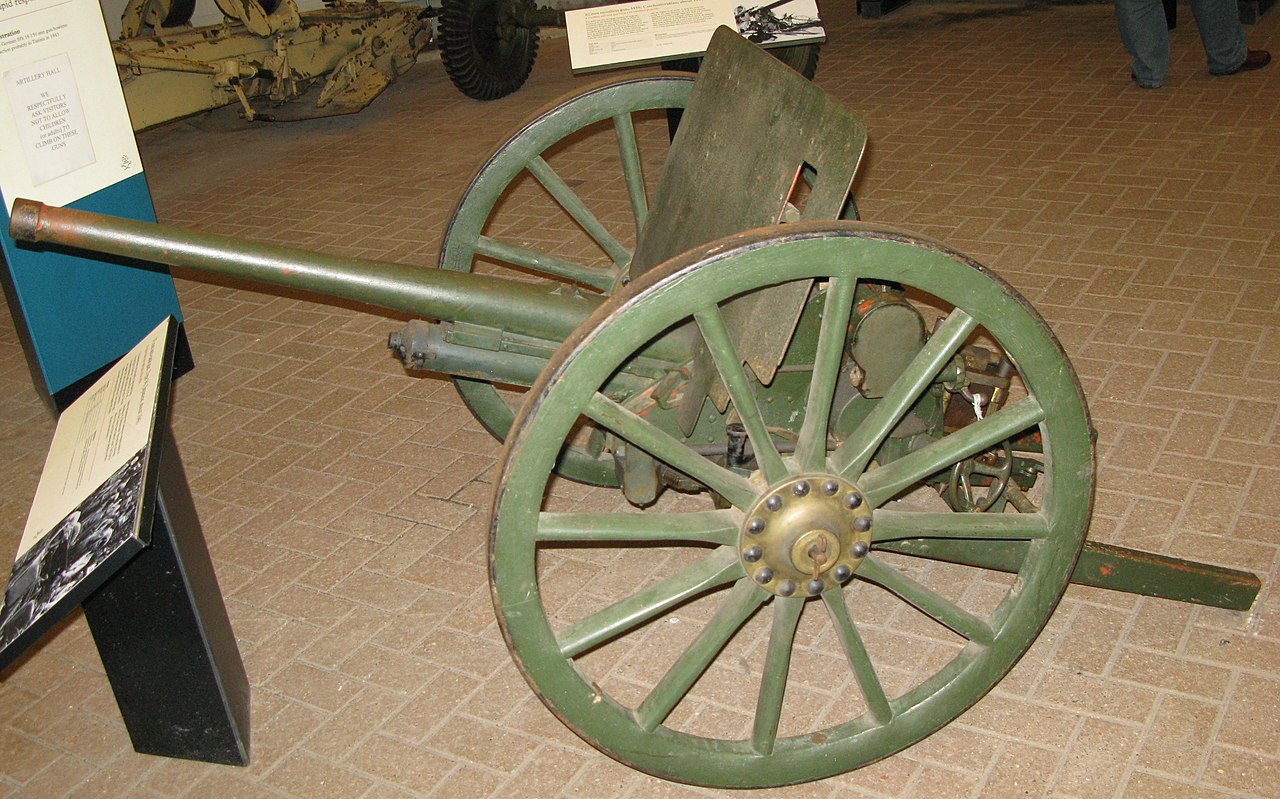
me · CC BY-SA 4.0
- Name
- Type 94 37 mm quick-firing gun
- Field
- anti-tank cannon.
- Region
- Empire of Japan.
VALÉORINE Encyclopedia
VALÉORINE documentary reading
Documentary summary
The Kyūyon-shiki sanjyūnana-miri sokushahō was an anti-tank gun developed by the Imperial Japanese Army. It was used in combat during the Second Sino-Japanese War and World War II. The Type 94's number was designated for the year the gun was accepted, 2594 in the Japanese imperial year calendar, or 1934 in the Gregorian calendar.
Admitted source layer · organised and presented by VALÉORINE
Reference Check
Propose documentary evidence for Type 94 37 mm Anti-Tank Gun. A contribution is never written directly as fact: identity, source, rights and evidence gates still decide.
Sign in to contribute
World of VALÉORINE
Documentary connections
Only confirmed graph relationships appear here. Images are shown only when their identity and reuse rights both pass the documentary gate.

Documentary evidence
Documentary basis
Authority files
wikidata · Q7860822 · wikipedia · Type 94 37 mm anti-tank gun
In this article
Key facts
Key facts
• Name — Type 94 37 mm quick-firing gun • Origin — Empire of Japan • Type — Anti-tank gun Quick-firing gun • Is Artillery — yes • Service — 1936–1945 • Used By — Imperial Japanese Army, North Vietnam • Wars — Second Sino-Japanese War, Soviet-Japanese Border Wars, World War II, First Indochina War • Unit Cost — 8,400 yen ($2,257 USD) in August 1939 ($51,029 USD in 2024) • Production Date — 1936-1941 • Number — 3,400 • Weight — 324 kg approx • Length — 2.9 m • Part Length — 1.765 m L/46.1 • Width — 1.19 m • Cartridge — Fixed QF 37×165 mm. R • Cartridge Weight —.69 kg • Caliber — 37 mm (1.45 in) • Rate — 30 rpm • Velocity — 700 m/s (2,300 ft/s) • Range — 2,870 m • Max Range — 4,500 m (4,900 yds) • Sights — straight telescopic • Breech — Sliding horizontal breech • Elevation — -10° to +25° • Traverse — 60°
History and development
History and development
The Type 94 37-mm AT gun was introduced in 1936. The design originated as an improvement to the Type 11 37 mm infantry gun, which was also used as a primitive anti-tank weapon. However, its short bore, low muzzle velocity, short range and slow reloading time gave it a limited capacity against enemy armor. Development of a replacement began in July 1933 and was completed a year later. Initial testing indicated that a trained crew could fire up to 30 rounds per minute; however, Army planners felt that the initial design was too heavy. A modified design was tested in 1935, and actual production began in 1936; however, the weapon retained its original “Type 94” (imperial year 2594 = western year 1934) designation. Approximately 3,400 units were produced. It later was developed into the Type 1 37 mm anti-tank gun.
Design
Design
• Illustration — A Type 94 gun in the Military Historical Museum of Artillery, Engineers and Signal Corps in Saint Petersburg, Russia. As with many Japanese designs, it had a very low profile and was intended to be operated from a squatting or prone position. The gun had a gun shield to protect the gunner and open carriage-style legs which could be spread to improve the stability. The breech had a semi-automatic cartridge case ejection system to improve reloading time. When the shell was loaded, the rear of the cartridge case tripped a catch closing the breechblock. The recoil action of firing opened the breech and extracted the cartridge case. The carriage was equipped with either wooden spoked or perforated steel wheels, and the whole assembly could be broken down into four pack loads each weighing less than 100 kilograms to permit transport in four horse loads. Sighting was by a straight telescopic sight. The gun could fire either high-explosive or armor-piercing rounds.
Combat record
Combat record
• Illustration — Type 94 gun on display at the American National World War II Museum The Type 94 37mm AT guns were typically assigned in groups of four to combat infantry regiments. Each weapon was manned by a squad of 11 personnel, and was kept in contact with the regimental headquarters (typically up to 300 meters away) by field telephone or messenger runners. With the standard AP shell, it could penetrate 1.7 inches (43 mm) of armor at 500 yards (460 meters). The Army Technical Bureau continued to experiment with ways to increase muzzle velocity through 1941. The Type 94 37mm AT gun was effective against Soviet lightly armored BT tanks in the Nomonhan Incident of 1939, but was considered obsolete against more advanced Allied tanks, such as the M4 Sherman, by the start of the Pacific War. However, it remained in service on most fronts in World War II for lack of a better replacement. The Type 1 47 mm anti-tank gun was put into service starting in early 1942, and was intended to replace it, but was never available in large enough numbers to do so completely.
Surviving examples
Surviving examples
One of the few remaining Type 94 guns is on display at the Missouri Yacht Club in Lake Lotawana, Missouri.
Primary material
Documents and archives
authority record
- Wikidata, structured authority record Q7860822: Type 94 37 mm Anti-Tank Gun
General reference · Wikidata
reference work
- “Type 94 37 mm anti-tank gun”, English Wikipedia, consulted as further reading
Reputable secondary · Wikipedia
Notes from the source article
Cited by Wikipedia
Notes from the source article
These works are cited by the source article, in its own numbering. They are recorded as its citations, not as sources VALÉORINE has verified.
- 1.Military catalogue of the Japanese military, p. 95
- 2.Banking and Monetary Statistics, 1914-1941, Part I, p. 673
- 3.Chamberlain, Peter. Anti-tank weapons. Arco Pub. Co. 30. 1974. 0668036079.
- 4.War Department TM-E-30-480 Handbook on Japanese Military Forces September 1944 p 400
- 5.Nakanishi. Japanese Infantry Arms in World War II.
- 6.Bishop, The Encyclopedia of Weapons of World War II
- 7.http://www.ibiblio.org/hyperwar/Japan/IJA/HB/HB-9.html#III US Technical Manual E 30-480
- 8.US Department of War, Japanese Tank and Anti-Tank Warfare . United States Government Printing Office. Washington D.C., page 108-109.
- 9.Chant, Artillery of World War II. Pp. 60
- 10.Taki’s Imperial Japanese Army: "Type 94 37mm AT"
- 11.Nakanishi, Japanese Infantry Arms in World War II
Bibliography printed in the source article · 8
- Bishop, Chris (eds) The Encyclopedia of Weapons of World War II. Barnes & Nobel. 1998.
- Chant, Chris. Artillery of World War II, Zenith Press, 2001,
- McLean, Donald B. Japanese Artillery; Weapons and Tactics. Wickenburg, Ariz.: Normount Technical Publications 1973. .
- Nakanishi, Ritta Japanese Infantry Arms in World War II, Dainipponkaiga Company 1991,
- US Department of War, TM 30-480, Handbook on Japanese Military Forces, Louisiana State University Press, 1994.
- War Department TM-E-30-480 Handbook on Japanese Military Forces September 1944
- Ministry of the Army. 兵器臨時定価、予価、表送付の件 Military catalogue of the Japanese military. National Archives of Japan.
- Board of Governors of the Federal Reserve System (U.S.). Banking and Monetary Statistics, 1914-1941, Part I. Federal Reserve Bank of St. Louis. January 1943.
References
Citations
References
Each reference names the institution holding it, so a reader may go to the document itself.
authority record
Secondary witnessreference work
Secondary witness
Further particulars
Held on the record
Further particulars
Open the remaining particulars
Type 94 37 mm Anti-Tank Gun is connected to 1 other published record in the VALÉORINE Encyclopedia.
The Encyclopedia exists whether or not anything is for sale. Corrections are recorded rather than overwritten, and every version of this record is kept. Published 16 August 2026.
Elsewhere in Militaria
6,095 published records in this field, each with its sources named.
- Type 93Terminology
- Type 93 heavy machine gunTerminology
- Type 93/Type 100Terminology
- Type 94Terminology
- Type 95 75 mm field gunTerminology
- Type 96Terminology
- Type 96 150 mm howitzerTerminology
- Type 96 24 cm howitzerTerminology
Best supported in this field
For owners
Own an object connected with Type 94 37 mm Anti-Tank Gun?
A specialist will read what you send and tell you what the house can establish, what it cannot, and whether the object is suited to sale. There is no charge and no obligation. The object stays with you throughout; nothing is shipped to us unless it is arranged in writing beforehand.