
Sophie, Duchess of Hohenberg
Sophie, Duchess of Hohenberg (Sophie Marie Josephine Albina Gräfin Chotek von Chotkow und Wognin; Žofie Marie Josefína Albína hraběnka Chotková z Chotkova a Vojnína; 1 March 1868 – 28 June 1914) was the wife of Archduke Franz Ferdinand of Austria, the heir to the Austro-Hungarian throne. Their assassination in Sarajevo sparked a series of events that led, four weeks later, to World War I.
Sophie, Duchess of Hohenberg

will nicht genannt werden · Public domain
- Name
- Sophie
- Born
- 1 March 1868
- Birthplace
- Stuttgart, Kingdom of Württemberg
- Died
- 28 June 1914
- Place of death
- Sarajevo, Austria-Hungary
- Nationality
- Cisleithania
- Occupation
- lady-in-waiting · photographer
VALÉORINE Encyclopedia
VALÉORINE documentary reading
Documentary summary
Sophie, Duchess of Hohenberg (Sophie Marie Josephine Albina Gräfin Chotek von Chotkow und Wognin; Žofie Marie Josefína Albína hraběnka Chotková z Chotkova a Vojnína; 1 March 1868 – 28 June 1914) was the wife of Archduke Franz Ferdinand of Austria, the heir to the Austro-Hungarian throne. Their assassination in Sarajevo sparked a series of events that led, four weeks later, to World War I.
Admitted source layer · organised and presented by VALÉORINE
Reference Check
Propose documentary evidence for Sophie, Duchess of Hohenberg. A contribution is never written directly as fact: identity, source, rights and evidence gates still decide.
Sign in to contribute
Documentary evidence
Documentary basis
Authority files
wikidata · Q153099 · wikipedia · Sophie, Duchess of Hohenberg
In this article
Key facts
Key facts
• Name — Sophie • Title — Duchess of Hohenberg • Born — 1 March 1868 • Birthplace — Stuttgart, Kingdom of Württemberg • Died — 28 June 1914 • Place of death — Sarajevo, Austria-Hungary • Death Cause — Assassination • Burial Place — Artstetten Castle, Artstetten-Pöbring • Issue — * Princess Sophie of Hohenberg • Maximilian, Duke of Hohenberg • Prince Ernst of Hohenberg • Full Name — Sophie Maria Josephine Albina Chotek von Chotkow und Wognin • Noble Family — *Chotek • Hohenberg (founded) • Father — Count Bohuslaw Chotek von Chotkow und Wognin • Mother — Countess Wilhelmine Kinsky von Wchinitz und Tettau
Early life and ancestry
Early life and ancestry
• Illustration — Sophie's childhood residence: Old castle in Velké Březno, Ústí nad Labem Disctrict, Czech Republic Countess Sophie Chotek von Wognin was born in Stuttgart as the fifth child and fourth daughter of Count Bohuslav Chotek von Chotkow und Wognin and his wife, Countess Wilhelmine Kinsky von Wchinitz und Tettau (1838–1886). Her father was a Bohemian aristocrat, by birth a member of an old House of Chotek, who served as an Austrian ambassador to the royal courts of Stuttgart, Saint Petersburg and Brussels. Sophie and her siblings spent their youth in the old castle of Velké Březno, which was owned by her father, Count Bohuslav Chotek von Wognin, an estate intentionally designed to look almost identical to the Upper Březno castle owned by another branch of the Chotek family. After the death of her parents, Sophie became a lady-in-waiting to Archduchess Isabella, the wife of Archduke Friedrich, Duke of Teschen, head of the Bohemian cadet branch of the House of Habsburg-Lorraine.
Courtship with Franz Ferdinand
Courtship with Franz Ferdinand
It is unknown where Sophie first met Archduke Franz Ferdinand, although it may have been at a ball in Prague in 1894. Franz Ferdinand, who was stationed at a military garrison in Prague, paid frequent visits to Halbturn Castle, the home of Archduke Friedrich, and it was assumed that he had fallen in love with Friedrich's eldest daughter, Archduchess Marie Christine. The liaison was discovered by Archduchess Isabella, herself only born into a mediatised family (the House of Croÿ). When Isabella discovered Franz Ferdinand's locket lying on the tennis court, she opened it, expecting a photo of her daughter. Instead, the locket contained a photo of Sophie. From this, a scandal ensued. Franz Ferdinand had become heir presumptive to the throne, after the suicide of his cousin Crown Prince Rudolf in 1889 and the death of his father Karl Ludwig of typhoid in 1896. As such his uncle, the Emperor Franz Joseph, informed him that he could not marry Sophie, who could not become an Empress consort. To be an eligible consort for any member of the Imperial House of Habsburg, one needed to belong to one of the reigning or formerly reigning princely dynasties of Europe. Although the Chotek family were noble since at least the 14th century and had been made counts of the Holy Roman Empire in 1745, they were not of dynastic rank (although Sophie was also of royal blood by being a descendant of the Habsburgs, in particular from Matilda of Habsburg, daughter of King Rudolf I of Germany, who was also Franz Ferdinand's ancestor). • Illustration — Seal of Albert IV, Count of Habsburg, mutual ancestor of Sophie and Franz Ferdinand. Franz Ferdinand refused to renounce Sophie to marry equally and beget an heir to the throne, compounding the scandal surrounding the suicide of Crown Prince Rudolf and his mistress.
Marriage with Franz Ferdinand
Marriage with Franz Ferdinand
In 1899, under pressure from family members (especially the Archduchess Maria Theresa, the emperor's formidable sister-in-law and Franz Ferdinand's stepmother) the couple were granted permission to wed. Franz Ferdinand was allowed to retain his place in the order of succession and a suitable title was promised for his future wife. However, to prevent Franz Ferdinand from attempting to proclaim his wife empress-queen or declaring their future children dynasts and thus eligible to inherit the crown (especially that of Hungary, where morganatic marriages were unknown to law) once he ascended the throne, he was compelled to appear at the Hofburg Imperial Palace before the gathered archdukes, ministers, and dignitaries of the court, the Cardinal-Archbishop of Vienna and the Primate of Hungary on 28 June 1900 to execute by signature an official instrument in which he publicly declared that Sophie would be his morganatic wife, never to bear the titles of empress, queen or archduchess, and acknowledging that their descendants would neither inherit nor be granted dynastic rights or privileges in any of the Habsburg realms. Sophie and Franz Ferdinand were married on 1 July 1900 at Reichstadt (now Zákupy) in Bohemia. The Emperor did not attend the nuptials, nor did any of the archdukes, including Franz Ferdinand's brothers. The only members of the Imperial family who were present were Franz Ferdinand's stepmother, Archduchess Maria Theresa, and her two daughters, Maria Annunciata and Elisabeth Amalie. Upon her marriage, Sophie was given the title Fürstin von Hohenberg ("Princess of Hohenberg") with the style of Durchlaucht ("Serene Highness"). In 1909, she was elevated to Herzogin (Duchess) and accorded the higher style of Hoheit ("Highness"). Nonetheless, all of the archduchesses, mediatized princesses and countesses of Austria and Hungary took precedence before her. For the fourteen years of their marriage, Sophie never shared her husband's rank, title, or precedence. Her position at the Imperial court was humiliating, aggravated by the Imperial Obersthofmeister, Alfred, 2nd Prince of Montenuovo, whose insecurity about his own morganatic background is said to have prompted him to rigorously enforce court protocol at Sophie's expense. Problems of protocol prevented many royal courts from hosting the couple despite Franz Ferdinand's position as heir to the throne. Nonetheless, some did so, including King George V and Queen Mary of the United Kingdom, who warmly welcomed the couple to Windsor Castle from 17 to 21 November 1913. Queen Mary's father, Francis, Duke of Teck, was the offspring of a morganatic marriage and was shunned by royal families in Europe. The couple had four children: • Princess Sophie of Hohenberg (1901–1990), married Count Friedrich von Nostitz-Rieneck (1891–1973) • Maximilian, Duke of Hohenberg (1902–1962), married Countess Elisabeth von Waldburg zu Wolfegg und Waldsee (1904–1993). His descendants married descendants of the Royal Houses of France and Portugal and Austria (Archduke Joseph Arpad). • Prince Ernst of Hohenberg (1904–1954), married Marie-Therese Wood (1910–1985) • stillborn son (1908)
Assassination
Assassination
• Illustration — In reports of the assassination, the Duchess was often referred to specifically as the morganic (or morganatic) wife, the caption of the image in this report further asserting that "because she was not of royal blood, she was cordially detested by all Austrians". In 1914, Archduke Franz Ferdinand was invited by General Oskar Potiorek, Governor of the Austro-Hungarian province of Bosnia and Herzegovina, to watch troops on maneuvers for three days in Sarajevo, the provincial capital. Sophie was not usually allowed to accompany her husband on ceremonial visits because of her lower status, but on this occasion, Franz Ferdinand was invited as a military commander rather than a royal personage. The archduke therefore arranged for Sophie to join him on 28 June, the third and final day, for a troop review followed by a visit to the city to dedicate a new museum before returning to Vienna. The date coincided with the 14th anniversary of their Oath of Renunciation and was a rare opportunity to celebrate in public together, although he knew that the visit would be dangerous. At 10:10 am of Sunday, 28 June 1914, when the procession passed the Sarajevo central police station, Nedeljko Čabrinović hurled a hand grenade at the archduke's car. The driver accelerated when he saw the object flying towards the car and the grenade exploded under the wheel of the next car. Two of the occupants, Eric von Merizzi and Count Boos-Waldeck, were seriously wounded. Fourteen spectators were hit by bomb splinters. After attending the official reception at the City Hall, Franz Ferdinand asked about the members of his party that had been wounded by the bomb. When the archduke was told they were badly injured and had been taken to the hospital, he insisted on being taken to see them. A member of the archduke's staff, Andreas, Freiherr von Morsey, suggested this might be dangerous, but General Oskar Potiorek, who was responsible for the safety of the Imperial party, replied, "Do you think Sarajevo is full of assassins?" However, Potiorek did accept it would be better if Sophie remained behind in the city hall. When Freiherr Morsey told Sophie about the revised plans, she refused to stay, arguing: "As long as the Archduke shows himself in public today I will not leave him." In order to avoid the city centre, Potiorek decided that the Imperial car should travel straight along the Appel Quay to the Sarajevo Hospital. However, Potiorek forgot to tell the driver, Leopold Loyka, about this decision. On the way to the hospital, by the Latin Bridge, the driver took a right turn into Franz Joseph Street. One of the conspirators, Gavrilo Princip, was standing on the corner at the time. Oskar Potiorek immediately realized the driver had taken the wrong route and shouted "What is this? This is the wrong way! We're supposed to take the Appel Quay!" The driver put his foot on the brake, and began to back up. In doing so he moved slowly past the waiting Gavrilo Princip. The assassin stepped forward, drew his pistol, and at a distance of about five feet, fired twice into the car. Franz Ferdinand was hit in the neck and Sophie in the abdomen. Sophie said to her husband, "For God's sake, what has happened to you?!" She then fell bleeding. Before losing consciousness he pleaded, "Sopherl! Sopherl! Don't die! Stay alive for our children!", using his pet name for the duchess. They were both dead within an hour. On trial, Gavrilo Princip said that instead of Sophie, he intended to assassinate Oskar Potiorek, but he missed him and hit her. The assassination triggered the July Crisis which led to the First World War.
Funeral and burial
Funeral and burial
The bodies were transported to Trieste by the battleship Viribus Unitis and then to Vienna by special train for a joint funeral mass in a short ceremony at the Hofburg Palace attended by the immediate imperial family. The Archduke and Duchess were then taken to be entombed side by side as he had requested in the crypt of Artstetten Castle, the Habsburgs' summer home, because burial in the Imperial Crypt was forbidden to Sophie. Today the castle houses a museum in their memory. • Illustration — Photo montage (2012) showing Artstetten Castle, its chapel, and the final resting place of the couple, showing each resting at equal heights
Commemorative coin
Commemorative coin
Duchess Sophie's castle of Artstetten was selected as a main motif for the 10-euro Castle of Artstetten commemorative coin minted on 13 October 2004. The reverse of the coin shows the entrance to the Hohenberg family crypt, with left-set overlay profile portraits of Sophie and Archduke Franz Ferdinand.
Titles and styles
Titles and styles
• 1 March 1868 – 1 July 1900: Countess Sophie Chotek von Chotkow und Wognin • 1 July 1900 – 1905: Her Grace The Princess of Hohenberg • 1905 – 4 October 1909: Her Serene Highness The Princess of Hohenberg • 4 October 1909 – 28 June 1914: Her Highness The Duchess of Hohenberg
Life and career
Dated record
Life and career
The full dated record · 2 entries
1868
Sophie, Duchess of Hohenberg born at Stuttgart.
1914
Sophie, Duchess of Hohenberg died at Sarajevo.
Titles, styles, honours and arms
Titles, styles, honours and arms
• Illustration — Arms of Sophie as Duchess of Hohenberg 1909–1914 • Illustration — Arms of Sophie as Princess of Hohenberg 1900–1909
Honours
Honours
• Austrian Empire Kingdom of Hungary Austria-Hungary: • Dame of the Order of the Starry Cross, 1889 • Grand Cross of the Imperial Austrian Order of Elizabeth, 1913 • Kingdom of Bavaria: Dame of Honour of the Order of Saint Elizabeth • Flag of the Vatican City (2 by 3).svg Holy See: Grand Cross of the Order of the Holy Sepulchre of Jerusalem • Sovereign Military Order of Malta: Dame of Honour and Devotion
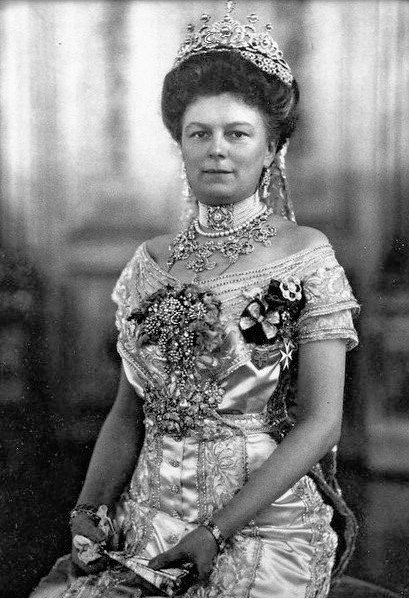
Sophie Chotek, duchess of Hohenberg, spouse of archduke Franz Ferdinand of Austria
[1]

Rodový erb Chotků z Chotkova
VitVit
Notes from the source article
Cited by Wikipedia
Notes from the source article
These works are cited by the source article, in its own numbering. They are recorded as its citations, not as sources VALÉORINE has verified.
- 1.Montgomery-Massingberd, Hugh (editor). Burke's Guide to the Royal Family, Burke's Peerage, London, 1973, p. 238.
- 2.Willis, Daniel A., The Descendants of King George I of Great Britain, Clearfield Company, 2002, pp. 153, 613
- 3.Enache, Nicolas. La Descendance de Marie-Therese de Habsburg. ICC, Paris, 1996. pp. 54, 58. French.
- 4.Genealogisches Handbuch des Adels, Fürstliche Häuser XV. "Hohenberg". C.A. Starke Verlag, 1997, pp. 600–601.
- 5.Kuchar, Jaroslava. Auf Spuren von Graf Chotek und seiner Enkelin Sophie: Velké Březno. Radio Prague International. Radio Prague. 2014-06-21.
- 6.McMeekin, Sean. July 1914: Countdown to War. Basic Books. 29 April 2014. 9780465038862.
- 7.Descendancy for Mathilde von Habsburg: Genealogics.
- 8.Pragmatic Sanction of 1713. heraldica.org. 2011.
- 9.Oxford University Press. Pope-Hennessy, (Richard) James (Arthur) (1916–1974). Oxford Dictionary of National Biography. 2018-02-06. 10.1093/odnb/9780192683120.013.31560.
- 10.Austria Will Avenge Murder. The Winnipeg Tribune. 1. 29 June 1914.
- 11.Keister Jr, Edwin. An Incomplete History of World War I. Pier 9. 2007. 978-1-74045-970-9.
- 12.Time. Time Magazine Milestones (as Leopold Lojka). 1926-08-09.
- 13.The Funeral of the Archduke. The Independent. 59. 13 July 1914.
- 14.Hof- und Staatshandbuch der Österreichisch-Ungarischen Monarchie (1915), Genealogy p. 2
- 15.Druck und Verlag der K.K. Hof- und Staatsdruckerei. Hof- und Staatshandbuch der Österreichisch-Ungarischen Monarchie. 232, 246. 1914.
- 16.Justus Perthes, Almanach de Gotha (1913) page 6
Bibliography printed in the source article · 2
- Brook-Shepherd, Gordon. Victims at Sarajevo: The Romance and Tragedy of Franz Ferdinand and Sophie (Harvill, 1984)
- Pauli, Hertha. The Secret of Sarajevo: The Story of Franz Ferdinand and Sophie (Collins, 1966)
References
Citations
References
Each reference names the institution holding it, so a reader may go to the document itself.
reference work
Secondary witnessreference work
Secondary witness
The Encyclopedia exists whether or not anything is for sale. Corrections are recorded rather than overwritten, and every version of this record is kept. Published 14 August 2026.
Elsewhere in Photography
11,392 published records in this field, each with its sources named.
- Sophie Lissitzky-KüppersPhotographer
- Sophie PetersenPhotographer
- Sophie RistelhueberPhotographer
- Sophie RiveraPhotographer
- Sophocles AlexiouPhotographer
- Sophus Juncker-JensenPhotographer
- Sophus TromholtPhotographer
- Sophy RickettPhotographer
Best supported in this field
For owners
Own a work by Sophie, Duchess of Hohenberg?
A specialist will read what you send and tell you what the house can establish, what it cannot, and whether the object is suited to sale. There is no charge and no obligation. The object stays with you throughout; nothing is shipped to us unless it is arranged in writing beforehand.