
Sarcophagi of Karajía
The Sarcophagi of Karajía (Sarcófagos de Karajía, or Carajía) are unusually large pre-Inca Chachapoyas culture sarcophagi at the Karajía Archaeological Monumental Zone in the Utcubamba Valley, located 18 km northwest of the city of Chachapoyas, Peru in Trita District, Luya Province, Amazonas Region. The site contains eight Chachapoyan mummies located on a cliffside, referred to by local residents as the “ancient wise men”. The Chachapoya culture had the tradition of protecting their dead and located their sarcophagi in protected difficult to get to locations.
Also recorded as Sarcophagi of Carajia · Sarcophagi of Carajía · Karajía · Carajía
Sarcophagi of Karajía
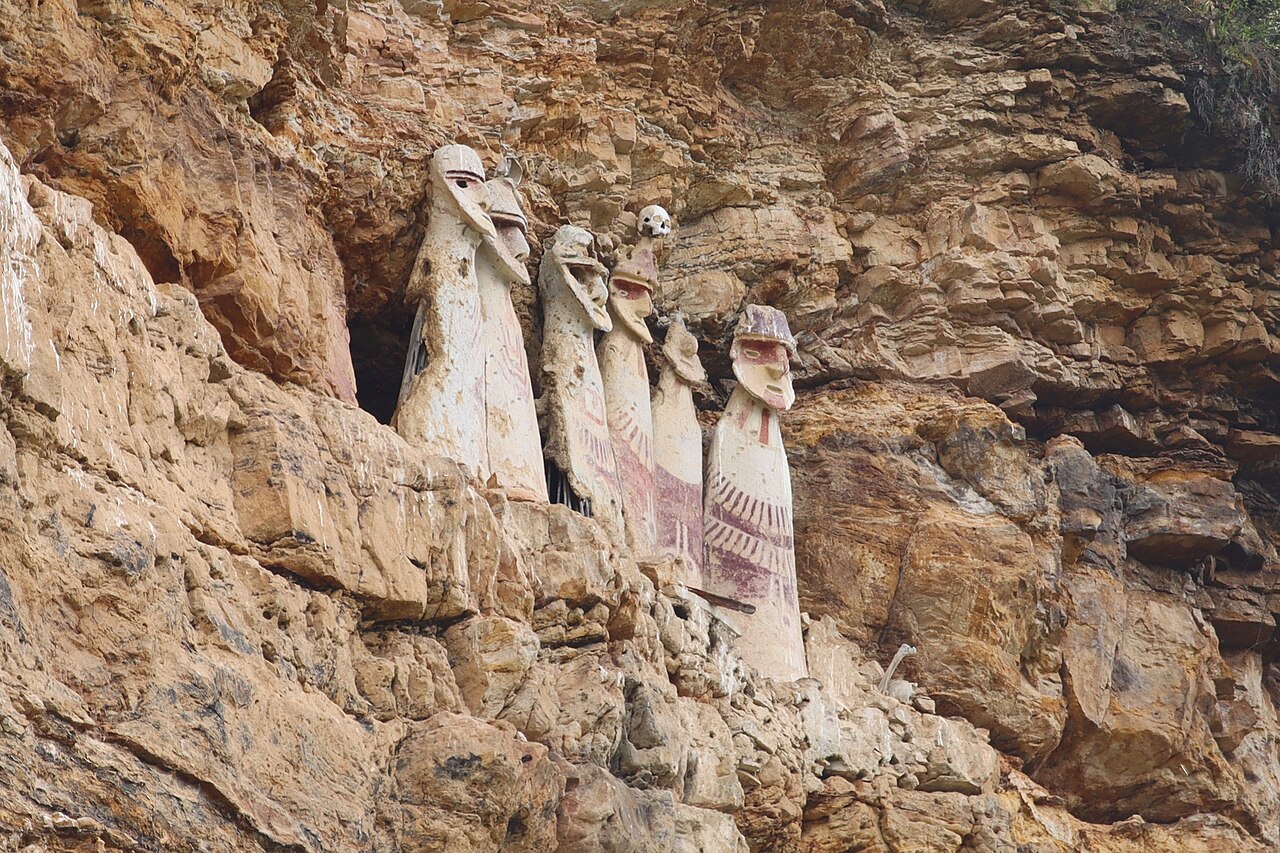
Draceane · CC BY-SA 4.0
- Name
- Sarcophagi of Karajía
- Region
- Peru
VALÉORINE Encyclopedia
VALÉORINE documentary reading
Documentary summary
The Sarcophagi of Karajía (Sarcófagos de Karajía, or Carajía) are unusually large pre-Inca Chachapoyas culture sarcophagi at the Karajía Archaeological Monumental Zone in the Utcubamba Valley, located 18 km northwest of the city of Chachapoyas, Peru in Trita District, Luya Province, Amazonas Region. The site contains eight Chachapoyan mummies located on a cliffside, referred to by local residents as the “ancient wise men”. The Chachapoya culture had the tradition of protecting their dead and located their sarcophagi in protected difficult to get to locations.
Admitted source layer · organised and presented by VALÉORINE
Reference Check
Propose documentary evidence for Sarcophagi of Karajía. A contribution is never written directly as fact: identity, source, rights and evidence gates still decide.
Sign in to contribute
Documentary evidence
Documentary basis
Authority files
wikidata · Q1728918 · wikipedia · Sarcophagi of Carajía
In this article
Overview
Overview
The Sarcophagi of Karajía are unique in their genre for their large size, up to 2.50 m high, for their careful making, and, for the fact that they were remained practically intact because of their location atop a ravine of difficult access.
Key facts
Key facts
• Name — Sarcophagi of Karajía • Native Names — Sarcófagos de Karajía • Location — * └ Amazonas Region • └ Luya Province • └ Trita District • Region — Utcubamba Valley • Part Of — Karajía Archaeological Monumental Zone • Height — 2549 m • Epochs — Late Intermediate Period • Cultures — Chachapoyas • Excavations — 1985 • Archaeologists — Federico Kauffmann Doig • Owner — Ministry of Culture (MINCUL) • Public Access — yes
Antisuyo expedition
Antisuyo expedition
Although the model of burial using coffins of anthropomorphous shape and sarcophagi, was already mentioned in the Mercurio Peruano (1791) as part of the cultural area of Chachapoyas, and it deserved the attention of Louis Langlois (1939) and of the archaeologists Henry and Paule Reichlen (1950), this Chachapoyas's peculiarity of burying their illustrious deceased was almost completely forgotten. The Antisuyo Expedition/84 located, at Karajía, the most amazing group of sarcophagi known till then, thanks to references provided by Carlos Torres Mas and Marino Torrejón. It was remaining completely unpublished and still untouched. The Peruvian archaeologist Federico Kauffmann Doig also participated in this work. Thanks to the support given by members of the Club Andino Peruano, the archaeologists were able to climb 24 m of rocky vertical wall and gain access to the cave where the sarcophagi are located. This place is located to more than 200 m from the bottom of the gorge. The Sarcophagi of Karajía consists of a group of seven sarcophagi. The eighth one collapsed probably during the earthquake of 1928, disappearing in the abyss. Since the sarcophagi are sideways next to each other, the one which collapsed opened some holes in the contiguous sides of the next.
Findings
Findings
This fact allowed scientists to investigate in detail the content of this sarcophagi and to determine the content of the remaining ones. In this way, the remaining ones did not have to be forced and they remain intact. Inside the open sarcophagus, a mummy was found. It sat on an animal skin and was wrapped in mortuary cloths. Ceramics and diverse objects were accompanying the deceased as gifts. The date obtained by radiocarbon was 1460 AC +60. Rodents and birds of prey had disturbed the burial, after the holes had appeared in the sarcophagus. The sarcophagus was emptied by scientists to preserve the mummy and its belongings. The sarcophagi are shaped into big anthropomorphous capsules, made of clay and mixed with sticks and stones. Only the head and part of the chest are compact. Both body and head are decorated by red painting of two tones, applied over a white base.
Appearance of sarcophagi
Appearance of sarcophagi
It is believed that the sarcophagi are evocations of the typical form of funeral bundle found in the coast and in the mountain range, corresponding to the period of the Tiahuanaco-Huari. In effect, the anthropomorphous form has been only given in the outlines of the human body, without the forms corresponding to the extremities taking shape. It is necessary to notice that the head of the sarcophagus has received sculptural treatment, and the face is the result of copying in clay funeral masks that were originally done in a wooden table, cut away in a half moon shape to represent the jaw. The projecting jaw that the sarcophagi present has to be made by having reproduced in clay the flat funeral masks worked in the base of a wooden table. Apparently the faces of the monoliths of Recuay, the cuchimilcos of Chancay and even that represented in the Tumi of Lambayeque, were made in the same way.
Chronology
Dated record
Chronology
The full dated record · 1 entries
1619
Sarcophagi of Karajía is recorded at coordinates -6.1619, -78.0214.
Places
Named by the record
Places
Only places the record itself states, plotted where the house gazetteer settles their coordinates. Nothing is inferred from a name or a nationality.
- Peru
Description
• Illustration — Position of some of the sarcophagi in the rock • Illustration — Six of the Sarcophagi • Illustration — 7th Sarcophagus The seven sarcophagi stand up to 2.5 meters tall, constructed of clay, sticks and grasses, with exaggerated jawlines. Their inaccessible location high above a river gorge has preserved them from destruction by looters. However, an earthquake toppled one of the original eight in 1928. They have been radiocarbon dated to the 15th century, coincident with the Inca conquest of the Chachapoya in the 1470s. The sarcophagi are of a type particular to the Chachapoya called purunmachus. The construction is painted white and overlaid with details of the body and adornment in yellow ochre and two red pigments, such as the feathered tunics and male genitalia visible on the Karajía purunmachus. Often the solid clay head will boast a second, smaller head atop it. The purunmachus of Karajía are unique because of the human skulls that sit atop their heads, visible in the photograph.
Primary material
Context
The circumstances in which Sarcophagi of Karajía stands. Recorded at coordinates -6.1619, -78.0214. Recorded as archaeological site. Karajía lies within Amazonas Department. Located at Luya District. Karajía lies within Luya District. Situated in Peru.
Related discoveries
Notes from the source article
Cited by Wikipedia
Notes from the source article
These works are cited by the source article, in its own numbering. They are recorded as its citations, not as sources VALÉORINE has verified.
- 1.Discover the mysterious Sarcophagi of Karajía.
- 2.Ministry of Foreign Trade and Tourism (MINCETUR). Sitio Arqueológico Karajía. consultasenlinea.mincetur.gob.pe. 2024.
- 3.Ministry of Foreign Trade and Tourism of Peru. Sarcófagos de Karajía. www.ytuqueplanes.com. 2025.
- 4.Kauffmann Doig, Federico. Los Chachapoya(s) : moradores ancestrales de los Andes amazónicos peruanos. UAP. 16, 17, 50, 63, 83, 205, 207, 221. 2003. 978-9972-9719-1-4.
- 5.Kauffmann Doig, Federico. Los sarcófagos de Karajía. UAP. 2014.
- 6.Ministry of Culture (MINCUL). Resolución Viceministerial N.° RVM N.° 143-2019-VMPCIC-MC. www.gob.pe. 2019.
- 7.Archaeological Institute of America. Realm of the cloud people: a trek through the remote outposts of a lost pre-Columbian civilization. Archaeology. 61. 1. 40–45. 2008-01-01. 0003-8113.
- 8.Chachapoya mortuary behavior: a consideration of method and meaning. Revista de Antropología Chilena. 42. 2. 477–495. 2010. 10.4067/s0717-73562010000200010.
- 9.von Hogen, Adriana. An overview of Chachapoya archaeology and history. Museo Leymebamba.
References
Citations
References
Each reference names the institution holding it, so a reader may go to the document itself.
reference work
Secondary witnessreference work
Secondary witness
The Encyclopedia exists whether or not anything is for sale. Corrections are recorded rather than overwritten, and every version of this record is kept. Published 16 August 2026.
Elsewhere in Furniture
924 published records in this field, each with its sources named.
- Santa Cristina al Tiverone AltarpieceTerminology
- Sao ChingchaTerminology
- Sarcofago di AdelfiaTerminology
- Sarcophagi of Helena and ConstantinaTerminology
- sarcophagusTerminology
- Sarcophagus of Bella GalianaTerminology
- Sarcophagus of Junius BassusTerminology
- Sarcophagus of Seianti Hanunia TlesnasaTerminology
Best supported in this field
For owners
Own an object connected with Sarcophagi of Karajía?
A specialist will read what you send and tell you what the house can establish, what it cannot, and whether the object is suited to sale. There is no charge and no obligation. The object stays with you throughout; nothing is shipped to us unless it is arranged in writing beforehand.