
Rogier van der Weyden
Illustration — Imaginative portrait by Cornelis Cort, 1572 Rogier van der Weyden (lang; 1399 or 1400 in Tournai18 June 1464 in Brussels), initially Roger de la Pasture, was an early Netherlandish painter whose surviving works consist mainly of religious triptychs, altarpieces, and commissioned single and diptych portraits. He was highly successful in his lifetime; his paintings were exported to Italy and Spain, and he received commissions from, amongst others, Philip the Good, Burgundian nobility, and foreign aristocrats. However his fame lasted only until the 17th century, and largely due to changing taste, he was almost totally forgotten by the mid-18th century.
Also recorded as Roger de la Pasture · Rogier Van der Weyden · Rogir Fan der Veĭden · Rogier De La Pasture Weyden
Rogier van der Weyden
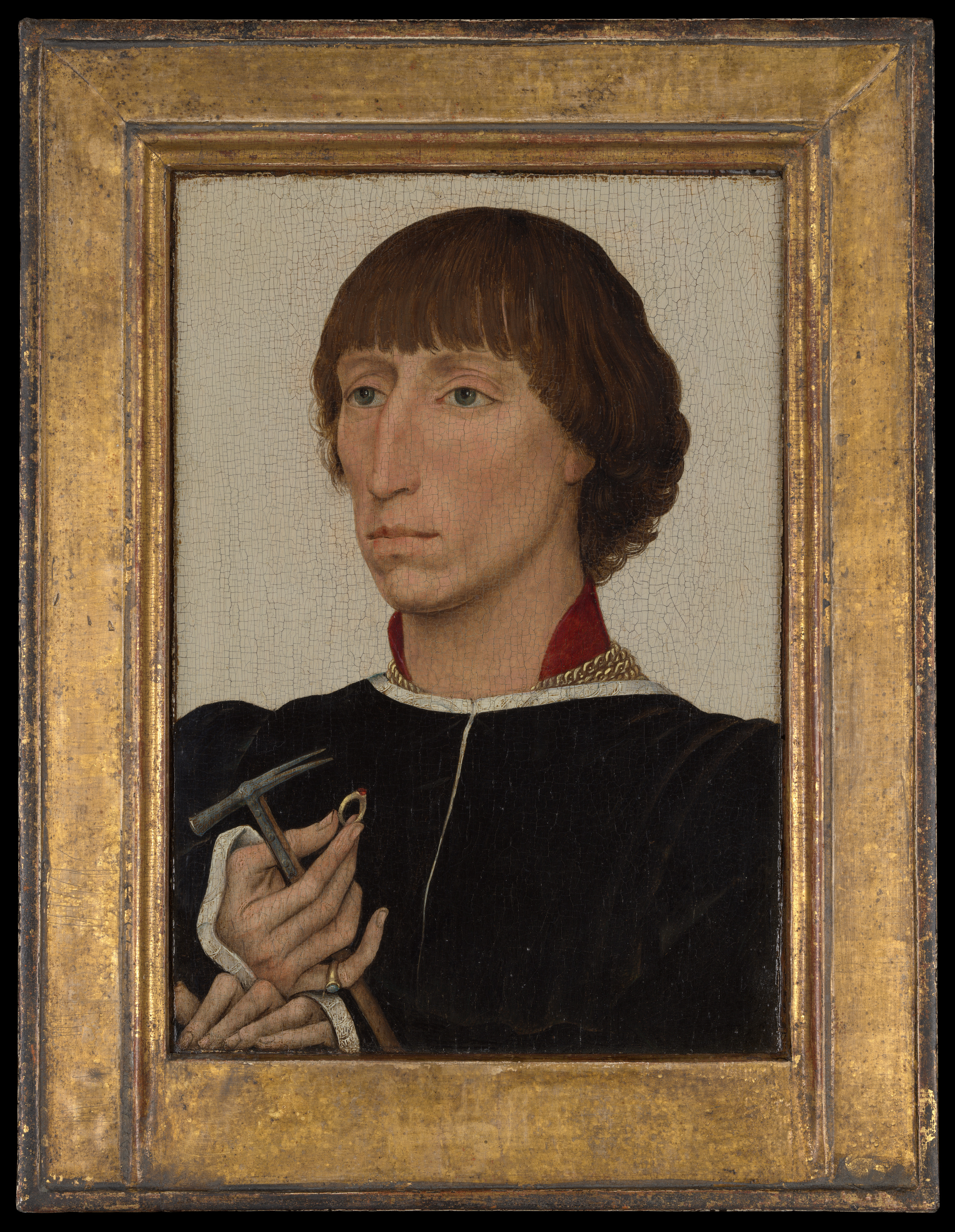
Rogier van der Weyden · The Metropolitan Museum of Art, New York · The Friedsam Collection, Bequest of Michael Friedsam, 1931 · Public domain (CC0, Met Open Access)
- Full name
- Roger de le Pasture.
- Born
- the 1390s. · Tournai.
- Died
- Rogier van der Weyden died, sources differ on the date (on 18 June 1464 and on 16 June 1464). · Brussels.
- Nationality
- Burgundian Netherlands.
- Occupation
- painter, illuminator and architectural drafter.
- Fields
- painting.
- Movements
- Early Netherlandish painting.
- Teachers
- Robert Campin.
- Known for
- Braque Triptych, Saint Luke Drawing the Virgin, Miraflores Altarpiece, The Descent from the Cross, Mérode Altarpiece, Annunciation Triptych, Bladelin Triptych and Columba Triptych.
VALÉORINE Encyclopedia
VALÉORINE documentary reading
Documentary summary
Illustration — Imaginative portrait by Cornelis Cort, 1572 Rogier van der Weyden (lang; 1399 or 1400 in Tournai18 June 1464 in Brussels), initially Roger de la Pasture, was an early Netherlandish painter whose surviving works consist mainly of religious triptychs, altarpieces, and commissioned single and diptych portraits. He was highly successful in his lifetime; his paintings were exported to Italy and Spain, and he received commissions from, amongst others, Philip the Good, Burgundian nobility, and foreign aristocrats. However his fame lasted only until the 17th century, and largely due to changing taste, he was almost totally forgotten by the mid-18th century.
Admitted source layer · organised and presented by VALÉORINE
Reference Check
Propose documentary evidence for Rogier van der Weyden. A contribution is never written directly as fact: identity, source, rights and evidence gates still decide.
Sign in to contribute
World of VALÉORINE
Documentary connections
Only confirmed graph relationships appear here. Images are shown only when their identity and reuse rights both pass the documentary gate.

Documentary evidence
Documentary basis
Authority files
bnf · getty · gnd · loc · wikidata · Q68631 · wikipedia · Rogier van der Weyden
In this article
Early life and apprenticeship
Early life and apprenticeship
Weyden worked between 1390 and 1464 across painter, illuminator and architectural drafter. The registers place that work in religious painting, portrait, still life and history painting. Every statement below returns to a source shown in the evidence panel; where the record is silent or divided, the article says so instead of resolving it.
Training under Robert Campin is recorded. Hans Memling is recorded as having studied under Rogier van der Weyden. The field of work recorded is painting. Subjects and genres recorded for the work are religious, portrait, still life and history. The authority associates the name with Early Netherlandish painting. Places of work recorded in the authority are Tournai, Brussels and Italy. Works named in the authority record are Braque Triptych, Saint Luke Drawing the Virgin, Miraflores Altarpiece, The Descent from the Cross, Mérode Altarpiece and Annunciation Triptych. Work by Rogier van der Weyden is recorded in the collections of Städel Museum, Minneapolis Institute of Art, Museo del Prado, Art Institute of Chicago and The Nelson-Atkins Museum of Art.
• Illustration — The Descent from the Cross (c. 1435), oil on oak panel, 220 × 262 cm. Museo del Prado, Madrid Due to the loss of archives in 1695 and again in 1940, there are few certain facts of Van der Weyden's life. Rogelet de le Pasture (Roger of the Pasture) was born in Tournai (then a Bishopric, now part of Belgium) in 1399 or 1400. His parents were Henri de le Pasture and Agnes de Wattrélos. The Pasture family had earlier settled in the city of Tournai where Rogier's father worked as a maître-coutelier (knife manufacturer). In 1426, Rogier married Elisabeth, the daughter of a Brussels shoemaker, Jan Goffaert and his wife Cathelyne van Stockem. Rogier and Elisabeth had four children, the first being Cornelius (b. 1427), who became a Carthusian monk and Margaretha, born in 1432. By 21 October 1435, the family had settled in Brussels, where the two younger children were born: Pieter in 1437 and Jan in 1438. These latter two would go on to become respectively a painter and a goldsmith. On moving to Brussels, Rogier began using the Flemish version of his name: "Rogier van der Weyden". From 2 March 1436 onward, Rogier held the title of 'painter to the town of Brussels' (stadsschilder), a very prestigious post since Brussels was at that time the most important residence of the splendid court of the Dukes of Burgundy. • Illustration — Portrait of a Woman with a Winged Bonnet, c. 1440. Gemäldegalerie, Berlin Little is known about Rogier's training as a painter. The archival sources from Tournai were completely destroyed during World War II, but had been partly transcribed in the 19th and early 20th century. The sources on his early life are confusing and have led to different interpretations by scholars. It is known that the city council of Tournai offered eight pitchers of wine in honour of a certain 'Maistre Rogier de le Pasture' on 17 November 1426. However, on 5 March of the following year, the records of the painters' guild show a "Rogelet de le Pasture" entered the workshop of Robert Campin together with Jacques Daret. Records show that de le Pasture was already established as a painter. Only five years later, on the first of August 1432, de le Pasture obtained the title of a "Master" (Maistre) painter. His later entry into apprenticeship might be explained by the fact that during the 1420s the city of Tournai was in crisis and as a result the guilds were not functioning normally. The late apprenticeship may have been a legal formality. Also Jacques Daret was then in his twenties and had been living and working in Campin's household for at least a decade. It is possible that Rogier obtained an academic title (Master) before he became a painter and that he was awarded the wine of honour on the occasion of his graduation. The sophisticated and learned iconographical and compositional qualities of the paintings attributed to him are sometimes used as an argument in favour of this supposition. The social and intellectual status of Rogier in his later life surpassed that of a mere craftsman at that time. In general, the close stylistic link between the documented works of Jacques Daret and the paintings attributed to Robert Campin and Van der Weyden are the main arguments to consider Rogier van der Weyden as a pupil of Campin.
Acclaim in Brussels
Acclaim in Brussels
• Illustration — Braque Triptych, c. 1452. Musée du Louvre, Paris The final mention of Rogier de la Pasture in the financial records of Tournai, on 21 October 1435, lists him as demeurrant à Brouxielles ("living in Brussels"). At the same time, the first mention of Rogier de Weyden places him as the official painter of Brussels. It is this fact that puts de la Pasture and Van der Weyden as one and the same painter. The post of city painter was created especially for Van der Weyden and was meant to lapse on his death. It was linked to a huge commission to paint four justice scenes for the "Golden Chamber" of Brussels City Hall. Different properties and investments are documented and witness his material prosperity. The portraits he painted of the Burgundian Dukes, their relatives and courtiers, demonstrate a close relationship with the elite of the Netherlands. While Rogier van der Weyden became increasingly wealthy, he also gave generously in alms to the poor. Further testimony of his philanthropy is Van der Weyden's position as administrator of the hospital and charitable foundation Ter Kisten of the Beguine convent in Brussels between 1455 and 1457. The Miraflores Altarpiece was probably commissioned by King Juan II of Castile, since Juan II donated it to the monastery of Miraflores in 1445. • Illustration — Beaune Altarpiece, c. 1445–1450. 220 cm × 548 cm (excluding frames). Oil on oak, Hospices de Beaune, interior view According to some sources, in 1449 Rogier went to Italy, and in the holy year 1450 quite possibly made a pilgrimage to Rome, which brought him in contact with Italian artists and patrons. However, his Italian experiences had no influence on his style. The House of Este and the Medici family commissioned paintings from him. After interventions from both the Duke of Burgundy and the Dauphin of France, the future Louis XI, Rogier van der Weyden was persuaded to accept the request of Bianca Maria Visconti, Duchess of Milan, that her court painter Zanetto Bugatto go to Brussels to become an apprentice in his workshop. Rogier's international reputation increased progressively. In the 1450s and 1460s humanist scholars such as Nicolas Cusanus, Filarete and Bartolomeo Facio referred to him in superlatives: 'the greatest', 'the most noble' of painters. Van der Weyden died on 18 June 1464 at Brussels, and was buried in St. Catherine's Chapel of the Cathedral of St. Michael and St. Gudula.
Attribution
Attribution
• Illustration — Portrait of a Lady, c. 1460. National Gallery of Art, Washington DC No single work can be attributed with certainty to Van der Weyden on 15th-century documentary evidence alone. However, Lorne Campbell has stated that three well-authenticated paintings are known, but each has been doubted or underestimated. The best documented is The Descent from the Cross in the Museo del Prado, Madrid. Campbell points out that this painting's provenance can be traced in some detail from the 16th century. Originally hung in the church Notre-Dame-hors-des-Murs in Leuven, The Descent from the Cross was sent to the King of Spain. While the ship on which it was travelling sank, the painting floated, and careful packaging meant that it was scarcely damaged. A copy of the masterpiece by Michel Coxcie was donated to the people of Leuven to replace the original sent to Spain. The Triptych of the Virgin or Miraflores Altarpiece, since 1850 in the Gemäldegalerie, Berlin, was given in 1445 to the Charterhouse of Miraflores near Burgos by John II of Castile; it was described in the deed of gift as the work of great and famous Flandresco Rogel. The Crucifixion, now in the Escorial Palace, was donated by Rogier to the Charterhouse of Scheut outside Brussels. In his catalogue raisonné of Van der Weyden, the Belgian art historian Dirk de Vos agrees with Campbell about the authenticity of these three paintings. Rogier's apprenticeship under Campin instilled a number of preoccupations, most noticeably his approach to feminine beauty, which was often expressed both through the elegant form of the model herself as well as her dress. Both painters positioned their models within strong diagonal lines, rendered either through headdress or folds of surrounding draperies or cloth. Both emphasised the vivacity of their model's character by contrasting them against dark flat backgrounds and throwing strong light from the near left hand side. Campbell compares Campin's Thief with Rogier's Prado The Descent from the Cross in their emotional depictions of anguish. The resemblance was to such an extent – compare Campin's Portrait of a Womans similarity to Rogier's Berlin portrait – that Campin's works were for a period attributed to Rogier's early career. Châtelet illustrates how subsequent generations of art historians have conflated and confused Rogier van der Weyden's identity, thereby mis-attributing works of art. It can be traced back to a geographical error in Vasari's Vite de' più eccellenti pittori, scultori e architettori where he states that the artist 'Rugiero da Brugia' lived in Bruges. Van Mander, who knew that Rogier van der Weyden resided in Brussels, read Vasari's text and believed that there were two different artists with the same name, who both appear separately in his Schilder-boeck of 1604. Châtelet explains how the Brussels archivist Alphonse Walters discovered in 1846 that there was a Rogier van der Weyden who lived in Brussels but that he had died earlier than stated in the Schilder-Boeck; this led Alfred Michiels to claim that there were two Rogier van der Weyden painters, a father and son. A further complication arose at the end of the 19th century when William Bode and Hugo von Tschudi attributed a group of works of art to the "Maître de Flémalle"; despite discrepancies, these works are similar to those of Van der Weyden and so it was believed that these works were in fact by Rogier and that he was the "Maître de Flémalle". It was only in 1913 that Hulin de Loo indicated that these works were actually painted by Rogier's teacher Robert Campin. There was still a divide in critical opinion over whether there was one Rogier van der Weyden or two artists, the other being Rogier de la Pasture of Tournai, until Erwin Panofsky wrote his definitive work in 1953 Early Netherlandish Painting and established that there was only one painter with two names.
Work
Work
• Illustration — Seven Sacraments Altarpiece, a triptych c. 1445–1450. Royal Museum of Fine Arts, Antwerp Relatively few works are attributed to Van der Weyden's relatively long career, but this does not mean he was un-prolific, more that it is likely that many have been lost. Nonetheless, he had a very well defined style, and the majority of the attributions are generally accepted. Van der Weyden left no self-portraits. However it has been suggested that he painted a self-portrait into one of the Justice panels, which was subsequently copied into the Bern tapestry. A drawing with the inscription "Recueil d'Arras" is also said to depict Van der Weyden. Many of his most important works were destroyed during the late 17th century. He is first mentioned in historical records in 1427 when, relatively late in life, he studied painting under Campin during 1427–32, and soon outshone his master and, later, even influenced him. After his apprenticeship, he was made master of the Tournai Guild of St Luke. He moved to Brussels in 1435, where he quickly established his reputation for his technical skill and emotional use of line and colour. He completed his Deposition in 1435, which as he had deliberately intended, made him one of the most sought after and influential artists in northern Europe and is still considered his masterpiece. The fragment of the London National Gallery's The Magdalen Reading has been described by Campbell as "one of the great masterpieces of fifteenth-century art and among Rogier's most important early works". Since the 1970s, this painting has been linked to two small heads in the collection of the Calouste Gulbenkian Museum (Lisbon), of Saint Catherine and of St Joseph. It is now widely believed that these three fragments came from the same large altarpiece depicting the "Virgin and Child with Saints", partly recorded in a later drawing now in Stockholm. At some unknown date before 1811, this altarpiece was carved up into these three fragments. • Illustration — Crucifixion Diptych, c. 1460. Philadelphia Museum of Art The lost The Justice of Trajan and Herkinbald, which survived until the end of the 17th century, consisted of four large panels representing the Justice of Trajan and Justice of Herkenbald. These were commissioned by the City of Brussels for the Gulden Camere (Golden Chamber) of the Brussels Town Hall. The first and third panels were signed, and the first dated 1439. All four were finished before 1450. They were destroyed in the French Bombardment of Brussels in 1695, but are known from many surviving descriptions, from a free partial copy in tapestry (Bern Historical Museum) and from other free and partial copies in drawing and painting. The paintings probably measured about 4.5 m each, which was an enormous scale for a painting on panel at that time. They served as 'examples of justice' for the aldermen of the city who had to speak justice in this room. The paintings were praised or described by a series of commentators until their destruction, including Dürer (1520), Vasari (1568), Molanus (c. 1570–1580), and Baldinucci (1688). In his commissioned portraits, Van der Weyden typically flattered his sitters. He often idealised or softened their facial features, allowing them a handsomeness or beauty, or interest or intelligence they might not have been blessed with in life. He often enlarged the eyes, better defined the contours of the face, and gave a much stronger jaw than the subject may have possessed in life. Among his most celebrated portraits are those of Philip the Good, his third wife Isabella of Portugal and their son Charles the Bold.
Gallery
Gallery
• Illustration — Virgin and Child Enthroned, c. 1433. Museo Thyssen-Bornemisza, Madrid • Illustration — Durán Madonna, 1435–38, Museo del Prado, Madrid • Illustration — The Crucifixion Triptych, 1440. Kunsthistorisches Museum, Vienna • Illustration — Jean Wauquelin presenting his 'Chroniques de Hainaut' to Philip the Good, c. 1448 • Illustration — Philip the Good (copy of Van der Weyden of c. 1450) • Illustration — Portrait of Isabella of Portugal, c. 1450 • Illustration — Crucifixion with the Virgin and St. John (1457–1464), oil on oak panel, El Escorial, Madrid • Illustration — Portrait of Francesco d'Este, c. 1460
Life and work
Life and work
Rogier van der Weyden was born in 1390 in Tournai. Weyden held the nationality of Burgundian Netherlands. Weyden studied under Robert Campin. Weyden worked as painter, illuminator and architectural drafter. Weyden worked in Tournai, Tournai, Brussels, Italy, Ferrara, Genoa, Naples and Rome. The fields Weyden worked in include religious painting, portrait, still life and history painting. Weyden is placed by the collections within Early Netherlandish painting. Weyden died on 18 June 1464 in Brussels. Weyden is buried at Cathedral of St. Michael and St.
Life and career
Dated record
Life and career
Explore 1390–1464
The full dated record · 6 entries
1390
Born at Tournai.
1427
Recorded as work location: Tournai.
1432
Recorded as work location: Tournai.
1435
Recorded as work location: Brussels.
1450
Recorded as work location: Italy.
1464
Dies at Brussels.
Places
Named by the record
Places
Only places the record itself states, plotted where the house gazetteer settles their coordinates. Nothing is inferred from a name or a nationality.
Tournai.
Birth place
Brussels.
Death place
Catalogued output
Works documented in more than one form
16 titles are catalogued under more than one form, which is to say the registers hold them both as a work and as a distinct object, score, recording or edition. Where a title is documented in several forms the evidence behind it is correspondingly wider, and the article treats those forms as separate records of the same work rather than as separate works. Braque Triptych, dated 1452 — catalogued as reredos, triptych and painting. Miraflores Altarpiece, dated 1443 — catalogued as triptych, painting and altarpiece. The Last Judgment (Beaune Altarpiece), dated 1443 — catalogued as polyptych, painting and winged altarpiece. Crucifixion Triptych, dated 1440 — catalogued as triptych, painting and altarpiece. John, dated 1455 — catalogued as triptych, painting and altarpiece. Chroniques de Hainaut, dated 1440 — catalogued as illuminated manuscript and version, edition or translation.
Crucifixion Diptych
1460 — catalogued as diptych and painting
The Altar of St
The Seven Sacraments
1440 — catalogued as triptych and painting
Columba Triptych
1453 — catalogued as triptych and painting
Bladelin Triptych
1440 — catalogued as triptych and painting
Diptych of Philip de Croÿ with The Virgin and Child
1460 — catalogued as diptych and painting
Annunciation Triptych
1434 — catalogued as triptych and painting
Jean Wauquelin presenting his 'Chroniques de Hainaut' to Philip the Good
1447 — catalogued as manuscript illumination and Presentation miniature
Portrait of a Young Woman
1430 — catalogued as drawing and painting
Portrait Diptych of Jean de Gros
1460 — catalogued as diptych and painting series
Saint Hubert Altarpiece
1430 — catalogued as altarpiece and painting series
Writings and published texts, 1946–2009
Catalogued output
Writings and published texts, 1946–2009
These are catalogued publications carrying the name — editions and printings, distinct from the works they contain and from writing about the subject. The 1940s are the densest part of the run, with 3 titles, and that concentration is a fact about what the registers have catalogued rather than a judgement on the work itself. They belong to a run of 10 titles in all, from 1946 to 2009.
Rogier van der Weyden; paintings from the Escorial and the Prado
1946
8 editions carry dates between 1946 and 2009
The entries follow Open Library
Le joyau des Hospices de Beaune
1947
Paasmorgen
1959
Rogier van der Weyden en zijn tijd
1974
Writings and published texts without a settled date
Catalogued output
Writings and published texts without a settled date
2 further editions are catalogued under Weyden's name without a date the collections agree on, which is why they are set apart from the dated run rather than placed in it.
Les chefs-d'oeuvre de Roger van der Weyden
Rogier van der Weyden - Pieta
Paintings, drawings and prints, 1424–1460
Catalogued output
Paintings, drawings and prints, 1424–1460
These are objects catalogued as visual works, each held or recorded by the institution named against it. 68 works carry dates between 1424 and 1460. The 1450s are the densest part of the run, with 19 titles, and that concentration is a fact about what the registers have catalogued rather than a judgement on the work itself. They belong to a run of 84 titles in all, from 1424 to 1549. A selection is set out below and the complete run may be opened beneath it.
The run opens with Fragment with group of men and closes with Diptych of Philippe de Croy
Fragment with group of men
1424
Virgin and Child Enthroned
1430
Madonna Standing
1430
The Holy Trinity
1430
The Exhumation of Saint Hubert
1430
Portrait of a Man (Guillaume Fillastre?)
1430
Saint Luke Portraying the Virgin
1431
The Arms of Philippe de Bourgogne
1431
The Magdalen Reading
1435
Durán Madonna
1435
Saint George and the Dragon
1435
The complete catalogue · 60
The run opens with Fragment with group of men and closes with Diptych of Philippe de Croy
Fragment with group of men
1424
Virgin and Child Enthroned
1430
Madonna Standing
1430
The Holy Trinity
1430
The Exhumation of Saint Hubert
1430
Portrait of a Man (Guillaume Fillastre?)
1430
Saint Luke Portraying the Virgin
1431
The Arms of Philippe de Bourgogne
1431
The Magdalen Reading
1435
Durán Madonna
1435
Saint George and the Dragon
1435
Bust of the Catherine (?)
1435
Annunciation
1435
Bust of Saint Joseph
1435
Visitation
1437
Madonna and Child
1439
The Descent from the Cross
1440
Crucifixion Triptych
1440
Portrait of a Young woman with a Winged Bonnet
1440
The Seven Sacraments (central panel)
1440
The Seven Sacraments (left panel)
1440
The Seven Sacraments (right panel)
1440
St Luke Drawing the Virgin
1440
The Pietà
1440
Right wing of a diptych: St
Katharina
1440
Pietà
1441
Miraflores Altarpiece
1443
The Last Judgment (Beaune Altarpiece)
1443
Bladelin Triptych Nativity (central panel)
1445
Portrait of Jean Froimont
Saint Lawrence
1448
Lamentation of Christ
1450
Portrait of Philippe de Croy
1450
The Annunciation
1450
Portrait of a Tournament Judge
1450
Portrait of a Man
1450
Saint Margaret and Saint Apollonia
1450
St Jerome and the Lion
1450
Braque Triptych
1452
Portrait of an Unknown Man
1452
Virgin and Child
1454
Crucifixion of Scheut
1454
Portrait of Charles the Bold
1454
Philip the Good (1396–1467)
1454
John
1455
Adoration of the Magi
1455
St Columba altarpiece: Annunciation
1455
Madonna with child, Revers: Emblem "Graces a Dieu"
1455
Portrait of Jean Gros
1457
Portrait of a Lady
1460
Medici Madonna
1460
Portrait of Francesco d'Este
1460
Portrait of Antoine, 'Grand Bâtard' of Burgundy
1460
Croy family shield
1460
Diptych of Philip de Croy - Virgin and Child
1460
Madonna and Child in a Landscape
1460
Mary and Saint John the Evangelist (right panel: Christ on the cross)
1460
Christ on the cross (left panel: Mary and Saint John the Evangelist)
1460
A further 2 recorded entries stand behind this article and are held on the record.
Paintings, drawings and prints, 1484–1549
Catalogued output
Paintings, drawings and prints, 1484–1549
7 works carry dates between 1484 and 1549. The 1480s are the densest part of the run, with 2 titles, and that concentration is a fact about what the registers have catalogued rather than a judgement on the work itself.
The run opens with St Luke Drawing the Portrait of the Madonna and closes with Descent from the cross
St Luke Drawing the Portrait of the Madonna
1484
Virgin with Child
1485
Saint Luke Drawing the Virgin
1490
Madonna with child
1500
Nativity with female donor
1500
Portrait of Philip the Good, Duke of Burgundy
1515
Descent from the cross
1549
Paintings, drawings and prints without a settled date
Catalogued output
Paintings, drawings and prints without a settled date
9 further works are catalogued under Weyden's name without a date the collections agree on, which is why they are set apart from the dated run rather than placed in it. Weston Triptych (triptych, left wing, inside). Weston Triptych (John the Baptist) (triptych, left wing, outside). The Calling of Andrew and Simon Peter (possibly a left wing of an altarpiece).
The Justice of Trajan and Herkinbald
Weston Triptych (Christ) (triptych, right wing, outside)
Weston Triptych (triptych, right wing, inside)
Branch of Holly (verso)
Head of the Virgin
Influence
• Illustration — Deposition – Follower of Rogier van der Weyden His vigorous, subtle, expressive painting and popular religious conceptions had considerable influence on European painting, not only in France and Germany but also in Italy and in Spain. Panofsky writes how Rogier van der Weyden introduced new religious iconography in his painting; he depicted patrons participating in sacred events and combined half-portraits of the Madonna with portraits of people in prayer to form diptychs. He also reformulated and popularised the subject of Saint Jerome removing the thorn from the lion's paw. Hans Memling was his greatest follower, although it is not proven that he studied under Rogier. Van der Weyden had also a large influence on the German painter and engraver Martin Schongauer whose prints were distributed all over Europe from the last decades of the 15th century. Indirectly Schongauer's prints helped to disseminate Van der Weyden's style. Delenda writes that, with the exception of Petrus Christus, who was a disciple of Jan van Eyck, traces of Rogier van der Weyden's art can be found in all fifteenth-century artists to varying degrees.
Primary material
Documents and archives
institutional register
- Bibliothèque nationale de France authority file 12002852c
General reference · Bibliothèque nationale de France
- Discogs authority file 2240845
General reference · Discogs
- FAST authority file 19760
General reference · FAST
- GND (German National Library) authority file 118860143
General reference · GND (German National Library)
- IdRef (French universities) authority file 028133277
General reference · IdRef (French universities)
- ISNI authority file 0000000107866833
General reference · ISNI
reference work
- “Rogier van der Weyden”, English Wikipedia, consulted as further reading
Reputable secondary · Wikipedia
Literature
Further cited scholarship
3 scholarly and reference publications are cited here, each one identified by title and by the publication, publisher or institution that carried it, with its year where the register states one. The cited literature runs from 2015 to 2022, which is a measure of how long Weyden has been a subject of scholarship rather than of how much has been written. The publications represented include Masterpieces from the Clowes Collection: Paintings and Renaissance Studies. The Encyclopedia cites this literature and does not summarise the arguments of works it has not read in full. Catalogue Rogier van der Weyden y los reinos peninsulares/Rogier van der Weyden and the Kingdoms of the Iberian Peninsula ed.
Follower of Rogier van der Weyden, Portrait of a Man, Masterpieces from the Clowes Collection: Paintings, 2022
Rogiervan derWeyden (Madrid, Museo Nacional del Prado, 24 March – 28 June 2015)
Museo Nacional del Prado, 2015
191 pp., 30 colour plates, 78 colour and 21 black‐and‐white illus. €25.00
Authority records
References
Citations
References
Each reference names the institution holding it, so a reader may go to the document itself.
institutional register
Bibliothèque nationale de France authority file 12002852cBibliothèque nationale de France
Secondary witnessinstitutional register
Secondary witnessinstitutional register
Secondary witnessinstitutional register
GND (German National Library) authority file 118860143GND (German National Library)
Secondary witnessinstitutional register
IdRef (French universities) authority file 028133277IdRef (French universities)
Secondary witnessinstitutional register
Secondary witnessinstitutional register
Library of Congress authority file n50082131Library of Congress
Secondary witnessinstitutional register
Secondary witness
Every cited source · 15
- 01
Bibliothèque nationale de France authority file 12002852c
institutional register · General reference · Bibliothèque nationale de France
Consult the source - 02
Discogs authority file 2240845
institutional register · General reference · Discogs
Consult the source - 03
- 04
GND (German National Library) authority file 118860143
institutional register · General reference · GND (German National Library)
Consult the source - 05
IdRef (French universities) authority file 028133277
institutional register · General reference · IdRef (French universities)
Consult the source - 06
ISNI authority file 0000000107866833
institutional register · General reference · ISNI
Consult the source - 07
Library of Congress authority file n50082131
institutional register · General reference · Library of Congress
Consult the source - 08
MusicBrainz authority file
institutional register · General reference · MusicBrainz
Consult the source - 09
National Library of Australia authority file 36550189
institutional register · General reference · National Library of Australia
Consult the source - 10
RKDartists authority file 83963
institutional register · General reference · RKDartists
Consult the source - 11
Union List of Artist Names authority file 500008384
institutional register · General reference · Union List of Artist Names
Consult the source - 12
- 13
- 14
Wikidata, structured authority record Q68631: Rogier van der Weyden
institutional register · General reference · Wikimedia Foundation
Consult the source - 15
“Rogier van der Weyden”, English Wikipedia, consulted as further reading
reference work · Reputable secondary · Wikipedia
Consult the source
People, houses and institutions
Knowledge graph
People, houses and institutions
Teachers, collaborators, publishers and institutions recorded against this person, each on a stated basis.
Associated with
1- Early Netherlandish paintingMovement
Established from a fact already recorded on a verified source.
The Encyclopedia exists whether or not anything is for sale. Corrections are recorded rather than overwritten, and every version of this record is kept. Published 17 August 2026.
Elsewhere in Paintings
18,623 published records in this field, each with its sources named.
- Roger HiltonArtist
- Roger PfundArtist
- Roger RaveelArtist
- Roger WittevrongelArtist
- Roh OguraArtist
- Rokeya SultanaArtist
- Roland ClarkArtist
- Roland DorcelyArtist
Best supported in this field
For owners
Own a work by Rogier van der Weyden?
A specialist will read what you send and tell you what the house can establish, what it cannot, and whether the object is suited to sale. There is no charge and no obligation. The object stays with you throughout; nothing is shipped to us unless it is arranged in writing beforehand.