
RobotWar
RobotWar is a programming game written by Silas Warner. This game, along with the companion program RobotWrite, was originally developed in the TUTOR programming language on the PLATO system in the 1970s. Later the game was commercialized and adapted for the Apple II and published by Muse Software in 1981.
RobotWar

Олеся · CC BY-SA 4.0
- Date
- 1981
- Publisher
- Muse Software
- Genre
- programming game
VALÉORINE Encyclopedia
VALÉORINE documentary reading
Documentary summary
RobotWar is a programming game written by Silas Warner. This game, along with the companion program RobotWrite, was originally developed in the TUTOR programming language on the PLATO system in the 1970s. Later the game was commercialized and adapted for the Apple II and published by Muse Software in 1981.
Admitted source layer · organised and presented by VALÉORINE
Reference Check
Propose documentary evidence for RobotWar. A contribution is never written directly as fact: identity, source, rights and evidence gates still decide.
Sign in to contribute
World of VALÉORINE
Documentary connections
Only confirmed graph relationships appear here. Images are shown only when their identity and reuse rights both pass the documentary gate.
Documentary evidence
Documentary basis
Authority files
wikidata · Q4048361
In this article
The object
The object
The premise is that in the distant future of 2002, war was declared hazardous to human health, and now countries settled their differences in a battle arena full of combat robots. The player selects multiple robots which do battle in an arena until only one is left standing. The robots do not have direct knowledge of the location or velocity of any of the other robots; they only use radar pulses to deduce distance, and perhaps use clever programming techniques to deduce velocity. There is no way for the player to actually take part in the battle.
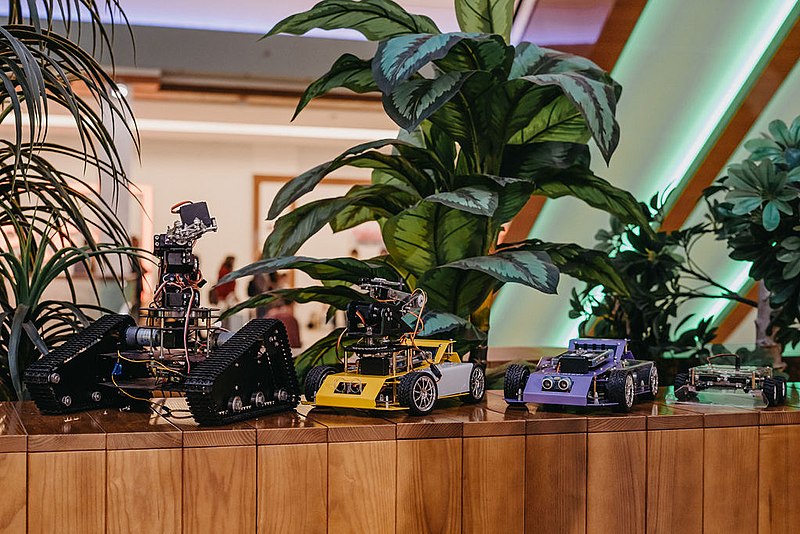
Учні створюють цікаві зразки робототехніки
Олеся

Робототехніка в дії
Олеся
Key facts
Key facts
• Title — RobotWar • Programmer — Silas Warner • Publisher — Muse Software • Released — 1981 • Platform — Apple II, PLATO • Genre — Programming
Robot programming
Robot programming
The robots' language is similar to BASIC. There are 34 registers that can be used as variables or for the robots' I/O functions. An example program from the game manual is: SCAN AIM + 5 TO AIM; MOVE GUN AIM TO RADAR; SEND RADAR PULSE LOOP IF RADAR < 0 GOSUB FIRE; TEST RADAR GOTO SCAN FIRE 0 - RADAR TO SHOT; FIRE THE GUN ENDSUB The robot with this program sweeps its radar in a circle, firing off radar pulses, and when it detects another robot, fires a projectile set to explode at the correct distance as estimated by the radar pulse. This particular robot stands still throughout the entire battle, as it never assigns any number to its movement registers.
Places
Named by the record
Places
Only places the record itself states, plotted where the house gazetteer settles their coordinates. Nothing is inferred from a name or a nationality.
- United States
Named but not plotted · 1
RobotWar is associated with United States.
Country
Reception
Harry White reviewed RobotWar in The Space Gamer No. 45. White commented that "RobotWar is worth [...] the price. And if you don't have an Apple, but do own some other brand of personal computer, just wait - there'll be a similar game for you soon. It has to happen." In its first issue Computer Gaming World praised RobotWars language as easy to learn, and for several years hosted contests for robot programs. In 1996, the magazine named it the 85th best game ever. BYTE also praised Battle Language and its potential for teaching programming, as well as the sophisticated editor and debugger, but noted that the language's slow performance caused robots to sometimes behave in unexpected ways. In a 2020 interview, Stewart Cheifet, the host and producer of Computer Chronicles told ZDNET that RobotWar was one of his favorite games, telling them "you didn't fight and shoot, you programmed your robot, it was a battle between the software, the robot you designed, and the robot the other guy designed,...it was brilliant."
Notes from the source article
Cited by Wikipedia
Notes from the source article
These works are cited by the source article, in its own numbering. They are recorded as its citations, not as sources VALÉORINE has verified.
- 1.Muse Software. RobotWar. 1. 1981.
- 2.White, Harry. Featured Review: RobotWar. The Space Gamer. Steve Jackson Games. 45. 4. November 1981.
- 3.Edmunds, William. RobotWar: A wargame for all programmers. Computer Gaming World. 13–17. November–December 1981.
- 4.Brooks, M. Evan. Never Trust A Gazfluvian Flingschnogger!. Computer Gaming World. 42–58. May 1994.
- 5.150 Best Games of All Time. Computer Gaming World. 64–80. November 1996.
- 6.Feigel, Craig. Robotwar. BYTE. 24. December 1981.
- 7.Looking back: Famous tech breakthroughs and failures. 4 November 2020.
References
Citations
References
Each reference names the institution holding it, so a reader may go to the document itself.
reference work
Secondary witness
The Encyclopedia exists whether or not anything is for sale. Corrections are recorded rather than overwritten, and every version of this record is kept. Published 17 August 2026.
Elsewhere in Collectables
20,755 published records in this field, each with its sources named.
- Robot WarlordsWork
- RobotrekWork
- Robotron 64Work
- RobotsWork
- RoboWarWork
- RoboWarriorWork
- Roc'n RopeWork
- RochardWork
Best supported in this field
For owners
Own a copy of RobotWar?
A specialist will read what you send and tell you what the house can establish, what it cannot, and whether the object is suited to sale. There is no charge and no obligation. The object stays with you throughout; nothing is shipped to us unless it is arranged in writing beforehand.