
Richard Rowlands
Richard Rowlands Richard Verstegen (or Verstegan; c. 1550–1640), also known as Richard Rowlands, was an Anglo-Dutch antiquary, publisher, humorist and translator.
Also recorded as Richard Verstegen · Richard Verstegan
Richard Rowlands
Richard Rowlands · Wellcome Collection, London · Wellcome Collection · Public Domain Mark
- Born
- Richard Rowlands was born in 1550. · London.
- Died
- Richard Rowlands died in 1640. · Antwerp.
- Nationality
- Kingdom of England
- Occupation
- journalist · poet · publisher · humorist · translator · antiquarian bookseller
- Languages
- Latin · English
VALÉORINE Encyclopedia
VALÉORINE documentary reading
Documentary summary
Richard Rowlands Richard Verstegen (or Verstegan; c. 1550–1640), also known as Richard Rowlands, was an Anglo-Dutch antiquary, publisher, humorist and translator.
Admitted source layer · organised and presented by VALÉORINE
Note VALÉORINE
Richard Rowlands (1550–1640) was an antiquarian bookseller, humorist and journalist, among other activities, a national of the Kingdom of England. The antiquarian bookseller was born in London and died in Antwerp. Richard Rowlands worked in Antwerp and London.
Languages used include English and Latin. Works are held at Museum Boijmans Van Beuningen.
Composed from admitted, traceable facts · 27 September 2026
VALÉORINE
Reference Check
Propose documentary evidence for Richard Rowlands. A contribution is never written directly as fact: identity, source, rights and evidence gates still decide.
Sign in to contribute
World of VALÉORINE
Documentary connections
Only confirmed graph relationships appear here. Images are shown only when their identity and reuse rights both pass the documentary gate.

Documentary evidence
Documentary basis
Authority files
wikidata · Q656317 · wikipedia · Richard Verstegen
In this article
Life and career
Life and career
Verstegan was born in East London, the son of a cooper. His grandfather, Theodore Roland Verstegen, was a refugee from Guelders in the Spanish Netherlands who arrived in England around the year 1500. A convert to the Catholic Church, Rowlands produced an English translation of the Little Office of the Blessed Virgin Mary; the translation and primer prayer book that contained it remained among the most popular English Catholic devotionals for two centuries. Under the patronym Rowlaunde, Richard came up to Christ Church, Oxford, in 1564, where he may have studied early English history and the Anglo-Saxon language. Having become a Catholic, he left the university without a degree to avoid swearing the Oath of Supremacy. Thereafter he was indentured to a goldsmith, and in 1574 became a freeman of the Worshipful Company of Goldsmiths. In 1576 he published a guidebook to Western Europe, translated from German, entitled The Post of the World. At the end of 1581 he secretly printed an account of the execution of Edmund Campion but was discovered and 'being apprehended, brake out of England'. In exile, he resumed his ancestral Dutch surname of Verstegen (Anglicized Verstegan) and, in 1585 or 1586, he moved to the Spanish Netherlands. With covert financial support from the Spanish Crown, Verstegan set up a residence, "in Antwerp near the bridge of the tapestry makers", as a publisher, engraver, "a valued secret agent of the Spanish party", and a smuggler of banned books as well as Roman Catholic priests and laity to and from the British Isles. Verstegan also used his many contacts throughout the strictly illegal and underground Catholic Church in England, Wales, and in Ireland to both write and publish detailed accounts of the sufferings of English, Welsh, and Irish Catholic Martyrs. To the fury of the English Court, Verstegan's books made the whole of Catholic Europe aware of the religious persecution taking place under the rule of Queen Elizabeth I.
Theatrum crudelitatum Hæreticorum nostri temporis
Theatrum crudelitatum Hæreticorum nostri temporis
• Illustration — Richard Verstegen's color engraving of the 1584 torture and execution of Archbishop Dermot O'Hurley. The 1579 hanging of fellow Irish Catholic Martyrs Bishop Patrick O'Hely and Friar Conn Ó Ruairc is shown in the background. Verstegan's detailed and highly influential Renaissance Latin volume Theatrum crudelitatum Hæreticorum nostri temporis ("Theatre of the Cruelties of the Heretics of our Time") was published in Antwerp in the Spanish Netherlands in 1587. Irish historian J.J. Meagher has written of the volume and of Verstegan, "He enhanced his account with an engraving which was a composite representation of the three Irish martyrs, Dermot O'Hurley, Patrick O'Healy, and Conn O'Rourke. The printed word helped considerably to propagate and preserve the reputation of martyrdom. There were at least eight editions of Verstegan's Theatrum up to 1607, and these contributed in no small way to maintaining the fama martyrii overseas." While in Paris in 1588, Verstegan was briefly imprisoned pending extradition to England by King Henri III at the insistence of the English Ambassador, Sir Edward Stafford, who declared the book's claims of religious persecution a libel against Queen Elizabeth I, but, as the recent Latin-Middle French translation of Theatrum crudelitatum Hæreticorum nostri temporis had already heavily contributed to the ideology of the Catholic League during the French Wars of Religion, Verstegan had many influential sympathisers and protectors. At the insistence of both the Catholic League and the Papal Nuncio, the French King refused Sir Francis Walsingham's demands for Verstegan's extradition to England to stand trial for high treason and the exiled Englishman was quietly released. After his release, Verstegan lived briefly in Rome, where he was the recipient of a temporary pension from Pope Sixtus V.
Other works
Other works
In 1595, Verstegan published in Antwerp the Latin-Elizabethan English translation of An Epistle in the Person of Jesus Christ to the Faithful Soule by John Justus of Landsberg, which St. Philip Howard had made while imprisoned for Recusancy in the Tower of London. St. Philip Howard's literary translation of Marko Marulić's Renaissance Latin religious poem Carmen de doctrina Domini nostri Iesu Christi pendentis in cruce ("A Dialogue Betwixt a Christian and Christ Hanging on the Crosse"), was also published in lieu of an introduction in the Antwerp edition. From 1617 to about 1630 Verstegan was a prolific writer in Dutch, producing epigrams, characters, jestbooks, polemics. He also penned journalistic commentaries, satires and editorials for the Nieuwe Tijdinghen (New Tidings) printed in Antwerp by Abraham Verhoeven from 1620 to 1629. This makes him one of the earliest identifiable newspaper journalists in Europe.
Latter days
Latter days
According to Louise Imogen Guiney, "The poet passed his remaining days in Antwerp, beloved by the best names of his time, English or foreign; his closest friends were such men, among Protestants, as Ortelius or Bochins, Sir Thomas Gresham and Sir Robert Cotton, the index of whose manuscript collection in the British Museum names Verstegan more than once. He was also a friend and great correspondent of Father Robert Persons, S.J.: many of Verstegan's letters to the latter figure in the Westminster Cathedral Archives." Although the exact date of Verstegan's death remains unknown, his will survives in Antwerp and bears the date of 26 February 1640.
Poetry
Poetry
The verses celebrating the Battle of Kinsale and the defeat of the uprising by the Irish clans under Aodh Mór Ó Néill, Lord of Tír Eoghain, and Red Hugh O'Donnell, Lord of Tír Chonaill, and entitled England's Joy, by R. R. (1601), have mistakenly been attributed to Verstegan, as have other poems that were in reality composed, "by the notorious Richard Vennar or Vennard." Verstegan did, however, compose an Elizabethan English elegy about the 1584 martyrdom of Blessed Dermot O'Hurley outside the walls of Dublin and entitled "The Fall of the Baron of Slane", several poems in praise of Thomas More, occasioned by the 1630 publication of the biography by the latter's great grandson, and a lullaby addressed to the Christ Child in the persona of the Blessed Virgin. Louise Imogen Guiney, however, has commented that Verstegan's works of Christian poetry have, "a most rustic simplicity. At his best, he touches Southwell, as at about a half a dozen points in the lovely lullaby." A.O. Meyer later wrote of the same poems, "They are pervaded by the peace of a soul that has freed itself from all earthly things."
Journalism and satire
Journalism and satire
According to Louise Imogen Guiney, "A few of Verstegan's saying which have survived will show him to have had a caustic eighteenth-century sort of wit, with an endearing slyness almost like Steele's. He says, for example, that Holland is as fertile in sects as Italy is in mushrooms: new doctrines sprout overnight from the dreams of men. The Dutch ministers are less greedy of glory than merchants are, for these latter will rush to India to steal the profits of the Portuguese, whereas the former do not fly there to dispute with the Jesuits for the crown of martyrdom. Of the Irish, it is said that the inhabitants of this country, having observed that to obtain great wealth they must do hard work, have found it desirable to deprive themselves of the one, that they may do without the other. A striking passage deals in no hackneyed fashion with Queen Elizabeth. 'She had that instinctive malice that makes one pick out for hatred the very persons who have done one a good turn... She was not merely ungrateful, but her only response to a benefit received was to revenge it.' Such comments cannot have been without effect on Verstegan's generation."
Works
Works
• Illustration — Plate from Theatrum crudelitatum Hæreticorum nostri temporis (1587), depicting Protestant atrocities and religious persecution against Roman Catholics. • The post of the vvorld...the most famous cities in Europe, with their trade and traficke, with their wayes and distance of myles (1576) • Theatrum crudelitatum Hæreticorum nostri temporis (= Theatre of the Cruelties of the heretics of our time) (1587) • A Restitution of Decayed Intelligence in Antiquities concerning the most noble and renowned English Nation (1605; reprinted 1628, 1634, 1652, 1655, 1673). This includes the first English version of the story of the Pied Piper of Hamelin. • Nederlantsche Antiquiteyten (1613; further editions 1631, 1646, 1662, 1700, 1701, 1705, 1714, 1725, 1733, 1756, 1809); an adaptation of the Restitution of Decayed Intelligence • Neder-duytsche epigrammen op verscheyden saecken (Mechelen, Henry Jaye, 1617) – a volume of epigrams, available on Google Books • De gazette van nieuwe-maren, van de gheheele wereldt. Ghemenght met oude waerheden. Hierby is oock ghevoegt eene wederlegginghe van eenighe onbequame Nederlandtsche spreuckwoorden (Antwerp, Hieronymus Verdussen, 1618) • Sundry Successive Regal Governments in England (1620) • Spiegel der Nederlandsche Elenden (1621) • Scherp-sinnighe characteren. Oft subtijle beschrijvinghe (Antwerp, Willem Lesteens, 1622). Available on Google Books • Oorloge ghevochten met die wapenen van die waerheydt en van die reden (Antwerp, Jan Knobbaert, 1628) • Medicamenten teghen de melancholie (published by Hendrick Aertsens, 1633)
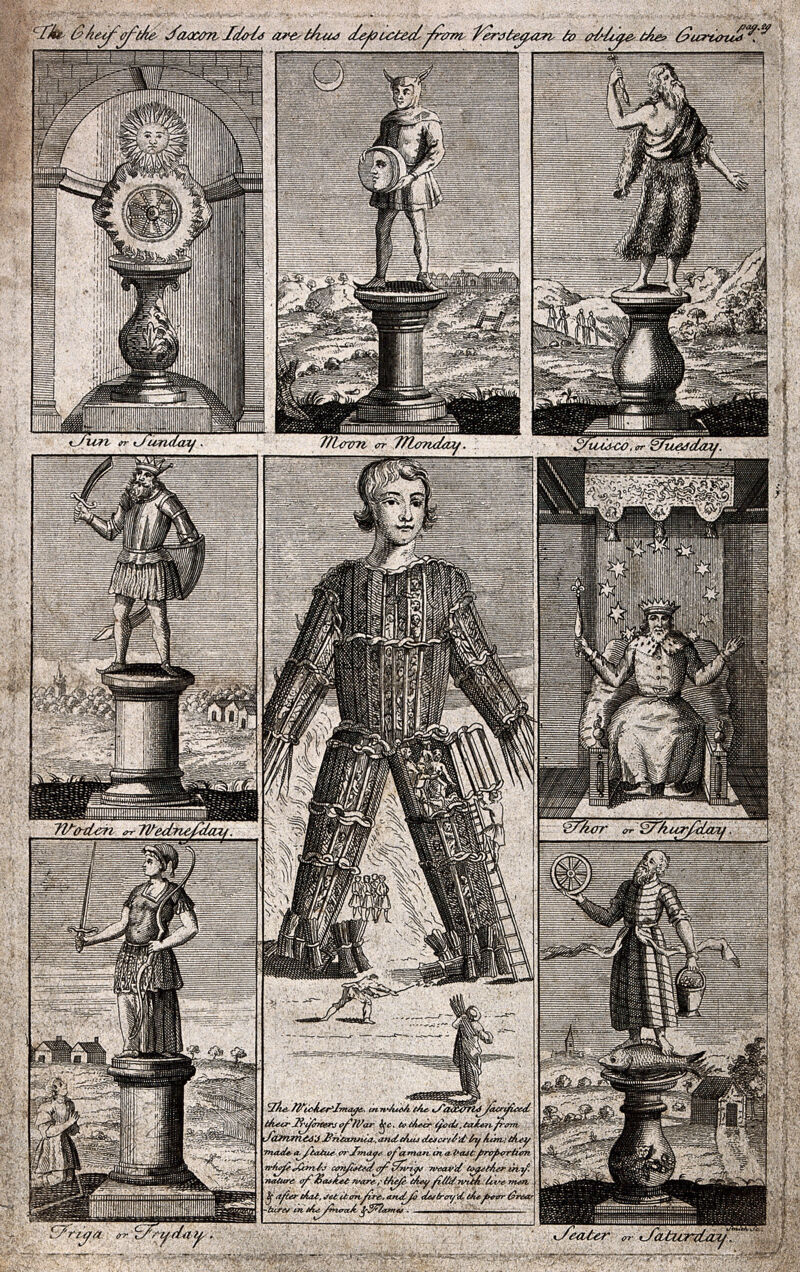
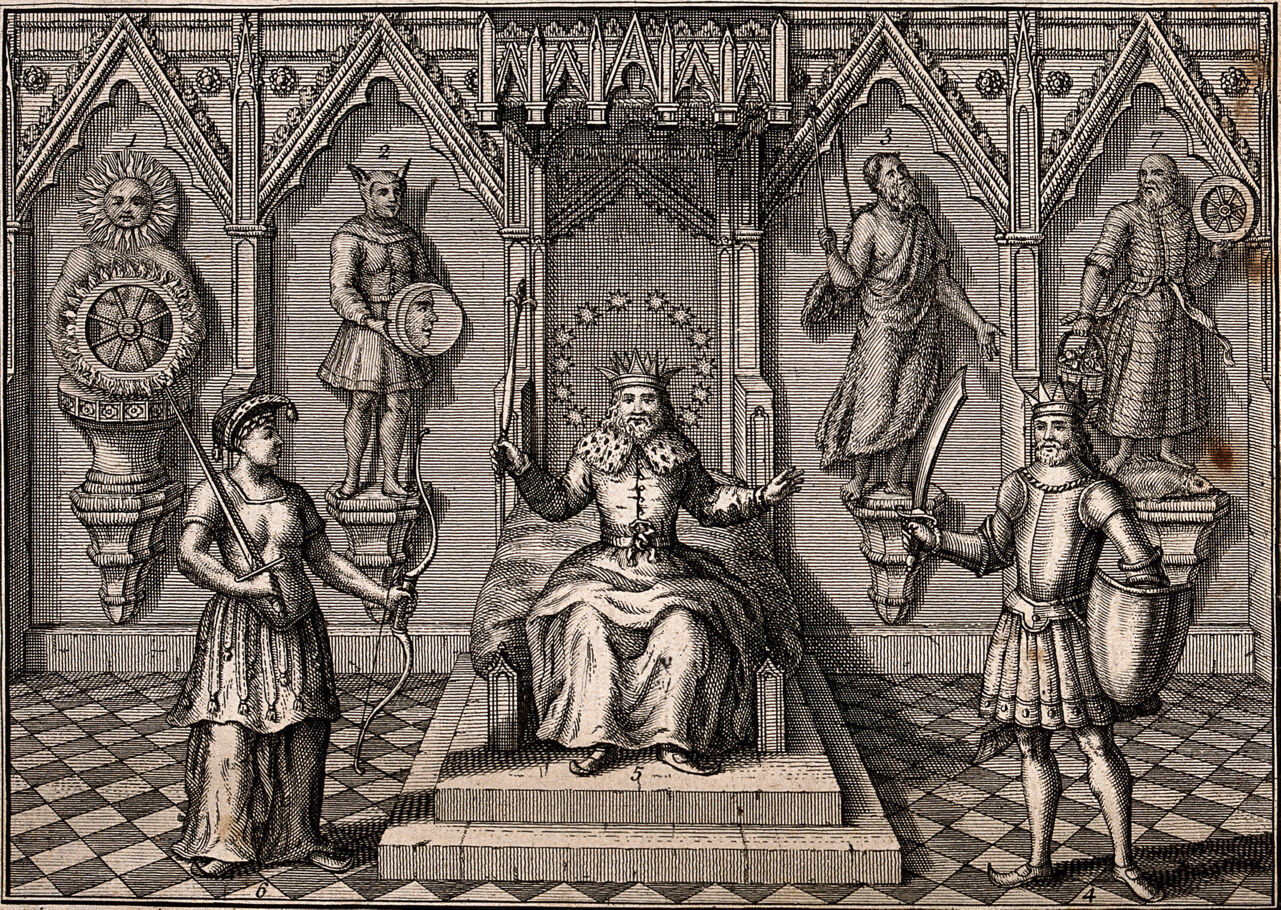
A wicker man inside which people are sacrificed, surrounded by the principal deities of the Saxons. Etching by Smith after R. Verstegen and A. Sammes., by Richard Rowlands
Richard Rowlands · Wellcome Collection, London · Wellcome Collection
Places
Named by the record
Places
Only places the record itself states, plotted where the house gazetteer settles their coordinates. Nothing is inferred from a name or a nationality.
Richard Rowlands was born at London.
Birthplace
London.
Birth place
Antwerp.
Death place
Primary material
Documents and archives
reference work
- “Richard Verstegen”, English Wikipedia, consulted as further reading
Reputable secondary · Wikipedia
authority record
- Wikidata, structured authority record Q656317: Richard Rowlands
General reference · Wikidata
Notes from the source article
Cited by Wikipedia
Notes from the source article
These works are cited by the source article, in its own numbering. They are recorded as its citations, not as sources VALÉORINE has verified.
- 1.23. 787.
- 2.Oxford University Press. The Oxford Dictionary of the Christian Church. 1327. 1997. 0-19-211655-X.
- 3.Louise Imogen Guiney (1939), The Recusant Poets: With a Selection from their Work: From Thomas More to Ben Jonson, Sheed & Ward. Page 203.
- 4.Richard Verstegan, Catholic Encyclopedia.
- 5.Franz Posset (2021), Catholic Advocate of the Evangelical Truth: Marcus Marullus (Marko Marulić) of Split (1450-1524), Wipf and Stock Publishers. Pages 38-39.
- 6.Paul Arblaster, From Ghent to Aix: How They Brought the News in the Habsburg Netherlands (Leiden and Boston, 2014), pp. 92-93. Partial view on Google Books.
- 7.A.O. Meyer (1916), England and the Catholic Church under Elizabeth, page 216.
- 8.LOT:27 Pied Piper of Hamelin.- [Rowlands (Richard) "Richard Verstegan." A Restitution of Decayed Intelligence: In antiquities, first edition, Antwerp & London, Printed at Antwerp by Robert Bruney, And to be sold at London.by John Norton and John Bill, 1605. www.forumauctions.co.uk.
- 9.Gazette on Google Books
- 10.Oorloge (1628) on Google Books
Bibliography printed in the source article · 9
- Arblaster, Paul (2004). "Verstegan [Rowlands], Richard (1548x50–1640)". In Oxford Dictionary of National Biography http://www.oxforddnb.com/view/article/24217 accessed 5 Nov 2006
- Arblaster, Paul. Antwerp and the World. Richard Verstegan and the International Culture of Catholic Reformation. Leuven University Press. 2004.
- Bremmer jr., Rolf H. The Recovery of Old English. Anglo-Saxon Studies in the Sixteenth and Seventeenth Centuries. 141–172. 2000.
- Clement, Richard W. Reinventing the Middle Ages & the Renaissance: Constructions of the Medieval and Early Modern Periods. Brepols. 19–36. 1998. 2-503-50804-9.
- Corish. The Irish martyrs. Four Courts Press. 1. 66–80. 2005. 9781851828586.
- Guiney, Louise Imogen. The Recusant Poets: With a Selection from their Work: From Thomas More to Ben Jonson. Sheed & Ward. 1939.
- Kendrick, Thomas. British Antiquity. Methuen & Co. Ltd. 116–20. 1950.
- Catholic Record Society. The Letters and Despatches of Richard Verstegan (c.1550-1640). 1959.
- Brepols. Richard Rowlands Verstegan: A Versatile Man in an Age of Turmoil. 2012. 9782503535753.
References
Citations
References
Each reference names the institution holding it, so a reader may go to the document itself.
reference work
Secondary witnessauthority record
General reference
The Encyclopedia exists whether or not anything is for sale. Corrections are recorded rather than overwritten, and every version of this record is kept. Published 20 August 2026.
Elsewhere in Books
39,078 published records in this field, each with its sources named.
- Richard RohrAuthor
- Richard RolleAuthor
- Richard RosAuthor
- Richard RoseAuthor
- Richard RussoAuthor
- Richard RyanAuthor
- Richard S. PratherAuthor
- Richard SavageAuthor
Best supported in this field
For owners
Own a work by Richard Rowlands?
A specialist will read what you send and tell you what the house can establish, what it cannot, and whether the object is suited to sale. There is no charge and no obligation. The object stays with you throughout; nothing is shipped to us unless it is arranged in writing beforehand.