
Pierre Puvis de Chavannes
Pierre Puvis de Chavannes (French pronunciation: [pjɛʁ pyvi də ʃavan]; 14 December 1824 – 24 October 1898) was a French painter known for his mural painting, who came to be known as "the painter for France". He became the co-founder and president of the Société Nationale des Beaux-Arts, and his work influenced many other artists, notably Robert Genin, and he aided medallists by designs and suggestions for their works. Puvis de Chavannes was a prominent painter in the early Third Republic. Émile Zola described his work as "an art made of reason, passion, and will".
Also recorded as Pierre-Cécile Puvis de Chavannes · Pierre Cécile Puvis de Chavannes · Pierre Cecile Puvis de Chavannes · Pierre Cecile Puvis De Chavannes
Pierre Puvis de Chavannes
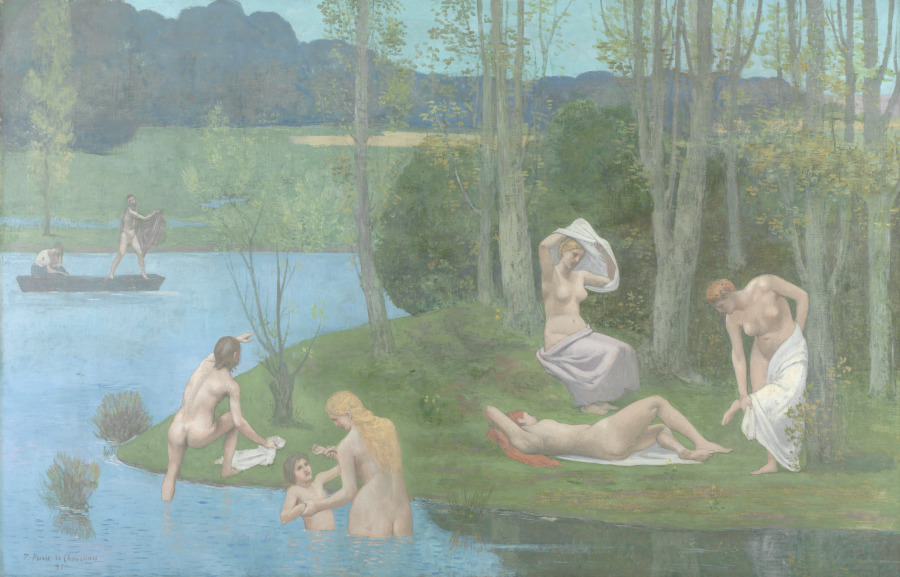
Pierre Puvis de Chavannes · The Cleveland Museum of Art · Gift of Mr. and Mrs. J. H. Wade · CC0
- Born
- 1824.
- Died
- 1898.
- Nationality
- France.
- Occupation
- painter, photographer and visual artist.
- Fields
- history painting.
- Movements
- Symbolism.
- Known for
- The Poor Fisherman, Young black boy with a sword and Jeunes Filles au bord de la mer.
VALÉORINE Encyclopedia
VALÉORINE documentary reading
Documentary summary
Pierre Puvis de Chavannes (French pronunciation: [pjɛʁ pyvi də ʃavan]; 14 December 1824 – 24 October 1898) was a French painter known for his mural painting, who came to be known as "the painter for France". He became the co-founder and president of the Société Nationale des Beaux-Arts, and his work influenced many other artists, notably Robert Genin, and he aided medallists by designs and suggestions for their works. Puvis de Chavannes was a prominent painter in the early Third Republic. Émile Zola described his work as "an art made of reason, passion, and will".
Admitted source layer · organised and presented by VALÉORINE
Note VALÉORINE
Pierre Puvis de Chavannes (1824–1898) was a painter, photographer and visual artist, of French nationality.
The painter worked in Belgium, Italy and London, among others. Pierre Puvis de Chavannes was associated with Symbolism.
Among the works are Jeunes Filles au bord de la mer, The Poor Fisherman and Young black boy with a sword. The work spans history painting.
Composed from admitted, traceable facts · 27 September 2026
VALÉORINE
Reference Check
Propose documentary evidence for Pierre Puvis de Chavannes. A contribution is never written directly as fact: identity, source, rights and evidence gates still decide.
Sign in to contribute
Documentary evidence
Evidence Panel
not yet certified
- Identity
- resolved
- Independent source families
- 0
- Admitted assertions
- 0
- Open conflicts
- 0
Authority files
gnd · 1091374163 · wikidata · Q216873 · wikipedia · Pierre Puvis de Chavannes
In this article
Early life
Early life
Puvis de Chavannes was born Pierre-Cécile Puvis in a suburb of Lyon, France, on December 14, 1824. He was the son of a mining engineer and descended from an old noble family of Burgundy. He later added the ancestral "de Chavannes" to his name. Throughout his life, he spurned his Lyon origins, preferring to identify himself with the 'strong' blood of the Burgundians, where his father originated. Puvis de Chavannes was educated at the Amiens College and at the Lycée Henri IV in Paris. He intended to follow his father's profession until a serious illness compelled him to convalesce at Mâcon with his brother and sister-in-law in 1844 and 1845, which interrupted his studies. A journey to Italy opened his mind to fresh ideas, and on his return to Paris in 1846, he announced his intention to become a painter. He studied first under Eugène Delacroix, but only very briefly, as Delacroix closed his studio shortly afterwards due to ill health. He studied subsequently under Henri Scheffer and then Thomas Couture. His training was not classical as he found that he preferred to work alone. He took a large studio near the Gare de Lyon and attended anatomy classes at the Académie des Beaux Arts. It was not until a number of years later, when the government of France acquired one of his works, that he gained wide recognition. In 1850, Puvis de Chavannes made his Salon debut with Dead Christ, Jeune noir à l'épée (Black youth with a sword), The Reading Lesson, and Portrait of a Man.
Work
Work
Puvis de Chavannes's work is seen as symbolist in nature, even though he studied with some of the romanticists, and he is credited with influencing an entire generation of painters and sculptors, particularly the works of the Modernists. One of his protégés was Georges de Feure.
Mural work
Mural work
Puvis de Chavannes is best known for his mural painting, and came to be known as 'the painter for France.' His first commission was for his brother's chateau, Le Brouchy, a medieval-style structure near Cuiseaux in Saône-et-Loire. The principal decorations take the four seasons as their theme. His first public commissions came early in the 1860s, with work at the Musée de Picardie at Amiens. The first four works were Concordia (1861), Bellum (1861), Le Travail (Work; 1863) and Le Repos (Rest; 1863). Between 1883 and 1886 he painted a mural for the Museum of Fine Arts in Lyon.
The regions
The regions
Over the course of his career, Puvis received a substantial number of commissions for works to be carried out in public and private institutions throughout France. His early work at the Musée de Picardie had helped him to develop his classicizing style, and the decorative aesthetic of his mural works. Among his public works are the later cycles completed at Amiens (Ave Picardia Nutrix, 1865), at Marseille, at Lyon and at Poitiers. Of particular importance is the cycle at the Palais de Beaux Arts in Lyon, which includes three significant works, filling the wall space in the main staircase. From left to right, the works are Antique Vision (1884), The Wood Dear to the Arts and the Muses (1884), and Christian Inspiration (1884).
Paris
Paris
Puvis' career was tied up with a complicated debate that had been ongoing since the beginning of the Third Republic (1870), and at the end of the violence of the Paris Commune. The question at stake was the identity of France and the meaning of 'Frenchness'. Royalists felt that the revolution of 1789 had been an immense disaster and that France had been thrown off course, while the Republicans felt that the Revolution had allowed France to revert to its true course. Consequently, works that were to be displayed in public spaces, such as murals, had the important task of fulfilling the ideology of the commissioning party. Many scholars of Puvis's works have noted that his success as a 'painter for France' was largely due to his ability to create works which were agreeable to the many ideologies in existence at this time. His first Parisian commission was for a cycle at the church of Saint Genevieve, which is now the secular Pantheon, begun in 1874. His two subjects were L'Education de Sainte Geneviève and La Vie Pastoral de Sainte Geneviève. This commission was followed by works at the Sorbonne, namely the enormous hemicycle, The Sacred Grove or L'Ancienne Sorbonne amongst the muses in the Grand Amphitheater of the Sorbonne. His final commission in this trinity of Republican commissions was the crowning glory of Puvis's career, the works Summer and Winter, at the Hôtel de Ville (City Hall) in Paris. Many of these works are characterized by their nod to classical art, visible in the careful balanced compositions, and the subject matter is frequently a direct reference to visions of Hellenistic Greece, particularly in the case of Antique Vision.
Works on canvas
Works on canvas
Puvis de Chavannes was president and co-founder in 1890 of the Société Nationale des Beaux-Arts (National Society of Fine Arts) founded in Paris. It became the dominant salon of art at the time and held exhibitions of contemporary art that was selected only by a jury composed of the officers of the Société. Those who translated best the spirit of the work of Puvis de Chavannes in their own creations were, in Germany, the painter Ludwig von Hofmann and in France, Auguste Rodin. His easel paintings also may be found in many American and European galleries. Some of these paintings are: Death and the Maiden The Dream The Poor Fisherman, 1881, oil on canvas Vigilance The Meditation Mary Magdalene at Saint Baume Saint Genoveva Young Girls at the Seaside, 1879, oil on canvas Mad Woman at the Edge of the Sea Hope Hope (nude) Kneeling nude woman, viewed from back The Sacred Grove As far as the appreciation of his life's work is concerned, Puvis de Chavannes was never properly understood by his contemporaries. At the beginning of his career, art criticism was divided into two camps. Adored by the idealists, he was despised by the partisans of the realists. Only with the advent of Symbolism did these two camps unite, but without achieving a convincing appreciation of the painter. Today's research has inherited this contradiction of art criticism and therefore still does not offer a convincing presentation of Puvis de Chavanne's art.
Personal life
Personal life
In Montmartre, he had an affair with one of his models, Suzanne Valadon, who would become one of the leading artists of the day as well as the mother, teacher, and mentor of Maurice Utrillo. From 1856, he was in a relationship with the Romanian princess, Marie Cantacuzène. The couple were together for 40 years, and were married before their deaths in 1898.
Life and career
Dated record
Life and career
The full dated record · 2 entries
1824
Pierre Puvis de Chavannes was born in 1824.
1898
Pierre Puvis de Chavannes died at Paris.
Primary material
Documents and archives
reference work
- Wikidata, structured authority record Q216873: Pierre Puvis de Chavannes
Reputable secondary · Wikimedia Foundation
- “Pierre Puvis de Chavannes”, English Wikipedia, consulted as further reading
Reputable secondary · Wikipedia
authority file
- Gemeinsame Normdatei 1091374163, Pierre Puvis de Chavannes (1994 : Amsterdam).
Unverified · Deutsche Nationalbibliothek
Puvis de Chavannes Prize
Beginning in 1926, The Prix Puvis de Chavannes (Puvis de Chavannes prize) was awarded by the National Society of Fine Arts (Société Nationale des Beaux-Arts). The Prix Puvis de Chavannes is the retrospective exhibition in Paris of the main works of the artist awarded the prize that year. During the twentieth century, this exhibition was located at the Grand Palais or the Musée d'Art Moderne. Recipients of the prize include: 1941: Wilhem Van Hasselt 1944: Jean Gabriel Domergue 1948: Joseph Pinchon 1952: Tristan Klingsor 1955: Georges Delplanque 1957: Albert Decaris 1958: Jean Picard Le Doux 1963: Maurice Boitel, 1966: Pierre Gaillardot 1968: Pierre-Henry 1969: Louis Vuillermoz 1970: Daniel du Janerand 1971: Jean-Pierre Alaux 1975: Jean Monneret 1987: André Hambourg 1991: Gaston Sébire 1993: Jean Cluseau-Lanauve 2006: Paul Collomb
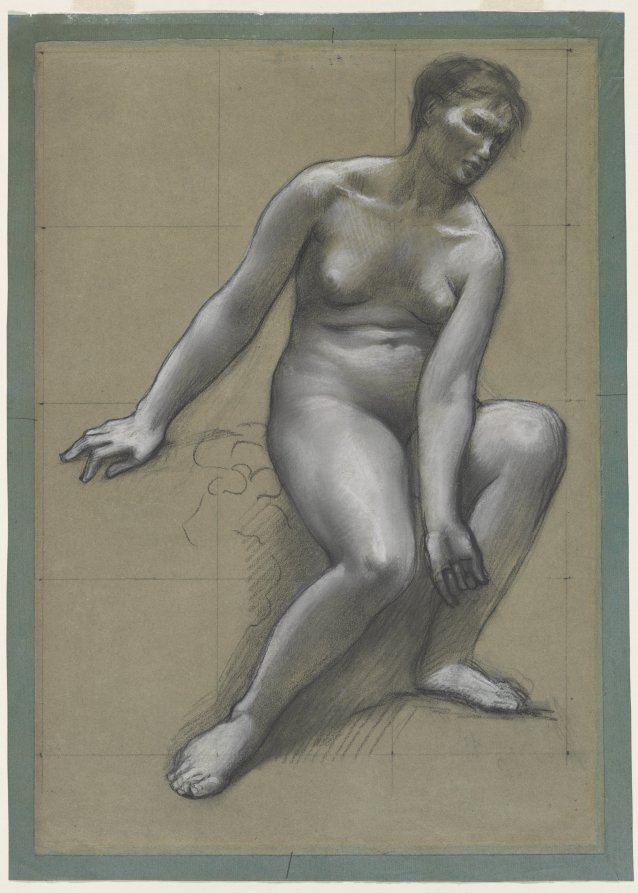
Study for the Mother in The Fisherman's Family, c. 1875, by Pierre Puvis de Chavannes
Pierre Puvis de Chavannes · The Cleveland Museum of Art · Bequest of Muriel Butkin
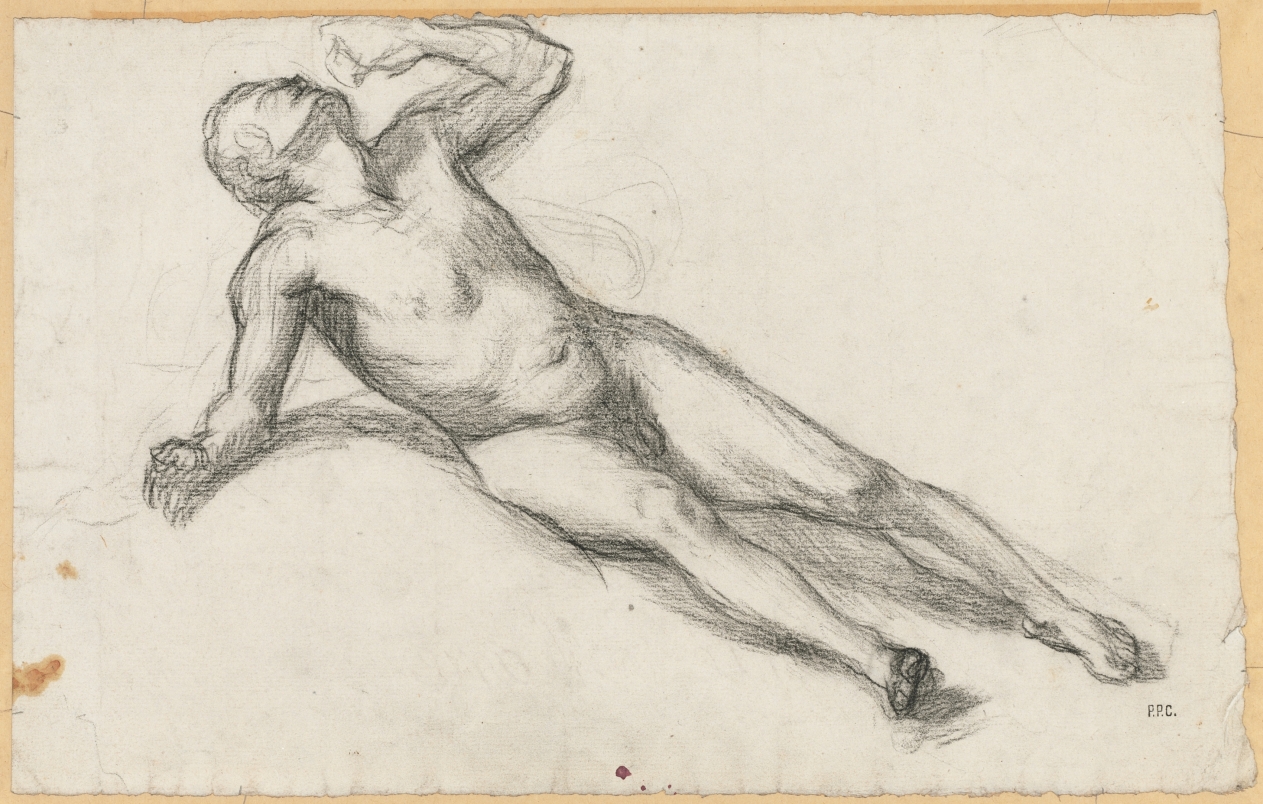
Study for The War, 1861, by Pierre Puvis de Chavannes
Pierre Puvis de Chavannes · The Cleveland Museum of Art · Dudley P. Allen Fund
Notes from the source article
Cited by Wikipedia
Notes from the source article
These works are cited by the source article, in its own numbering. They are recorded as its citations, not as sources VALÉORINE has verified.
- 1.Brown Price, A., 2010, V1
- 2.Forrer, L. Biographical Dictionary of Medallists. Spink & Son Ltd. I. 417–418. 1904.
- 3.Shaw, J. L., 'Frenchness, Memory and Abstraction: The Case of Pierre Puvis de Chavannes' in Hargrove, J., & McWilliam, N., eds., 2005, Nationalism and French Visual Culture, National Gallery of Art, Washington, Distributed by Yale University Press, New Haven and London, p. 153
- 4.Brown Price, A., 2010, Pierre Puvis de Chavannes, Vol. 1, The Artist and his Art, New Haven and London: Yale University Press, p. 7
- 5.Frantz, 1911
- 6.1905.
- 7.Brown Price 2010
- 8.Musée d'Orsay: non_traduit. www.musee-orsay.fr.
- 9.Brown Price, A., 2010, V1, p. 26
- 10.Bätschmann, Oskar. Ferdinand-Hodler, Catalogue raisonné der Gemälde, Die Figurenbilder. Schweizerisches Institut für Kunstwissenschaft. 475. 2017. 978-3-85881-256-8.
- 11.lvh.ch - und andere Domains günstig und einfach online kaufen auf top-domains.ch. Top-domains.ch. 4 October 2016.
- 12.The study Poemas e pedras, by Rita Rios, São Paulo, (2011).
- 13.Manuel Mayer: Die erträumte Kunst Pierre Puvis de Chavannes’. Eine Studie zum Verhältnis von Forschung und Kunstkritik im Angesicht einer Malerei zwischen Staffelei- und Wandbild, ART Dok, Publikationsplattform Kunst- und Bildwissenschaften Universität Heidelberg, Heidelberg 2020. http://archiv.ub.uni-heidelberg.de/artdok/7008/7/Mayer_Die_ertraeumte_Kunst_Pierre_Puvis_de_Chavannes_2020.pdf
- 14.Berk Jiminez, Jill. Dictionary of Artists' Models. Routledge. 104–105. 2013. 9781135959210.
- 15.Home page of Maurice Boitel
- 16.Société Nationale des Beaux-Arts, Biennale 1991, Grand Palais, année du centenaire, catalogue pages 8 and 9
Bibliography printed in the source article · 21
- Paul Baudoüin, "Souvenirs sur Puvis de Chavannes", Gazette des Beaux-Arts, 6e période, tome XIII, janvier 1935, pp. 295-314.
- Manuel Mayer: Die erträumte Kunst Pierre Puvis de Chavannes’. Eine Studie zum Verhältnis von Forschung und Kunstkritik im Angesicht einer Malerei zwischen Staffelei- und Wandbild. Hrsg.: ART Dok. Publikationsplattform Kunst- und Bildwissenschaften der Universität Heidelberg. Heidelberg 2020. http://archiv.ub.uni-heidelberg.de/artdok/7008/7/Mayer_Die_ertraeumte_Kunst_Pierre_Puvis_de_Chavannes_2020.pdf
- Arcadia by the shore : the mythic world of Puvis de Chavannes, [Exhibotion Catalogue Katalog, Bunkamura Museum of Art (Tokyo), Shimane Art Museum (Matsue)], Aimée Brown-Price, with contribution by Bertrand Puvis de Chavannes, Tokyo/Matsue 2014.
- Aimée Brown-Price Pierre Puvis de Chavannes, 2 vols, New Haven/London 2010, Yale University Press.
- Kerstin Thomas: Welt und Stimmung bei Puvis de Chavannes, Seurat und Gauguin, Passagen/Passages Deutsches Forum für Kunstgeschichte, Berlin/Munich 2010.
- Puvis de Chavannes. Une voie singulière au siècle de l'Impressionnisme, [Exhibition Catalogue, Musée de Picardie Amiens], Matthieu Pinette, Amiens 2005.
- Jennifer L. Shaw Dream States. Puvis de Chavannes, Modernism, and the Fantasy of France, New Haven/London 2002.
- From Puvis de Chavannes to Matisse and Picasso: toward modern art, [Exhibition Catalogue, Palazzo Grassi], Serge Lemoine, Venice 2002.
- Puvis de Chavannes au musée des Beaux-Arts de Lyon, [Exhibition Catalogue, Musée des Beaux-Arts Lyon], Dominique Brachlianoff, Lyon 1998.
- Brian Petrie Puvis de Chavannes, Aldershot/Vermont 1997.
- Pierre Puvis de Chavannes, [Exhibition Catalogue, Van Gogh Museum, Amsterdam], Aimée Brown Price, Zwolle 1994.
- Robinson, W.H., 1991, ‘Puvis de Chavannes’s ‘Summer’ and the Symbolist Avant-Garde’, The Bulletin of the Cleveland Museum of Art, Vol. 78, No. 1 (Jan.) pp. 2–27
- Dictionnaire de la peinture française, Librairie Larousse, 1989/1991, Paris,
- Stefan Germer Historizität und Autonomie. Studien zu Wandbildern im Frankreich des 19. Jahrhunderts. Ingres, Chassériau, Chenavard und Puvis de Chavannes, Studien zur Kunstgeschichte, vol 47, Hildesheim/Zurich/New York 1988.
- Puvis de Chavannes. 1824–1898, [Exhibition Catalogue, Grand Palais, Paris, Galerie nationale du Canada, Ottawa], Secrétariat d'État à la Culture und Éditions des Musées Nationaux, Louise d'Argencourt (Ottawa) and Jacques Foucart (Paris), Paris 1976 / The National Gallery of Canada, Ottawa 1977.
- Puvis de Chavannes and The Modern Tradition, [Exhibition Catalogue, Art Gallery of Ontario], Richard J. Wattenmaker, Toronto/Ontario 1975.
- Joseph Ishikawa Moderne Malgré Lui: The Phenomenon of Puvis de Chavannes, Art Journal 27:4, summer 1968.
- Robert Goldwater Puvis de Chavannes. Some Reasons for a Reputation, Art Bulletin 28, March 1946.
- René Jullian L'Oeuvre de jeunesse de Puvis de Chavannes, Gazette des beaux-arts, November 1938.
- Levin, M.R., 1986, Republican Art and Ideology in Late Nineteenth Century France, Ann Arbor: UMI Research Press
- Russell T. Clement Four French Symbolists. A Sourcebook on Pierre Puvis de Chavannes, Gustave Moreau, Odilon Redon, and Maurice Denis, Westport/London 1996.
References
Citations
References
Each reference names the institution holding it, so a reader may go to the document itself.
authority file
Gemeinsame Normdatei 1091374163, Pierre Puvis de Chavannes (1994 : Amsterdam).Deutsche Nationalbibliothek
Partially resolvedreference work
Wikidata, structured authority record Q216873: Pierre Puvis de ChavannesWikimedia Foundation
Partially resolvedreference work
Partially resolved
The Encyclopedia exists whether or not anything is for sale. Corrections are recorded rather than overwritten, and every version of this record is kept. Published 14 August 2026.
Elsewhere in Photography
11,392 published records in this field, each with its sources named.
- Pierre LotiPhotographer
- Pierre LouÿsPhotographer
- Pierre MolinierPhotographer
- Pierre Moulin du Coudray de La BlanchèrePhotographer
- Pierre RossierPhotographer
- Pierre TerrassonPhotographer
- Pierre ToulgouatPhotographer
- Pierre Toutain-DorbecPhotographer
Best supported in this field
For owners
Own a work by Pierre Puvis de Chavannes?
A specialist will read what you send and tell you what the house can establish, what it cannot, and whether the object is suited to sale. There is no charge and no obligation. The object stays with you throughout; nothing is shipped to us unless it is arranged in writing beforehand.