
Peter the Patrician
Peter the Patrician (Petrus Patricius, Petros ho Patrikios; c. 500–565) was a senior Byzantine official, diplomat, and historian. A well-educated and successful lawyer, he was repeatedly sent as envoy to Ostrogothic Italy in the prelude to the Gothic War of 535–554.
Also recorded as Peter Patrikios · Petros Patrikios
Peter the Patrician
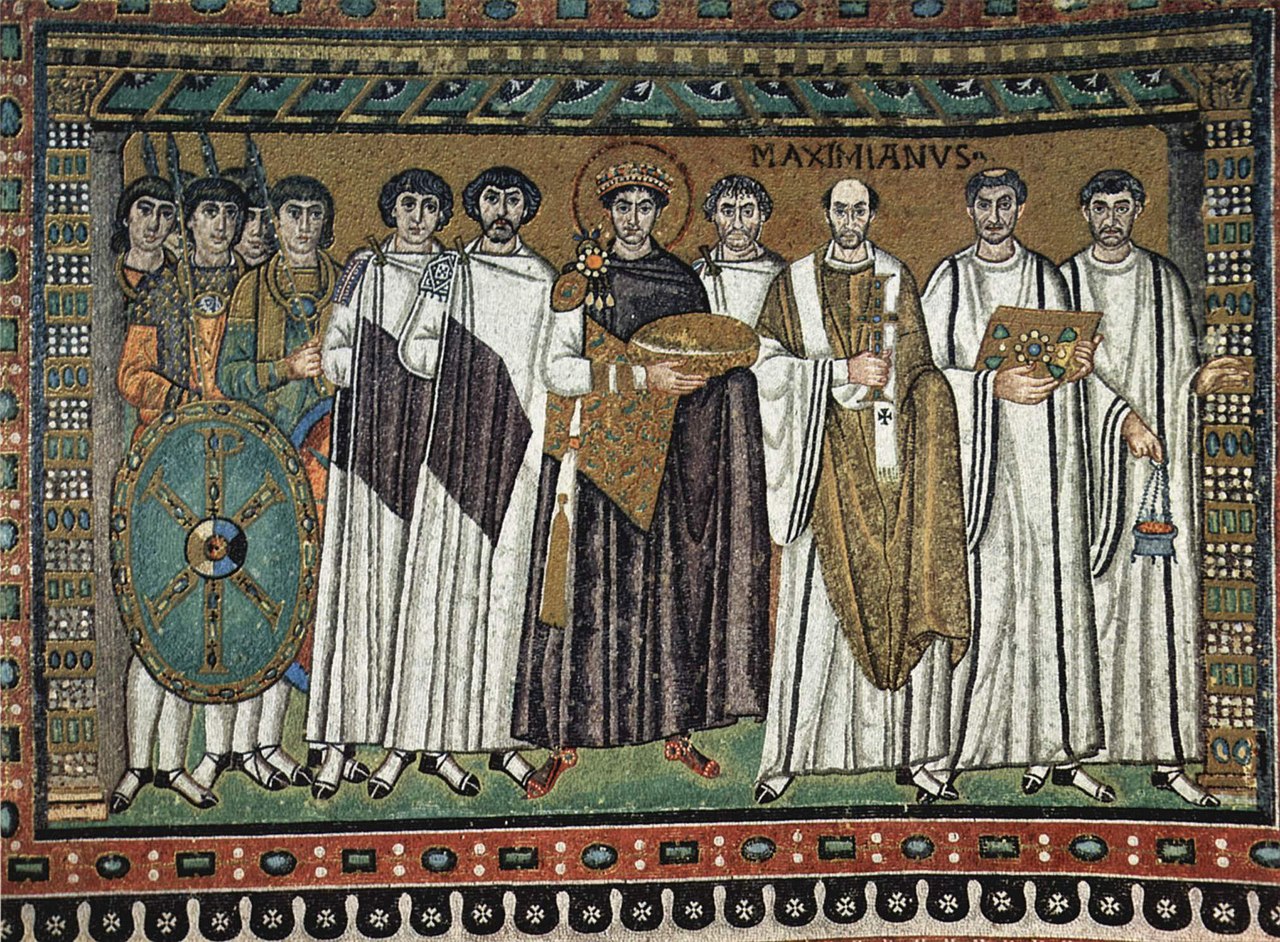
Meister von San Vitale in Ravenna · The Yorck Project (2002) 10.000 Meisterwerke der Malerei (DVD-ROM), distributed by DIRECTMEDIA Publishing GmbH. ISBN: 3936122202. · Public domain
- Name
- Peter
- Born
- c. 500
- Died
- 565
- Nationality
- Byzantine Empire
- Occupation
- historian · diplomat · writer
- Known for
- On ceremonies · History · Collection
- Languages
- medieval Greek
VALÉORINE Encyclopedia
VALÉORINE documentary reading
Documentary summary
Peter the Patrician (Petrus Patricius, Petros ho Patrikios; c. 500–565) was a senior Byzantine official, diplomat, and historian. A well-educated and successful lawyer, he was repeatedly sent as envoy to Ostrogothic Italy in the prelude to the Gothic War of 535–554.
Admitted source layer · organised and presented by VALÉORINE
Reference Check
Propose documentary evidence for Peter the Patrician. A contribution is never written directly as fact: identity, source, rights and evidence gates still decide.
Sign in to contribute
Documentary evidence
Documentary basis
Authority files
wikidata · Q964738 · wikipedia · Peter the Patrician
In this article
Biography
Biography
Despite his diplomatic skill, he was not able to avert war, and was imprisoned by the Goths in Ravenna for a few years. Upon his release, he was appointed to the post of magister officiorum, head of the imperial secretariat, which he held for an unparalleled 26 years. In this capacity, he was one of the leading ministers of Emperor Justinian I (r. 527–565), playing an important role in the Byzantine emperor's religious policies and the relations with Sassanid Persia; most notably he led the negotiations for the peace agreement of 562 that ended the 20-year-long Lazic War. His historical writings survive only in fragments, but provide unique source material on early Byzantine ceremonies and diplomatic issues between Byzantium and the Sassanids.
Key facts
Key facts
• Name — Peter • Office — Magister officiorum of the Byzantine Empire • Term Start — 539 • Term End — 565 • Monarch — Justinian I • Predecessor — Basilides • Successor — Anastasius • Born — c. 500 • Died — 565
Early career: envoy to Italy
Early career: envoy to Italy
• Illustration — Emperor Justinian I (r. 527–565) and his entourage, mosaic from the Basilica of San Vitale in Ravenna Peter was born in Thessalonica about the year 500, and was of Illyrian origin according to Procopius; according to Theophylact Simocatta, however, his origin was from Solachon, near Dara in Mesopotamia. After studying law, he embarked on a successful career as a lawyer in Constantinople, which brought him to the attention of Empress Theodora. During his time in Constantinople, Peter lived in the so-called "old Petrin" house that was later named after himself. In 534, on account of his rhetorical skills, he was employed as an imperial envoy to the Ostrogothic court at Ravenna. At the time, a power struggle was developing there between Queen Amalasuntha, regent to the young king Athalaric, and her cousin Theodahad. Following the death of Athalaric, Theodahad usurped the throne, imprisoned Amalasuntha, and sent messages to Emperor Justinian hoping for recognition. Peter met the envoys at Aulon, on his way to Italy, and notified Constantinople, seeking new instructions. Emperor Justinian ordered him to convey the message to Theodahad that Amalasuntha was under the Emperor's protection and not to be harmed. Nevertheless, at the time Peter arrived in Italy, Amalasuntha had been killed; Procopius's narrative in the Gothic War is ambiguous here, but in his Secret History, he explicitly claims that Peter arranged the murder of Amalasuntha on instructions from Theodora, who feared her as a potential rival for Justinian's attentions. Whatever assurances might have been privately given by Theodora to Theodahad, in public, Peter strongly condemned the act, and declared that there would be "war without truce between the emperor and themselves" as a result. Peter then returned to Constantinople with letters from Theodahad and the Roman Senate to the imperial couple, bearing pleas for a peaceful solution, but by the time he reached the imperial capital, Emperor Justinian had resolved on war and was preparing his forces. Consequently, Peter returned to Italy in the summer of 535 conveying an ultimatum: only if Theodahad abdicated and returned Italy to imperial rule, could war be averted. A two-pronged Byzantine offensive followed soon thereafter, attacking the outlying possessions of the Ostrogothic kingdom: Belisarius took Sicily, while Mundus invaded Dalmatia. Upon hearing these news, Theodahad despaired, and Peter was able to secure wide-ranging concessions from him: Sicily was to be ceded to the Byzantine Empire; the Gothic king's authority within Italy was severely restricted; a gold crown was to be sent as an annual tribute and up to 3,000 men were to be provided for the imperial army, underlining Theodahad's subject status. Theodahad, however, fearing that his first offer would be rejected, then instructed Peter, under oath, to offer the cession of all Italy, but only if the original concessions were rejected by Justinian. In the event, Justinian rejected the first proposal, and was delighted to learn of the second one. Peter was sent back to Italy with Athanasius, bearing letters to Theodahad and the Gothic nobles, and for a time it seemed as if the cradle of the Roman Empire would return peacefully to the fold. It was not to be: upon their arrival in Ravenna, the Byzantine envoys found Theodahad in a changed disposition. Supported by the Gothic nobility and buoyed up by a success against Mundus in Dalmatia, he resolved to resist, and imprisoned the ambassadors.
Magister officiorum
Magister officiorum
Peter remained imprisoned in Ravenna for three years, until released in June/July 539 by the new Gothic king, Witigis, in exchange for Gothic envoys. As a reward for his services, Emperor Justinian then appointed Peter to the post of magister officiorum ("Master of the Offices"), one of the highest positions in the state, heading the palace secretariat, the imperial guards (the Scholae Palatinae), and the Public Post with the dreaded agentes in rebus. He would hold this post for 26 consecutive years, longer by a wide margin than any other before or after. At about the same time or shortly thereafter, he was raised to the supreme title of patrician and the supreme senatorial rank of gloriosissimus ("most glorious one"). He was also awarded an honorary consulship. As magister, he took part in the discussions with Western bishops in 548 on the Three-Chapter Controversy, and was repeatedly sent as an envoy in 551–553 to Pope Vigilius, who opposed the emperor on the issue. Peter is also recorded as attending the Second Council of Constantinople in May 553. • Illustration — The Roman–Persian border as agreed in 561–562 In 550, he was sent as envoy by Justinian to negotiate a peace treaty with Persia, a role he reprised in 561, when he met the Persian envoy Izedh Gushnap at Dara, to end the Lazic War. Reaching an agreement over the Persian evacuation of Lazica and the delineation of the border in Armenia, the two envoys concluded a fifty-year peace between the two empires and their respective allies. The annual Roman subsidies to Persia would resume, but the amount was lowered from 500 to 420 pounds of gold. Further clauses regulated cross-border trade, which was to be limited to the two cities of Dara and Nisibis, the return of fugitives, and the protection of the respective religious minorities (Christians in the Persian Empire and Zoroastrians in Byzantium). In exchange for Persian recognition for the existence of Dara, whose construction had originally sparked a brief war, the Byzantines agreed to limit their troops there and remove the seat of the magister militum per Orientem from the city. As disagreements remained on two border areas, Suania and Ambros, in spring 562, Peter travelled to Persia to negotiate directly with the Persian Shah, Chosroes I, without however achieving a result. He then returned to Constantinople, where he died sometime after March 565. His son Theodore, nicknamed Kontocheres or Zetonoumios, would succeed him as magister officiorum in 566 under Justin II, after a brief interval where the post was held by the quaestor sacri palatii ("Quaestor of the Sacred Palace") Anastasius. He held the post until some time before 576, being appointed as comes sacrarum largitionum ("Count of the Sacred Largess") thereafter; in the same year, he also led an unsuccessful embassy to Persia to end the ongoing war over the Caucasus.
Assessment
Assessment
As one of the leading officials of the age, Peter was a controversial figure, receiving greatly differing assessments from his contemporaries. To John Lydus, a mid-level bureaucrat of the praetorian prefecture of the East, Peter was a paragon of every virtue, an intelligent, firm but fair administrator and a kind man. Procopius in his public histories attests his mild manners and desire to avoid giving insult, but in his private Secret History he accuses him of "robbing the scholares" (the members of the Scholae) and being "the biggest thief in the world and absolutely filled with shameful avarice", as well as being responsible for the murder of Amalasuntha. In the Patria of Constantinople, Peter is said to have been called "Barsymios the Syrian, who held many honours with distinction." From quite early in his career, Peter was renowned for his learning, his passion for reading, and his discussions with scholars. As a speaker, he was eloquent and persuasive; Procopius calls him "fitted by nature to persuade men", while Cassiodorus, who witnessed his embassies to the Ostrogoth court, also praises him as vir eloquentissimus and disertissimus ("most eloquent man"), and as sapientissimus ("most wise"). On the other hand, the late 6th-century historian Menander Protector, who relied on Peter's work for his own history, accuses him of boastfulness and of rewriting the records to enhance his own role and performance in the negotiations with the Persians.
Life and career
Dated record
Life and career
The full dated record · 2 entries
500
Peter the Patrician born at Thessaloniki.
565
Peter the Patrician died at Constantinople.
Places
Named by the record
Places
Only places the record itself states, plotted where the house gazetteer settles their coordinates. Nothing is inferred from a name or a nationality.
Thessaloniki.
Birth place
Constantinople.
Death place
Writings
Peter wrote three books, all of which survive only in fragments: a history of the first four centuries of the Roman Empire, from the death of Julius Caesar in 44 BC to the death of Emperor Constantius II in 361 AD, of which about twenty fragments are extant (it has been suggested that the third-century material in this was taken from Philostratus); a history of the office of magister officiorum from its institution under Constantine the Great (r. 306–337) to the time of Justinian, containing a list of its holders and descriptions of various imperial ceremonies, several of which are reproduced in chapters 84–95 of the first volume of the 10th-century De Ceremoniis of Emperor Constantine VII Porphyrogennetos (r. 913–959); and an account of his diplomatic mission to the Persian Empire in 561–562, which was used as a source by Menander Protector, and is found in Constantine's Excerpta. Until recently, Peter was also ascribed the authorship of the 6th-century Peri Politikes Epistemes ("On Political Science"), a six-volume book discussing political theory, drawing extensively from Classical texts such as Plato's The Republic and Cicero's De re publica. It too survives only in fragments. Peter was the first late Roman/Byzantine author to write on imperial ceremonies, beginning a tradition that lasted unto the 14th century. His histories are also an important historical source; for instance, his work alone preserves the negotiations and provisions of the Roman–Persian treaty of 298 between Galerius and Narseh. The Lost History of Peter the Patrician, published by Routledge in 2015, is an annotated translation from the Greek by Thomas M. Banchich of the fragments of Peter's History, including additional fragments which used to be considered the work of the Roman historian Cassius Dio's so-called Anonymous Continuator, the Anonymus post Dionem.
Primary material
Documents and archives
scholarly publication
- Peter Patrikios (Peter the Patrician), The Encyclopedia of Ancient History, 2022
Scholarly · Crossref registry · 2022
- The Lost History of Peter the Patrician, 2015
Scholarly · Crossref registry · 2015
- The lost history of Peter the Patrician: an account of Rome's imperial past from the age of Justinian, Choice Reviews Online, 2016
Scholarly · Crossref registry · 2016
reference work
- Wikidata, structured authority record Q964738: Peter the Patrician
Reputable secondary · Wikimedia Foundation
- “Peter the Patrician”, English Wikipedia, consulted as further reading
Reputable secondary · Wikipedia
authority file
- VIAF cluster 250926283 for Peter the Patrician, aggregating national library name authorities.
General reference · OCLC
Literature
Literature
Literature
The Lost History of Peter the Patrician, 2015. The lost history of Peter the Patrician: an account of Rome's imperial past from the age of Justinian, Choice Reviews Online, 2016.
Peter Patrikios (Peter the Patrician), The Encyclopedia of Ancient History, 2022
Procopius of Caesarea, Peter the Patrician, and the Outbreak of the Gothic War, Mnemosyne, 2023
THE HISTORIA AUGUSTA, NICOMACHUS FLAVIANUS, AND PETER THE PATRICIAN, The Classical Review, 2004
Scholarly footprint
Literature
Scholarly footprint
A count of publications is evidence of attention, not of standing, and is given here only as a measure.
Notes from the source article
Cited by Wikipedia
Notes from the source article
These works are cited by the source article, in its own numbering. They are recorded as its citations, not as sources VALÉORINE has verified.
- 1.Martindale, 1992, p=1482 .
- 2.ODB, p=1641 .
- 3.Martindale, 1992, p=994 .
- 4.Harvard Univ. Press. Accounts of medieval Constantinople: the Patria. 205. 2013. 978-0-674-72481-5.
- 5.Bury, 1923, pp=161–164 .
- 6.Bury, 1923, pp=164–166 .
- 7.Procopius. De Bello Gothico, I.4.
- 8.Bury, 1923, pp=168–169 .
- 9.Bury, 1923, pp=172–173 .
- 10.Bury, 1923, pp=173–175 .
- 11.ODB, p=1267 .
- 12.Lee, 1993, p=43 .
- 13.Martindale, 1992, p=996 .
- 14.Martindale, 1992, pp=996–997 .
- 15.Evans, 1996, p=259 ; .
- 16.Martindale, 1992, p=997 .
- 17.Martindale, 1992, pp=997–998 .
- 18.Martindale, 1992, pp=1255–1256 .
- 19.Procopius. Secret History, XXIV.24.
- 20.Martindale, 1992, p=998 .
- 21.Procopius. De Bello Gothico, I.3.
- 22.Maas, 2005, p=390 .
- 23.ODB, pp=596, 1641 .
- 24.ODB, pp=1629–1630 .
- 25.Dignas, Winter, 2007, p=122 .
Bibliography printed in the source article · 7
- Bury, John Bagnell. History of the Later Roman Empire: From Arcadius to Irene (395 A.D. to 800 A.D.), Volume II. Macmillan & Company. 1923.
- Dignas, Beate. Rome and Persia in Late Antiquity: Neighbours and Rivals. Cambridge University Press. 2007. 978-0-521-61407-8.
- Evans, James Allan Stewart. The Age of Justinian: The Circumstances of Imperial Power. Routledge. 1996. 0-415-02209-6.
- Lee, A. D. Information and Frontiers: Roman Foreign Relations in Late Antiquity. Cambridge University Press. 1993. 978-0-521-39256-3.
- Maas, Michael. The Cambridge Companion to the Age of Justinian. Cambridge University Press. 2005. 0-521-81746-3.
- Potter, David S. Prophecy and History in the Crisis of the Roman Empire: A Historical Commentary on the Thirteenth Sibylline Oracle. Clarendon Press. 1990.
- Antonopoulos, Panagiotis T. From Late Antiquity to Early Byzantium: Proceedings of the Byzantinological Symposium in the 16th International Eirene Conference. 49–53. 1985.
References
Citations
References
Each reference names the institution holding it, so a reader may go to the document itself.
scholarly publication
Institutional witnessscholarly publication
The Lost History of Peter the Patrician, 2015Crossref registry
Institutional witnessscholarly publication
The lost history of Peter the Patrician: an account of Rome's imperial past from the age of Justinian, Choice Reviews Online, 2016Crossref registry
Institutional witnessauthority file
Secondary witnessreference work
Wikidata, structured authority record Q964738: Peter the PatricianWikimedia Foundation
Secondary witnessreference work
Secondary witness
The Encyclopedia exists whether or not anything is for sale. Corrections are recorded rather than overwritten, and every version of this record is kept. Published 15 August 2026.
Elsewhere in Books
38,988 published records in this field, each with its sources named.
- Peter TatchellAuthor
- Peter TempleAuthor
- Peter TerrinAuthor
- Peter the DeaconAuthor
- Peter TownsendAuthor
- Peter TrowerAuthor
- Peter TurriniAuthor
- Peter V. BrettAuthor
Best supported in this field
For owners
Own a work by Peter the Patrician?
A specialist will read what you send and tell you what the house can establish, what it cannot, and whether the object is suited to sale. There is no charge and no obligation. The object stays with you throughout; nothing is shipped to us unless it is arranged in writing beforehand.