
Opicinus de Canistris
Opicinus de Canistris (24 December 1296 – c. 1353), also known as the Anonymous Ticinensis, was an Italian priest, writer, mystic, and cartographer who generated a number of unusual writings and fantastic cosmological diagrams. Autobiographical in origin, they provide the majority of information about his life.
Also recorded as Opicinus · Anonimo ticinese · Opicino de Canistris · Opicino
Opicinus de Canistris

Opicinus de Canistris · Drawing Cathedral of Pavia, 1335–50 (found online at blog.metmuseum.org) · Public domain
- Born
- 1296 · Lomello.
- Occupation
- writer · illuminator · catholic priest · mystic · cartographer
- Languages
- Latin
VALÉORINE Encyclopedia
VALÉORINE documentary reading
Documentary summary
Opicinus de Canistris (24 December 1296 – c. 1353), also known as the Anonymous Ticinensis, was an Italian priest, writer, mystic, and cartographer who generated a number of unusual writings and fantastic cosmological diagrams. Autobiographical in origin, they provide the majority of information about his life.
Admitted source layer · organised and presented by VALÉORINE
Note VALÉORINE
Opicinus de Canistris (1296–1350) was a cartographer, catholic priest and Catholic priest, among other activities. The cartographer was born in Lomello and died in Avignon. Opicinus de Canistris worked in Avignon. Languages used include Latin.
Composed from admitted, traceable facts · 30 September 2026
VALÉORINE
Reference Check
Propose documentary evidence for Opicinus de Canistris. A contribution is never written directly as fact: identity, source, rights and evidence gates still decide.
Sign in to contribute
World of VALÉORINE
Documentary connections
Only confirmed graph relationships appear here. Images are shown only when their identity and reuse rights both pass the documentary gate.
Documentary evidence
Documentary basis
Authority files
getty · 500066578 · gnd · 119092751 · wikidata · Q3354174 · wikipedia · Opicinus de Canistris
In this article
Northern Italy (1296-1329)
Northern Italy (1296-1329)
When his works were rediscovered in the early twentieth century, some scholars deemed his works to be “psychotic” due to their extraordinary theological musings and schematic diagrams. The merits of this psychoanalytic interpretation, however, are currently under debate.
• Illustration — Opicinus de Canistris World Map, 1296-1300 Opicinus was born December 24, 1296, in Lomello, near Pavia, Italy. His family, which was well known in Pavia, actively supported the Guelphs against the Ghibellines. He went to school from the age of six. He then studied liberal arts and progressively received an eclectic encyclopaedical training. From a very early age he was interested in drawing. He had several temporary jobs to materially help his family. The storming of Pavia by the Ghibellines on October 8, 1315 forced Canistris' family to take exile in Genoa for three years. Opicinus then distanced himself from the Guelph part of his family, especially following the death of his father and one of his younger brothers. In Genoa he studied theology and the Bible in greater depth and developed his talent for drawing. During this period he was able to see the first "sea maps" (incorrectly known as "portolans"). When he returned to Pavia in 1318, he studied to become a priest, and from 1319 he drew up religious treaties. He was ordained in Parma on February 27, 1320, and in 1323 obtained a modest parish in Pavia (Santa Maria Capella). Between 1325 and 1328, his autobiography doesn't mention any event. Towards the end of this period, he wrote a treatise defending the supremacy of the papacy over the Empire (De preeminentia spiritualis imperii) against the ecclesiological views of Marsilius of Padua, then a close adviser to the emperor elect Lewis of Bavaria in whose hands Pavia had fallen. It is probably this which lead him to leave the city, and find refuge in the nearby Piemontese city of Valenza in the summer of 1329.
Avignon (1329 – circa 1353)
Avignon (1329 – circa 1353)
• Illustration — Cathedral of Pavia from manuscript Vatican, Pal. Lat. 1993, 1335–50 • Illustration — Diagram with Crucifixion, 1335–50 During his stay in Valenza, he wrote a treatise on the issue of Christian poverty (which has not been preserved). Arrived in Avignon in April 1329, where the Papal Court was located he managed to present his treatise to Pope John XXII. Returning to Valenza, he revised the De preeminentia spiritualis imperii and submitted to the pope. While awaiting for some rewards for his efforts, Opicinus produced a description of the city of Pavia (De laudibus civitatis ticinensis). He eventually obtained a position as scribe at the Apostolic Penitentiary on December 4, 1330. However soon after, a suit was brought against him before the Rota, by the new bishop of Pavia, Giovanni Fulgosi, as part of a wider effort to reorganize the local clergy. Little is known about the suit, as in his writings, Opicinus is quite vague about its nature.
Illness and visions
Illness and visions
On March 31, 1334 Opicinus suffered a serious illness in which he became comatose for nearly two weeks. When he recovered, he discovered that much of his memory was gone, that he could not speak and that his right hand was useless. He wrote, On March 31, 1334 I fell sick. I received the sacraments and was near death through the first third of April. When I came to I found my limbs out of action…I had forgotten everything and could not even remember how the world looked outside of our dormitory…In the consequences of the disease I was mute, my right hand was lame and I had lost in a miraculous way a great deal of my literal memory. Ultimately, Opicinus did recover his memory, speech and some function in his hand. He attributed this healing to a vision he experienced on August 15 (coincidentally the date of the feast of the assumption of the Virgin). In the night of August 15, I saw a dream of the Virgin with the Child in her lap...and through her merits she has given me back not the littera (knowledge) but a double spirit. Since February 1, 1335, I began to retire, bit by bit, from the work in our office because of the weakness of my hand. Opicinus believed that his illness was the result of hidden sins that had corrupted his body. However, he interpreted his recovery as spiritual gift that allowed him to reveal spiritual truth. In a spiritual work, however, this same hand proved stronger than before: since then it has draw all these pictures without any human help. At present my lost literal knowledge is replaced twofold by spiritual knowledge; my right hand is weak in worldly work, but strong in spiritual endeavors.” The “pictures” he refers to are a complex series of maps and schematic diagrams in two manuscripts currently held at the Vatican library, Palatinus 1993 and Vaticanus 6435. These drawings were a means for Opicinus to chart the spiritual realities that he believed were the underpinnings of the physical world. Much scholarship has interpreted Opicinus’s illness as psychosomatic, specifically the product of schizophrenia. However, whatever symptomatology can be gleaned from Opicinus’s abstruse writings seems to suggest that he suffered a stroke in addition to potential psychotic episodes. He died in Avignon around 1353.
Work after 1334
Work after 1334
Opicinus is best known for the two manuscripts he created following his illness, "BAV, Pal. lat. 1993" and "BAV, Vat. lat. 6435." These two manuscripts contain a variety of autobiographic drawings and writings which chart Opicinus's life and illness.
The Vaticanus latinus 6435 manuscript
The Vaticanus latinus 6435 manuscript
• Illustration — Vatican Lat. 6435 folio 79v. Opicinus wrote the Vaticanus latinus between June and November 1337 and subsequently inserted addita (the last in December 1352). This manuscript, which was only identified on the eve of World War II, was recently fully published and translated by the medievalist Muriel Laharie as well as several studies by the psychiatrist Guy Roux – a multi-disciplinary collaboration essential to examining this singular work. The Vaticanus comes in the form of a paper codex with 87 folios, with only written text in the first half, text and drawings (often map based) in the second half. It is a very dense document. This codex looks similar to a journal written in chronological order. However, its polymorphous content, which is difficult to decipher, bears witness to the encyclopaedic culture of its author. Opicinus used all his knowledge to construct a cosmic identity appearing in numerous guises; he is God, the Sun, the Pope, Europe, Avignon, etc. Its colour anthropomorphic maps of the Mediterranean area, precise and curiously organised, illustrate "good" and "bad" characters and animals on which he projects himself and his enemies. The use of symbols, his taste for dissimulating and manipulating (words, numbers, space), and his attraction to the obscene and scatological are omnipresent and relate strongly to similar themes found broadly in medieval culture.
The Palatinus latinus 1993 manuscript
The Palatinus latinus 1993 manuscript
The Palatinus latinus, first identified in 1913, was the subject of a study by Richard Salomon in 1939, with a partial edition of the document and comments. With 52 large colour drawings on parchment (often used on both sides) and covered with notes, Palatinus, 1993 apparently relies much less on a cartographic format; yet, invisible maps of the Mediterranean are underlying most of the diagrams, with sometimes only a few places expressed. The drawings are extremely schematic, using human figures covered in circles and ellipses. Opicinus also included a plethora of biblical quotations, calendars, astrological charts and medical imagery. Some scholars (M. Laharie and G. Roux) claim that these drawings were produced later than the Vaticanus, with no firm basis. Only two diagrams are dated or connected to the 1350 Jubilee. Other evidences rather point to an early production of most of the other drawings, in 1335 or 1336, before the Vaticanus.

Diagram with Zodiac Symbols by Opicinus de Canistris, Avignon, France, 1335–50
Opicinus de Canistris · 14th century drawings (found online at blog.metmuseum.org)
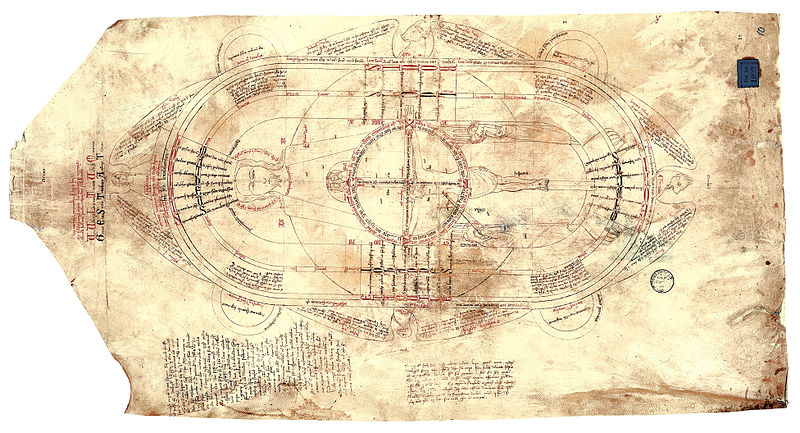
Diagram with Crucifixion by Opicinus de Canistris, Avignon, France, 1335–50
Opicinus de Canistris · 14th century drawings (found online at [http: blog.metmuseum.org)
Life and career
Dated record
Life and career
The full dated record · 2 entries
1296
Opicinus de Canistris was born on 24 December 1296.
1350
Opicinus de Canistris died in 1350 at Avignon.
Places
Named by the record
Places
Only places the record itself states, plotted where the house gazetteer settles their coordinates. Nothing is inferred from a name or a nationality.
Lomello.
Birth place
Avignon.
Death place
Writings prior to 1334
These are treaties without drawings and known by the author's friends. Only De preeminentia spiritualis imperii (The primacy of spiritual power) and De laudibus Papie (Pavia eulogy) have survived to date in the form of copies. • 1319: Liber metricus de parabolis Christi • 1320: De decalogo mandatorum • 1322: religious treaties • 1324: Libellus dominice Passionis secundum concordantiam IIII evangelistarum • 1329: De paupertate Christi, De virtutibus Christi, Lamentationes virginis Marie, De preeminentia spiritualis imperii • 1330: Tractatus dominice orationis, Libellus confessionis, De laudibus Papie • 1331: Tabula ecclesiastice hierarchie • 1332: De septiloquio virginis Marie • 1333: De promotionibus virginis Marie
Primary material
Documents and archives
authority file
- Gemeinsame Normdatei 119092751, Opicinus, de Canistris.
General reference · Deutsche Nationalbibliothek
- Getty Union List of Artist Names 500066578, Opicinus de Canistris.
General reference · The Getty Research Institute
reference work
- Wikidata, structured authority record Q3354174: Opicinus de Canistris
Reputable secondary · Wikidata
- “Opicinus de Canistris”, English Wikipedia, consulted as further reading
Reputable secondary · Wikipedia
Notes from the source article
Cited by Wikipedia
Notes from the source article
These works are cited by the source article, in its own numbering. They are recorded as its citations, not as sources VALÉORINE has verified.
- 1.Salomon, Richard. A Newly Discovered Manuscript of Opicinus de Canistris. Journal of the Warburg and Courtauld Institutes. The Warburg Institute. 16. 45–57. 1953. 750226.
- 2.Quaglino, Gian Piero. Opicinus de Canistris: some notes from Jung's unpublished Eranos Seminar on the medieval Codex Palatinus Latinus 1993. The Journal of Analytical Psychology. 55. 3. 2010-06-07. 10.1111/j.1468-5922.2010.01852.x.
- 3.Harding, Catherine. “Open to God: The Cosmological Diagrams of Opicinus de Canistirs,” in Zeitscherift für Kunstgeschichte, 61 (1998): 18-39
- 4.Piron, Sylvain. Dialectique du monstre. Enquête sur Opicino de Canistris. Zones sensibles. 62–65. 2015.
- 5.De preeminentia spiritualis imperii (1329). Cf. SCHOLZ (R.), Unbekannte Kirchenpolitische Streischriften aus der Zeit Ludwig des Bayern (1327–1354), Rome, Verlag von Loescher & Cie, vol. 1, 1911, p. 37-43, and vol. 2, 1914, p. 89-104. De laudibus civitatis ticinensis (1330). Cf. GIANANI (F.), in Opicino de Canistris, l’Anonimo Ticinese, Pavia, EMI, 1996, p. 73-121; and AMBAGLIO (D.), Il libro delle lodi della città di Pavia, Pavia, 1984.
Bibliography printed in the source article · 15
- Camille, Michael. “The Image and the Self: Unwriting Late Medieval Bodies,” in Framing Medieval Bodies. (ed.) Sarah Kay and Miri Rubin. New York, NY. Manchester University Press, 1994
- Gurevich, Aron Yakovlevich. “L'individualité au Moyen Age: le cas d'Opicinus de Canistris,” in Annales ESC: économies, sociétés, civilisations: (later Annales - Histoire, Sciences Sociales) vol. 48:5, pp. 1263–1280, 1993
- Kris, Ernst. “A Psychotic Artist of the Middle Ages,” in Psychoanalytic Exploration in Art. New York, NY. International Universities Press, 1952
- Laharie (M.), Le journal singulier d’Opicinus de Canistris (1337 - circa. 1341), Vatican City, Bibliotheca Apostolica Vaticana, 2008, 2 volumes, LXXXVIII + 944 p., 47 ill.
- Laharie (M.), "Une cartographie ‘à la folie’ : le journal d’Opicinus de Canistris", in Mélanges de l'École française de Rome (Moyen Âge), Ecole française de Rome, 119, 2, 2007, p. 361-399.
- Morse, Victoria, A Complext Terrain: Church, Society and the Individual in the Thought of Opicino de Canistris. Unpublished dissertation completed at the University of California-Berkeley, 1996
- Morse, Victoria. “Seeing and Believing: The Problem of Idolatry in the Thought of Opicino de Canistris,” in. Orthodoxie, Christianisme, Histoire. (ed.) Susanna Elm, Eric Rebillard, and Antonella Romano. Ecole Francois de Rome, 2000 pp. 163-176
- Morse, Victoria. “The Vita Mediocris: The Secular Priesthood in the Thought of Opicino de Canistris,” in Quaderni di Storia Religiosa pp. 257-82 Verona, Cierre Edizione, 1994
- Piron, Sylvain. Dialectique du monstre. Enquête sur Opicino de Canistris, Bruxelles, Zones sensibles, 2015, 208 p.
- Roux (G.), Opicinus de Canistris (1296–1352), prêtre, pape et Christ ressuscité, Paris, Le Léopard d’Or, 2005, 484 p.
- Roux (G.), Opicinus de Canistris (1296–1352), Dieu fait homme et homme-Dieu, Paris, Le Léopard d’Or, 2009, 310 p.
- Roux (G.) & Laharie (M.), Art et Folie au Moyen Âge. Aventures et Énigmes d’Opicinus de Canistris (1296-1351 ?), Paris, Le Léopard d’Or, 1997, 364 p., 94 ill.
- Salomon (R.G.), Opicinus de Canistris. Weltbild und Bekenntnisse eines Avignonesichen Klerikers des 14. Jahrhunderts, London, The Warburg Institute, 1936, 2 volumes; reprint. Lichtenstein, Kraus Reprints, 1969, 292 p. + 89 ill.
- Tozzi (P.), Opicino e Pavia, Pavia, Libreria d’Arte Cardano, 1990, 76 p.
- Whittington, Karl. Body-Worlds: Opicinius de Canistris and the Medieval Cartographic Imagination. Toronto, Pontifical Institute of Medieval Studies, 2014, xii + 212 p, 45 ill.
References
Citations
References
Each reference names the institution holding it, so a reader may go to the document itself.
authority file
Gemeinsame Normdatei 119092751, Opicinus, de Canistris.Deutsche Nationalbibliothek
Secondary witnessauthority file
Getty Union List of Artist Names 500066578, Opicinus de Canistris.The Getty Research Institute
Secondary witnessreference work
Secondary witnessreference work
Secondary witness
People, houses and institutions
Knowledge graph
People, houses and institutions
Teachers, collaborators, publishers and institutions recorded against this person, each on a stated basis.
Died at
1- AvignonPlace
Established from a fact already recorded on a verified source.
The Encyclopedia exists whether or not anything is for sale. Corrections are recorded rather than overwritten, and every version of this record is kept. Published 16 August 2026.
Elsewhere in Maps and atlases
1,180 published records in this field, each with its sources named.
- Olaus MagnusAuthor
- Ole Christopher WesselAuthor
- Olga FedchenkoAuthor
- Olof Johan SödermarkAuthor
- Oronce FinéAuthor
- Osborn Maitland MillerAuthor
- Oscar BaumannAuthor
- Osgood CarletonAuthor
Best supported in this field
For owners
Own a work by Opicinus de Canistris?
A specialist will read what you send and tell you what the house can establish, what it cannot, and whether the object is suited to sale. There is no charge and no obligation. The object stays with you throughout; nothing is shipped to us unless it is arranged in writing beforehand.