
Museum of Fine Arts, Budapest
The Museum of Fine Arts (Hungarian: Szépművészeti Múzeum, pronounced [ˈseːpmyveːsɛti ˈmuːzɛum]) is a museum in Heroes' Square, Budapest, Hungary, facing the Hall of Art. It was built by the plans of Albert Schickedanz and Fülöp Herzog in an eclectic-neoclassical style, between 1900 and 1906. The museum's collection is made up of international art (other than Hungarian), including all periods of European art, and comprises more than 100,000 pieces.
Also recorded as Szépmüvészeti Múzeum · Museum of Fine Arts (Budapest) · Szépművészeti Múzeum · Museum of Fine Arts Budapest
Museum of Fine Arts, Budapest

Civertan Grafik · CC BY-SA 2.5
- Founded
- 1906.
- Headquarters
- Budapest.
VALÉORINE Encyclopedia
VALÉORINE documentary reading
Documentary summary
The Museum of Fine Arts (Hungarian: Szépművészeti Múzeum, pronounced [ˈseːpmyveːsɛti ˈmuːzɛum]) is a museum in Heroes' Square, Budapest, Hungary, facing the Hall of Art. It was built by the plans of Albert Schickedanz and Fülöp Herzog in an eclectic-neoclassical style, between 1900 and 1906. The museum's collection is made up of international art (other than Hungarian), including all periods of European art, and comprises more than 100,000 pieces.
Admitted source layer · organised and presented by VALÉORINE
Note VALÉORINE
No house-authored Note is published until its assertions and sources pass the VALÉORINE evidence contract. The documentary article remains available in full while that enrichment is being consolidated.
Documentary enrichment in progress · no unsupported statement published
Reference Check
Propose documentary evidence for Museum of Fine Arts, Budapest. A contribution is never written directly as fact: identity, source, rights and evidence gates still decide.
Sign in to contribute
Documentary evidence
Evidence Panel
not yet certified
- Identity
- resolved
- Independent source families
- 0
- Admitted assertions
- 0
- Open conflicts
- 0
Authority files
wikidata · Q840886 · wikipedia · Museum of Fine Arts (Budapest)
In this article
Classical antiquities
Classical antiquities
The core of the collection was made up of pieces acquired from Paul Arndt, a classicist from Munich. The exhibition mainly includes works from Ancient Greece and Rome. Most significant is the 3rd century marble statue called the Budapest dancer. The Cyprean and Mycenaean collection is also notable, also the ceramics and bronzes.
Art after 1800
Art after 1800
The museum's collection of 19th- and 20th-century art is less significant than those found in other departments; it is a younger collection. The bulk of the painting is from the Biedermeier period and French art. From the latter are representatives of the Romantic period (Eugène Delacroix), the Barbizon School (Jean-Baptiste-Camille Corot, Gustave Courbet) and Impressionism (Édouard Manet, Claude Monet, Camille Pissarro, Pierre-Auguste Renoir, Henri de Toulouse-Lautrec). There is a large collection of sculptures by Auguste Rodin and Constantin Meunier.
Vasarely Museum
Vasarely Museum
Hungarian artist, Victor Vasarely, donated a significant collection of his works to the gallery. These have found a permanent home outside the walls of the gallery at the Zichy mansion in Óbuda. The two-storey wing of the building is known as the Vasarely Museum and is the only one of its kind in eastern Europe.
Directors of the museum
Directors of the museum
1906–1914 Ernő Kammerer 1914–1935 Elek Petrovics 1935–1944 Dénes Csánky 1949–1952 Imre Oltványi 1952–1955 Ferenc Redő 1956–1964 Andor Pigler 1964–1984 Klára Garas 1984–1989 Ferenc Merényi 1989–2004 Miklós Mojzer 2004– László Baán
Budapest Museum Quarter project
Budapest Museum Quarter project
In 2008, the director of the Museum of Fine Arts, László Baán, proposed the merging of his museum with that of the Hungarian National Gallery, due to the similar exhibition and collection profile of the two. Both (along with the Ludwig Museum of Contemporary Art) specialise in 20th century and contemporary fine art, much of which was created by Hungarian artists living overseas. After his request to add an €18million underground extension to the Museum of Fine Arts, which would have united collections spread across the city, was denied in February 2011, Baán presented an alternative plan to the government to build two new buildings at the cost of €150M. He envisioned the new buildings, one housing contemporary European art and the other Hungarian photography, as a "special museum island" that would complement the Museum of Fine Arts and the Hall of Art (Műcsarnok) by permanently joining the two collections by 2017. In September 2011, Secretary of State for Culture Géza Szőcs officially announced plans to build a new structure along Andrássy út close to City Park and near the existing Budapest Museum of Fine Arts and Hall of Art (Műcsarnok). This building would house the collections of the current Hungarian National Gallery. This expanded plan, which would utilise the entire boulevard, is also referred to as the Budapest Museum Quarter or Andrássy Quarter. In early December 2011, Ferenc Csák, director of the Hungarian National Gallery since 2010, and critical of the proposed merger of the gallery with the Museum of Fine Arts, called the merge process "[v]ery unprofessional, anti–democratic and short–sighted" and announced that he would resign at the end of 2011. As of 5 March 2012, a new director had not been named and the Hungarian National Gallery was being led by Deputy General Director, György Szűcs.
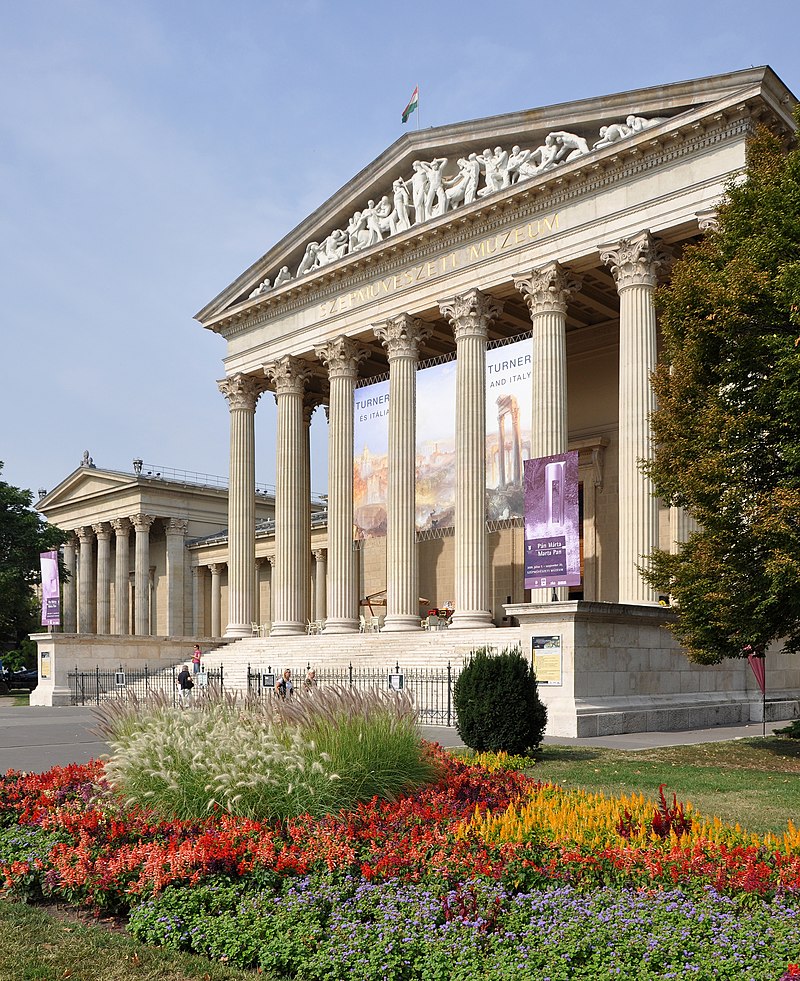
Budapest (Hungary): Museum of Fine Arts
Marc Ryckaert (MJJR)
Institutional history
Dated record
Institutional history
The full dated record · 2 entries
1906
Museum of Fine Arts, Budapest established.
1906
Museum of Fine Arts, Budapest is recorded from 1906.
Old master paintings (13th to 18th centuries)
Old master paintings (13th to 18th centuries)
The 3000 paintings in the collection offer an almost uninterrupted survey of the development of European painting from the 13th to the late 18th centuries. The core of the collection is constituted by the 700 paintings acquired from the Esterhazy estate. The collection is split up into Italian, German, Dutch, Flemish, French, English and Spanish art. The most important works include Maso di Banco's Coronation of the Virgin, Sassetta's Saint Thomas Aquinas at Prayer, Domenico Ghirlandaio's Saint Stephen Martyr, Bernardo Bellotto's The Piazza della Signoria in Florence, Gentile Bellini's Portrait of Caterina Cornaro, Giorgione's Portrait of a Young Man, Raphael's Esterhazy Madonna, Giambattista Pittoni's St Elizabeth Distributing Alms, three works by Corrado Giaquinto, Allegory of Painting, The Angel Annunciant and Moses receiving the Laws, Correggio's Madonna and Child with an Angel, three works by Sebastiano del Piombo, Bronzino's Adoration of the Shepherds as well as his Venus, Cupid and Jealousy, Romanino's Doge Agostino Barbarigo Handing over a Banner to Niccolo Orsini, Titian's Portrait of Doge Marcantonio Trevisani, Tintoretto's Supper at Emmaus, Tiepolo's St James the Greater in the Battle of Clavijo, Dürer's Portrait of a Young Man, Bernard van Orley's Portrait of Emperor Charles V, eight pictures by Lucas Cranach the Elder, Pieter Bruegel the Elder's St John the Baptist Preaching, Rubens's Mucius Scaevola Before Porsenna, Murillo's The Christ Child Distributing Bread to Pilgrims, Maarten van Heemskerck's Lamentation, two portraits by Frans Hals, and a collection of works by Spanish masters including El Greco, Velázquez, and Goya.
Old sculpture
Old sculpture
The collection's main section is devoted to pieces from the Middle Ages to the 17th century. It was based on the Italian collection of Karoly Pulszky and Istvan Ferenczy's bronze collections. From the latter came one of the most treasured works, the Rearing Horse and Mounted Warrior by Leonardo da Vinci. A number of painted wooden sculptures feature in the German and Austrian section.
Drawings and prints
Drawings and prints
The collection shows selected rotating exhibitions of its collection of 10,000 drawings and 100,000 prints originating mainly from the Esterhazy, Istvan Delhaes and Pal Majovsky acquisitions. All periods of European graphic art are represented. Important pieces include two studies by Leonardo da Vinci for the Battle of Anghiari, 15 drawings by Rembrandt, 200 pieces by Goya, and French aquatints.
Collection of Egyptian Antiquities
Collection of Egyptian Antiquities
The collection is made up of older additions such as those from Buda Castle, the Esterházy and Zichy estates, as well as donations from individual collectors. The Museum's collection is made up of six departments: Egyptian, Antique, Old sculpture gallery, Old master paintings gallery, Modern collection, Graphics collection. The institution celebrated its centenary in 2006.
The Museum of Fine Arts in Budapest holds one of the largest collection of Ancient Egyptian art in Central‑Eastern Europe, consisting of approximately 3,500 artefacts. It comprises a number of collections bought together by Hungarian Egyptologist, Eduard Mahler, in the 1930s. Subsequent digs in Egypt have expanded the collection. Some of the most interesting pieces are the painted mummy sarcophagi.
Documents and archives
Primary material
Documents and archives
reference work
- “Museum of Fine Arts (Budapest)”, English Wikipedia, consulted as further reading
Reputable secondary · Wikipedia
authority record
- Wikidata, structured authority record Q840886: Museum of Fine Arts, Budapest
Unverified · Wikidata
Notes from the source article
Cited by Wikipedia
Notes from the source article
These works are cited by the source article, in its own numbering. They are recorded as its citations, not as sources VALÉORINE has verified.
- 1.Liptay, Éva. About the Collection. egyptian.szepmuveszeti.hu. 2017.
- 2.Mélyi, József. Notes for a Budapest Museum Master Plan. Art Margins Online. 3 November 2010.
- 3.Unwin, Richard. Budapest director's double vision for national museum. The Art Newspaper. 3 August 2011.
- 4.MTI. Government commissioner appointed for planned "museum quarter" in Budapest. Realdeal.hu. 3 October 2011.
- 5.Földes, András. Houdini-cirkusz es fiákerek az Andrássyn. Index. 15 September 2011.
- 6.Unwin, Richard. Hungarian national gallery director resigns in protest. The Art Newspaper. 7 December 2011.
- 7.Contact. Hungarian National Gallery.
Bibliography printed in the source article · 4
- Van Dyke, John Charles. Vienna, Budapest: critical notes on the Imperial Gallery and Budapest Museum. Charles Scribner's Sons. 1914.
- Corvina. The Budapest Museum of Fine Arts. 1988. 978-9-6313-4328-1.
- Urbach, Susan. Distinguished Contributions to the Study of the Arts in the Burgundian Netherlands. Harvey Miller. I. November 30, 2015. 978-1-909400-09-2.
- Urbach, Susan. Distinguished Contributions to the Study of the Arts in the Burgundian Netherlands. Harvey Miller. II. November 30, 2015. 978-1-909400-29-0.
References
Citations
References
Each reference names the institution holding it, so a reader may go to the document itself.
reference work
Partially resolvedauthority record
Unverified
The Encyclopedia exists whether or not anything is for sale. Corrections are recorded rather than overwritten, and every version of this record is kept. Published 14 August 2026.
Elsewhere in Institutions
3,152 published records in this field, each with its sources named.
- Museum of Fine Arts in OsijekOrganisation
- Museum of Fine Arts of CórdobaOrganisation
- Museum of Fine Arts of LyonOrganisation
- Museum of Fine Arts of NancyOrganisation
- Museum of Fine Arts, HoustonOrganisation
- Museum of Fine Arts, SplitOrganisation
- Museum of Fine Arts, St. Petersburg, Florida, USAOrganisation
- Museum of Furuta OribeOrganisation
Best supported in this field
For owners
Own an object connected with Museum of Fine Arts, Budapest?
A specialist will read what you send and tell you what the house can establish, what it cannot, and whether the object is suited to sale. There is no charge and no obligation. The object stays with you throughout; nothing is shipped to us unless it is arranged in writing beforehand.