
Musée des Beaux-Arts et d'Archéologie de Besançon
The musée des Beaux-Arts et d'Archéologie (Museum of Fine Arts and Archeology) in the French city of Besançon is the oldest public museum in France. It was set up in 1694, nearly a century before the Louvre became a public museum. Reorganized from 1967 to 1970 by Louis Miquel, a pupil of Le Corbusier, the museum is again the subject of a total renovation and an enlargement from October 2015.
Also recorded as Musée des Beaux-Arts de Besançon · Musée des Beaux-Arts
Musée des Beaux-Arts et d'Archéologie de Besançon

CC BY-SA 3.0
- Name
- Museum of Fine Arts and Archeology of Besançon
- Founded
- 1694
- Headquarters
- France
VALÉORINE Encyclopedia
VALÉORINE documentary reading
Documentary summary
The musée des Beaux-Arts et d'Archéologie (Museum of Fine Arts and Archeology) in the French city of Besançon is the oldest public museum in France. It was set up in 1694, nearly a century before the Louvre became a public museum. Reorganized from 1967 to 1970 by Louis Miquel, a pupil of Le Corbusier, the museum is again the subject of a total renovation and an enlargement from October 2015.
Admitted source layer · organised and presented by VALÉORINE
Note VALÉORINE
No house-authored Note is published until its assertions and sources pass the VALÉORINE evidence contract. The documentary article remains available in full while that enrichment is being consolidated.
Documentary enrichment in progress · no unsupported statement published
Reference Check
Propose documentary evidence for Musée des Beaux-Arts et d'Archéologie de Besançon. A contribution is never written directly as fact: identity, source, rights and evidence gates still decide.
Sign in to contribute
World of VALÉORINE
Documentary connections
Only confirmed graph relationships appear here. Images are shown only when their identity and reuse rights both pass the documentary gate.
Documentary evidence
Evidence Panel
not yet certified
- Identity
- resolved
- Independent source families
- 0
- Admitted assertions
- 0
- Open conflicts
- 0
Authority files
wikidata · Q1324926 · wikipedia · Musée des Beaux-Arts et d'Archéologie de Besançon
In this article
Overview
Overview
Three years later, the completely renovated museum was inaugurated on November 16, 2018 in the presence of the President of the Republic Emmanuel Macron, the Minister of Culture Franck Riester and the Mayor Jean-Louis Fousseret. Attendance is then on the rise with 105,459 visitors recorded at the end of 2019.
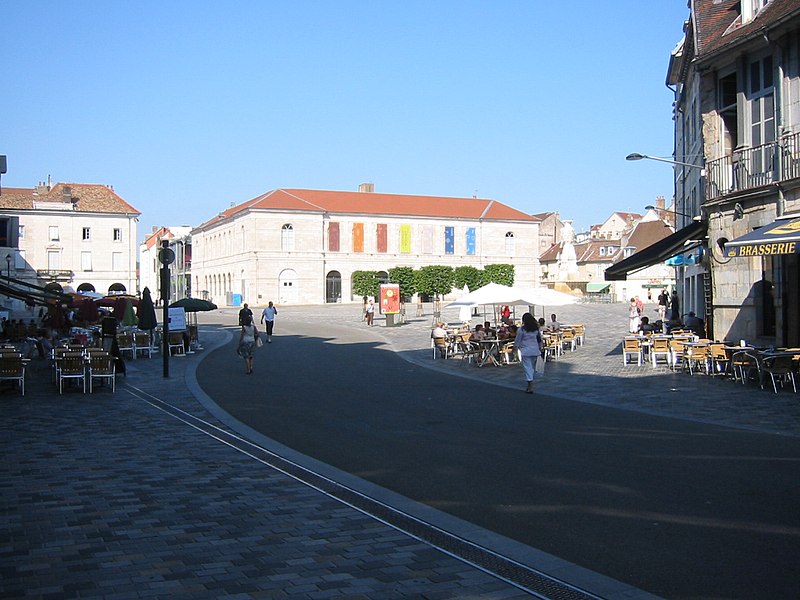
Place de la Révolution et Musée des Beaux Art de Besancon

Musée des Beaux-Arts et d'archéologie de Besançon
myself · I, Wikipedro
Key facts
Key facts
• Name — Museum of Fine Arts and Archeology of Besançon • Native Name — Musée des Beaux-Arts et d'Archéologie de Besançon • Location — Besançon, France • Visitors — 105,459 (2019) • Website — http: www.mbaa.besancon.fr
Archaeology
Archaeology
• Illustration — Three-horned bull called the "Bull of Avrigney." Discovered in 1756. An example of Gallo-Roman religious art • Illustration — Roman art gallery. • The Egyptian collection includes the mummies of Seramon, a royal scribe who lived in the end of the 21st Dynasty, and of Ankhpakhered, Amon's artist and son of a priest of the 26th Dynasty but also a series of statuettes representing gods, ushabtis, etc. • An important prehistoric collection includes objects of the Neolithic, Bronze Age and Iron Age. • The most important archaeology collection belongs to the Gallo-Roman period. It includes mosaics (mosaïque du Neptune and mosaïque de la Méduse found in the domus of the collège Lumière), other objects found during digs in the town, the bronze statue of a bull with three horns from Avrigney, and the bronze statuette called the God of Besançon. • The medieval collection includes statues, stone sarcophagus and other relics.
Origin of the collections
Origin of the collections
• Illustration — 19th c. paintings. • Illustration — Covered courtyard by Louis Miquel. The collections of the museum mostly originated in four gifts. In 1694, Abbot Boisot gave his collection (manuscripts, printed books, medals, eleven paintings and four busts coming from the Granvelle family) to the town's Benedictine monks, on the condition that the public had access to these collections twice a week. This bibliothèque-musée Boisot (Boisot Library-Museum) lasted for the whole of the 18th century. In 1819 Pierre-Adrien Pâris, the King's architect, added his collection (38 paintings and 183 drawings including those of Fragonard). Jean Gigoux gave the museum his collection in 1894 (over 3000 drawings and 460 paintings of Spanish, English, Northern and German schools), and finally George Besson and his wife gave the museum their collection in 1960 (112 paintings and 220 modern and contemporary drawings).
Building
Building
Since 1843, the museum has been located in a former grain hall, in the center of the town. The building became too small following Besson's donation and was rebuilt from 1967 to 1970 by Louis Miquel, a student of Le Corbusier. The interior courtyard was covered with a concrete structure. The museum was renovated from 2014 to 2018. It was inaugurated on 16 November 2018 by the French President Emmanuel Macron.
Places
Named by the record
Places
Only places the record itself states, plotted where the house gazetteer settles their coordinates. Nothing is inferred from a name or a nationality.
- France
Drawing cabinet
Drawing cabinet
• The musée des Beaux-Arts et d’Archéologie de Besançon is home to one of the largest drawing cabinets of France thanks to its collection of over 5,500 works from European schools dating from the end of the 15th century to the middle of the 20th century. Artists present in the collection include Federico Barocci, Tintoretto, Annibale Carracci and Giovanni Battista Tiepolo for Italian works of the 15th to 18th centuries; Albrecht Dürer, Peter Paul Rubens, Jacob Jordaens and Rembrandt for northern works of the 16th and 17th centuries, and Nicolas Poussin, Eustache Le Sueur, Simon Vouet, François Boucher, Jean-Honoré Fragonard, Hubert Robert, Antoine Watteau, Jacques-Louis David, Théodore Géricault, Eugène Delacroix, Gustave Courbet, Raoul Dufy, Albert Marquet, Henri Matisse and Auguste Rodin for French works from the end of the 16th to the 20th centuries.
Paintings
Paintings
The collections shows the main tendencies and evolutions of European art from the 14th to 20th centuries: • Italy: Filippino Lippi, Giovanni Bellini, Tintoretto, Titian, Dosso Dossi, Lavinia Fontana, Onofrio Palumbo, Giuseppe Recco, Luca Giordano, Elisabetta Sirani, Giovanni Battista Tiepolo and notably Bronzino with his masterpiece: the Deposition of Christ. • Northern Schools are represented by Lucas Cranach the Elder, Hans Baldung Grien, Jan Brueghel the Elder, Peter Paul Rubens, Jacob Jordaens, Jan Lievens, Jacob van Ruisdael, Aelbert Cuyp, Willem Claesz Heda and Jan van Goyen. • Spain is represented by Francisco de Zurbarán, Juan de Arellano and Francisco Goya. • The French collection: paintings by Simon Vouet, Philippe de Champaigne, Eustache Le Sueur, Hubert Robert, Jean-Honoré Fragonard, Donat Nonnotte, Jacques-Louis David, Antoine-Jean Gros, Jean-Auguste-Dominique Ingres, Théodore Géricault, Paul Delaroche, Jean-Léon Gérôme, James Tissot, Édouard Vuillard and also, for the 20th century, Paul Signac, Pierre Bonnard, Félix Vallotton, Auguste Renoir, Henri Matisse, Suzanne Valadon and Albert Marquet. François Boucher and Gustave Courbet are particularly well represented, with multiple chinoiseries by the former and the monumental Killing a Deer by the latter. • Japan is represented by Kakizaki Hakyo, with eleven original portraits from the Ishūretsuzō.
Collections
The collections of the musée des Beaux-Arts et d'Archéologie de Besançon are divided in three categories: archaeology, painting, and drawing cabinet.
Notes from the source article
Cited by Wikipedia
Notes from the source article
These works are cited by the source article, in its own numbering. They are recorded as its citations, not as sources VALÉORINE has verified.
References
Citations
References
Each reference names the institution holding it, so a reader may go to the document itself.
reference work
“Musée des Beaux-Arts et d'Archéologie de Besançon”, English Wikipedia, consulted as further readingWikipedia
Partially resolvedreference work
Wikidata, structured authority record Q1324926: Musée des Beaux-Arts et d'Archéologie de BesançonWikidata
Partially resolved
The Encyclopedia exists whether or not anything is for sale. Corrections are recorded rather than overwritten, and every version of this record is kept. Published 14 August 2026.
Elsewhere in Institutions
3,152 published records in this field, each with its sources named.
- Musée des Beaux-Arts de TournaiOrganisation
- Musée des Beaux-Arts de ToursOrganisation
- Musée des Beaux-Arts de TroyesOrganisation
- Musée des Beaux-Arts de ValenciennesOrganisation
- Musée des Beaux-Arts et d'Archéologie de Châlons-en-ChampagneOrganisation
- Musée des Beaux-Arts Jules ChéretOrganisation
- Musée du MontparnasseOrganisation
- musée du Pays châtillonnaisOrganisation
Best supported in this field
For owners
Own an object connected with Musée des Beaux-Arts et d'Archéologie de Besançon?
A specialist will read what you send and tell you what the house can establish, what it cannot, and whether the object is suited to sale. There is no charge and no obligation. The object stays with you throughout; nothing is shipped to us unless it is arranged in writing beforehand.