
Manuel Salvador Carmona
Illustration — Manuel Salvador Carmona; portrait by Anna Maria Mengs • Illustration — Bust Portraits of Charles III, with Charles IV and Queen Maria Luisa • Illustration — A Tooth-puller and his Patient Manuel Salvador Carmona (20 May 1734 – 15 October 1820) was a Spanish engraver, designer and illustrator. Two of his brothers were also artists: José Salvador Carmona, a sculptor, and Juan Antonio Salvador Carmona, also an engraver.
Manuel Salvador Carmona
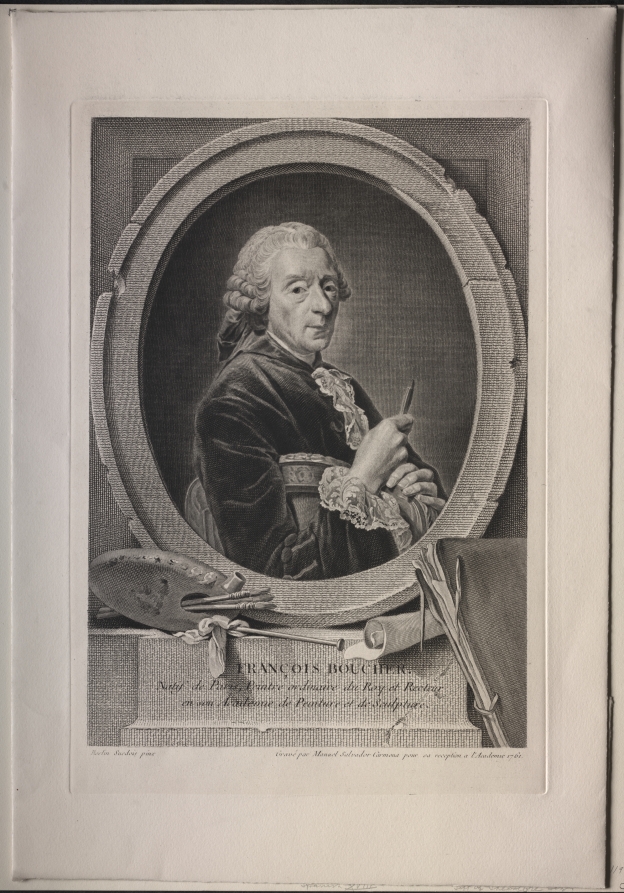
Manuel Salvador Carmona · The Cleveland Museum of Art · Gift of Theodore Sizer · CC0
- Born
- 1734 · Nava del Rey.
- Died
- 1820 · Madrid.
- Nationality
- Spain
- Occupation
- printmaker
- Languages
- Spanish
VALÉORINE Encyclopedia
VALÉORINE documentary reading
Documentary summary
Illustration — Manuel Salvador Carmona; portrait by Anna Maria Mengs • Illustration — Bust Portraits of Charles III, with Charles IV and Queen Maria Luisa • Illustration — A Tooth-puller and his Patient Manuel Salvador Carmona (20 May 1734 – 15 October 1820) was a Spanish engraver, designer and illustrator. Two of his brothers were also artists: José Salvador Carmona, a sculptor, and Juan Antonio Salvador Carmona, also an engraver.
Admitted source layer · organised and presented by VALÉORINE
Reference Check
Propose documentary evidence for Manuel Salvador Carmona. A contribution is never written directly as fact: identity, source, rights and evidence gates still decide.
Sign in to contribute
World of VALÉORINE
Documentary connections
Only confirmed graph relationships appear here. Images are shown only when their identity and reuse rights both pass the documentary gate.
Documentary evidence
Documentary basis
Authority files
wikidata · Q3820874 · wikipedia · Manuel Salvador Carmona
In this article
Biography
Biography
José Gómez de Navia and Blai Ametller i Rotllan are recorded as having studied under Manuel Salvador Carmona. The recorded working language is Spanish. Places of work recorded in the authority are Madrid. Work by Manuel Salvador Carmona is recorded in the collections of Nationalmuseum, Museo del Prado, Art Institute of Chicago, Finnish National Gallery and Philadelphia Museum of Art.
Carmona was born in Nava del Rey. His first studies were with his uncle, the sculptor Luis Salvador Carmona, at the Real Academia de Bellas Artes de San Fernando. Later, he studied in París, learning the burin technique from Nicolas-Gabriel Dupuis and becoming married to Marguerite Legrand. In 1759, he became an assistant at the Académie Royale de Peinture et de Sculpture. Two years later, he was admitted as a member and received the right to style himself "Engraver to the King". In 1762, with his reputation at its height, he returned to Madrid, presenting himself at the Academia with a request to be named "honorary director". This was not granted but, in 1764, he was named an Academician of Merit and, in 1777, upon the death of Juan Bernabé Palomino, he became Director of Engraving. The following year, having become a widower, he married the artist Anna Maria Mengs, daughter of the court painter, Anton Raphael Mengs. In 1783, he became the court engraver. He died in Madrid. He also served as a teacher. Among his notable students were his brother, Juan Antonio, José Gómez de Navia, Manuel Alegre (engraver), Luis Fernández Noseret and Fernando Selma. A few decades after his death, he was largely forgotten.
Selected works
Selected works
• An Allegory in honour of Charles III of Spain; after Francesco Solimena. • Bacchus crowning his Votaries; after Velázquez. • A Madonna seated on Clouds; after Murillo. 1802. • A Madonna; after Van Dyck. 1757. • The Resurrection; after Van Loo. 1757. • St. John the Baptist; after Anton Raphael Mengs. 1784. • The Magdalene; after the same. • St. Ferdinand praying; after Murillo. 1791. • Angels appearing to Mary Magdalene; alter Guercino. • Portrait of François Boucher; after Roslin Sedois • Portrait of Collin de Vermont; ibid • Portrait of Charles III.; after Anton Raphael Mengs. 178Í!. • Don Alfonso de Guzman; after Van Dyck. • Joseph, a Carmelite Monk; after Velázquez
Places
Named by the record
Places
Only places the record itself states, plotted where the house gazetteer settles their coordinates. Nothing is inferred from a name or a nationality.
Nava del Rey.
Birth place
Madrid.
Death place
Notes from the source article
Cited by Wikipedia
Notes from the source article
These works are cited by the source article, in its own numbering. They are recorded as its citations, not as sources VALÉORINE has verified.
Bibliography printed in the source article · 4
- Carderera, Valentín: Manuel Salvador Carmona (1734-1820). Grabador de las cortes reales de España y Francia; ed. de Juan José Antequera Luengo; Sevilla, Facediciones, 2010.
- Carrete Parrondo, Juan, El grabado a buril en la España Ilustrada. Manuel Salvador Carmona, Madrid, Fábrica Nacional de Moneda y Timbre, 1989
- Carrete Parrondo, Juan, Diccionario de grabadores y litógrafos que trabajaron en España. Siglos XIV a XIX
- Gallego, Antonio, Historia del grabado en España, Madrid, Ediciones Cátedra, 1999,
References
Citations
References
Each reference names the institution holding it, so a reader may go to the document itself.
reference work
Secondary witnessreference work
Secondary witness
The Encyclopedia exists whether or not anything is for sale. Corrections are recorded rather than overwritten, and every version of this record is kept. Published 16 August 2026.
Elsewhere in Prints
4,138 published records in this field, each with its sources named.
- Mansoor GhandrizEngraver
- Manuel CastellanoEngraver
- Manuel Maria Bordalo PinheiroEngraver
- Manuel Rodriguez Sr.Engraver
- Marc ChagallEngraver
- Marc FerrezEngraver
- Marc PessinEngraver
- Marc QuinnEngraver
Best supported in this field
For owners
Own a work by Manuel Salvador Carmona?
A specialist will read what you send and tell you what the house can establish, what it cannot, and whether the object is suited to sale. There is no charge and no obligation. The object stays with you throughout; nothing is shipped to us unless it is arranged in writing beforehand.