
Madeleine Riffaud
Marie-Madeleine Riffaud (23 August 1924 – 6 November 2024) was a French Resistance fighter, poet, journalist and war correspondent. After active resistance to the German occupation of France during World War II, in the course of which she was imprisoned and tortured, Riffaud reported for the Communist newspaper L'Humanité and other left-wing publications on the Algerian War (during which she survived an assassination attempt) and on the French, and subsequently American, wars in Vietnam. Her reporting on Vietnam was informed by four years she spent in the North in the early 1950s, and in the 1960s by the connections she developed in the South with the Viet Cong.
Madeleine Riffaud

Selbymay · CC BY-SA 4.0
- Name
- Madeleine Riffaud
- Born
- 23 August 1924
- Birthplace
- Arvillers, France
- Died
- 6 November 2024
- Place of death
- Paris, France
- Occupation
- * Resistance fighter
- Awards
- * Ordre national du Mérite
- Full name
- Marie Madeleine Armande Riffaud.
- Nationality
- France.
- Fields
- literary activity, journalism and translating activity.
- Honours
- Croix de guerre 1939–1945, Knight of the Legion of Honour, Angoulême International Comics Festival René Goscinny award and Officer of the National Order of Merit.
- Languages
- French.
VALÉORINE Encyclopedia
VALÉORINE documentary reading
Documentary summary
Marie-Madeleine Riffaud (23 August 1924 – 6 November 2024) was a French Resistance fighter, poet, journalist and war correspondent. After active resistance to the German occupation of France during World War II, in the course of which she was imprisoned and tortured, Riffaud reported for the Communist newspaper L'Humanité and other left-wing publications on the Algerian War (during which she survived an assassination attempt) and on the French, and subsequently American, wars in Vietnam. Her reporting on Vietnam was informed by four years she spent in the North in the early 1950s, and in the 1960s by the connections she developed in the South with the Viet Cong.
Admitted source layer · organised and presented by VALÉORINE
Note VALÉORINE
Madeleine Riffaud (1924–2024) was a French writer, french resistance fighter and journalist. The writer was born Marie Madeleine Armande Riffaud in Arvillers and died in 3rd arrondissement of Paris. Madeleine Riffaud was also known as Rainer.
Madeleine Riffaud worked for L'Humanité and was a member of Francs-tireurs et partisans and French Forces of the Interior. Activity centred on journalism, literary activity and translating activity. Awards and honours include Angoulême International Comics Festival René Goscinny award, Croix de guerre 1939–1945 and Knight of the Legion of Honour, among others.
Composed from admitted, traceable facts · 03 October 2026
VALÉORINE
Reference Check
Propose documentary evidence for Madeleine Riffaud. A contribution is never written directly as fact: identity, source, rights and evidence gates still decide.
Sign in to contribute
World of VALÉORINE
Documentary connections
Only confirmed graph relationships appear here. Images are shown only when their identity and reuse rights both pass the documentary gate.

Documentary evidence
Documentary basis
Authority files
wikidata · Q3275723 · wikipedia · Madeleine Riffaud
In this article
Biography
Biography
Riffaud worked between 1924 and 2024 across war correspondent, journalist, poet, French resistance fighter and political activist and 2 further recorded occupations. This article rests on 11 published texts and 6 scholarly references drawn from named institutional registers. Every statement below returns to a source shown in the evidence panel; where the record is silent or divided, the article says so instead of resolving it.
The recorded working language is French. The field of work recorded is literary activity, journalism and translating activity. Employment is recorded with L'Humanité. Distinctions recorded are Croix de guerre 1939–1945, Knight of the Legion of Honour, Angoulême International Comics Festival René Goscinny award and Officer of the National Order of Merit.
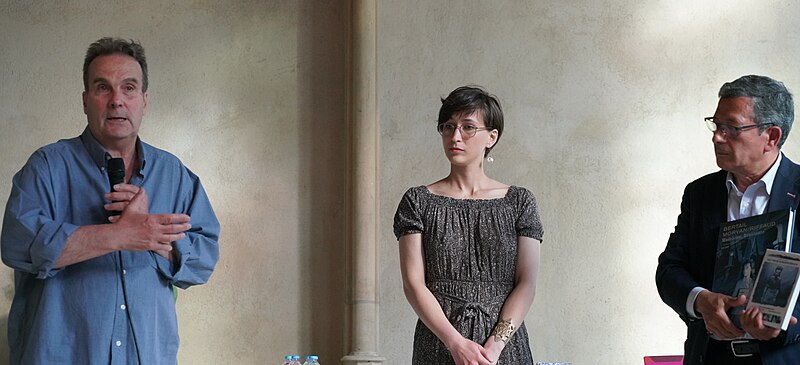
rencontre Apulée au musée le vergeur.
G.Garitan
Key facts
Key facts
• Name — Madeleine Riffaud • Born — 23 August 1924 • Birthplace — Arvillers, France • Died — 6 November 2024 • Place of death — Paris, France • Occupation — * Resistance fighter • Writer • Journalist • War correspondent • Works — * Le Poing Fermé • On l'appelait Rainer • Awards — * Ordre national du Mérite • Friendship Medal of Vietnam
Resistance fighter
Resistance fighter
Riffaud was born on 23 August 1924 in Arvillers (Somme), a village that had been occupied by the Germans in 1870, and destroyed by their advance into France in 1914. Her parents, Gabrielle (Boissin) Riffaud, a devout Catholic, and Jean-Émile Riffaud were both teachers. Riffaud acknowledged a political debt to her father. Jean-Émile had volunteered for service in the Great War, had been wounded and, in protest against "suicidal" offensives, had participated in the mutinies of 1917. In 1936, when the Spanish Civil War broke out, he had wanted to volunteer for the Republic but was turned down because of "his bum left leg". Riffaud was 15 when the Germans again invaded France in May 1940, and found herself in a column of refugees from the Somme strafed by the Luftwaffe. The experience, together with "a massive kick in the ass" delivered in a train station by Germans whose advances she had resisted, steeled her determination to resist the occupation. Aged 18, Riffaud made contact with the Resistance in 1942, while recovering near Grenoble from tuberculosis she had contracted as student midwife. The director of her sanatorium would hide Resistance fighters and Jews with false medical certificates, and maintained a clandestine printing room. In Paris, after entering the leadership of its affiliated National Front of Medical Students, in 1944 Riffaud joined the Communist Party (PCF) and its resistance group Francs-tireurs et partisans (FTP). She operated under the codename "Rainer", chosen in homage to the Austrian-German poet Rainer Maria Rilke: her war, she insisted was "not with the German people, but with the Nazis”. Although, the Allies, after successful landings, were approaching Paris both from the north and from the south of France, in summer of 1944 the Resistance in the capital were demoralised by the recent execution of twenty three members of one particularly audacious group, the Manouchians, and by the persistent Pétainiste propaganda denouncing the armed resisters as foreigners, Jews and criminals. In June, the Waffen-SS massacred 642 civilians in a village from Riffaud's childhood, Oradour-sur-Glane, prompting the FTP Resistance to direct its members to each kill a German. Riffaud recalled: I have no hate. It was a mission. We had to do it in daylight, to encourage the population. To show them there was an opposition to the German occupation and it was French. I wanted to do more than simply harangue people in queues, telling them the truth of what was happening and I was cross at being told always to carry weapons across town for the men to use, so I asked for permission to use a gun myself. On 23 July 1944, in broad daylight on a bridge overlooking the river Seine, she approached a lone German NCO and when he turned to face her ("it was important to me not to shoot him in the back”) she shot him twice in the temple. She later reflected: “Can one be mean, when one looks at the Seine? He was perhaps a good guy… but well, that’s war”. As she fled the scene on her bicycle she was knocked over by a car driven by French collaborator, a Milicien, who, before she could turn her gun on herself, had her handcuffed. After two weeks of being whipped, electrocuted and half-drowned in Gestapo headquarters, she was incarcerated in Fresnes Prison. She had not named names, maintaining that she had acted alone to avenge the execution of a boyfriend. Minutes before she was scheduled for execution she was reprieved, only to be tortured for another ten days for her contacts. On 15 August she jumped from a train taking her to Ravensbrück concentration camp, but was recaptured. Four days later she was freed in a prisoner exchange negotiated by the Swedish consul Raoul Nordling with Wehrmacht's last Paris commander, Dietrich von Choltitz. She immediately returned to the Resistance. On 23 August, in command of four men, and with the support of railway workers she trapped a train carrying loot and munitions in the Buttes-Chaumont tunnel and secured the surrender of the 80 German soldiers aboard. On the 25th she took part in an attack on the barracks on Place de la République, whose garrison had refused to accept von Choltitz's order to surrender. After the Liberation of Paris, Riffaud was demobilised on 31 August 1944. She had hoped to finish the war with the rest of her resistance group, now part of the regular French army, but, at a time when women in France did not yet have the right to vote, she was told that she did not have her father's permission. Left behind in Paris, she found herself acting as a guide to the city for a young American soldier, the future singer Sammy Davis Jr..
Poet, journalist and anti-colonial war correspondent
Poet, journalist and anti-colonial war correspondent
Riffaud said she owed her life to the surrealist poet Paul Éluard who encouraged her to write. "After what we'd been through", she explained that she, and her fellow resisters, "couldn't live like other people". She, in particular, was haunted by what she had been forced to witness under interrogation, the disfigurement, dismemberment and killing of other prisoners. With Louis Aragon, Vercors, and Pablo Picasso, Éluard was one of group of artist and writers who "virtually adopted her. While working as a journalist for Ce soir, a newspaper run by Aragon, in 1945 Riffaud published her first poetry collection, Le Poing Fermé (The Clenched Fist), with a preface by Éluard and a sketch portrait of her by Picasso on the cover. Riffaud drew on her wartime experience for two stories published in the young-readers (Jeunesse héroïque) series of the PCF-aligned Éditions France d’abord: La belle vengeance de Bleuette (‘Bleuette’s vengeance’, 1945) and On s’est battu contre la mort (‘We fought against death’, 1946).
Anti-Colonialism
Anti-Colonialism
Riffaud understood support for anti-colonial struggle as a continuation of her wartime commitment to liberation of France: "a people who oppress another", she maintained, "can never be a free people". Allusions to the French Resistance would mark her later reporting from Vietnam (the Viet Cong as the "maquis") and from Algeria. She explained: During the war, Germans tortured people I didn't know in front of me, saying they'd stop if I talked. They'd shout at me: "Look! Look!" I decided to make it my profession: To go out into the field, look at the truth and tell it. To bear witness, especially to act against colonialism: I didn't want France to do elsewhere what the Nazis wanted to do here. Ruffaud's opposition to the Communist Party's participation in a post-war government, intent on reasserting French colonial authority, ended a brief marriage to Pierre Daix, a party member (and a friend and biographer of Pablo Picasso). Their young daughter, Fabienne, was to die in the care of Daix's parents of tuberculosis, which Riffaud believed she had passed to her.
Algeria
Algeria
Already, in 1946, Riffaud was familiar with the violence of French rule in Algeria. She had hosted an Algerian high school student, the future writer and journalist Kateb Yacine, who bore witness to massacres in Algeria that had followed the Muslim demonstrations of 8 May 1945. In Paris, Riffaud supported the Movement for the Triumph of Democratic Liberties (MTLD), led by Messali Hadj, and their banned demonstration of 14 July 1953 which the police dispersed with deadly fire. In 1952, and again 1954, La Vie Ouvrière, the press organ of the labour federation CGT, sent Riffaud to Algeria where she reported on the political and social tensions rising in advance of the Algerian insurrection. Initially, she covered the Algerian War for L’Humanité from Paris. She documented the torture and disappearance of Algerian activists in the city, repression that culminated in the 1961 Paris massacre when police killed, possibly, two to three hundred Algerians. Returned to Algeria, in 1962 her vehicle was ambushed by the pro-settler Organisation Armée Secrète (OAS), who had condemned her to death. Severely injured and with partial eyesight loss, she was chased by the OAS for four days, before having to spend several months in hospital.
Vietnam
Vietnam
In July 1946, Riffaud met Ho Chi Minh in Paris where he had sought to negotiate an end to French colonial rule in Vietnam. A few months later, in November 1946, she published a poem in La Vie Ouvrière decrying the French bombardment of Haiphong (the opening salvo of the First Indochina War). In Berlin, reporting on the 1951 World Festival of Youth and Students, Riffaud met and fell in love with the poet (and later, North Vietnamese Vice-State President) Nguyễn Đình Thi. She lived with him for four years in North Vietnam as Hanoi correspondent for L’Humanité and other left-wing publications. Their subsequent long-distance relationship lasted for 50 years. Later, in the 1960s, she reported from South Vietnam where, with the Australian journalist Wilfred Burchett, she was embedded for eight weeks with the Viet Cong. Their work framed a documentary by film maker Roger Pic, Dans le maquis du Sud-Vietnam (1965). Riffaud also published Au Nord-Vietnam: écrit sous les bombes (1967), a diary of the North under American bombing.
Later life
Later life
Upon her return from Vietnam in 1973, and after working in as a nursing assistant in a Paris hospital, she wrote her best-seller Les Linges de la nuit (1974) exposing the drudgery and poor work conditions of hospital workers. She also published another anthology of poems, Cheval rouge: anthologie poétique, 1939–1972. In the mid-1970s, Riffaud moved discreetly away from the Communist Party and refused to talk about her past. It was only in 1994, on the 50th anniversary of the Liberation, that a former comrade, Raymond Aubrac, persuaded her to honour the memory of her friends who had died in the struggle by speaking publicly of her experience of the Resistance: That year a curator found some of her poetry, partly written in prison, and convinced her to write a memoir giving them context; this resulted in the book On l'appelait Rainer. In 2001, in an award presented by Aubrac, President Jacques Chirac named Riffaud a Chevalier de la Légion d'honneur. In 2013, President Nicholas Sarkozy awarded her the Ordre national du Mérite for her contributions to France and the world. She received the Vietnamese Order of Resistance in 1984, and the Friendship Medal in August 2004, and was honoured for campaigning on behalf Vietnamese Agent Orange/dioxin victims. Riffaud turned 100 on 23 August 2024. The occasion was marked by a visit from Vietnamese ambassador to France and the release of the final volume of her graphic war-time memoir, Madeleine, Résistante, created with artist Dominique Bertail and writer Jean-David Morvan. Riffaud died on 6 November at her Paris apartment.
Obituaries
Obituaries
• Yves Bordenave, "Madeleine Riffaud, French Resistance heroine, dies aged 100". Le Monde. 6 November 2024. Retrieved 6 November2024. • Sam Roberts, "Madeleine Riffaud, Known as 'the Girl Who Saved Paris," Dies at 100". The New York Times. 27 November 2024. Retrieved 27 November 2024. *
Life and work
Life and work
Madeleine Riffaud was born on 23 August 1924 in Arvillers. Riffaud held the nationality of France. Recorded partner: Nguyễn Đình Thi. Recorded father: Jean Riffaud. Riffaud worked as war correspondent, journalist, poet and French resistance fighter, and the authority record catalogues a further 3 occupations under the same name, among them political activist, writer and translator. Riffaud was employed by L'Humanité. Riffaud worked in French.
Life and career
Dated record
Life and career
Explore 1924–2024
The full dated record · 5 entries
1924
Madeleine Riffaud was born on 23 August 1924.
Undated
Receives Croix de guerre 1939–1945.
2001
Receives Knight of the Legion of Honour.
2024
Dies at Paris.
2024
Madeleine Riffaud died on 6 November 2024.
Places
Named by the record
Places
Only places the record itself states, plotted where the house gazetteer settles their coordinates. Nothing is inferred from a name or a nationality.
Arvillers.
Birth place
3rd arrondissement of Paris.
Death place
Publications
Publications
• Le Poing fermé (1945), • Le Courage d'aimer (1949), • Les Carnets de Charles Debarge, documents recueillis et commentés par Madeleine Riffaud (1951), • Les Baguettes de jade (1953), • Le Chat si extraordinaire (1958), • Ce que j'ai vu à Bizerte (1961), • De votre envoyée spéciale... (1964), • Dans les maquis "Vietcong" (1965), • Au Nord-Vietnam: écrit sous les bombes (1967), • Nguyễn Đinh Thi: Front du ciel (Mãt trãn trên cao) (1968), • Cheval rouge: anthologie poétique, 1939–1972 (1973), • Les Linges de la nuit (1974), • On l'appelait Rainer: 1939–1945 (1994), • La Folie du jasmin: poèmes dans la nuit coloniale (2001), • Bleuette (2004), • In German • Graphic novel
Books and published writings
Catalogued output
Books and published writings
These are catalogued publications carrying the name — editions and printings, distinct from the works they contain and from writing about the subject. The 1960s are the densest part of the run, with 3 titles, and that concentration is a fact about what the registers have catalogued rather than a judgement on the work itself.
The run opens with De votre envoyée spéciale and closes with Madeleine Resistente
11 editions carry dates between 1964 and 2022
The entries follow Open Library
De votre envoyée spéciale
1964
Dans les maquis "vietcong."
1965
Au Nord Viet-nam
1967
Cheval rouge
1973
Les linges de la nuit
1974
Le Chasseur changé en crabe, conte du Vietnam
1981
On l'appelait Rainer
1994
La folie du jasmin
2001
Primary material
Documents and archives
reference work
- “Madeleine Riffaud”, English Wikipedia, consulted as further reading
Reputable secondary · Wikipedia
authority record
- Wikidata, structured authority record Q3275723: Madeleine Riffaud
General reference · Wikidata
Institutional memberships
Where the work is held
Institutional memberships
Riffaud is recorded as a member of French Forces of the Interior and Francs-tireurs et partisans. Membership is stated by the bodies' own records and is not read here as evidence of office or of any particular role within them.
Honours and awards
Where the work is held
Honours and awards
They run from 1945 to 2001.
4 honours stand against the name
Angoulême International Comics Festival René Goscinny award
Officer of the National Order of Merit
Croix de guerre 1939–1945
1945
Knight of the Legion of Honour
2001
Authority records
Notes from the source article
Cited by Wikipedia
Notes from the source article
These works are cited by the source article, in its own numbering. They are recorded as its citations, not as sources VALÉORINE has verified.
- 1.Obituaries, Telegraph. Madeleine Riffaud, French Resistance heroine who withstood weeks of torture by the Gestapo. The Telegraph. 2024-11-14. 0307-1235.
- 2.Smith, Leonard V. Between Mutiny and Obedience: The Case of the French Fifth Infantry Division during World War I. Princeton University Press. 2014. 978-1-4008-6379-2.
- 3.Henley, Jon. You can't know how wonderful it was to finally battle in the daylight. The Guardian. 21 August 2004.
- 4.Christophe, Dauphin. Madeleine RIFFAUD (Revue Les Hommes sans Epaules). www.leshommessansepaules.com. 2023.
- 5.Resistance fighter Madeleine Riffaud's century of words and wars. RFI. 2024-11-09.
- 6.Sebba, Anne. Interview with Madeleine Riffaud – The girl who saved Paris. The Times T2. July 2016.
- 7.Madeleine Riffaud, French resistance heroine and war correspondent, dies at 100. The Jerusalem Post. 2024-11-08. 0792-822X.
- 8.Pouchot, Frédéric. 'I put two bullets in the Nazi's head', French Resistance heroine recalls. The Times of Israel. AFP. 14 August 2019.
- 9.The return of the Republic Chemins de mémoire. www.cheminsdememoire.gouv.fr.
- 10.Madeleine Riffaud aux Buttes-Chaumont, symbole d'une jeunesse en résistance. Paris Lights Up. 2024-08-23.
- 11.Mons, Isabelle. Madeleine Riffaud: L'esprit de résistance. Payot. 2019-10-09. 978-2-228-92432-0.
- 12.Gildea, Robert. Madeleine Riffaud obituary. The Guardian. 2024-12-01. 0261-3077.
- 13.Anizon, Emmanuelle. A Life on the Front Line. Jacobin. 22 July 2018.
- 14.Sophie, Dubillot. The Résistante and the Collaborationist: an odd connection in the Liberation Collection. Languages across Borders, Cambridge University Libraries. 2020.
- 15.Cosnard, Denis. Madeleine Riffaud, French Resistance figure: 'After what we'd been through, we couldn't live like other people'. Le Monde. 3 December 2023.
- 16.Daix, Pierre. Dictionary of Art Historians.
- 17.Roberts, Sam. Madeleine Riffauf, Known as 'the Girl Who Saved Paris," Dies at 100. The New York Times. 174. 60351. B10. 27 November 2024. 0362-4331.
- 18.Gallissot, René. KATEB Yacine. Dictionnaire Algérie. Maitron/Editions de l'Atelier. 2022-06-24.
- 19.Roger Pannequin, Adieu Camarades, Paris, Sagittaire, 1977, p. 214 (ISBN 2727500432) .
- 20.Algérie : l'odeur du jasmin : épisode 4/10 du podcast Madeleine Riffaud, la mémoire sauve. France Culture.
- 21.L’Hôtellier, Anysia. MIAILHE Mireille. née GLODEK Mireille. Maitron/Editions de l'Atelier. 2022-04-06.
- 22.Rouaba, Ahmed. How a massacre of Algerians in Paris was covered up. BBC News. 16 Oct 2021.
- 23.Mort de Madeleine Riffaud, franc-tireuse de tous les combats. www.telerama.fr. 2024-11-06.
- 24.Anizon, Emmanuelle. A Life on the Front Line. Jacobin. 22 July 2018.
- 25.DANS LES MAQUIS DU SUD VIETNAM - Roger PIC - 1965 - Catalogue complet - plus de 900 films en ligne Ciné-Archives, fonds audiovisuel du PCF et du mouvement ouvrier.
- 26.Au Nord-Vietnam, écrit sous les bombes. www.defnat.com.
- 27.Mélinard, Michaël. BD : Madeleine Riffaud, au nom de tous les siens - L'Humanité. www.humanite.fr. 2021-08-27.
- 28.Légion d'honneur Promotion du 1er janvier 2001. L'Humanité. 4 January 2001.
- 29.Vubaochi. Vietnam Embassy – Veteran French journalist honoured. vietnamembassy-southafrica.org.
- 30.Nguyen, Hannah. Great Friend of Vietnam, Madeleine Riffaud Remembered. Vietnam Times. 2024-11-22.
- 31.Vietnam honors peace advocate Madeleine Riffaud. VietnamPlus. VNA. 23 August 2024.
- 32.Bordenave, Yves. Madeleine Riffaud, French Resistance heroine, dies aged 100. Le Monde. 6 November 2024.
- 33.Platthaus, Andreas. Rezension des Comics "Madeleine, die Widerständige". FAZ.NET. 19 September 2024.
Bibliography printed in the source article · 3
- Chiaroni, Keren. Resistance Heroism and the End of Empire. Routledge. 2017. 978-1-138-22731-6.
- Gubser, Alexandra. Sie nannte sich Rainer – 75 Jahre Befreiung von Paris. Schweizer Radio und Fernsehen (SRF). 25 August 2019.
- Koltermann, Ulrike. Widerstandskämpferin Madeleine Riffaud : "Ich habe die Nazis gehasst, nicht die Deutschen". Der Tagesspiegel. 12 January 2023.
References
Citations
References
Each reference names the institution holding it, so a reader may go to the document itself.
reference work
Secondary witnessauthority record
General reference
People, houses and institutions
Knowledge graph
People, houses and institutions
Teachers, collaborators, publishers and institutions recorded against this person, each on a stated basis.
Died at
1- ParisPlace
Established from a fact already recorded on a verified source.
Further particulars
Held on the record
Further particulars
Open the remaining particulars
Madeleine Riffaud was recorded at birth as Marie Madeleine Armande Riffaud. She also worked under the name Rainer. Her recorded language was French. She was the child of Jean Riffaud. She married Pierre Daix. Riffaud worked in literary activity, journalism and translating activity. She was employed by L'Humanité. She belonged to French Forces of the Interior and Francs-tireurs et partisans. Riffaud received Croix de guerre 1939–1945, Knight of the Legion of Honour, Angoulême International Comics Festival René Goscinny award and Officer of the National Order of Merit.
Identity and origins
Career and activity
Recognition and collections
The Encyclopedia exists whether or not anything is for sale. Corrections are recorded rather than overwritten, and every version of this record is kept. Published 17 August 2026.
Elsewhere in Books
39,529 published records in this field, each with its sources named.
- Madeleine Marie SlavickAuthor
- Madeleine MonetteAuthor
- Madeleine Ouellette-MichalskaAuthor
- Madeleine PelletierAuthor
- Madeleine ThienAuthor
- Madeleine VernetAuthor
- Madeleva WolffAuthor
- Madeline DeFreesAuthor
Best supported in this field
For owners
Own a work by Madeleine Riffaud?
A specialist will read what you send and tell you what the house can establish, what it cannot, and whether the object is suited to sale. There is no charge and no obligation. The object stays with you throughout; nothing is shipped to us unless it is arranged in writing beforehand.