
Lawrence M. Krauss
Lawrence Maxwell Krauss (born May 27, 1954) is a Canadian-American theoretical physicist and cosmologist who taught at Arizona State University (ASU), Yale University, and Case Western Reserve University.[64] He founded ASU's Origins Project in 2008 to investigate fundamental questions about the universe and served as the project's director. Krauss is an advocate for public understanding of science. An anti-theist, Krauss seeks to reduce the influence of what he regards as superstition and religious dogma in popular culture.[2] Krauss is the author of several bestselling books, including The Physics of Star Trek (1995) and A Universe from Nothing (2012), and chaired the Bulletin of the Atomic Scientists Board of Sponsors.[3][4] Upon investigating allegations about sexual misconduct by Krauss, ASU determined that Krauss had violated university policy, and did not renew his directorship of ASU's Origins Project for a third term in July 2018.[94] Krauss retired as a professor at ASU in May 2019, at the end of the following academic year.
Also recorded as Lawrence Krauss · Larry Krauss · Lawrence Maxwell Krauss
Lawrence M. Krauss

Hilary Perkins from London, UK · Lawrence Krauss in conversation with A.C. Grayling · CC BY-SA 2.0
- Birth Name
- Lawrence Maxwell Krauss
- Birthplace
- New York City, U.S.
- Born
- 27 May 1954
- Field
- * Theoretical physics
- Education
- * Carleton University
- Known for
- * Dark energy
- Awards
- * Andrew Gemant Award (2001)[84]
- Nationality
- United States
- Occupation
- astronomer · physicist · astrophysicist · writer · university teacher · actor
- Fields
- cosmology · theoretical physics · popular science literature · scientific non-fiction literature
- Movements
- antitheism
- Honours
- Humanist of the Year · Oersted Medal · Fellow of the American Physical Society · Lilienfeld Prize · Fellow of the Committee for Skeptical Inquiry · Emperor Has No Clothes Award
VALÉORINE Encyclopedia
VALÉORINE documentary reading
Documentary summary
Lawrence Maxwell Krauss (born May 27, 1954) is a Canadian-American theoretical physicist and cosmologist who taught at Arizona State University (ASU), Yale University, and Case Western Reserve University.[64] He founded ASU's Origins Project in 2008 to investigate fundamental questions about the universe and served as the project's director. Krauss is an advocate for public understanding of science. An anti-theist, Krauss seeks to reduce the influence of what he regards as superstition and religious dogma in popular culture.[2] Krauss is the author of several bestselling books, including The Physics of Star Trek (1995) and A Universe from Nothing (2012), and chaired the Bulletin of the Atomic Scientists Board of Sponsors.[3][4] Upon investigating allegations about sexual misconduct by Krauss, ASU determined that Krauss had violated university policy, and did not renew his directorship of ASU's Origins Project for a third term in July 2018.[94] Krauss retired as a professor at ASU in May 2019, at the end of the following academic year.
Admitted source layer · organised and presented by VALÉORINE
Reference Check
Propose documentary evidence for Lawrence M. Krauss. A contribution is never written directly as fact: identity, source, rights and evidence gates still decide.
Sign in to contribute
World of VALÉORINE
Documentary connections
Only confirmed graph relationships appear here. Images are shown only when their identity and reuse rights both pass the documentary gate.
Documentary evidence
Documentary basis
Authority files
bnf · gnd · loc · wikidata · Q470468 · wikipedia · Lawrence Krauss
In this article
Biography
Biography
He is President of The Origins Project[70] Foundation,[26] Inc. (a new organization, founded in 2019[5][6]). Krauss hosts The Origins Podcast with Lawrence Krauss[7] and publishes a blog titled Critical Mass.[8] Krauss has faced scrutiny for his association with child sex offender Jeffrey Epstein. He organized a 2006 physics conference funded by an Epstein foundation and received funding from Epstein for an academic project. He also publicly defended Epstein after his 2008 conviction and maintained correspondence and social contact with him over many years.[9]
Krauss studied at Carleton University and Massachusetts Institute of Technology. The recorded working language is English. The field of work recorded is cosmology, theoretical physics and popular science literature. Employment is recorded with Case Western Reserve University, Yale University and Arizona State University. Works named in the authority record are A Universe from Nothing. Distinctions recorded are Humanist of the Year, Oersted Medal, Fellow of the American Physical Society and Lilienfeld Prize.
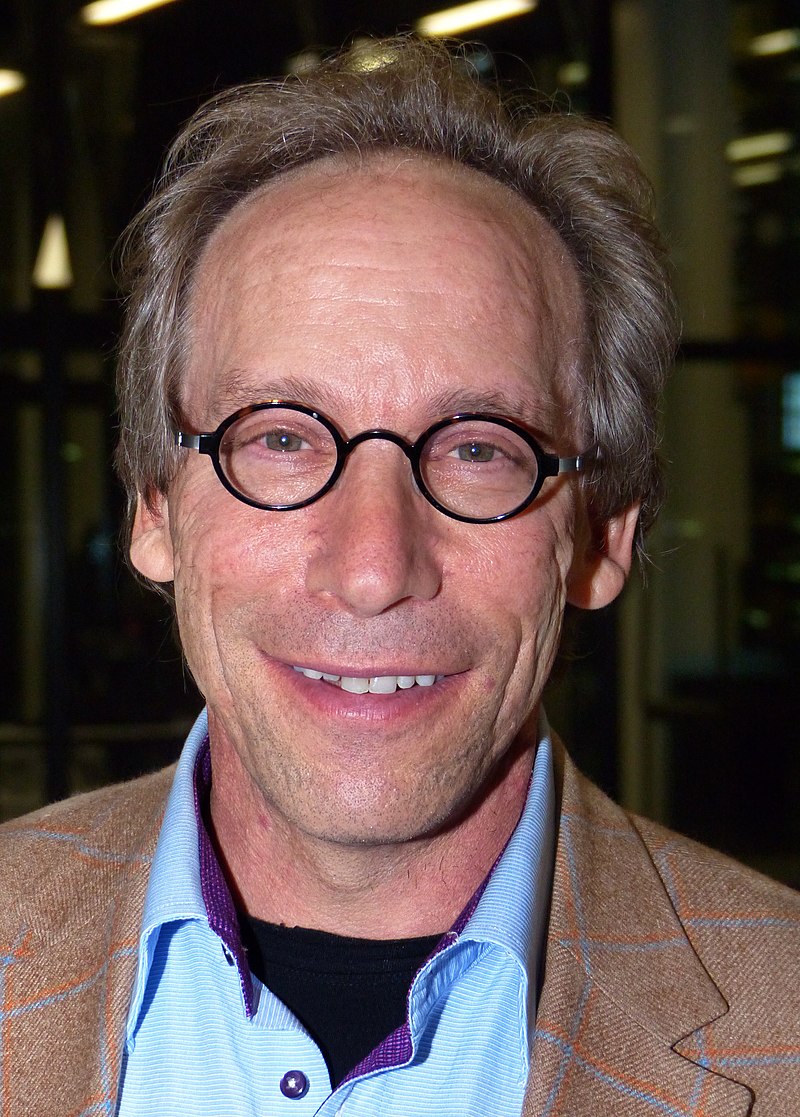
Laurence Krauss bij Het Denkgelag in Gent op 17 oktober 2013
Jvangiel
Key facts
Key facts
• Birth Name — Lawrence Maxwell Krauss • Birthplace — New York City, U.S. • Born — 27 May 1954 • Field — * Theoretical physics • Cosmology • Education — * Carleton University • Massachusetts Institute of Technology • Workplaces — * Arizona State University • Australian National University • New College of the Humanities • Yale University • Case Western Reserve University • Harvard University • Known for — * Dark energy • Zero-energy states • Awards — * Andrew Gemant Award (2001)[84] • Lilienfeld Prize (2001) • Science Writing Award (2002)[85] • Oersted Medal (2004) • Richard Dawkins Award (2016) • Doctoral Advisor — Roscoe Giles[1] • Thesis Url — http: library.mit.edu/item/000160895 • Thesis Title — Gravitation and Phase Transitions in the Early Universe • Thesis Year — 1982 • Website — https: www.lawrencemkrauss.com/
Early life and education
Early life and education
Krauss was born on May 27, 1954, in New York City, but spent his childhood in Toronto. He was raised in a household that was Jewish but not religious.[10] Krauss received undergraduate degrees in mathematics and physics with first-class honours at Carleton University in Ottawa in 1977, and was awarded a Ph.D. in physics at the Massachusetts Institute of Technology in 1982.[11][12]
Career
Career
After some time in the Harvard Society of Fellows, Krauss became an assistant professor at Yale University in 1985 and associate professor in 1988. He left Yale for Case Western Reserve University in 1993 when he was named the Ambrose Swasey Professor of Physics, professor of astronomy, and chairman of the physics department until 2005. In 2006, Krauss led the initiative for the no-confidence vote against Case Western Reserve University's president Edward M. Hundert and provost John L. Anderson by the College of Arts and Sciences faculty. On March 2, 2006, both no-confidence votes were carried: 131–44 against Hundert and 97–68 against Anderson.[13] In August 2008, Krauss joined the faculty at Arizona State University as a foundation Professor in the School of Earth and Space Exploration at the Department of Physics in the College of Liberal Arts and Sciences. He also became the director of the Origins Project, a university initiative "created to explore humankind's most fundamental questions about our origins".[14] In 2009, he helped inaugurate this initiative at the Origins Symposium, in which eighty scientists participated and three thousand people attended.[16] Krauss appears in the media both at home and abroad to facilitate public outreach in science. He has also written editorials for The New York Times. As a result of his appearance in 2002 before the state school board of Ohio, his opposition to intelligent design has gained national prominence.[17] Krauss attended and was a speaker at the Beyond Belief symposia in November 2006 and October 2008. He served on the science policy committee for Barack Obama's first (2008) presidential campaign and, also in 2008, was named co-president of the board of sponsors of the Bulletin of the Atomic Scientists. In 2010, he was elected to the board of directors of the Federation of American Scientists, and in June 2011, he joined the professoriate of the New College of the Humanities, a private college in London.[18] In 2013, he accepted a part-time professorship at the Research School of Astronomy and Astrophysics in the physics department of the Australian National University.[19] Krauss is a critic of string theory, which he discusses in his 2005 book Hiding in the Mirror.[20] In his 2012 book A Universe from Nothing Krauss says about string theory "we still have no idea if this remarkable theoretical edifice actually has anything to do with the real world".[21][22] Released in March 2011, another book titled Quantum Man: Richard Feynman's Life in Science, while A Universe from Nothingwith an afterword by Richard Dawkinswas released in January 2012, and became a New York Times bestseller within a week. Originally, its foreword was to have been written by Christopher Hitchens, but Hitchens grew too ill to complete it.[23][24] The paperback version of the book appeared in January 2013 with a new question-and-answer section and a preface integrating the 2012 discovery of the Higgs boson at the Large Hadron Collider. On March 21, 2017, his newest book, The Greatest Story Ever Told—So Far: Why Are We Here? was released in hardcover, paperback, and audio version. A July 2012 article in Newsweek, written by Krauss, indicates how the Higgs particle is related to our understanding of the Big Bang. He also wrote a longer piece in The New York Times explaining the science behind and significance of the particle.[25] In January 2019, Krauss became President of the Origins Project Foundation, a non-profit corporation intended to host public panel discussions on science, culture, and social issues.[27] On June 21, 2019, a new video podcast, The Origins Podcast with Lawrence Krauss, launched with Krauss as host. The first episodes included dialogues with Ricky Gervais, Noam Chomsky, and Jenny Boylan. In 2024, Krauss edited the book The War on Science, a collection of essays from 39 academics addressing perceived threats to academic freedom and scientific progress, such as DEI programs, wokeness, and cancel culture. Contributors include Nicholas Christakis, Richard Dawkins, Peter Boghossian, Jordan Peterson, Steven Pinker, Alan Sokal and Elizabeth Weiss. Krauss wrote an introductory overview and an epilogue. This is his third book published through the conservative Christian imprint Post Hill Press.[28]
Scientific work
Scientific work
• Illustration — Krauss lecturing about cosmology at TAM 2012 Krauss mostly works in theoretical physics and has published research on a variety of topics within that field. In 1995 he argued in favour of the energy-density of the universe being dominated by the energy of empty space, quoting many other scientists who supported the existence of a nonzero cosmological constant.[29] In 1998 this prediction was confirmed by two observational collaborations and in 2011 the Nobel Prize was awarded for their discovery. Krauss has formulated a model in which the Universe could have potentially come from "nothing", as outlined in his 2012 book A Universe from Nothing. He explains that certain arrangements of relativistic quantum fields might explain the existence of the Universe as we know it while disclaiming that he "has no idea if the notion [of taking quantum mechanics for granted] can be usefully dispensed with".[30] As his model appears to agree with experimental observations of the Universe (such as its shape and energy density), it is referred to by some as a "plausible hypothesis".[31] His model has been criticized by cosmologist and theologian George Ellis,[32] who said it "is not tested science" but "philosophical speculation". Initially, Krauss was skeptical of the existence of the Higgs boson.[33] However, after it was detected by CERN, he researched the implications of the Higgs field on the nature of dark energy.[34]
Activism
Activism
• Illustration — Lawrence Krauss sends a solidarity message to ex-Muslims convening in London in July 2017. Krauss has argued that public policy debates in the United States should have a greater focus on science.[35] He criticized Republican presidential candidate Ben Carson's statements on science, writing that Carson's remarks "suggest he never learned or chooses to ignore basic, well-tested scientific concepts".[39] Krauss has described himself as an antitheist[40] and takes part in public debates on religion. Krauss is featured in the 2013 documentary The Unbelievers, in which he and Richard Dawkins travel across the globe speaking publicly about the importance of science and reason as opposed to religion and superstition.[41] He has participated in many debates with religious apologists, including William Lane Craig[42] and John Lennox. In his book A Universe from Nothing: Why There is Something Rather than Nothing (2012), Krauss discusses the premise that something cannot come from nothing, which has often been used as an argument for the existence of a prime mover. He has since argued in a debate with John Ellis and Don Cupitt that the laws of physics allow for the Universe to be created from nothing. "What would be the characteristics of a universe that was created from nothing, just with the laws of physics and without any supernatural shenanigans? The characteristics of the universe would be precisely those of the ones we live in."[44] In an interview with The Atlantic, however, he states that he has never claimed that "questions about origins are over". According to Krauss, "I don't ever claim to resolve that infinite regress of why-why-why-why-why; as far as I'm concerned it's turtles all the way down".[45]
Relationship with Jeffrey Epstein
Relationship with Jeffrey Epstein
In 2006, Krauss helped organize a conference on gravity funded by a foundation run by financier and later-convicted sex offender Jeffrey Epstein. The conference was held on St. Thomas in the U.S. Virgin Islands and included a trip to Epstein's private island for dinner.[47] Krauss helped invite roughly 20 well-known physicists to the conference, including Gerard 't Hooft, David Gross, Frank Wilczek, Stephen Hawking, Kip Thorne, Lisa Randall, Maria Spiropulu, Barry Barish, and Alan Guth, as well as author Betsy Devine.[49] Later, The Origins Project, which was at the time under the direction of Krauss, received $250,000 from an Epstein foundation called "Enhanced Education".[50] Krauss defended Epstein after his 2008 guilty plea of procuring for prostitution a girl below age 18. In 2011, Krauss told an interviewer, "As a scientist I always judge things on empirical evidence and he always has women ages 19 to 23 around him, but I've never seen anything else, so as a scientist, my presumption is that whatever the problems were I would believe him over other people...I don't feel tarnished in any way by my relationship with Jeffrey; I feel raised by it."[53] Harvard Professor Steven Pinker said that Krauss was one of several colleagues who invited him to "salons and coffee klatsches" that included Epstein.[55] In August 2025, The New York Times published reports of letters given to Epstein for his 63rd birthday, including one from Krauss. Krauss stated that he did not recall the letter but attended several gatherings at Epstein's home.[56] On November 12, 2025, the House Committee on Oversight and Government Reform published additional files related to Epstein showing that he had exchanged more than 60 emails with Krauss.[57][58] In 2011, Krauss wrote to Epstein, "Beyond anything else, you are my friend. I hope we can both always remember that, no matter what." In an email dated 2017, Krauss asked Epstein for advice in responding to allegations of sexual misconduct.[59] In another exchange, dated 2018, Krauss responded to Epstein's joke "Let's do a men of the world conference," by suggesting that the notional conference include Kevin Spacey, Bill Clinton, Al Franken and Woody Allen. Each of these men had been publicly accused of sexual wrongdoing.[60] In February 2026, the Department of Justice released further documents indicating that Epstein emailed Krauss in an attempt to get him to introduce him to podcaster Joe Rogan. Krauss reached out to Rogan but he refused to meet Epstein.[61][62]
Allegations of sexual misconduct
Allegations of sexual misconduct
In a February 2018 article describing allegations that "range from offensive comments to groping and non-consensual sexual advances",[63] BuzzFeed News reported a variety of sexual misconduct claims against Krauss, including two complaints from his years at Case Western Reserve University. Krauss responded that the article was "slanderous" and "factually incorrect". In a public statement, he apologized to anyone he made feel intimidated or uncomfortable, but stated that the BuzzFeed article "ignored counter-evidence, distorted the facts and made absurd claims about [him]."[65][66] Case Western Reserve responded to the student complaint by restricting Krauss's access to campus, although by the time the sanctions began he had already left for ASU. ASU stated that they had not received complaints from faculty, staff, or students before the BuzzFeed article but subsequently began an internal investigation regarding an accusation that Krauss grabbed a woman's breast while at a convention in Australia.[67] Investigators interviewed two eyewitnesses, and two other witnesses who immediately spoke with the unnamed woman. The witnesses described the woman as troubled and shocked. The woman told investigators that "she did not feel victimized, felt it was a clumsy interpersonal interaction and thought she had handled it in the moment." ASU found that the preponderance of evidence suggested that Krauss had violated the university's policy against sexual harassment by grabbing a woman's breast without her permission.[68] As a result, Krauss was not renewed as director of the Origins Project and the university moved its staff to a project run by planetary scientist Lindy Elkins-Tanton, formally ending the Origins project.[71] In response to the university determination, Krauss produced a 51-page appeal document responding to the allegations, including a counter-claim that a photo claimed to be of Krauss grabbing a woman's breast was actually showing his hand moving away from the woman.[72] Several organizations also canceled scheduled talks by Krauss. Krauss resigned from the position of chair of the Bulletin of the Atomic Scientists Board of Sponsors when informed that its other members felt his presence was distracting "from the ability of the Bulletin to effectively carry out [its] work".[73] Following the ASU investigation, Krauss was placed on paid administrative leave starting in March 2018 and was recommended for dismissal by the dean of the department. He later retired from ASU at the end of the 2018–2019 academic year.[75]
Contributor
Contributor
• 100 Things to Do Before You Die (plus a few to do afterwards). 2004. Profile Books. • The Religion and Science Debate: Why Does It Continue? 2009. Yale Press.
Articles
Articles
* • "A dark future for cosmology". 2007. Physics World. • "The End of Cosmology". 2008. Scientific American. • "The return of a static universe and the end of cosmology". 2008. International Journal of Modern Physics. • "Late time behavior of false vacuum decay: Possible implications for cosmology and metastable inflating states". 2008. Physical Review Letters. • "The Cosmological Constant is Back", with M. S. Turner, Gen.Rel.Grav.27:1137–1144, 1995 *
Television
Television
• How the Universe Works (2010–2018)
Life and work
Life and work
Krauss was born on 27 May 1954 in New York City. Krauss held the nationality of United States. Krauss was educated at Carleton University and Massachusetts Institute of Technology. Krauss worked as astronomer, physicist, astrophysicist and non-fiction writer, and the authority record catalogues a further 4 occupations under the same name, among them university teacher, theoretical physicist, writer and actor. Krauss worked in English. Krauss is placed by the collections within antitheism.
Life and career
Dated record
Life and career
Explore 1954–2016
The full dated record · 13 entries
1954
Lawrence M. Krauss born at New York City.
1986
Recorded as employer: Yale University.
1993
Recorded as employer: Case Western Reserve University.
2001
Receives Lilienfeld Prize.
2001
Receives Andrew Gemant Award.
2002
Receives Science Writing Award.
2004
Receives Oersted Medal.
2005
Receives Joseph A. Burton Forum Award.
2008
Recorded as employer: Arizona State University.
2011
Receives Physics World Book of the Year Award.
2015
Receives Humanist of the Year.
2016
Receives Emperor Has No Clothes Award.
2016
Receives Richard Dawkins Award.
Works, 1989–2017
Catalogued output
Works, 1989–2017
These are texts written by the subject, distinct both from writings about the subject and from printed editions of other people's work. 10 works carry dates between 1989 and 2017. The 1990s are the densest part of the run, with 3 titles, and that concentration is a fact about what the registers have catalogued rather than a judgement on the work itself. They belong to a run of 11 titles in all, from 1989 to 2017.
The run opens with The Fifth Essence and closes with The Greatest Story Ever Told—So Far
The Fifth Essence
1989
Fear of Physics: A Guide for the Perplexed
1994
The Physics of Star Trek
1995
Beyond Star Trek
1997
The Search for Missing Mass in the Universe
2000
An Odyssey from the Big Bang to Life on Earth..and Beyond
2001
Hiding in the Mirror
2005
Richard Feynman's Life in Science
2011
A Universe from Nothing
2012
The Greatest Story Ever Told—So Far
2017
Works without a settled date
Catalogued output
Works without a settled date
1 further work are catalogued under Krauss's name without a date the collections agree on, which is why they are set apart from the dated run rather than placed in it.
The Physics of Climate Change
Books
Books
• The Fifth Essence (1989), Basic Books, • Fear of Physics: A Guide for the Perplexed (1994), Basic Books, • The Physics of Star Trek (1996), Basic Books, • Beyond Star Trek: Physics from Alien Invasions to the End of Time (1998), HarperCollins, • Quintessence: The Search for Missing Mass in the Universe (2000), Basic Books, • Atom: An Odyssey from the Big Bang to Life on Earth...and Beyond (2001), Little, Brown and Company, • Hiding in the Mirror: The Mysterious Allure of Extra Dimensions, from Plato to String Theory and Beyond (2005), Viking Press, • Quantum Man: Richard Feynman's Life in Science (2011), Atlas & Company • A Universe from Nothing: Why There Is Something Rather Than Nothing (2012), Atria Books,[77] • The Greatest Story Ever Told—So Far: Why Are We Here? (2017), Atria Books, • The Physics of Climate Change (2021), Post Hill Press, • The Known Unknowns (2023), Head of Zeus/Apollo, • The Edge of Knowledge (2023), Post Hill Press, • The War on Science (2025), Post Hill Press,
Editions and issues
Primary material
Editions and issues
The discography assembled here shows how Krauss's work has been published in sound, not what Krauss made. 4 sound issues are catalogued, carrying dates from 2012 to 2025. An issue is a published recording, distinct from the composition it carries, from a printed score of that composition and from any single performance of it; none of the entries below is counted in the catalogue of works above, and several of them carry the same work in different readings. The 2020s are the densest decade of publication, with 3 issues. The performers and issuing labels are as the discographic register states them; where it names no performer the article names none.
The Poetry of Reality with Richard Dawkins #15, “Science Beyond Safe Spaces”
2023
Lives Well Lived, Series 2, #19, “Our Cosmic Significance in an Indifferent Universe”
2025
Documentary films
Documentary films
• The Unbelievers (2013) • The Principle (2014) • (2016) • Lo and Behold, Reveries of the Connected World (2016) • The Farthest (2017)
Films
Films
• London Fields (2015) (cameo)[78] • Salt and Fire (2016)[79] • Intersect (2020)[80]
Teaching
The work is documented at Case Western Reserve University, Yale University and Arizona State University.
Primary material
Documents and archives
institutional register
- Bibliothèque nationale de France authority file 133296141
General reference · Bibliothèque nationale de France
- GND (German National Library) authority file 120368412
General reference · GND (German National Library)
- IdRef (French universities) authority file 035685751
General reference · IdRef (French universities)
- ISNI authority file 0000000116815018
General reference · ISNI
- Library of Congress authority file n88603890
General reference · Library of Congress
- MusicBrainz artist authority ce4b4f8c-1aa1-4dd5-8c0c-e934b7ad2733
General reference · MusicBrainz
scholarly publication
- Lawrence Krauss moving to Arizona State University, Physics Today, 2008
Scholarly · Crossref registry · 2008
- University finds prominent astrophysicist Lawrence Krauss grabbed a woman’s breast, Science, 2018
Scholarly · Crossref registry · 2018
reference work
- “Lawrence Krauss”, English Wikipedia, consulted as further reading
Reputable secondary · Wikipedia
Honors
Honors
In an interview with Krauss in the Scientific American, science writer Claudia Dreifus called Krauss "one of the few top physicists who is also known as a public intellectual." Krauss is one of very few to have received awards from all three major American physics societies: the American Physical Society, the American Association of Physics Teachers, and the American Institute of Physics. In 2012, he was awarded the National Science Board's Public Service Medal for his contributions to public education in science and engineering in the United States.[46]
Awards
Awards
• Illustration — Krauss is given the Richard Dawkins Award by Mark W. Gura and Melissa Pugh of Atheist Alliance of America at the Reason Rally 2016. • Gravity Research Foundation First Prize Award in the 1984 Essay Competition[81] • American Association for the Advancement of Science's Award for the Public Understanding of Science and Technology (2000)[82] • Julius Edgar Lilienfeld Prize (2001)[83] • Andrew Gemant Award (2001) • American Institute of Physics Science Writing Award (2002) • Oersted Medal (2003)[86] • American Physical Society Joseph A. Burton Forum Award (2005)[87] • Center for Inquiry World Congress Science in the Public Interest Award (2009)[88] • Helen Sawyer Hogg Prize of the Royal Astronomical Society of Canada and the Astronomical Society of Canada (2009) • Physics World Book of the Year, 2011[89] • National Science Board 2012 Public Service Award and Medal (2012)[90] • Elected as Laureate of the International Academy of Humanism (2013)[91] • Gravity Research Foundation First Prize Award in the 2014 Essay Competition • Humanist of the Year, 2015, American Humanist Association[92] (revoked in 2018 after allegations of sexual misconduct)[93] • Richard Dawkins Award 2016, Atheist Alliance of America[95]
Honours and awards
Where the work is held
Honours and awards
They run from 2001 to 2016.
11 honours stand against the name
Fellow of the American Physical Society
Fellow of the Committee for Skeptical Inquiry
Lilienfeld Prize
2001
Andrew Gemant Award
2001
Science Writing Award
2002
Oersted Medal
2004
Burton Forum Award
2005
Physics World Book of the Year Award
2011
Humanist of the Year
2015
Emperor Has No Clothes Award
2016
Richard Dawkins Award
2016
Authority records
Notes from the source article
Cited by Wikipedia
Notes from the source article
These works are cited by the source article, in its own numbering. They are recorded as its citations, not as sources VALÉORINE has verified.
- 1.Massachusetts Institute of Technology. Alumni Notes. October 2025.
- 2.Krauss, Lawrence. Faith and Foolishness: When Religious Beliefs Become Dangerous. Scientific American. 303. 2. 36. August 2010. 0036-8733.
- 3.Derra, Skip. ASU's Krauss elected board chair for Bulletin of Atomic Scientists. ASU News.
- 4.Lawrence M. Krauss. Bulletin of the Atomic Scientists.
- 5.Determination Letter: FinalLetter_83-2843258_THEORIGINSPROJECTFOUNDATIONINC_01222019_01. IRS.gov.
- 6.Origins Project Foundation.
- 7.The Origins Project Foundation dead link. The Origins Podcast (now a part of the Origins Project Foundation). October 2025.
- 8.Critical Mass. Via Substack.
- 9.Tomsett, Ben. Emails show Jeffrey Epstein rejected US physicist's $250k Otago uni funding pitch. NZ Herald.
- 10.WHYY-FM. On 'Radio Times:' Lawrence Krauss explains the 'curious accident' of human existence. March 20, 2017.
- 11.Carleton University Alumni Association. Lawrence M. Krauss, BSc / 77.
- 12.Massachusetts Institute of Technology. Alumni/ae Notes. October 2025.
- 13.Jaschik, Scott. President Quits at Case Western. Inside Higher Ed. March 17, 2006.
- 14.Arizona State University. About The Origins Project. Origins.asu.edu. April 21, 2015.
- 15.Krauss, Lawrence. Curriculum Vitae. Arizona State University. October 2025.
- 16.Arizona State University. Origins Symposium 2009. Origins.asu.edu. October 2025.
- 17.Ratliff, Evan. The Crusade Against Evolution. Wired. 12. 10. 156–161. October 2004. 1059-1028.
- 18."The professoriate" , New College of the Humanities, accessed June 8, 2011.
- 19.Australian National University. Renowned cosmologist makes ANU a long-term fixture. October 2025.
- 20.Boutin, Paul. Theory of Anything? Physicist Lawrence Krauss Turns on His Own. Slate. November 23, 2005.
- 21.Reynosa, Peter. Some of the Changes Lawrence M. Krauss Should Make to the Second Edition of 'A Universe From Nothing'. The Huffington Post. April 12, 2016.
- 22.Krauss, Lawrence M. A Universe from Nothing: Why There Is Something Rather Than Nothing. Free Press. 130. 2012. 978-1-4516-2445-8.
- 23.Afterword from Lawrence Krauss' New Book – A Universe From Nothing – Richard Dawkins – RDFRS. RichardDawkins.net. January 16, 2012.
- 24.Overbye, Dennis. There's More to Nothing Than We Knew. The New York Times. February 20, 2012.
- 25.Krauss, Lawrence M. How the Higgs Boson Posits a New Story of our Creation. Newsweek. 9 July 2012.
- 26.People – The Origins Project Foundation.
- 27.Origins Project Foundation Events. The Origins Project Foundation. October 2025.
- 28.Lawrence M. Krauss. Post Hill Press.
- 29.Krauss, Lawrence M. The Cosmological Constant is Back. General Relativity and Gravitation. 27. 11. 1137–1144. 1995. 10.1007/BF02108229.
- 30.On the Origin of Everything. The New York Times. March 25, 2012.
- 31.Dreifus, Claudia. Questions That Plague Physics: A Conversation with Lawrence M. Krauss. Scientific American. 291. 2. 82–85. August 2004. 0036-8733.
- 32.Horgan, John. Is Lawrence Krauss a Physicist, or Just a Bad Philosopher?. Scientific American Blog Network. November 20, 2015.
- 33.Krauss, Lawrence M. The greatest story ever told. so far. Atria Books. 255. 2017. 978-1-4767-7761-0.
- 34.Krauss, Lawrence M. Phys. Rev. Lett. 111, 061802 (2013): Higgs Seesaw Mechanism as a Source for Dark Energy. Physical Review Letters. 111. 6. August 7, 2013. 10.1103/PhysRevLett.111.061802.
- 35.Nina Burleigh. It's Time for Presidential Candidates to Talk About Science. Newsweek. August 12, 2015.
- 36.Lawrence Krauss on Science Debate. YouTube cbignore. February 23, 2008.
- 37.Americans Deserve a Presidential Science Debate. The Huffington Post. March 20, 2012.
- 38.Australian Broadcasting Corporation. Lawrence Krauss – The LHC, going to Mars, and the US Presidential campaign. The Science Show. September 27, 2008.
- 39.Lawrence Krauss. Ben Carson's Scientific Ignorance. The New Yorker. September 28, 2015.
- 40."I cannot hide my own intellectual bias here. As I state in the first sentence of the book, I have never been sympathetic to the notion that creation requires a creator. And like our late friend, Christopher Hitchens, I find the possibility of living in a universe that was not created for my existence, in which my actions and thoughts need not bend to the whims of a creator, far more enriching and meaningful than the other alternative. In that sense, I view myself as an anti-theist rather than an atheist." , Everything and Nothing: An Interview with Lawrence M. Krauss . Samharris.org, January 3, 2012
- 41.Richard Dawkins Foundation for Reason and Science. The Unbelievers Official Trailer (Richard Dawkins & Lawrence Krauss). February 8, 2013.
- 42.A universe from nothing? Putting the Krauss-Craig debate into perspective by Luke Barnes, Australian Broadcasting Corporation, August 13, 2013.
- 43.Brierley, Justin. Unbelievable?: Why after ten years of talking with atheists, I'm still a Christian. SPCK. 29. 2017. 978-0-281-07799-1.
- 44.Krauss, Lawrence. Why There Is Something Rather than Nothing. Institute of Art and Ideas. n.d.
- 45.Andersen, Ross. Has Physics Made Philosophy and Religion Obsolete?. The Atlantic. April 23, 2012.
- 46.University of Texas at Austin. The M.E.L. Oakes Undergraduate Lecture Series
- 47.Patel, Neel. Jeffrey Epstein liked palling around with scientists—what do they think now?. The Verge. July 13, 2019.
- 48.Kantor, Jodi. Jeffrey Epstein Was a Sex Offender. The Powerful Welcomed Him Anyway. The New York Times. July 13, 2019.
- 49.Krauss, Lawrence M. The Energy of Empty Space that Isn't Zero. Edge.org. July 5, 2006.
- 50.Jeffrey Epstein Called Himself A "Science Philanthropist" And Donated Millions To These Researchers. BuzzFeed News.
- 51.Moreno, J. Edward. Lawrence Krauss, accused of sexual misconduct, received $250K from Jeffrey Epstein. The Arizona Republic.
- 52.Potter, Alexis. Former ASU professor Lawrence Krauss received $250,000 from Jeffrey Epstein. The State Press. Arizona State University. July 12, 2019.
- 53.Wolfe, Alexandra. Jeffrey Epstein's society friends close ranks. April 1, 2011.
- 54.Darby, Luke. Private jets, parties and eugenics: Jeffrey Epstein's bizarre world of scientists. The Guardian. August 19, 2019.
- 55.Stewart, James B. Jeffrey Epstein Hoped to Seed Human Race With His DNA. The New York Times. July 31, 2019.
- 56.Enrich, David. Inside Jeffrey Epstein's Manhattan Townhouse: Birthday Letters, First Edition 'Lolita' and More. The New York Times. August 5, 2025.
- 57.Oversight Committee Releases Additional Epstein Estate Documents. United States House Committee on Oversight and Government Reform. 2025-11-12.
- 58.Vergano, Dan. Jeffrey Epstein E-mails Reveal Depth of Ties to High-Profile Scientists. Scientific American. 13 November 2025.
- 59.VanderKlippe, Nathan. Influential Canadian physicist sought Epstein’s advice on how to respond to sex-misconduct allegations, files show. Globe and Mail. 2025-11-14.
- 60.Ray, Siladitya. 'Never On The Island': What The Latest Epstein Files Say About Bill Clinton. Forbes. November 13, 2025.
- 61.read, Ryan Harkness·4 min. UFC, Joe Rogan, and the Fertitta brothers appear in the latest Epstein files … but not how you’d think. Yahoo Sports. 2026-02-01.
- 62.Gunn, Haley. Joe Rogan Appears in Latest Epstein Files Dump — Sick Pedo Begged To Meet 'Funny' Podcaster Through Famous Physicist Lawrence Krauss, Emails Claim. RadarOnline. 2026-02-02.
- 63.Scragg, Chris. ASU professor Lawrence Krauss accused of sexual misconduct. The State Press. Arizona State University. February 25, 2018.
- 64.Aldhous, Peter. Celebrity Atheist Lawrence Krauss Accused Of Sexual Misconduct For Over A Decade. BuzzFeed News. February 22, 2018.
- 65.Ryman, Anne. ASU professor Lawrence Krauss: Sex-misconduct allegations are 'absurd,' 'libelous'. AZcentral. March 7, 2018.
- 66.Chang, Kenneth. Arizona State Suspends Lawrence Krauss During Inquiry Over Sexual Misconduct Accusations. The New York Times. March 7, 2018.
- 67.Wadman, Meredith. University finds prominent astrophysicist Lawrence Krauss grabbed a woman's breast. Science. August 3, 2018. 10.1126/science.aav0010.
- 68.Searle, Mark. Office of the Executive Vice President and Provost; Arizona State University. July 31, 2018.
- 69.Rapanut, Kimberly. Lawrence Krauss violated ASU sexual harassment policies, investigation shows. The State Press. Arizona State University. August 7, 2018.
- 70.Shea, Parker. Lawrence Krauss replaced as director of The Origins Project. The State Press. Arizona State University. August 2, 2018.
- 71.Shea, Parker. ASU's Origins Project to move under Interplanetary Initiative. The State Press. Arizona State University. September 29, 2018.
- 72.Arizona State U. Physicist Offers Lengthy Rebuttal to Sexual-Misconduct Accusations. The Chronicle of Higher Education. October 25, 2018.
- 73.Sinclaire, Janice. Lawrence Krauss resigns from Bulletin of the Atomic Scientists' Board of Sponsors. Bulletin of the Atomic Scientists. March 6, 2018.
- 74.Krauss, Lawrence M. March 6, 2018.
- 75.Haag, Matthew. Lawrence Krauss to Retire From Arizona State After Sexual Misconduct Accusations. The New York Times. October 22, 2018.
- 76.Lawrence M. Krauss. Google Scholar.
- 77.Arizona State University. Lawrence Krauss.
- 78.Interview with Lawrence Krauss. June 7, 2014.
- 79.Salt and Fire (2016). IMDB.
- 80.Intersect (2020).
- 81.Gravity Research Foundation. Award Essays by Year. n.d.
- 82.American Association for the Advancement of Science. AAAS Public Engagement with Science Award Recipients. n.d.
- 83.American Physical Society. Julius Edgar Lilienfeld Prize. www.aps.org.
- 84.American Institute of Physics. Gemant Award Winners. www.aip.org.
- 85.American Physical Society. Elections. www.aps.org.
- 86.American Association of Physics Teachers. The Oersted Medal. www.aapt.org.
- 87.American Physical Society. Joseph A. Burton Forum Award. www.aps.org.
- 88.The Committee for Skeptical Inquiry. Randi, Krauss, Kurtz Honored with Major Awards. www.csicop.org.
- 89.Dacey, James. Physics World s 2011 Books of the Year. Physics World. 19 December 2011. 0953-8585.
- 90.National Science Foundation. The National Science Board Announces Recipient of the 2012 Public Service Award.
- 91.Council for Secular Humanism; Center for Inquiry. International Academy of Humanism. n.d.
- 92.Krauss named Humanist of the Year. ASU News. December 4, 2014.
- 93.Henry, Sarah. AHA Board of Directors Revokes Lawrence Krauss Humanist of the Year Award. American Humanist Association. October 25, 2018.
- 94.Seering, Lauryn. Lawrence Krauss's 2016 National Convention Speech - Freedom From Religion Foundation. ffrf.org. January 27, 2017.
- 95.Mark.Gura. Dr. Lawrence Krauss Receives the 2016 Richard Dawkins Award. Atheist Alliance of America.
References
Citations
References
Each reference names the institution holding it, so a reader may go to the document itself.
scholarly publication
Institutional witnessscholarly publication
University finds prominent astrophysicist Lawrence Krauss grabbed a woman’s breast, Science, 2018Crossref registry
Institutional witnessinstitutional register
Bibliothèque nationale de France authority file 133296141Bibliothèque nationale de France
Secondary witnessinstitutional register
GND (German National Library) authority file 120368412GND (German National Library)
Secondary witnessinstitutional register
IdRef (French universities) authority file 035685751IdRef (French universities)
Secondary witnessinstitutional register
Secondary witnessinstitutional register
Library of Congress authority file n88603890Library of Congress
Secondary witnessinstitutional register
Secondary witness
Every cited source · 12
- 01
Lawrence Krauss moving to Arizona State University, Physics Today, 2008
scholarly publication · Scholarly
Consult the source - 02
University finds prominent astrophysicist Lawrence Krauss grabbed a woman’s breast, Science, 2018
scholarly publication · Scholarly
Consult the source - 03
Bibliothèque nationale de France authority file 133296141
institutional register · General reference · Bibliothèque nationale de France
Consult the source - 04
GND (German National Library) authority file 120368412
institutional register · General reference · GND (German National Library)
Consult the source - 05
IdRef (French universities) authority file 035685751
institutional register · General reference · IdRef (French universities)
Consult the source - 06
ISNI authority file 0000000116815018
institutional register · General reference · ISNI
Consult the source - 07
Library of Congress authority file n88603890
institutional register · General reference · Library of Congress
Consult the source - 08
MusicBrainz artist authority
institutional register · General reference · MusicBrainz
Consult the source - 09
National Library of Australia authority file 35670719
institutional register · General reference · National Library of Australia
Consult the source - 10
- 11
Wikidata, structured authority record Q470468: Lawrence M. Krauss
institutional register · General reference · Wikimedia Foundation
Consult the source - 12
“Lawrence Krauss”, English Wikipedia, consulted as further reading
reference work · Reputable secondary · Wikipedia
Consult the source
Further particulars
Held on the record
Further particulars
Open the remaining particulars
The authorities additionally record the headings Lawrence Krauss, Larry Krauss and Lawrence Maxwell Krauss. His recorded language was English. His recorded confession was atheism. Formation and teaching. Krauss studied at Carleton University and Massachusetts Institute of Technology. The record notes the qualification Doctor. Krauss received Humanist of the Year, Oersted Medal, Fellow of the American Physical Society, Lilienfeld Prize, Fellow of the Committee for Skeptical Inquiry and Emperor Has No Clothes Award. Krauss is recorded as astronomer, physicist, astrophysicist, writer and university teacher.
Identity and origins
Recognition and collections
The Encyclopedia exists whether or not anything is for sale. Corrections are recorded rather than overwritten, and every version of this record is kept. Published 15 August 2026.
Elsewhere in Books
39,529 published records in this field, each with its sources named.
- Lawrence DurrellAuthor
- Lawrence HillAuthor
- Lawrence La Fountain-StokesAuthor
- Lawrence LiptonAuthor
- Lawrence N. GreenleafAuthor
- Lawrence NorfolkAuthor
- Lawrence of BřezováAuthor
- Lawrence OsborneAuthor
Best supported in this field
For owners
Own a work by Lawrence M. Krauss?
A specialist will read what you send and tell you what the house can establish, what it cannot, and whether the object is suited to sale. There is no charge and no obligation. The object stays with you throughout; nothing is shipped to us unless it is arranged in writing beforehand.