
Kubo Shunman
Kubo • Illustration — The Tamagawa of Noda, colour woodcut print from the series The Six Tama Rivers, c. 1787 Kubo Shunman (c. 1757 – 26 October 1820) was a Japanese artist and writer.
Also recorded as Shosado · Issetsu Senjo · Kitao · Kubota
Kubo Shunman
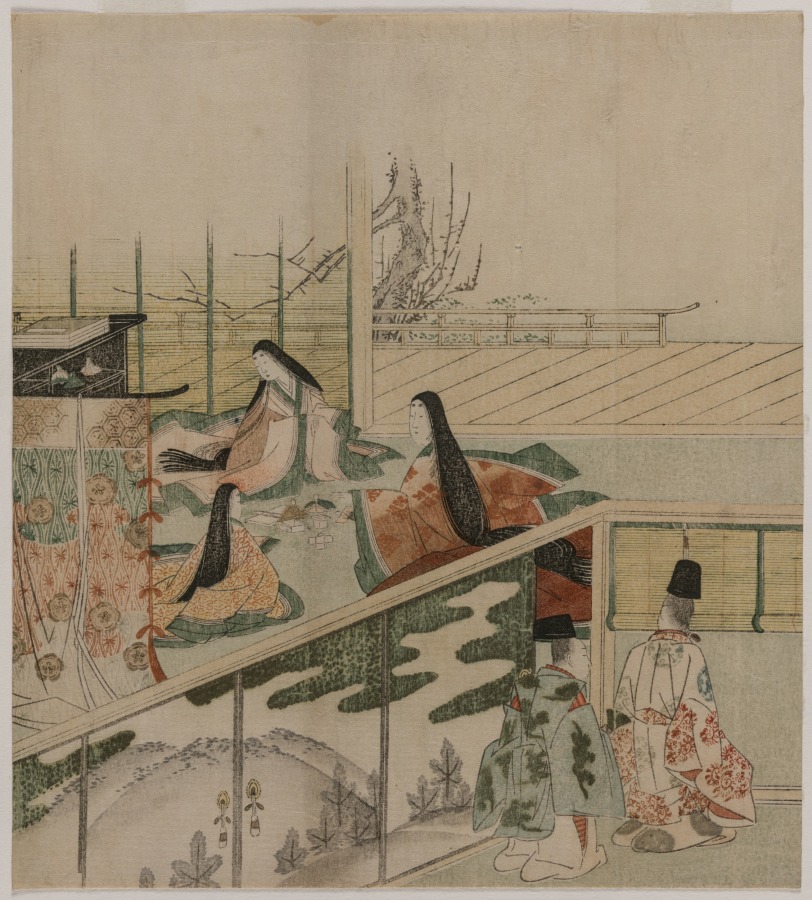
Kubo Shunman · The Cleveland Museum of Art · Gift of Myrta Leonora Jones · CC0
- Born
- 1757 · Edo.
- Died
- 1820 · Edo.
- Nationality
- Japan
- Occupation
- painter · ukiyo-e artist · gesakusha · waka poet · graphic artist · xylographer
- Teachers
- Katori Nahiko · Ishikawa Masamochi
VALÉORINE Encyclopedia
VALÉORINE documentary reading
Documentary summary
Kubo • Illustration — The Tamagawa of Noda, colour woodcut print from the series The Six Tama Rivers, c. 1787 Kubo Shunman (c. 1757 – 26 October 1820) was a Japanese artist and writer.
Admitted source layer · organised and presented by VALÉORINE
Reference Check
Propose documentary evidence for Kubo Shunman. A contribution is never written directly as fact: identity, source, rights and evidence gates still decide.
Sign in to contribute
Documentary evidence
Documentary basis
Authority files
wikidata · Q3200184
In this article
Life and career
Life and career
He produced ukiyo-e prints and paintings, gesaku novels, and kyōka and haiku poetry.
Training under Katori Nahiko and Ishikawa Masamochi is recorded. Places of work recorded in the authority are Japan. Work by Kubo Shunman is recorded in the collections of Minneapolis Institute of Art, Museo del Prado, Art Institute of Chicago, The Nelson-Atkins Museum of Art and Finnish National Gallery.
Shunman was born in about 1757 (Hōreki 7 on the Japanese calendar) with the surname of either Kubo (窪) or Kubota (窪田) and the given name Yasubei (易兵衛 or 安兵衛). He was orphaned while young. He studied under Katori Nahiko, a poet, kokugaku scholar, and painter in the style of the Chinese Shen Quan. He later also studied under the ukiyo-e artist Kitao Shigemasa. Upon finishing his apprenticeship took the art name Shunman (first spelt 春満, later 俊満). Other art names he used include Shōsadō (尚左堂) and Sashōdō (左尚堂), both of which use the character 左 sa, meaning "left", as he was left-handed. Early in his career he published as a gesaku novelist under the names Nandaka Shiran (南陀伽 紫蘭) and Kizandō (黄山堂), as a kyōka poet under the name Hitofushi Chitsue (一節 千杖), and as a haiku poet under the name (塩辛房). He had a heightened sense of beauty and devoted himself to the pleasure-seeking world. Shunman's earliest works dates to 1774: a votive plaque copied from Nahiko. His works include some ukiyoe prints, book illustrations, paintings, illustrated novels, and poetry. He was the most prolific producer of paintings in the Kitao school; more than 70 of his paintings survive. His best known prints come from the Tenmei (1781–1789) through the Kansei (1789–1801) eras, when Shunman tended toward boldly florid colours in his prints, and adhered to the Beni-girai ("red-hating") trend of avoiding reds and other flashy colours. His bijin-ga portraits of beauties were less in the stately style of his master Shigemasa than in that of the long, slender beauties of Torii Kiyonaga. Critics have considered Shunman's prints an improvement on this Kiyonaga model, which he reworked into a personal style with particular attention to evocative atmosphere. Shunman belongs to a group of refined artists, including Kitao Shigemasa and Santō Kyōden, whose pictorial talents have never been fully celebrated, since their main efforts were directed instead toward book illustration and literature. Shunman was a member of the poets' clubs Bakuro-ren and Rokujuen, and became head of Bakuro-ren. He stopped making designing commercial prints in 1790 to focus on deluxe commissioned prints, and provided poetry for the prints of Hokusai, Utamaro, and Eishi. • Illustration — Five cranes on a spit of sand. Surimono, probably 1816. Chester Beatty Library • Illustration — Objects Representing the Ceremony of Exorcising Demons, One of the New Year Performances, surimono, 18th century. The Met.
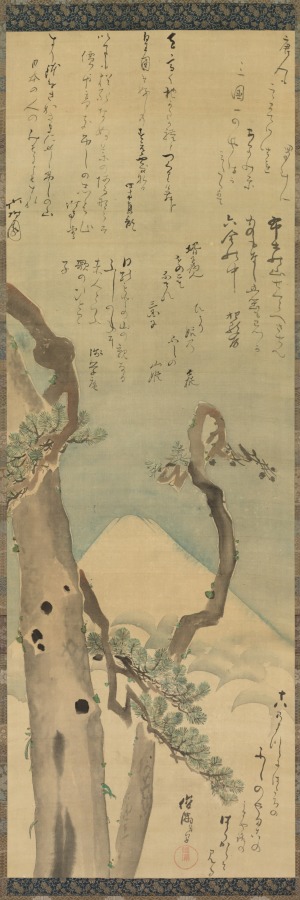
Mt. Fuji through Pines, late 1700s-early 1800s, by Kubo Shunman
Kubo Shunman · The Cleveland Museum of Art · Kelvin Smith Fund
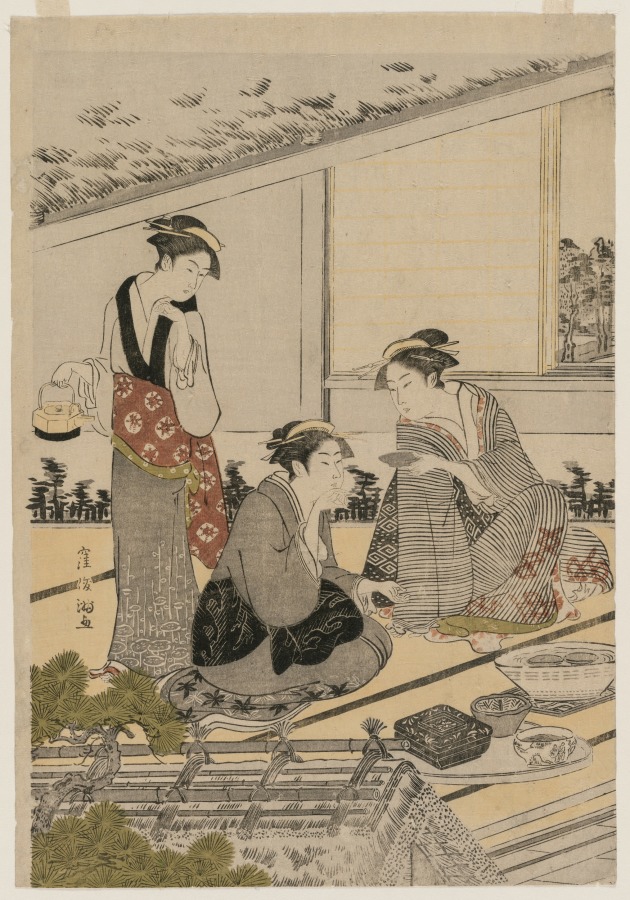
Women in a Tea House, late 1780s, by Kubo Shunman
Kubo Shunman · The Cleveland Museum of Art · Bequest of Edward L. Whittemore
Life and career
Dated record
Life and career
The full dated record · 2 entries
1757
Kubo Shunman born at Edo.
1820
Kubo Shunman died at Edo.
Notes from the source article
Cited by Wikipedia
Notes from the source article
These works are cited by the source article, in its own numbering. They are recorded as its citations, not as sources VALÉORINE has verified.
- 1.Milone 2022, 115
Bibliography printed in the source article · 3
- cite book
- cite book
- cite book
References
Citations
References
Each reference names the institution holding it, so a reader may go to the document itself.
reference work
Secondary witness
The Encyclopedia exists whether or not anything is for sale. Corrections are recorded rather than overwritten, and every version of this record is kept. Published 18 August 2026.
Elsewhere in Paintings
19,183 published records in this field, each with its sources named.
- Ksenija Wladimirowna EnderArtist
- Kseniya BoguslavskayaArtist
- Kseniya SimonovaArtist
- Kshitindranath MazumdarArtist
- Kubota BeisenArtist
- Kubra KhademiArtist
- Kudzanai ChiuraiArtist
- Kudzanai-Violet HwamiArtist
Best supported in this field
For owners
Own a work by Kubo Shunman?
A specialist will read what you send and tell you what the house can establish, what it cannot, and whether the object is suited to sale. There is no charge and no obligation. The object stays with you throughout; nothing is shipped to us unless it is arranged in writing beforehand.