
Kenneth Macpherson
Illustration — Kenneth Macpherson - Macbeth-Opening-Audience-1 Kenneth Macpherson (27 March 1902 – 14 June 1971) was a Scottish-born novelist, photographer, critic, and film-maker, the son of Scottish painter John 'Pop' Macpherson and Clara Macpherson, and descended from six generations of artists. It is only in recent years that Macpherson's contribution to cinematography has come to be recognised with the re-discovery of his work, which, though limited in output, was far ahead of its time, both in subject matter and cinematic technique. In his work with the Pool Group (1927–1933), which he co-founded with Bryher and H.D, Macpherson also established the influential film journal Close Up.
Kenneth Macpherson
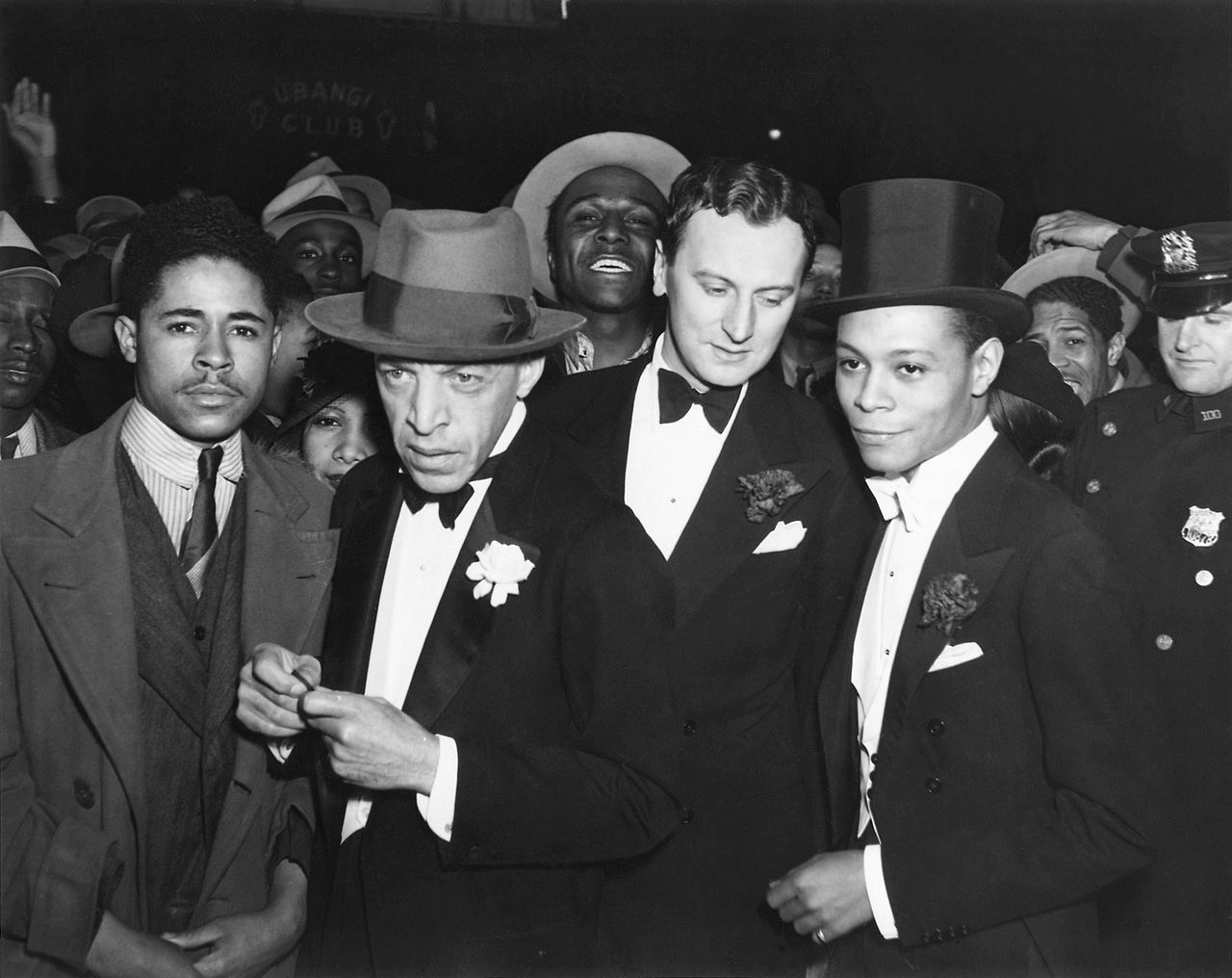
Federal Theatre Project · Library of Congress American Memory Collection · Public domain
- Born
- 1902
- Died
- 1971
- Nationality
- United Kingdom
- Occupation
- cinematographer · film director · screenwriter · photographer · writer
- Languages
- English
VALÉORINE Encyclopedia
VALÉORINE documentary reading
Documentary summary
Illustration — Kenneth Macpherson - Macbeth-Opening-Audience-1 Kenneth Macpherson (27 March 1902 – 14 June 1971) was a Scottish-born novelist, photographer, critic, and film-maker, the son of Scottish painter John 'Pop' Macpherson and Clara Macpherson, and descended from six generations of artists. It is only in recent years that Macpherson's contribution to cinematography has come to be recognised with the re-discovery of his work, which, though limited in output, was far ahead of its time, both in subject matter and cinematic technique. In his work with the Pool Group (1927–1933), which he co-founded with Bryher and H.D, Macpherson also established the influential film journal Close Up.
Admitted source layer · organised and presented by VALÉORINE
Note VALÉORINE
Kenneth Macpherson (1902–1971) was a cinematographer, film director and photographer, among other activities, of British nationality. Languages used include English.
Composed from admitted, traceable facts · 01 October 2026
VALÉORINE
Reference Check
Propose documentary evidence for Kenneth Macpherson. A contribution is never written directly as fact: identity, source, rights and evidence gates still decide.
Sign in to contribute
World of VALÉORINE
Documentary connections
Only confirmed graph relationships appear here. Images are shown only when their identity and reuse rights both pass the documentary gate.
Documentary evidence
Documentary basis
Authority files
wikidata · Q6390436 · wikipedia · Kenneth Macpherson
In this article
Personal life
Personal life
• Illustration — Kenneth Macpherson (left foreground) and Jimmie Daniels at the opening of the Federal Theatre Project's production of Macbeth (April 14, 1936) Little is known of Macpherson's early life, the pre-Pool Group period, although much is made of his post-Pool Group years, which appear to have been colourful. One commentary goes as far as to disingenuously identify, for interested parties, the source of 'a lurid description of his personal life during his New York years'. Macpherson's story began in 1927, when he married English writer, Annie Winifred Ellerman, (known as Bryher in the literary world), the daughter of a British shipping magnate. Bryher's inherited fortune would help to finance Macpherson's projects. Although Bryher's and Macpherson's marriage lasted for twenty years, for much of the marriage, both Macpherson and Bryher had extra-marital affairs. Bryher was lesbian but Macpherson was distinctly bisexual. Macpherson was in a relationship with cabaret singer Jimmie Daniels for most of the 1930s. Early in their relationship, Bryher commissioned Richmond Barthé to make a bust of Daniels. In 1937, during his relationship with Daniels, Macpherson had a brief affair with Féral Benga. A sexual partner, common to both Bryher and Macpherson, was the American poet H.D., who had been a close friend of Bryher since 1921. H.D. and Bryher had a lesbian relationship, spending a lot of time together in Riant Chateau, Territet, Switzerland, where Bryher had a house. Not long after their marriage, Macpherson and Bryher moved to Territet, later joined by Doolittle, who brought along her 9-year-old daughter Perdita. (Perdita's father was Cecil Gray, the Scottish music critic and composer). In 1928, Doolittle had a sexual relationship with Macpherson, becoming pregnant by him. The pregnancy was aborted later that year. In the same year, Macpherson and Bryher formally adopted Perdita, registering her name as Frances Perdita Macpherson. In September 1931, Macpherson and Bryher moved to a new home at La Tour-de-Peilz, which they had commissioned art director and architect Alexander Ferenczy to build. Following Ferenczy's death, the work was completed by Hermann Henselmann, then an employee of Ferenczy's, who subsequently went on to claim ownership of the entire project. The home, which overlooked Lake Geneva, came to be known as Kenwin, derived from the names, Kenneth and Winifred, and was designed as both a film studio (although there is no evidence it was used as such) and home. Bryher gave her address at the time as Villa Kenwin, Chemin de Vallon, 1814 Burier-La-Tour, Vaud, Switzerland. (During the war years, Bryher used Kenwin as a staging post for the evacuation of refugees from Nazi Germany.)
Background
Background
It was the late 1920s, and race, sex and mental illness were decidedly taboo subjects for cinema audiences; cinematography was just a tool for the use of Hollywood moguls in the production of lucrative films for mass entertainment. The stage was being set, though, for a challenge on this 'phoney' world with new thinking individuals springing up to present alternative ideas. Film-makers were being influenced by the philosophy of the Frankfurt School, the theories on human behaviour of Sigmund Freud in Vienna and the innovation of Soviet and German 'montage cinema'. Macpherson would identify with this new thinking and hope to contribute. In 1927, together with Bryher and Doolittle, Macpherson co-founded the Pool Group. Realising that their ambitions would be stifled by British censorship and the social prejudices of the time, the group re-located to Switzerland. There, they could fully consider sensitive taboo issues and investigate the means of successfully transferring these thoughts onto celluloid. It was during this period in Switzerland that Macpherson would produce his main work, the film, Borderline. At the time, however, the film received a lukewarm reception from the critics, and Macpherson would archive the film in a 'bottom drawer', where it would lie dormant for the next 53 years.
The Pool Group
The Pool Group
It was in 1927, from their base in Territet, that Macpherson, Bryher and Doolittle launched themselves as the Pool Group. Pool would veer away from the West's commercial model of film production, and produce material which would promote cinematography as an 'art form'. Their model would be based on the work coming out of Germany, particularly G W Pabst, and coming out of Russia, particularly Sergei Eisenstein. Their subject matter would be human behaviour, and its many facets, and their task would be representing this behaviour on screen, influenced by the work of Freud.
Close Up
Close Up
Also at Territet, Macpherson founded the influential film journal Close Up, dedicated to "independent cinema and cinema from around the world". The first issue of Close Up, describing itself on the front cover as an "international magazine devoted to film art", appeared in July 1927. Macpherson was editor, with Bryher as assistant editor, and Doolittle making regular contributions. Macpherson, who was particularly influenced by the Russian film-maker Sergei Eisenstein whom he first met in 1929, "dictated the tone and direction of the publication, contributing articles that defined the role of the director and defended the integrity of cinema and its right to be considered as art". Close Up published many of the first translations of Eisenstein's ideas. Macpherson continued as the main editor until the magazine's demise in 1933.
Shorts
Shorts
His first short film, Wing Beat (1927) was an investigation into telepathy and featured himself and H.D. in acting roles. The film survives only in fragments. Macpherson described the film as 'A study in thought... a free verse poem'. His second short, Foothills (1928), footage of which was discovered in 1979, concerns a city-woman visiting the countryside, with 'added psychoanalytic ingredients'. Nine minutes and ten seconds of footage, in 16mm black and white, exist of his third short film, Monkeys' Moon (1929), which featured Macpherson's 2 pet douroucouli monkeys. This film was thought to be lost until the Beinecke Library of Yale University acquired a copy in 2008, where it was fully restored and digitised.
Borderline
Borderline
Macpherson's sole feature, Borderline (1930), originally believed to have been lost, was re-discovered by chance in Switzerland in 1983. The silent film with English inter-titles, dissected race and gender relations and was centred on a love triangle, featuring Paul Robeson and H.D. It attempted to delve into the mental states of its characters using the technique of 'montage', based on Eisenstein's film theories. The film confused and bewildered critics leading the London Evening Standards Clive MacManus to advise Macpherson "to spend a year in a commercial studio" before attempting something as difficult again. Deeply upset by the film's hostile reception, Macpherson archived his film and withdrew from film directing. In 2006, the British Film Institute sponsored the restoration and eventual DVD release of Borderline, revitalising interest in Macpherson's work.
Dreams That Money Can Buy
Dreams That Money Can Buy
After spending a few months in New York in 1935, Macpherson eventually based himself there to focus on writing, photography and his art collection. It was here that he met Peggy Guggenheim, a wealthy American art collector, who instantly fell in love with him and with whom he shared an apartment for a while. In 1944, in New York, he co-produced Hans Richter's avant-garde compendium, Dreams That Money Can Buy, the project being financed by Macpherson and Guggenheim.
Later life
Later life
In 1944 Macpherson had an affair with Art Collector Peggy Guggenheim in New York. After the end of her marriage with German artist Max Ernst, they shared an apartment in East 61st Street. In 1947, Macpherson returned from America, spending much of his time in Switzerland and Italy. He bought a home on Capri, named Villa Tuoro, which he shared with his lover, the photographer Algernon Islay de Courcy Lyons. Bryher supported her husband and his friend on Capri, requesting that they take into their home the aging Norman Douglas, the Scottish novelist. Douglas had been friends of Bryher and Macpherson since 1931. Macpherson remained on Capri until Douglas's death in 1952, writing an epitaph for Douglas, from which the Latin inscription, on Douglas's gravestone, a quote from the Odes of Horace (Book II, Ode 3) is derived (Omnes Eodem Cogimur—we are all driven to the same place). Macpherson then moved to Rome, where he published Rome 12 Noon. In 1965, he 'retired' to Tuscany. Macpherson died in Cetona on 14 June 1971, leaving everything, including his inheritance from Douglas, to De Courcy Lyons.
Filmography
Filmography
• Wing Beat (18 min. fragments) (Switzerland 1927) Museum of Modern Art, New York • Foothills (Fragments) (Switzerland 1927) Museum of Modern Art, New York • Monkeys' Moon (Switzerland, 1929) • Borderline (Switzerland, 1928) 72min (BFI retail) • Dreams That Money Can Buy (USA, 1947)
Life and career
Dated record
Life and career
The full dated record · 2 entries
1902
Kenneth Macpherson was born on 27 March 1902.
1971
Kenneth Macpherson died on 14 June 1971.
Publications
• Gaunt Island (Riant Chateau Territet, Switzerland 1927) Published by Pool. • Pool Reflection (Riant Chateau Territet, Switzerland 1927) Published by Pool. • Out of the Air (1935) (Life And Letters Today; Editors, Robert Herring and Petrie Townshend) • Selected Reviews – Parker Tyler's View; Life And Letters Today (1936) • Rome 12 Noon (1964) Collins & Harvill Press, London • Close Up – A Magazine Devoted to the Art of Films (Ayer Co. Pub.) (first published 1988) • An Impossible Woman – Memories of Dottoressa Moor (by Elisabeth Moor) (Preface, notes and epilogue by Graham Greene) (London: Bodley Head, 1975; New York: Viking Press, 1976) • La Dottoressa: Mémoires d'une femme impossible (by Elisabeth Moor, Kenneth Macpherson) (Graham Greene, Georges Belmont, Hortense Chabrier) Le Livre de poche, 1977 • Omnes Eodem Cogimur – some notes written following the death of Norman Douglas • Life And Letters Today – Review of George Orwell's Keep The Aspidistra Flying (1936)George Orwell

Photograph of opening-night audience for the Federal Theatre Project production of Macbeth at the Lafayette Theatre
Federal Theatre Project · Library of Congress American Memory Collection
Films
Macpherson's films can best be summarised as presenting contentious issues using avant-garde experimental film-making techniques to represent emotional and psychological states of the human mind. "Macpherson's brilliance lies in his ability to photograph small movements as nuanced, meaning-producing gestures". His work would go on to influence future film-makers such as Nathaniel Dorsky and Robert Beavers. In all, Macpherson made three short films, Wing Beat, Foothills and Monkeys' Moon, one main feature, Borderline and co-produced Hans Richter's Dreams That Money Can Buy.
Primary material
Documents and archives
reference work
- “Kenneth Macpherson”, English Wikipedia, consulted as further reading
Reputable secondary · Wikipedia
institutional register
- Wikidata, structured authority record Q6390436: Kenneth Macpherson
General reference · Wikimedia Foundation
Notes from the source article
Cited by Wikipedia
Notes from the source article
These works are cited by the source article, in its own numbering. They are recorded as its citations, not as sources VALÉORINE has verified.
- 1.Close up, 1927–1933: Cinema and Modernism – James Donald, Anne Friedberg, Laura Marcus https://books.google.com/books?id=joAbufAs9ZMC&q=Close+up,+1927-1933:+Cinema+and+Modernism+-+James+Donald,+Anne+Friedberg,+Laura+Marcus
- 2.Vendryes, Margaret Rose. Barthé: A Life in Sculpture. Univ. Press of Mississippi. 90. 2008. 9781604730920.
- 3.Bergman, David. Gay American autobiography: writings from Whitman to Sedaris. University of Wisconsin press. 111. 2009. 978-0-299-23044-9.
- 4.Perdita Macpherson Schaffner (1919-2001). www.imagists.org.
- 5.Kossel, Elmar. Hermann Henselmann und die Moderne. Langewiesche. 30-34. 2013. 978-3784574059.
- 6.kenwin. www.veronique-goel.net.
- 7.The Rediscovery of Pool. www.filmintelligence.org.
- 8.Lost And Found – Richard Deming (Film Review – Monkeys' Moon, 2009) Stanford Univ. Press http://www.thefreelibrary.com/Lost+and+Found%3A+RICHARD+DEMING+ON+KENNETH+MACPHERSON'S+MONKEYS'+MOON.-a0203139479
- 9.AllVoices – Close-up Look at Kenneth Macpherson's Borderline.
- 10.Suchenski, Richard. Richter, Hans – Senses of Cinema. www.sensesofcinema.com. 29 December 2001.
- 11.Louis Silverstein's H.D. Chronology, Introduction. www.imagists.org.
- 12.YouTube 09S3knF75v0 Monkeys' Moon
References
Citations
References
Each reference names the institution holding it, so a reader may go to the document itself.
reference work
Secondary witnessinstitutional register
Wikidata, structured authority record Q6390436: Kenneth MacphersonWikimedia Foundation
General reference
Further particulars
Held on the record
Further particulars
Open the remaining particulars
Kenneth Macpherson is recorded with the occupation cinematographer. Recorded as cinematographer, film director, screenwriter, photographer and writer.
The Encyclopedia exists whether or not anything is for sale. Corrections are recorded rather than overwritten, and every version of this record is kept. Published 17 August 2026.
Elsewhere in Photography
11,392 published records in this field, each with its sources named.
- Kenji OgusuPhotographer
- Kenn DuncanPhotographer
- Kenneth GarrettPhotographer
- Kenneth JareckePhotographer
- Kenneth MeesPhotographer
- Kenny BiddlePhotographer
- Kenny HotzPhotographer
- Kenro IzuPhotographer
Best supported in this field
For owners
Own a work by Kenneth Macpherson?
A specialist will read what you send and tell you what the house can establish, what it cannot, and whether the object is suited to sale. There is no charge and no obligation. The object stays with you throughout; nothing is shipped to us unless it is arranged in writing beforehand.