
Joseph I, Holy Roman Emperor
Joseph I (Joseph Jacob Ignaz Johann Anton Eustachius; 26 July 1678 – 17 April 1711) was Holy Roman Emperor and ruler of the Habsburg monarchy from 1705 until his death in 1711. He was the eldest son of Leopold I, Holy Roman Emperor from his third wife, Eleonor Magdalene of Neuburg. Joseph was crowned King of Hungary at the age of nine in 1687 and was elected King of the Romans at the age of eleven in 1690.
Also recorded as Josef I
Joseph I, Holy Roman Emperor

Unidentified painter · originally uploaded to en.wikipedia by Magnus Manske (talk · contribs) on 7 July 2004, 12:17 under the file name Joseph I, Holy Roman Emperor.jpg. (+/−) · Public domain
- Born
- 1678. · Vienna.
- Died
- 1711. · Vienna.
- Nationality
- Austria and Habsburg monarchy.
- Occupation
- composer and monarch.
- Honours
- Knight of the Order of the Golden Fleece and Order of the Golden Fleece.
- Languages
- German.
VALÉORINE Encyclopedia
VALÉORINE documentary reading
Documentary summary
Joseph I (Joseph Jacob Ignaz Johann Anton Eustachius; 26 July 1678 – 17 April 1711) was Holy Roman Emperor and ruler of the Habsburg monarchy from 1705 until his death in 1711. He was the eldest son of Leopold I, Holy Roman Emperor from his third wife, Eleonor Magdalene of Neuburg. Joseph was crowned King of Hungary at the age of nine in 1687 and was elected King of the Romans at the age of eleven in 1690.
Admitted source layer · organised and presented by VALÉORINE
Note VALÉORINE
Joseph I, Holy Roman Emperor (1678–1711) was a composer and monarch and a national of Austria and the Habsburg monarchy. The composer was born and died in Vienna. Joseph I, Holy Roman Emperor held the positions of Holy Roman Emperor and King of Bohemia, among others.
Languages used include German. The composer received Knight of the Order of the Golden Fleece and Order of the Golden Fleece.
Composed from admitted, traceable facts · 26 September 2026
VALÉORINE
Reference Check
Propose documentary evidence for Joseph I, Holy Roman Emperor. A contribution is never written directly as fact: identity, source, rights and evidence gates still decide.
Sign in to contribute
World of VALÉORINE
Documentary connections
Only confirmed graph relationships appear here. Images are shown only when their identity and reuse rights both pass the documentary gate.
Documentary evidence
Evidence Panel
original value insufficient · checked 25 September 2026
- Identity
- resolved
- Independent source families
- 0
- Admitted assertions
- 0
- Open conflicts
- 0
Authority files
wikidata · Q152480 · wikipedia · Joseph I, Holy Roman Emperor
In this article
Early life
Early life
Joseph continued the War of the Spanish Succession, begun by his father against Louis XIV of France, in an attempt to make his younger brother Charles (later Emperor Charles VI) King of Spain. In the process, however, owing to the victories won by his military commander, Prince Eugene of Savoy, he did succeed in establishing Austrian hegemony over Italy. His motto was Amore et Timore (Latin for "Through Love and Fear"). Like his father and grandfather, he was a composer.
Born in Vienna, Joseph was educated strictly by Charles Theodore, Prince of Salm, and became a good linguist. Perhaps due to the influence of his formerly Protestant tutor he was a less devout Catholic than his parents and other relatives and developed into an adherent of the early Age of Enlightenment. He had two great enthusiasms: music and hunting. Although Joseph was the first son and child born of his parents' marriage, he was his father's third son and seventh child. Previously, Leopold had been married to Infanta Margaret Theresa of Spain, who had given him four children, one of whom survived infancy. He then married Claudia Felicitas of Austria, who gave him two short-lived daughters. Thus, Joseph had six half-siblings. In 1684, the six-year-old Archduke had his first portrait painted by Benjamin Block. At the age of nine, on 9 December 1687, he was crowned King of Hungary, and at the age of eleven, on 23 January 1690, King of the Romans.
Military service
Military service
In 1702, at the outbreak of the War of the Spanish Succession, Joseph saw his only military service. He joined the Imperial General, Louis William, Margrave of Baden-Baden, in the Siege of Landau.
Holy Roman Emperor
Holy Roman Emperor
Prior to his ascension, Joseph had surrounded himself with reform-hungry advisors and the young court of Vienna was ambitious in the elaboration of innovative plans. He was described as a "forward-looking ruler". The large number of privy councillors was reduced and attempts were made to make the bureaucracy more efficient. Measures were taken to modernise the central bodies and a certain success was achieved in stabilising the chronically poor Habsburg finances. Joseph also endeavoured to strengthen his position in the Holy Roman Empire — as a means of strengthening Austria's standing as a great power. When he sought to lay claim to imperial rights in Italy and gain territories for the Habsburgs, he even risked a military conflict with the Pope over the Duchy of Mantua. Joseph I was threatened with excommunication by Pope Clement XI on 16 June 1708. In Hungary, Joseph had inherited the kuruc rebellion from his father Leopold I: once again, nobles in Transylvania (Siebenbürgen) had risen against Habsburg rule, even advancing for a time as far as Vienna. Although Joseph was compelled to take military action, he refrained — unlike his predecessors — from seeking to teach his subjects a lesson by executing the leaders. Instead, he agreed to a compromise peace, which in the long term facilitated the integration of Hungary into the Habsburg domains. It was his good fortune to govern the Austrian dominions and to be head of the Empire, during the years in which his trusted general, Prince Eugene of Savoy, either acting alone in Italy or with the Duke of Marlborough in Germany and Flanders, was beating the armies of Louis XIV of France. During the whole of his reign, Hungary was disturbed by the conflict with Francis Rákóczi II, who eventually took refuge in the Ottoman Empire. The emperor reversed many of the authoritarian measures of his father, thus helping to placate opponents. He began the attempts to settle the question of the Austrian inheritance by a pragmatic sanction, which was continued by his brother Charles VI, Holy Roman Emperor.
Religious and ethnic policies
Religious and ethnic policies
During the Rákóczi's rebellion (1703–1711) in the Kingdom of Hungary, Joseph's government was also faced with various religious and ethnic challenges. A significant portion of the Hungarian nobility and people belonged to the Reformed Church (Calvinists). Hoping to gain full religious freedom and equality, Hungarian Calvinists were supportive of Rákóczi's movement, thus forcing the imperial court in Vienna to reexamine some staunchly pro-Catholic policies. At the same time, eastern and southern regions of the Kingdom were also inhabited by Eastern Orthodox Christians, mainly Serbs and Romanians. In order to secure their loyalty, Joseph issued (in 1706) official confirmation of religious liberties that were previously granted to Eastern Orthodox subjects by his father, late emperor Leopold I. In 1708, Joseph confirmed the establishment of the Metropolitanate of Krušedol. In 1710, Joseph extended his father's edict of outlawry against the Romani (Gypsies) in the Habsburg lands. Per Leopold, any Romani who entered the kingdom was to be declared an outlaw by letters patent. If the same person returned to Bohemia a second time, they were to be "treated with all possible severity". Joseph ordered that in the Kingdom of Bohemia they were to have their right ears cut off; in the Margraviate of Moravia, the left ear was to be cut off; in Austria, they would be branded on the back with a branding iron, representing the gallows. These mutilations were to enable the authorities to identify Romani who had been outlawed and returned. Joseph's edict specified "that all adult males were to be hanged without trial, whereas women and young males were to be flogged and banished forever." Officials who failed to enforce the edict could be fined 100 reichsthaler. Helping Romani was punishable by a half-year's forced labor. "Mass killings" of Romani were reported as a result.
Death
Death
During the smallpox epidemic of 1711, which killed Louis, Grand Dauphin and three siblings of the future Emperor Francis I, Joseph became infected. He died on 17 April in the Hofburg palace. He had previously promised his wife to stop having affairs, should he survive. The Emperor was buried in the Imperial Crypt, the resting place of the majority of the Habsburgs. His funeral took place on 20 April, in tomb no. 35 in Karl's Vault. His tomb was designed by Johann Lukas von Hildebrandt, decorated with pictures of various battles from the War of Spanish Succession. Josefstadt (the eighth district of Vienna) is named for Joseph.
Marriage and lack of heirs
Marriage and lack of heirs
On 24 February 1699, he married Wilhelmine Amalia of Brunswick-Lüneburg in Vienna. They had three children and their only son died of hydrocephalus before his first birthday. Joseph had a passion for love affairs (none of which resulted in illegitimate children) and he caught a sexually transmittable disease, probably syphilis, which he passed on to his wife while they were trying to produce a new heir. This incident rendered her sterile. Their father, who was still alive during these events, made Joseph and his brother Charles sign the Mutual Pact of Succession, under which Joseph's daughters would have precedence over Charles's daughters, in case neither fathered a son. This ruling, which made no provision for the accession of Charles's daughter Maria Theresa, led to the War of the Austrian Succession.
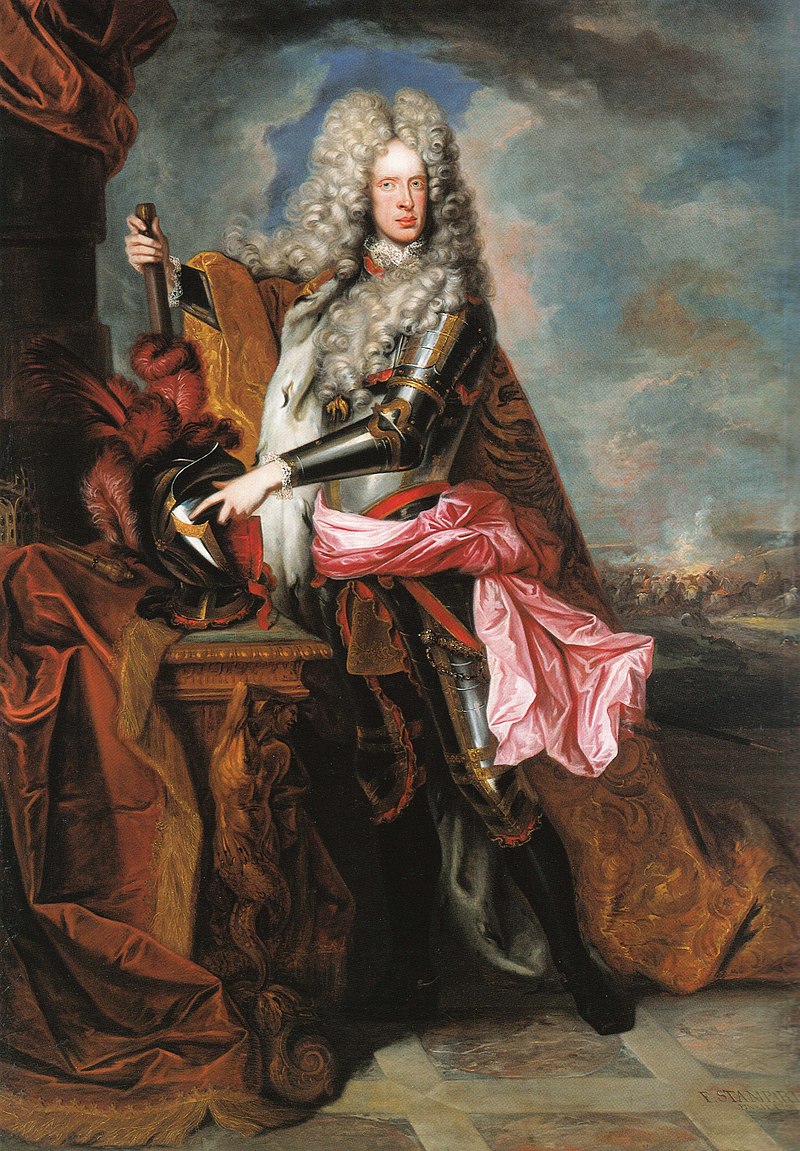
Ölgemälde von Kaiser Joseph I. mit Harnisch und Feldherrenstab vor einer Schlachtenszene.
Frans van Stampart · Brennpunkt Europas 1704
Primary material
Documents and archives
reference work
- “Joseph I, Holy Roman Emperor”, English Wikipedia, consulted as further reading
Reputable secondary · Wikipedia
authority record
- Wikidata, structured authority record Q152480: Joseph I, Holy Roman Emperor
Unverified · Wikidata
Notes from the source article
Cited by Wikipedia
Notes from the source article
These works are cited by the source article, in its own numbering. They are recorded as its citations, not as sources VALÉORINE has verified.
- 1.Johann Burkhard Mencke; Leben und Thaten Sr. Majestät des Römischen Käysers Leopold des Ersten pg 914 https://books.google.com/books?id=AdhXAAAAcAAJ&q=Josephus+Jacobus+Ignatius+Johannes+Antonius+Eustachius&pg=PA914
- 2.english.habsburger.net. Joseph I as Roman-German Emperor, oval portrait with motto. The World of the Habsburgs.
- 3.Joseph I, Holy Roman Emperor Songs, Albums, . AllMusic.
- 4.english.habsburger.net. Reforming zeal in the Baroque: Joseph I. The World of the Habsburgs.
- 5.Joseph I. 15. 514.
- 6.Joaquín Lorenzo Villanueva, Misapprehension of Patrick Curties and James Doyle concerning the oath which the bishops of Ireland take to the Roman Pontiff, (1825) page 65
- 7.David Crowe (2004): A History of the Gypsies of Eastern Europe and Russia (Palgrave Macmillan) p. XI pp. 36–37
- 8.Frédéric Guillaume Birnstiel. Généalogie ascendante jusqu'au quatrième degré inclusivement de tous les Rois et Princes de maisons souveraines de l'Europe actuellement vivans. 100. 1768.
- 9.NDB 5 85 86 Ferdinand III. Eder, Karl 118532529
- 10.Habsburg, Maria Anna von Spanien. 23.
- 11.NDB 20 384 Philipp Wilhelm Fuchs, Peter 118742221
- 12.Louda, Jirí. Lines of Succession: Heraldry of the Royal Families of Europe. Little, Brown and Company. table 84. 1999.
Bibliography printed in the source article · 7
- Ćirković, Sima. The Serbs. Blackwell Publishing. 2004. 978-1-4051-4291-5.
- Herchenhahn, J. C. Geschichte der Regierung Kaiser Josephs I (1786–1789)
- Hochedlinger, Michael. Austria's Wars of Emergence: War, State and Society in the Habsburg Monarchy, 1683–1797. Routledge. 2013. 978-1-317-88793-5.
- Ingrao, Charles W. In Quest and Crisis: Emperor Joseph I and the Habsburg Monarchy. Purdue University Press. 1979. 978-0-911198-53-9.
- Krones von Marchiand, F. Grundriss der österreichischen Geschichte (1882).
- van Noorden, C. Europäische Geschichte im achtzehnten Jahrhundert (1870–1882).
- Wagner, F. Historia Josephi Caesaris (1746).
References
Citations
References
Each reference names the institution holding it, so a reader may go to the document itself.
reference work
Partially resolvedauthority record
Unverified
The Encyclopedia exists whether or not anything is for sale. Corrections are recorded rather than overwritten, and every version of this record is kept. Published 14 August 2026.
Elsewhere in Music memorabilia
42,307 published records in this field, each with its sources named.
- Joseph HolbrookePerson
- Joseph HollmanPerson
- Joseph Hoo KimPerson
- Joseph HorovitzPerson
- Joseph J. LilleyPerson
- Joseph JoachimPerson
- Joseph John RichardsPerson
- Joseph JongenPerson
Best supported in this field
For owners
Own a work by Joseph I, Holy Roman Emperor?
A specialist will read what you send and tell you what the house can establish, what it cannot, and whether the object is suited to sale. There is no charge and no obligation. The object stays with you throughout; nothing is shipped to us unless it is arranged in writing beforehand.