
Josef Goller
Illustration — Mosaic at the entrance of Christuskirche Bischofswerda (together with Villeroy & Boch) Josef Goller (25 January 1868 in Dachau – 29 May 1947 in Obermenzing) was a German designer, most notably of stained glass.
Josef Goller
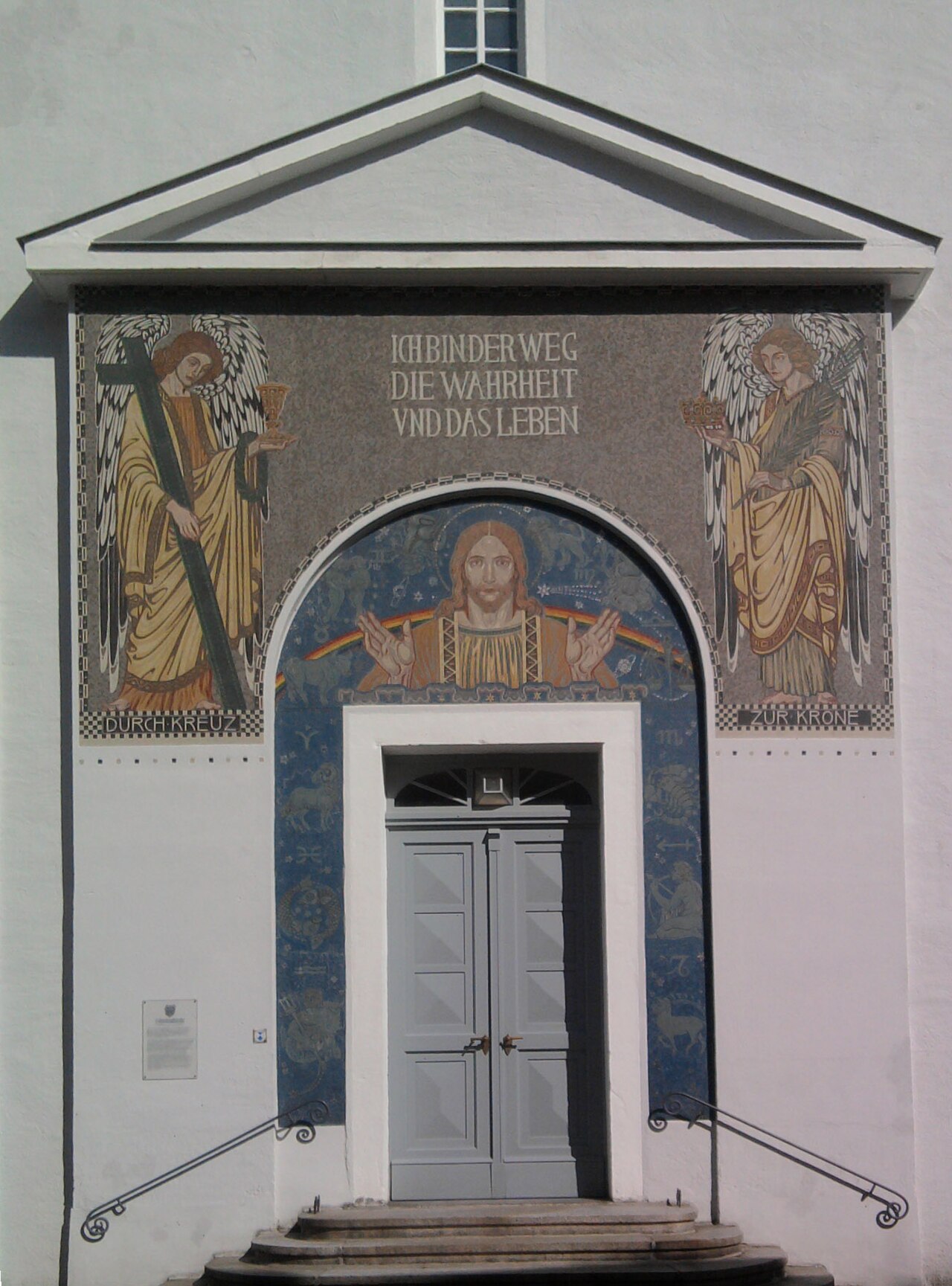
Photo by uploader · Mosaik Josef Goller · CC BY-SA 3.0
- Born
- 1868 · Dachau.
- Died
- 1947 · Obermenzing.
- Nationality
- Germany
- Occupation
- university teacher · graphic artist · illustrator · designer · draftsperson · exlibrist · glass painter
- Fields
- stained glass · graphics
- Movements
- Art Nouveau
- Languages
- German
VALÉORINE Encyclopedia
VALÉORINE documentary reading
Documentary summary
Illustration — Mosaic at the entrance of Christuskirche Bischofswerda (together with Villeroy & Boch) Josef Goller (25 January 1868 in Dachau – 29 May 1947 in Obermenzing) was a German designer, most notably of stained glass.
Admitted source layer · organised and presented by VALÉORINE
Reference Check
Propose documentary evidence for Josef Goller. A contribution is never written directly as fact: identity, source, rights and evidence gates still decide.
Sign in to contribute
World of VALÉORINE
Documentary connections
Only confirmed graph relationships appear here. Images are shown only when their identity and reuse rights both pass the documentary gate.
Documentary evidence
Documentary basis
Authority files
wikidata · Q1704673 · wikipedia · Josef Goller
In this article
Life
Life
Goller apprenticed at Franz Mayer & Co. and attended the School of Applied Arts in Munich. After a first employment in Zittau, in 1890 he moved to Dresden, where he joined the well-known stained glass company of Bruno Urban; he later became Urban's partner. From 1906 Goller taught at the School of Applied Arts in Dresden, now the Dresden Academy of Fine Arts, from about 1909 as a professor. Among his students were Otto Griebel (stained glass) and Friedrich Kurt Fiedler (graphics). In 1928 Goller returned to Munich.
Artwork
Artwork
He created stained glass for town halls in Nuremberg, Dresden, and Chemnitz and for many churches and schools in Saxony and the synagogue of Görlitz, but also for the windows of the neo-Baroque Kaiserpalast, Dresden's most impressive private building at that time, the Dresden Zoo and the Leipzig Hauptbahnhof. Moreover, Goller designed the interior of important national and international exhibitions in Dresden, as well as the colouring of the foyer in the Semperoper. Goller became known for his works in Art Nouveau style, but he remained open to new influences. He was a member of Die Elbier, a post-secessionist movement led by Gotthardt Kuehl which reflected impressionism and en plein air. With time Goller became a supporter of form follows function and joined the Deutscher Werkbund. He also created noted posters and designed books. He had friendly relations with Peter Behrens and Johann Vincenz Cissarz.
Career and activity
Career and activity
Josef Goller worked in stained glass and graphics. His work is associated with Art Nouveau. He was employed by Dresden Academy of Fine Arts. He belonged to Deutscher Werkbund and Grün-Weiß.
Identity
Identity
Josef Goller is recorded as university teacher, graphic artist, illustrator, designer and draftsperson.
![22.01.2007 01099 Dresden, Stauffenbergallee 9: Katholische St. Martin Kirche (Garnisonkirche, 1895 - 1900). Buntglasfenster St. Mauritius (links der Orgel). Die Buntglasfenster wurden nach Skizzen der Architekten Josef Goller (1868-1947) und Bruno Urban (1851-1910) geschaffen und von der Fa. Puhl und Wagner in Berlin ausgeführt[DSCN20686.TIF]20070122060DR.JPG(c)Blobelt](https://upload.wikimedia.org/wikipedia/commons/thumb/8/80/20070122060DR_Dresden_St_Martin_Garnisonkirche_Fenster.jpg/800px-20070122060DR_Dresden_St_Martin_Garnisonkirche_Fenster.jpg)
22.01.2007 01099 Dresden, Stauffenbergallee 9: Katholische St. Martin Kirche (Garnisonkirche, 1895 - 1900). Buntglasfenster St. Mauritius (links der Orgel). Die Buntglasfenster wurden nach Skizzen der Architekten Josef Goller (1868-1947) und Bruno Urban (1851-1910) geschaffen und von der Fa. Puhl und Wagner in Berlin ausgeführt[DSCN20686.TIF]20070122060DR.JPG(c)Blobelt
Jörg Blobelt

Plakat
Josef Goller (1868-1947)
Life and career
Dated record
Life and career
The full dated record · 2 entries
1868
Josef Goller was born in 1868 at Dachau.
1947
Josef Goller died in 1947 at Obermenzing.
Places
Named by the record
Places
Only places the record itself states, plotted where the house gazetteer settles their coordinates. Nothing is inferred from a name or a nationality.
Dachau.
Birth place
Obermenzing.
Death place
Literature
Literature
• Frank Fiedler, Uwe Fiedler: Lebensbilder aus der Oberlausitz, Books on Demand, 2017 (Digitalisat in the Internet Archive)
Literature
Literature
Literature
Goller, Josef, Benezit Dictionary of Artists, 2011
Scholarly footprint
Literature
Scholarly footprint
A count of publications is evidence of attention, not of standing, and is given here only as a measure.
Citations
References
Each reference names the institution holding it, so a reader may go to the document itself.
reference work
Secondary witnessreference work
Secondary witness
The Encyclopedia exists whether or not anything is for sale. Corrections are recorded rather than overwritten, and every version of this record is kept. Published 16 August 2026.
Elsewhere in Modern design
3,254 published records in this field, each with its sources named.
- José Arroyo CabreraDesigner
- José María AlguéDesigner
- Josef Andreas KrannerDesigner
- Josef EkbergDesigner
- Josef Hermann TautenhaynDesigner
- Josef MiklDesigner
- Josef ReinhardDesigner
- Josep Puig i CadafalchDesigner
Best supported in this field
For owners
Own a work by Josef Goller?
A specialist will read what you send and tell you what the house can establish, what it cannot, and whether the object is suited to sale. There is no charge and no obligation. The object stays with you throughout; nothing is shipped to us unless it is arranged in writing beforehand.