
Johann Elias Ridinger
Johann Elias Ridinger (16 February 1698 in Ulm – 10 April 1767 in Augsburg) was a German painter, engraver, draughtsman and publisher. He is considered one of the most famous German engravers of animals, particularly horses, hounds and hunting scenes. His art was also depicted on Meissen porcelain giving wide recognition in his time.
Also recorded as Johann Elias Redenger · Johann Elias Ridenger · Johann Elias Ridingerus · Johann Elias Redinger
Johann Elias Ridinger
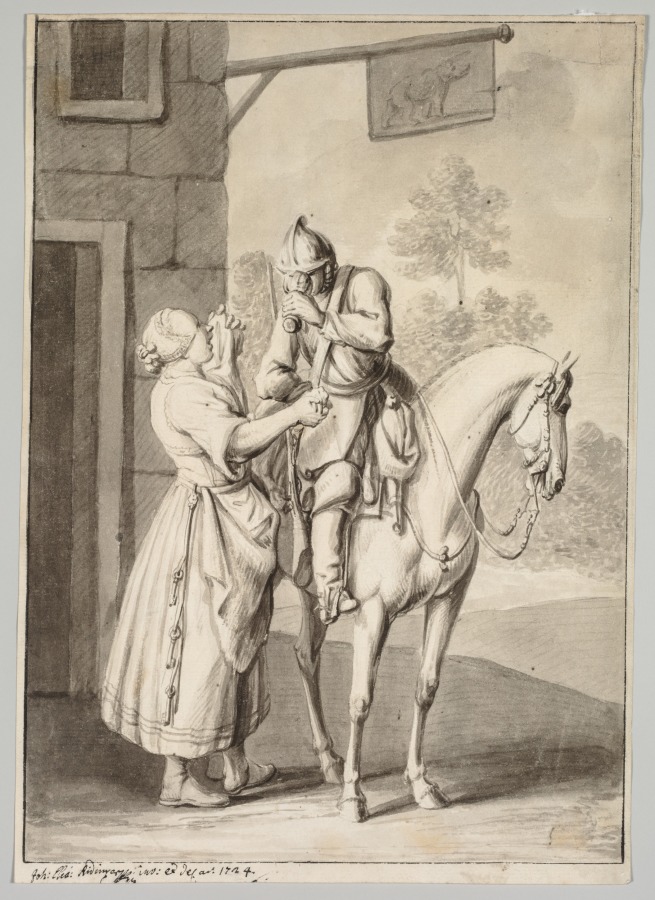
Johann Elias Ridinger · The Cleveland Museum of Art · Gift of Thomas le Claire · CC0
- Born
- sources differ (1698 and 1698).
- Died
- 1767.
- Nationality
- Germany.
- Occupation
- painter, graphic artist, publisher, printmaker and visual artist.
VALÉORINE Encyclopedia
VALÉORINE documentary reading
Documentary summary
Johann Elias Ridinger (16 February 1698 in Ulm – 10 April 1767 in Augsburg) was a German painter, engraver, draughtsman and publisher. He is considered one of the most famous German engravers of animals, particularly horses, hounds and hunting scenes. His art was also depicted on Meissen porcelain giving wide recognition in his time.
Admitted source layer · organised and presented by VALÉORINE
Reference Check
Propose documentary evidence for Johann Elias Ridinger. A contribution is never written directly as fact: identity, source, rights and evidence gates still decide.
Sign in to contribute
Documentary evidence
Documentary basis
Authority files
gnd · 2058091-5 · wikidata · Q530683 · wikipedia · Johann Elias Ridinger
In this article
Life and work
Life and work
Ridinger was born in Ulm in a family of artists. His father Johann Daniel (1656 – c. 1737) was a scribe married to Regina Catharina Miller (1663–1703). He began his training in Ulm with the painter Christoph Resch (1701–1716). Resch gave his students the menial tasks of painting wax models but trained them on perspective, geometry and architecture. Ridinger later studied under Johann Falch (1687–1727) in Augsburg. He learned the art of engraving from Georg Philipp Rugendas. On the recommendation of Gabriel Spitzel he worked for Wolf, Freiherr von Metternich (1706–1731), he spent three years in Regensburg: his coursing and visits to the riding school there proved decisive for his development. His engraved, etched and scratched sheets show the animals in characteristic movements and positions in a landscape environment. The ornamental movements in his works show visibly Rococo stylistic tendencies. He returned to Augsburg and studied engraving and etching under Georg Philipp Rugendas the Elder (1666–1742). Ridinger married Jacobina zur Helle, the widow of his friend Johannes Seuter in 1723 and shortly after founded his own art publishing house in Augsburg, where most of his works appeared. In 1757 he worked as an assessor at the Protestant Marriage Court and in 1759 he became the director of the Augsburg Stadtakademie. Nearly 1,600 prints were produced by his firm of which 1,200 depict animals. His drawings were often executed with precision and taste and hence his work was held in high esteem and was also transferred to decoration, porcelain and ceramics. He died from a stroke at the age of 69. His sons Martin Elias and Johann Jakob continued to produce prints from his original copperplates. Ridinger's life is known thanks to a manuscript biography written in 1764. This manuscript was owned by Rudolph Weigel (1804–1867) in Leipzig and was published in 1766. Ridinger's son also wrote a biography of their father. Georg August Wilhelm Thienemann (1781–1863) wrote another major biography.
Life and career
Dated record
Life and career
The full dated record · 2 entries
1698
Johann Elias Ridinger was born in 1698.
1767
Johann Elias Ridinger died at Augsburg.
Primary material
Documents and archives
scholarly publication
- 172. Johann Elias Ridinger an Gottsched, Augsburg 3. Juni 1745, März 1744 – September 1745, 2016
Scholarly · Crossref registry · 2016
reference work
- “Johann Elias Ridinger”, English Wikipedia, consulted as further reading
Reputable secondary · Wikipedia
authority record
- Wikidata, structured authority record Q530683: Johann Elias Ridinger
General reference · Wikidata
Literature
Peter Prange (2003). "Ridinger, Johann Elias". Neue Deutsche Biographie (in German). Vol. 21. Berlin: Duncker & Humblot. p. 555. (full text online). Ign. Schwarz: Katalog einer Ridinger-Sammlung. (Sammlung Rudolf Ritter von Gutmann.) Vienna 1910. erlebnis ridinger 1698-1998. Dem über die Jahrhunderte hinweg triumphierenden Meister und seinen Freunden zum 300. Geburtstag. Jubilée publication. 1998 Lüder H. Niemeyer: Dresdner Rede. Der verharmloste Ridinger, 27 April 1998 Lüder H. Niemeyer: Die Vanitas-Graphik von Johann Elias Ridinger, 2000 Lüder H. Niemeyer: Die fruchtbare Durchdringung. Watteau im Werke Ridinger's, 2000 Jan Hendrik Niemeyer: Johann Elias Ridinger im Reiche der Kolorierten Thiere. Entstehung und Vollendung einer Folge. New revised edition. 2010 Ellen Spickernagel: Dem Auge auf die Sprünge helfen. Jagdbare Tiere und Jagden bei Johann Elias Ridinger (1698–1767). In: Annette Bühler-Dietrich u. Michael Weingarten (eds.), Topos Tier: Neue Gestaltungen des Tier-Mensch-Verhältnisses. Bielefeld 2015, ISBN 978-3-8376-2860-9, pp. 103–123. U. Heise: Ridinger, Johann Elias. In: Allgemeines Künstler-Lexikon, vol. 98, Berlin, Munich, New York 2017, pp. 472 ff. J.E. Ridinger, Entwurff Einiger Thiere (...) 1738–1740. Faksimile edition, Dr. Wolfgang Schwarze Verlag, Wuppertal 1975. Johann Elias Ridinger. In: Monika Michel: Vorfahren und Verwandte des Tiermalers und Kupferstechers Johann Elias Ridinger (1698–1767). Blätter des Bayerischen Landesvereins für Familienkunde, 50th volume, issue 15, nos. 13–15. 1987. p. 396 f. Jan Hendrik Niemeyer: Ridinger Erlebnisse. Leben Werk Nachruhm in Daten + Annotationen. Norderstedt 2021. ISBN 978-3-7534-3535-0.
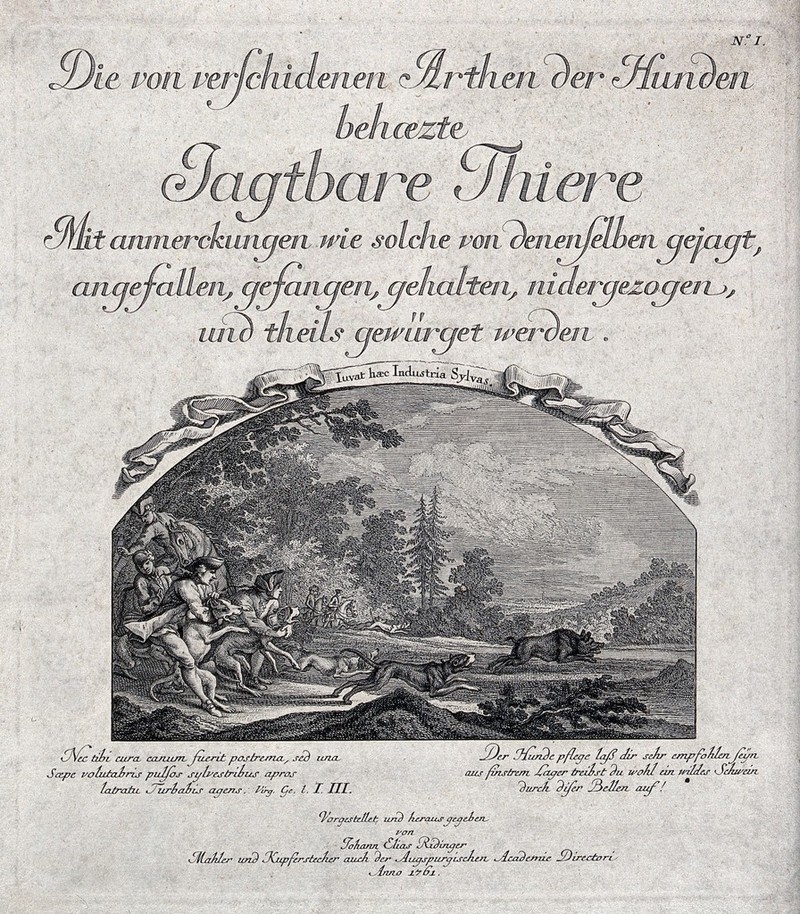
A hunting party in pursuit of a wild boar charging on to a clearing. Etching by J.E. Ridinger., 1761, by Johann Elias Ridinger
Johann Elias Ridinger · Wellcome Collection, London · Wellcome Collection
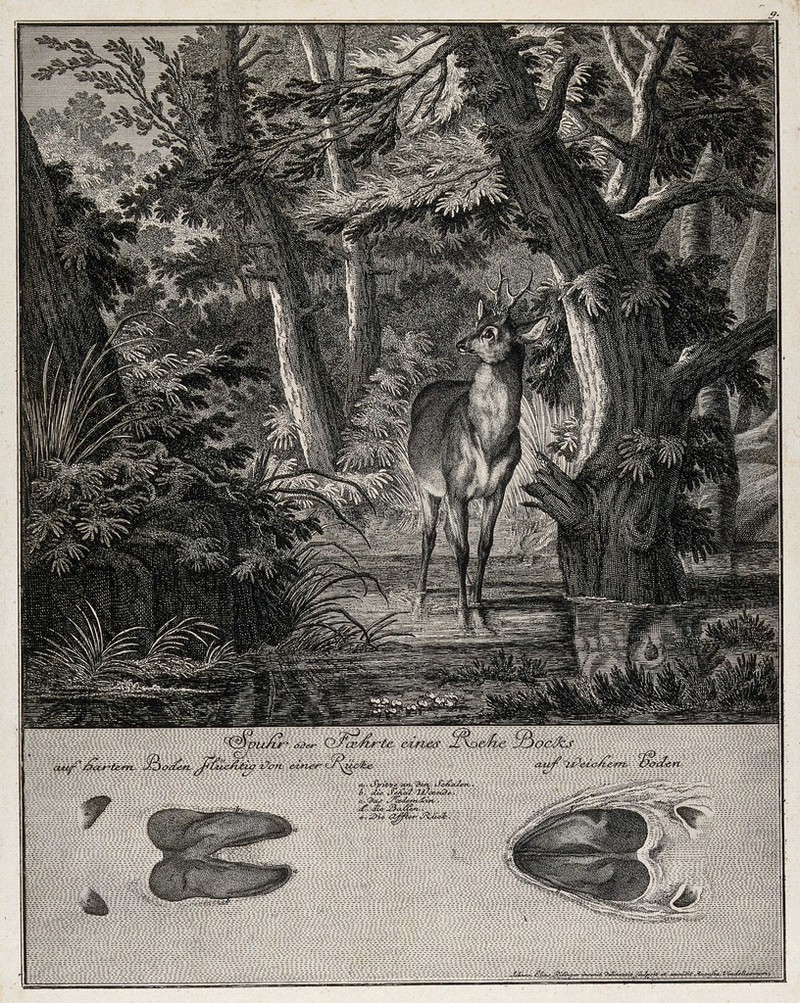
Above, a roebuck crossing a shallow stream in the forest, below, its track. Etching by J. E. Ridinger., by Johann Elias Ridinger
Johann Elias Ridinger · Wellcome Collection, London · Wellcome Collection
Notes from the source article
Cited by Wikipedia
Notes from the source article
These works are cited by the source article, in its own numbering. They are recorded as its citations, not as sources VALÉORINE has verified.
- 1.Johann Elias Ridinger. National Museum of Wildlife Art.
- 2.Antique Ridinger Prints. philographikon.com.
- 3.Johann Elias Ridinger. Answers.com.
- 4.Schmidt, Wilhelm. Allgemeine Deutsche Biographie, herausgegeben von der Historischen Kommission bei der Bayerischen Akademie der Wissenschaften, Band 28. Duncker and Humblot. 505–507. 1889.
- 5.Thienemann,Georg August Wilhelm. : Leben und Wirken des unvergleichlichen Tiermalers und Kupferstechers Ridinger. 1856.
- 6.Berg, Lars. Johann Elias Ridinger als Zeichner. Jahrbuch der Berliner Museen. 56. 91–110. 2014. 0075-2207.
References
Citations
References
Each reference names the institution holding it, so a reader may go to the document itself.
scholarly publication
172. Johann Elias Ridinger an Gottsched, Augsburg 3. Juni 1745, März 1744 – September 1745, 2016Crossref registry
Institutional witnessreference work
Secondary witnessauthority record
General reference
The Encyclopedia exists whether or not anything is for sale. Corrections are recorded rather than overwritten, and every version of this record is kept. Published 14 August 2026.
Elsewhere in Prints
4,138 published records in this field, each with its sources named.
- Johann Christian BrandEngraver
- Johann Christian ReinhartEngraver
- Johann Christoph StorerEngraver
- Johann Elias HaidEngraver
- Johann Evangelist HolzerEngraver
- Johann Friedrich NetteEngraver
- Johann Georg von DillisEngraver
- Johann Georg WilleEngraver
Best supported in this field
For owners
Own a work by Johann Elias Ridinger?
A specialist will read what you send and tell you what the house can establish, what it cannot, and whether the object is suited to sale. There is no charge and no obligation. The object stays with you throughout; nothing is shipped to us unless it is arranged in writing beforehand.