
Jean-Baptiste Alexandre Le Blond
Illustration — Le Blond's master plan for St. Petersburg has been known as "a plan conceived by a gardener". Jean-Baptiste Alexandre Le Blond (1679 – 10 March 1719) was a French architect and garden designer who became the chief architect of Saint Petersburg in 1716.
Also recorded as Jean-Baptiste-Alexandre Le Blond · Jean Baptiste Alexandre Le Blond · Alexandre Jean Baptiste Le Blond · Jean Leblond
Jean-Baptiste Alexandre Le Blond

The original uploader was Agustin.palacioslaloy at English Wikipedia. · CC BY-SA 2.5
- Born
- Jean-Baptiste Alexandre Le Blond was born in 1679. · Paris.
- Died
- Jean-Baptiste Alexandre Le Blond died on 10 March 1719. · Saint Petersburg.
- Nationality
- France
- Occupation
- architect
- Fields
- architecture · landscape architecture
- Movements
- Petrine Baroque
- Teachers
- André Le Nôtre
- Known for
- Constantine Palace · Hôtel de Vendôme
- Languages
- French
VALÉORINE Encyclopedia
VALÉORINE documentary reading
Documentary summary
Illustration — Le Blond's master plan for St. Petersburg has been known as "a plan conceived by a gardener". Jean-Baptiste Alexandre Le Blond (1679 – 10 March 1719) was a French architect and garden designer who became the chief architect of Saint Petersburg in 1716.
Admitted source layer · organised and presented by VALÉORINE
Reference Check
Propose documentary evidence for Jean-Baptiste Alexandre Le Blond. A contribution is never written directly as fact: identity, source, rights and evidence gates still decide.
Sign in to contribute
World of VALÉORINE
Documentary connections
Only confirmed graph relationships appear here. Images are shown only when their identity and reuse rights both pass the documentary gate.

Documentary evidence
Documentary basis
Authority files
wikidata · Q618237 · wikipedia · Jean-Baptiste Alexandre Le Blond
In this article
Career in France
Career in France
Training under André Le Nôtre is recorded. The recorded working language is French. The field of work recorded is architecture and landscape architecture. Places of work recorded in the authority are Saint Petersburg. Works named in the authority record are Constantine Palace and Hôtel de Vendôme. Work by Jean-Baptiste Alexandre Le Blond is recorded in the collections of Nationalmuseum.
He was the son of Jean Le Blond, painter in ordinary to the king, a printseller on the Pont Saint-Michel, Paris, and his wife, Jeanne d'Eu. He studied architecture with his mother's brother Jean Girard, in the service of Philippe I, duc d'Orléans. Jacques-François Blondel implied that he had derived gardening expertise from André Le Nôtre, finding that Le Blond was • one of our Architects, who among us most knew how to profit from the precepts of the great Master... It must be agreed, however, that, in imitating them, it would be suitable to be provided with a certain intelligence Indeed, Le Blond was responsible for more than simply the engravings in Dezallier d'Argenville's seminal work on the principles of French formal garden design, La théorie et la pratique du jardinage, 1709: according to the well-informed connoisseur Pierre-Jean Mariette, chronicler of French artists, he laid out the structural "canvas" of the work and oversaw in detail its writing; the work was published anonymously, but in later editions Le Blond was credited with the text. Named architecte du Roi, he made a set of presentation drawings, dated 1699, for the famous cascade and basin with its jet d'eau at the royal Parc de Saint-Cloud constructed several hôtels particuliers in Paris, notably the Hôtel de Clermont, Rue de Varenne, and the Hôtel de Vendôme, Rue d'Enfer (today Boulevard Saint-Michel). As theoretician and illustrator of architecture, Le Blond produced the second (1710) and third (1720) editions of the Cours d'architecture de Vignole translated with commentary by Charles-Augustin d'Aviler, which Le Blond illustrated with his own drawings. These works introduced the distinctions between state apartments (appartements de parade) and private apartments (appartements de commodités) that would characterize French eighteenth-century planning, and he popularized the small chimneypieces that would take the place of the large ones in the Italian mode, popular in the previous century. He also provided illustrations for L’Histoire de l'abbaye de Saint-Denis (1706) by Michel Félibien.
Career in Russia
Career in Russia
• Illustration — Le Blond's standard design of Saint Peterburg buildings, 1716 • Illustration — Apraksin Palace in St. Petersburg Le Blond did much in a short time to extend the Le Nôtre style beyond France. His cascade at Saint-Cloud may have convinced Peter the Great: in March 1716, Le Blond accepted the tsar's invitation to work at Saint Petersburg, where he arrived in August. An unprecedented title of "Architect-General" was bestowed upon him, together with a pension of some 5,000 roubles. His position was superior to that of all other architects and builders working in St. Petersburg. Within a short span of his stay there, Le Blond established the first nurseries along the banks of the Neva and about twenty workshops, specializing in carving, sculpture, stucco work, tapestries, and so forth. He also succeeded in introducing a program of illuminating the main streets with oil lanterns, designed by himself. Among his Russian projects, probably the best known is an idealistic plan which envisioned Vasilievsky Island as the focus of the new city. Le Blond's plan would have "enclosed the entire city within a perfectly elliptical wall of fortifications", with a network of streets at right angles and squares like the royal squares of France, but the project was not approved. Nor were his projects for the parterres of the Summer Garden and a residence for the tsar at Strelna (1717). Three centuries passed before Le Blond's design for a formal garden at Strelna was eventually implemented during the reconstruction of the Constantine Palace in 2003. Le Blond's main building work in St. Petersburg was a palace of Count Apraksin. Although foreign visitors admitted that "even a king would have been jealous of such a noble dwelling," the palace was eventually demolished to make room for the Winter Palace, which now occupies the site. Working with Friedrich Braunstein and Niccolo Michetti, the French architect also made many structural plans to the first palace and cascades of Peterhof (1717) for which none of his drawings survive, but which are known through copies made by J.E. Randahl, 1739. The architect died suddenly of smallpox in February 1719. The tsar himself was present at the funeral, but Le Blond's grave at the St. Sampson cemetery has not survived.
Life and career
Dated record
Life and career
Explore 1679–1720
The full dated record · 5 entries
1679
Jean-Baptiste Alexandre Le Blond was born on 1 January 1679.
1707
Hôtel de Vendôme is dated 1707.
1711
Peterhof Palaces and complex is dated 1711.
1719
Jean-Baptiste Alexandre Le Blond died at Saint Petersburg.
1720
Constantine Palace is dated 1720.
Places
Named by the record
Places
Only places the record itself states, plotted where the house gazetteer settles their coordinates. Nothing is inferred from a name or a nationality.
Jean-Baptiste Alexandre Le Blond was born at Paris.
Birthplace
Jean-Baptiste Alexandre Le Blond died at Saint Petersburg.
Deathplace
Paris.
Birth place
Saint Petersburg.
Death place
Principal works of architecture
• Hôtel de Vendôme (Hôtel de Chaulnes from 1733 to 1758), Rue d'Enfer, 1706–1707, for Antoine de La Porte, canon of Notre-Dame, backing onto the Jardin du Luxembourg (today housing the École nationale supérieure des mines de Paris); work also for Marie Anne de Bourbon. • Reconstruction of the Hôtel de Duras, rue Saint-Augustin, 1708, for Louise-Madeleine de La Marck, widow of Henri de Durfort, duc de Duras. • Hôtel de Clermont, 69 rue de Varenne, 1713, for Jeanne Thérèse Pélagie d'Albert de Luynes, marquise de Saissac. • House at Meudon, 1714, for Jeanne Baptiste d'Albert de Luynes, comtesse de Verrue. • Archbishop's Palace, Auch. • Jardins du Canet, near Narbonne. • Maison Regnault at Châtillon-sous-Bagneux. • Apraksin Palace, Saint Petersburg, 1717–1718. • Strelna and Peterhof parks, 1717–1718.
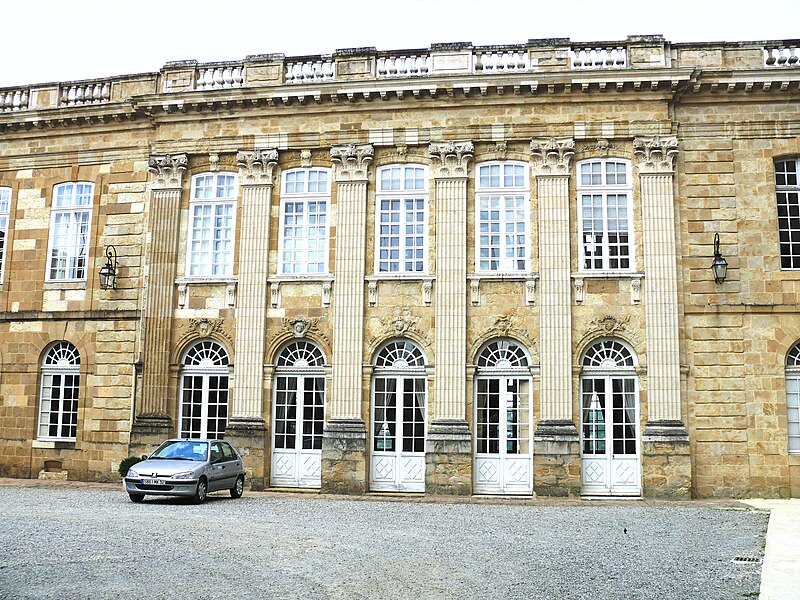
Auch - Prefecture du Gers, ancien Palais archiépiscopal
MOSSOT

Auch - Préfecture du Gers, ancien palais archiépiscopal
MOSSOT
Primary material
Documents and archives
scholarly publication
- Olga Medvedkova, Jean-Baptiste Alexandre Le Blond, architecte 1679-1719, Cahiers du monde russe, 2007
Scholarly · Crossref registry · 2007
- Review: <i>Jean-Baptiste Alexandre Le Blond, Architecte 1679–1719. De Paris à Saint-Pétersbourg</i>, by Olga Medvedkova, Journal of the Society of Architectural Historians, 2008
Scholarly · Crossref registry · 2008
reference work
- Wikidata, structured authority record Q618237: Jean-Baptiste Alexandre Le Blond
Reputable secondary · Wikimedia Foundation
- “Jean-Baptiste Alexandre Le Blond”, English Wikipedia, consulted as further reading
Reputable secondary · Wikipedia
References
Citations
References
Each reference names the institution holding it, so a reader may go to the document itself.
scholarly publication
Olga Medvedkova, Jean-Baptiste Alexandre Le Blond, architecte 1679-1719, Cahiers du monde russe, 2007Crossref registry
Institutional witnessscholarly publication
Institutional witnessreference work
Wikidata, structured authority record Q618237: Jean-Baptiste Alexandre Le BlondWikimedia Foundation
Secondary witnessreference work
Secondary witness
People, houses and institutions
Knowledge graph
People, houses and institutions
Teachers, collaborators, publishers and institutions recorded against this person, each on a stated basis.
Born at
1- ParisPlace
Established from a fact already recorded on a verified source.
The Encyclopedia exists whether or not anything is for sale. Corrections are recorded rather than overwritten, and every version of this record is kept. Published 16 August 2026.
Elsewhere in Design
11,558 published records in this field, each with its sources named.
- Jean-Amédée GibertDesigner
- Jean-Antoine AlavoineDesigner
- Jean-Antoine MorandDesigner
- Jean-Arnaud RaymondDesigner
- Jean-Baptiste Androuet du CerceauDesigner
- Jean-Baptiste BouchardonDesigner
- Jean-Baptiste ChermanneDesigner
- Jean-Baptiste De DobbeleerDesigner
Best supported in this field
For owners
Own a work by Jean-Baptiste Alexandre Le Blond?
A specialist will read what you send and tell you what the house can establish, what it cannot, and whether the object is suited to sale. There is no charge and no obligation. The object stays with you throughout; nothing is shipped to us unless it is arranged in writing beforehand.