
Hata no Kawakatsu
Hata no Kawakatsu (秦河勝, alternatively read as Hada no Kōkatsu), or Hata no Miyatsuko no Kawakatsu (秦造河勝), was a semi-legendary statesman active during the Asuka period in Japan. He is recorded as serving under Empress Suiko and Empress Kōgyoku in the Nihon Shoki, and appears as a noteworthy figure in narratives surrounding Prince Shōtoku. Later legends present Kawakatsu as the reincarnation of Emperor Qin Shi Huang, in addition to being the ancestor of the Hata clan and the founder of sarugaku.
Hata no Kawakatsu

Wikimedia Commons · Public domain
- Name
- Hata no Kawakatsu
- Occupation
- politician
- Born
- 600 · Korean Peninsula.
VALÉORINE Encyclopedia
VALÉORINE documentary reading
Documentary summary
Hata no Kawakatsu (秦河勝, alternatively read as Hada no Kōkatsu), or Hata no Miyatsuko no Kawakatsu (秦造河勝), was a semi-legendary statesman active during the Asuka period in Japan. He is recorded as serving under Empress Suiko and Empress Kōgyoku in the Nihon Shoki, and appears as a noteworthy figure in narratives surrounding Prince Shōtoku. Later legends present Kawakatsu as the reincarnation of Emperor Qin Shi Huang, in addition to being the ancestor of the Hata clan and the founder of sarugaku.
Admitted source layer · organised and presented by VALÉORINE
Note VALÉORINE
The Wikipedia record describes Hata no Kawakatsu as a musician. Hata no Kawakatsu was born in 600, in Korean Peninsula.
Composed from admitted, traceable facts · 27 September 2026
VALÉORINE
Reference Check
Propose documentary evidence for Hata no Kawakatsu. A contribution is never written directly as fact: identity, source, rights and evidence gates still decide.
Sign in to contribute
World of VALÉORINE
Documentary connections
Only confirmed graph relationships appear here. Images are shown only when their identity and reuse rights both pass the documentary gate.
Documentary evidence
Documentary basis
Authority files
wikidata · Q5680877 · wikipedia · Hata no Kawakatsu
In this article
Biography
Biography
He is also credited with the construction of Kōryū-ji in Kyoto, and is enshrined as the deity Ōsake Daimyōjin (大避大明神) at the Ōsake Shrine in Akō.
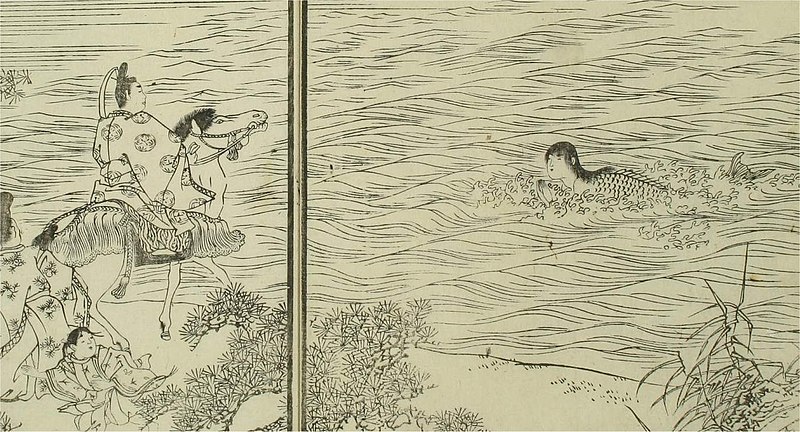
A ningyo (merman/mermaid) appeared before Prince Shōtoku in the reeds at Kanzaki-kōri, Ōmi Province. It revealed itself to be a fisherman at Katada in past life, and the prince, according to its wish, erected the Ishibaji (石馬寺; 石場寺 in the text) housing a Kannon statue for him, to grant peace to his soul. The prince is mounted, and at his side are presumably Hata no Kawakatsu 秦河勝 and Tomi no Ichi
Kōyo Shun'ō 厚誉春鶯 (text) · Kōyo Shun'ō
Key facts
Key facts
• Name — Hata no Kawakatsu • Occupation — politician • Period — Kofun - Asuka • Native Name — 秦河勝
Family
Family
Kawakatsu belonged to the Hata clan, an immigrant group that settled in Japan during the fourth and fifth centuries. They were particularly influential within the Kadono district of what is now Kyoto, and played a significant part in the formation of Japan's political and religious institutions. Furthermore, the Hata were renowned for being skilled weavers, brewers and construction workers, credited with the introduction of technologies such as sericulture. Various origins have been attributed to the Hata clan over time, with the Nihon Shoki recording that Yuzuki no Kimi, alongside 120 members of his clan (i.e. the Hata), settled in Japan from Baekje during the reign of Emperor Ōjin. Alternatively, the Shinsen Shōjiroku states that the Hata were descended from Emperor Qin Shi Huang, linking the name Hata (秦) to the Qin dynasty (秦). Despite this, it is agreed by most modern scholars that the Hata clan was of Korean origin, having arrived in Japan from Silla. Although little is known concerning Kawakatsu's direct family, the noh playwright Zeami Motokiyo claimed to be a distant descendant of his, even referring to himself as Hata no Motokiyo (秦元清). In his work the Fūshikaden (風姿花伝; "Transmission of the Flower Through Forms"), Zeami goes on to assert that the leaders of the Konparu troupe can trace their ancestry back to Hata no Ujiyasu (秦氏安), a descendant of Kawakatsu, who inherited the art of sarugaku and performed alongside his brother-in-law Ki no Gonnokami (紀権守). Together the two are also credited with establishing the three performances of Shiki-sanban (式三番; "The Three Ceremonies"). Much like Zeami, the musicians of Shitennō-ji likewise claimed to be descendants of Kawakatsu, and by extension Qin Shi Huang.
Nihon Shoki
Nihon Shoki
• Illustration — Kōryū-ji, a Shingon temple in the district of Uzumasa (Ukyō ward, Kyoto). The Nihon Shoki makes only sparse references to Hata no Kawakatsu, providing no record of his birth or death, but acknowledges him as a high-ranking courtier (大夫, taifu) who served Empress Suiko and Empress Kōgyoku. He is first mentioned in the eleventh year of Empress Suiko's reign (603 CE) as founding a temple called Hachioka-dera (蜂岡寺), also known as Kōryū-ji, after receiving a statue of the Buddha as a gift from Prince Shōtoku. In the eighteenth year of Empress Suiko's reign (610 CE), Kawakatsu was tasked with escorting a group of envoys from Silla, aided by another servant named Haji no Muraji Usagi (土師連菟). Together with Hashihito no Muraji Shiofuta (間人連臨蓋) and Abe no Omi Ōko (阿閉臣大籠) accompanying a group from Mimana, the envoys were brought before the south gate of the imperial court. Kawakatsu was also responsible for putting an end to the self-destructive worship of a "faddish deity" (流行神, hayarigami), named Tokoyo-no-Kami (常世の神; "God of the Everlasting World"), in the third year of Empress Kōgyoku's reign (644 CE). It is said that the people of that time then made a song, saying: The Nihon Shoki further states that the "Insect of the Everlasting World" (常世の虫, Tokoyo no Mushi) resembled a silkworm, over four inches in length and about as thick as a thumb. It had a green coloration with black spots, and lived on tachibana and hosoki (曼椒; "creeping pepper") trees. Based on this description it is theorized that the insect in question may have been the caterpillar of a Swallowtail butterfly, specifically P. xuthus, given that they feed on both Citrus and Zanthoxylum.
Shōtoku Taishi Denryaku
Shōtoku Taishi Denryaku
Kawakatsu is acknowledged as having close ties to Prince Shōtoku in the Shōtoku Taishi Denryaku (聖徳太子伝暦; "Biography of Prince Shōtoku"), compiled in the tenth century, which records his name as Hata no Miyatsuko no Kawakatsu (秦造川勝). • Illustration — A scroll from the "Illustrated Biography of Prince Shōtoku" (聖徳太子絵伝, Shōtoku Taishi Eden) owned by Shitennō-ji. It is written that, when Prince Shōtoku was sixteen years old, Kawakatsu served as the head of his army during the Battle of Shigisan. In an effort to secure victory, Prince Shōtoku commanded Kawakatsu to carve statues of the Four Heavenly Kings out of Chinese sumac (白膠, nude). Raising the statues over his head (or alternatively at the army's vanguard), Prince Shōtoku then vowed: “If I am granted victory, I will build a temple in honor of the Four Heavenly Kings who protect the world.” This temple being Shitennō-ji. During the battle, Kawakatsu was also responsible for beheading the rebel Mononobe no Moriya: When Prince Shōtoku was thirty three years old he addressed Kawakatsu about a dream he had, in which he traveled north to a beautiful village and attended a feast held by Kawakatsu's relatives. Kawakatsu himself confirmed that his village was exactly as the prince observed in his dream, and so the two departed for the village the following day. The building was later converted into a temple and given to Kawakatsu, in addition to 30 chō (町; approx. 0.99 hectares) of rice fields in front of the temple and 60 chō of mountains and fields behind the temple. He also received items such as Buddhist statues and banners that had been donated by the King of Silla. According to another biography produced in 1666, Prince Shōtoku's horse, the Black Steed of Kai (甲斐の黒駒, Kai no Kurokoma), was chosen from among a thousand horses that were gathered as a gift from Hata no Kawakatsu.
Fūshikaden
Fūshikaden
While Hata no Kawakatsu was merely presented as a courtly figure in the Nihon Shoki, the Kōryū-ji traditions asserted his identity as the semi-divine reincarnation of Emperor Qin Shi Huang. This is reflected in the Fūshikaden (風姿花伝), a treatise on noh drama written in the early fifteenth century by Zeami Motokiyo, which provides a legendary account of Kawakatsu's life, alongside other narratives concerning the origins and transmission of sarugaku. According to the Fūshikaden, Kawakatsu not only served under the emperors Kinmei, Bidatsu, Yōmei and Sushun, in addition to Empress Suiko and Prince Shōtoku, but was also the supernatural progenitor of the Hata clan. • Illustration — The Ukon no Tachibana (右近橘) located outside the Hall for State Ceremonies (紫宸殿, Shishinden) at the Kyoto Imperial Palace. According to the Gōdanshō (江談抄), the site was said to have formerly been the residence of Hata no Kawakatsu. Following this, the Fūshikaden also credits Kawakatsu and Prince Shōtoku with the founding of sarugaku: Kawakatsu, wishing to leave no trace of his manifestation (化人, kenin), is then said to have set out from Naniwa Bay, in the province of Settsu, aboard a "hollow ship" (うつぼ舟, utsubo-bune). Entrusting himself to the wind, he sailed across the western sea and eventually arrived at Sakoshi Bay in the province of Harima. Taikō Daimyōjin is also identified as Ōsake Daimyōjin (大避大明神), a deified form of Hata no Kawakatsu enshrined at the Ōsake Shrine in the town of Sakoshi (Akō).
Ikishima
Ikishima
A local legend from Sakoshi speaks of how Kawakatsu arrived at the bay by boat in 644, fleeing prosecution from the Soga clan. After his death, the Ōsake Shrine was subsequently built to appease Kawakatsu's spirit, with the nearby island of Ikishima, which belongs to the precincts of the Ōsake Shrine, claimed to be his final resting place. • Illustration — The otabisho of the Ōsake Shrine on the island of Ikishima in Sakoshi (Akō). An alleged "Grave of Hata no Kawakatsu" (秦河勝の墓) is also located on the island.
Shōyoshō
Shōyoshō
In a legend from the Shōyoshō (聖誉鈔), a Muromachi period work on Prince Shōtoku, Kawakatsu is noted as one of the two sons of Hata no Sake no Kimi. The account describes Sake no Kimi (酒公) as a great-grandson of the first Chinese emperor (i.e. Qin Shi Huang), who received his name because he grew up in a jar (酒瓶, sakebin). Having fled China, Sake no Kimi arrived in Japan at Naniwa Bay in Settsu where he was awarded the name Hada (秦) by Empress Suiko. He is then said to have begot two sons, with the older, Toshiyuki, being ennobled, and the younger, Kōkatsu, becoming a servant. Hata no Sake no Kimi is himself an important figure in the Hata clan's history, recognized in the Nihon Shoki as being made chief of the Hata in the fifteenth year of Emperor Yūryaku's reign (471 CE). Under Sake no Kimi's leadership the silk produced by the Hata workmen piled up so high that he was given the title of Uzumasa (禹豆麻佐, a phonetic spelling of 太秦).
Kōryū-ji
Kōryū-ji
• Illustration — The "Crowned Maitreya" (宝冠弥勒, Hōkan Miroku) statue housed at Kōryū-ji, designated as a national treasure. Hata no Kawakatsu is credited with founding Kōryū-ji (also called Uzumasa-dera (太秦寺), Kadono-dera (葛野寺), Hata no Kimi-dera (秦公寺) and Hachioka-dera (蜂岡寺)), a Hata clan temple located in the Uzumasa district. Said to be the oldest Buddhist temple in Kyoto. The Nihon Shoki records its construction as occurring in the year 603, after Kawakatsu received a statue of the Buddha as a gift from Prince Shōtoku. Temple tradition identifies this gift with a statue of Maitreya housed in its collection. According to the Kōryū-ji Engi (広隆寺縁起) and Kōryūji Shizai Kōtai Jitsurokuchō (広隆寺資財交替実録帳) however, the temple was instead built in the year 622, as a memorial to Prince Shōtoku. This appears to correspond with another report in the Nihon Shoki, that in the year 623 a Buddha statue, presented by envoys from Silla and Mimana, was installed at the Hata Temple in Kadono (葛野秦寺, Kadono no Hata-dera). Furthermore, the Jōgū Shōtoku Hōō Teisetsu (上宮聖徳法王帝説; "Imperial Record of Prince Shōtoku, Dharma King of the Upper Palace") lists Kōryū-ji as one of the seven temples built by Prince Shōtoku himself.
Ōsake Jinja
Ōsake Jinja
Kawakatsu is enshrined as Ōsake Daimyōjin (大避大明神), also called Ōsake-no-Ōkami (大避大神), at the Ōsake Shrine (大避神社) in Akō, he additionally serves as the central deity of the shrine's autumn festival, the "Sakoshi Boat Festival" (坂越の船祭り, Sakoshi no Funamatsuri). According to the historical documents of the shrine, the festival was traditionally held on the 12th of September (based on the lunar calendar), the date Kawakatsu was believed to have drifted ashore the nearby island of Ikishima, however the festival is now held on the second weekend of October. An Ōsake Shrine (大酒神社) is also present in Kyoto, formerly belonging to the precincts of Kōryū-ji before it was relocated during the Meiji Restoration. Although it does not enshrine Kawakatsu, instead venerating Emperor Qin Shi Huang, Yuzuki no Kimi and Hata no Sake no Kimi, it is said that the shrine was initially established by one King Kōman (功満王), a supposed descendant of Qin Shi Huang and ancestor of the Hata clan, to worship the deity Ōsake Myōjin (大酒明神). Additionally, the Engishiki records the shrine's name as Ōsake Jinja (大辟神社), with the enshrined deity being referred to as Ōsake-no-Kami (大辟神). The Japanese scholar Peter Yoshiro Saeki, in his work Uzumasa wo Ronzu (太秦を論ず; "Discussing the Hata"), argued that Ōsake (大酒 or 大辟) was derived from the Chinese name for King David (大闢, Dàpì), citing this, among other things, as proof that the Hata were of Jewish descent. This is widely dismissed as ahistorical in modern scholarship however, as Dàpì (大闢) is only used to render the name David in modern Chinese (while Duōhuì (多恵) was used historically), and the case for Jewish ancestry among the Hata lacks any significant textual or DNA evidence to support it.
Meishukushū
Meishukushū
Zeami Motokiyo's successor and son-in-law, Konparu Zenchiku, also viewed Kawakatsu as an important figure in his conception of the deity Okina, as developed in his incomplete work the Meishukushū (明宿集; "Collected Writings Illuminating the Indwelling Deity"). The text serves chiefly as an explication of the nature and significance of Okina (翁; "Old Man"), a name referring to the central role played in Shiki-sanban, interpreted by Zenchiku as a primordial deity who was the source of all the gods and buddhas. The Meishukushū identifies numerous figures as manifestations of Okina, such as Sumiyoshi Daimyōjin and Ariwara no Narihira, but places particular emphasis on Shukujin (宿神; meaning "astral deity" or "god of destiny"); a god worshiped among outcast groups; inhabitants of the shuku (宿; "relay station"), presented in the Meishukushū as a clan deity of the Konparu family. • Illustration — A Muromachi period Okina (翁; "Old Man") mask, used in Shiki-sanban According to Zenchiku, Okina came into being at the creation of the world to protect the imperial throne and aid the Japanese people. Kawakatsu in-turn served as one of the many incarnations of Okina, and performed Okina-sarugaku (翁猿楽) at the command of Prince Shōtoku with the intention of establishing peace in the realm. As a result, Zenchiku assigned spiritual significance to Kawakatsu's actions, stating of his involvement in the Battle of Shigisan: Additionally, the Konparu lineage claimed descent from Kawakatsu, citing as proof their inheritance of three treasures that had supposedly been handed down from Kawakatsu himself: A demon mask carved by Prince Shōtoku, a painting of Okina as performed by Kawakatsu (though formerly described by Zeami as a portrait of Kasuga Myōjin), and one of the Buddha's relics. In the Meishukushū, this mask was further explained by Zenchiku as representing the dual-nature of Shukujin, who manifests as both the benevolent deity of song and dance, Okina, and the "raging spirit" (荒神, kōjin) of Hata no Kawakatsu. • Illustration — An Edo period illustration of the "Ox Festival" (牛祭, Ushi-matsuri) held at Kōryū-ji, centered on the deity Matarajin. Though never explicitly mentioned in the Meishukushū, it has been suggested by Hattori Yukio that Zenchiku implicitly equated the Tendai deity Matarajin with his notion of Shukujin. Matarajin was chiefly enshrined at the backdoor (後戸, ushirodo) of temples, where sarugaku performances took place, and so merged with the figure of Okina as a protector of the performing arts. Hattori thus argued that the original function of sarugaku was to entertain and placate Matarajin, whose violent disposition was projected on to the stories surrounding Kawakatsu. A connection between the two figures is further evidenced by Matarajin's role in the annual "Ox Festival" (牛祭, Ushi-matsuri) held at Kōryū-ji, wherein a priest wearing a white mask (supposedly representing Matarajin), flanked by four monks dressed as demons (symbolizing the Four Heavenly Kings), rides a black ox while reciting saimon (祭文; "ritual text") aimed at eliminating disease. Moreover, it has been proposed that Matarajin was a deity worshiped by Korean immigrants such as the Hata clan, and that Matarajin's identification with Okina was facilitated by his association with such groups.
Primary material
Documents and archives
reference work
- “Hata no Kawakatsu”, English Wikipedia, consulted as further reading
Reputable secondary · Wikipedia
authority record
- Wikidata, structured authority record Q5680877: Hata no Kawakatsu
General reference · Wikidata
Notes from the source article
Cited by Wikipedia
Notes from the source article
These works are cited by the source article, in its own numbering. They are recorded as its citations, not as sources VALÉORINE has verified.
- 1.Scroll 10 - Emperor Ojin - shoki. 2011-08-23.
- 2.Shiki-sanban the-Noh.com Noh Terminology. db2.the-noh.com.
- 3.日本古典文学摘集 風姿花伝 第四 神祇 四 原文. www.koten.net.
- 4.Scroll 22 - Empress Suiko - shoki. 2011-08-23.
- 5.Scroll 24 - Empress Kogyoku - shoki. 2011-08-23.
- 6.都市史01 秦氏. www2.city.kyoto.lg.jp.
- 7.Encyclopedia of Shinto詳細. 國學院大學デジタルミュージアム.
- 8.聖徳太子伝暦 1/2 _Taiju's Notebook. www2s.biglobe.ne.jp.
- 9.聖徳太子伝暦 1/2 _Taiju's Notebook. www2s.biglobe.ne.jp.
- 10.聖徳太子伝暦 1/2 _Taiju's Notebook. www2s.biglobe.ne.jp.
- 11.聖徳太子伝暦 1/2 _Taiju's Notebook. www2s.biglobe.ne.jp.
- 12.聖徳太子伝暦 1/2 _Taiju's Notebook. www2s.biglobe.ne.jp.
- 13.聖徳太子伝暦 1/2 _Taiju's Notebook. www2s.biglobe.ne.jp.
- 14.日本古典文学摘集 風姿花伝 第四 神祇 三 原文. www.koten.net.
- 15.江談抄/第一 - Wikisource. ja.wikisource.org.
- 16.赤穂市/大避神社. www.city.ako.lg.jp.
- 17.大避神社(赤穂市) - Shrine-heritager. shrineheritager.com. 2021-01-16.
- 18.生島 : 観光 : 赤穂観光 FEEL AKO TIME. ako-kankou.jp.
- 19.Scroll 14 - Emperor Yuryaku - shoki. 2011-08-23.
- 20.Koryu-ji Temple (Miroku Bosatsu,location,history). 京都ガイド.
Bibliography printed in the source article · 21
- Aston, William George. Nihongi : chronicles of Japan from the earliest times to A.D. 697. Kegan Paul, Trench, Trübner & Co. 2. 1896.
- Como, Michael. Weaving and Binding: Immigrants Gods and Female Immortals in Ancient Japan. University of Hawaii Press. 2009. 978-0-8248-3752-5.
- Deal, William E. Religions of Japan in Practice. Princeton University Press. 17. 316–333. 1999. 978-0-691-21474-0.
- Faure, Bernard. From Bodhidharma to Daruma: The Hidden Life of a Zen Patriarch. Japan Review. International Research Centre for Japanese Studies, National Institute for the Humanities. 23. 45–71. 2011. 0915-0986.
- Faure, Bernard. The Cultic World of the Blind Monks: Benzaiten, Jūzenji, and Shukujin. Journal of Religion in Japan. 2. 2–3. 171–194. 2013. 2211-8349.
- Faure, Bernard. Protectors and Predators. University of Hawaii Press. 2. 2015. 978-0-8248-5772-1.
- Faure, Bernard. Rage and Ravage. University of Hawaii Press. 3. 2022. 978-0-8248-8938-8.
- Goethem, Ellen V. Nagaoka: Japan's Forgotten Capital. Brill. 69–92. 2008. 9789047433255.
- Keyworth, George A. Copying for the Kami: The Manuscript Set of the Buddhist Canon Held by Matsuno'o Shrine. Japanese Journal of Religious Studies. 44. 2. 161–190. 2017. 0304-1042.
- Kim, Sujung. Transcending Locality, Creating Identity: Shinra Myōjin, a Korean Deity in Japan. Columbia University. 2014. 10.7916/D8SF2TBT.
- Kondo, Masaki. The formation of sacred places as a factor of the environmental preservation: The case of Setonaikai (Inland Sea) in Japan. Marine Pollution Bulletin. 23. 649–652. 1991. 0025-326X.
- Morris, James H. The Legacy of Peter Yoshirō Saeki: Evidence of Christianity in Japan before the Arrival of Europeans. Journal of Academic Perspectives. 2016. 2. 1–22. 2328-8264.
- Payne, Richard. Activity of the Aya and Hata in the Domain of the Sacred. Pacific World: Journal of the Institute of Buddhist Studies. 10. 219–230. 1994. 0897-3644.
- Pinnington, Noel J. Invented Origins: Muromachi Interpretations of "okina sarugaku". Bulletin of the School of Oriental and African Studies. 61. 3. 492–518. 1998. 0041-977X.
- Pinnington, Noel J. Traces in the Way: Michi and the Writings of Komparu Zenchiku. Cornell University Press. 2006. 978-1-942242-32-1.
- Rambelli, Fabio. The Dharma of Music: Gagaku and Buddhist Salvation in Medieval Japan. Japanese Journal of Religious Studies. 48. 1. 45–71. 2021. 0304-1042.
- Rimer, J. Thomas. On the art of the nō drama : the major treatises of Zeami. Princeton University Press. 1984. 978-0-691-21330-9.
- Sakakibara, Sayoko. Domesticating Prince Shōtoku : Tokugawa sacred geography and the construction of a national landscape. Stanford University, Department of History. 2012.
- Scheid, Bernhard. The Culture of Secrecy in Japanese Religion. Routledge. 2015. 9781134168743.
- Su, Nan-Yao. Tokoyo no Kami: A Caterpillar Worshipped by a Cargo Cult in Ancient Japan. American Entomologist. 60. 3. 182–188. 2014. 1046-2821.
- Wilson, William Scott. The Spirit of Noh: A New Translation of the Classic Noh Treatise the Fushikaden. Shambhala Publications. 2013. 9780834828988.
References
Citations
References
Each reference names the institution holding it, so a reader may go to the document itself.
reference work
Secondary witnessauthority record
General reference
The Encyclopedia exists whether or not anything is for sale. Corrections are recorded rather than overwritten, and every version of this record is kept. Published 19 August 2026.
Elsewhere in Music memorabilia
42,934 published records in this field, each with its sources named.
- Hassan ShamaizadehPerson
- Hasse FröbergPerson
- Hassle RecordsOrganisation
- Hat Hut RecordsOrganisation
- Hatem Al IraqiPerson
- Hatsune OkumuraPerson
- Hattie McDanielPerson
- Haukur TómassonPerson
Best supported in this field
For owners
Own a work by Hata no Kawakatsu?
A specialist will read what you send and tell you what the house can establish, what it cannot, and whether the object is suited to sale. There is no charge and no obligation. The object stays with you throughout; nothing is shipped to us unless it is arranged in writing beforehand.