
Giovanni Domenico Tiepolo
Illustration — The artist's family, a rare portrait, unfinished. Giovanni Domenico Tiepolo (August 30, 1727March 3, 1804) was an Italian painter and printmaker in etching. He was the son of artist Giovanni Battista Tiepolo and elder brother of Lorenzo Baldissera Tiepolo.
Also recorded as Giandomenico Tiepolo · Domenico Tiepolo · Gian Domenico Tiepolo · giov. domenico tiepolo
Giovanni Domenico Tiepolo
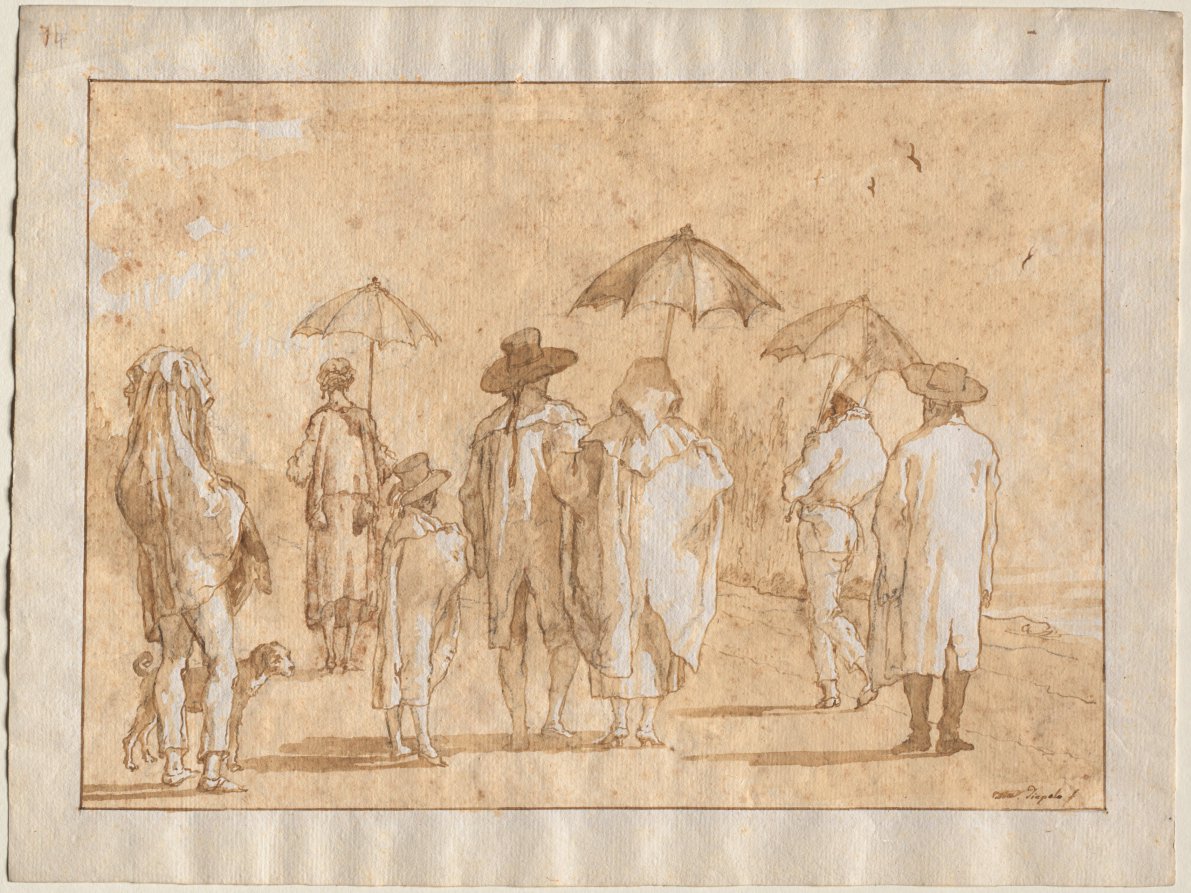
Giovanni Domenico Tiepolo · The Cleveland Museum of Art · Purchase from the J. H. Wade Fund · CC0
- Born
- 1727 · Venice.
- Died
- 1804 · Venice.
- Nationality
- Republic of Venice
- Occupation
- painter · printmaker · artist
- Fields
- genre
- Known for
- The Immaculate Conception · The Tiepolo Family · Camerino del falchetto · Sacrifice of Iphigeneia
- Languages
- Italian
VALÉORINE Encyclopedia
VALÉORINE documentary reading
Documentary summary
Illustration — The artist's family, a rare portrait, unfinished. Giovanni Domenico Tiepolo (August 30, 1727March 3, 1804) was an Italian painter and printmaker in etching. He was the son of artist Giovanni Battista Tiepolo and elder brother of Lorenzo Baldissera Tiepolo.
Admitted source layer · organised and presented by VALÉORINE
Reference Check
Propose documentary evidence for Giovanni Domenico Tiepolo. A contribution is never written directly as fact: identity, source, rights and evidence gates still decide.
Sign in to contribute
World of VALÉORINE
Documentary connections
Only confirmed graph relationships appear here. Images are shown only when their identity and reuse rights both pass the documentary gate.
Documentary evidence
Documentary basis
Authority files
wikidata · Q435316 · wikipedia · Giovanni Domenico Tiepolo
In this article
Life history
Life history
The recorded working language is Italian. Subjects and genres recorded for the work are genre. Residence is recorded at Mirano. Works named in the authority record are The Immaculate Conception, The Tiepolo Family, Camerino del falchetto and Sacrifice of Iphigeneia. Work by Giovanni Domenico Tiepolo is recorded in the collections of Museum Boijmans Van Beuningen, Städel Museum, Museo del Prado, Art Institute of Chicago and The Nelson-Atkins Museum of Art.
• Illustration — Christ and the Woman Taken in Adultery, 1752, 28.6″ (72.7 cm) X 41.2″ (104.7 cm) Domenico was born in Venice, studied under his father, and by the age of 13 was the elder Tiepolo's chief assistant. He was one of the many assistants, including his brother Lorenzo, who transferred the designs of his father (often executed in oil sketch es). By the age of 20, he was producing his own work for commissioners. He assisted his father in Würzburg 1751–3, decorating the famous stairwell fresco, in Vicenza at the Villa Valmarana ai Nani in 1757, and at the Royal Palace of Madrid for Charles III of Spain from 1762 to 1770.
Works
Works
• Illustration — The Minuet, 1756 His painting style developed after the death of his father in 1770, at which time he returned to Venice, and worked there as well as in Genoa and Padua. His painting, though keeping the decorative influence of his father, moved from its spatial fancy and began to take a more realistic direction. His portraits and scenes of life in Venice are characterised by movement, colour, and deliberate composition. After a lapse of 15 years, his work developed from the religious and mythological subjects of his father to a more secular style. He produced 104 sketches of Punchinello, the standard character of the commedia dell'arte (which would later become Punch in Punch and Judy), a physically deformed clown. These were created as 'Entertainments for the Children', and attempted to poke fun at the pretensions and behaviour of the viewer. The same protagonist featured in frescos (1759-1797) in his villa di Zianigo near Mirano. These frescoes were detached and nearly sold to be dealt once again in France, but the then Minister of Public Education, blocked the export and acquired them for the city of Venice. Since 1936, they have been on display, in a near replica of the original arrangement, in the Ca' Rezzonico Museum on the Grand Canal. The frescoes have undergone recent restoration. The scenes depict often cryptic events, part genre and part epic-farce, of crowds of Pulcinellos at play and work, as well as a carnival scene. The genre thematic and humor are strikingly different from the grand epic apotheoses painted his father.
Selected works
Selected works
• The quack or tooth puller (1754) - Musée du Louvre, Paris • A New Testament (edition 2006)
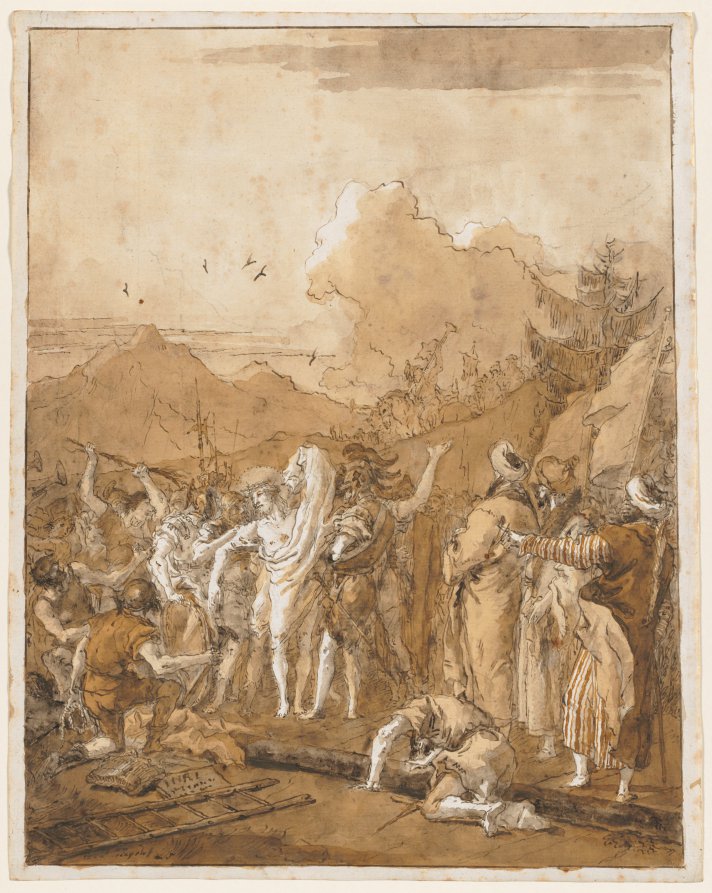
The Disrobing of Christ, c. 1785–90, by Giovanni Domenico Tiepolo
Giovanni Domenico Tiepolo · The Cleveland Museum of Art · Purchase from the J. H. Wade Fund
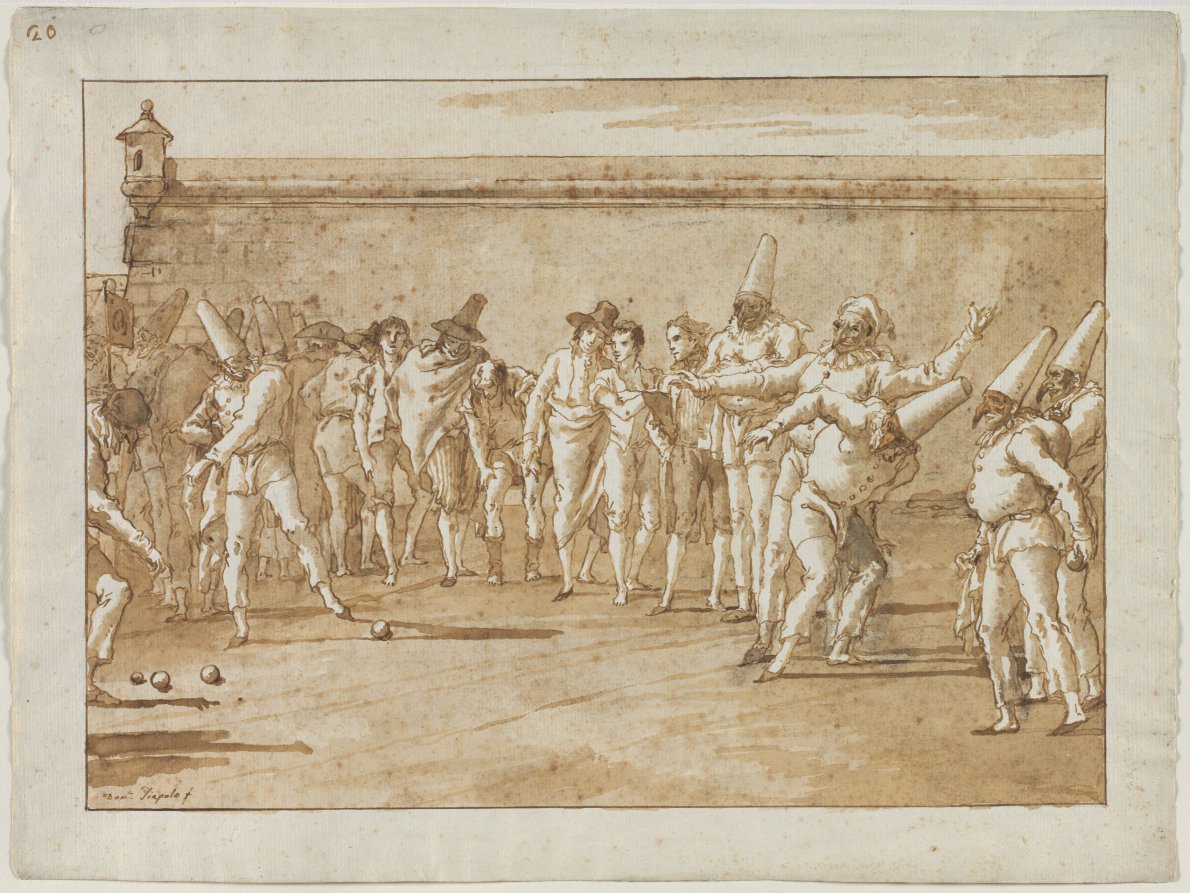
The Game of Bowls, 1797–1804, by Giovanni Domenico Tiepolo
Giovanni Domenico Tiepolo · The Cleveland Museum of Art · Purchase from the J. H. Wade Fund
Places
Named by the record
Places
Only places the record itself states, plotted where the house gazetteer settles their coordinates. Nothing is inferred from a name or a nationality.
Mirano
Residences
Venice.
Birth place
Drawings and prints
• Illustration — No. 21 of the Idee Pittoresche sulla Fuga in Egitto. Many of Domenico's works are drawings with ink wash, and he was a fine draftsman, although weaker than his father. His St. Ambrose Addressing the Young St. Augustine sketch is typical of the commissions he would receive. St. Ambrose, with the crozier and mitre, addresses and gives religious instruction to the beardless Saint Augustine. The composition has the pomp and grandiosity of his father's work, set out as if part of a theatrical display. He, however, took 18th-century Venice as the setting for this 4th-century act, drawing on his experience of the city and his many works depicting life in it. Domenico was also a significant printmaker in etching, often reproducing his own or his father's paintings. But his original compositions include a series of twenty-four illustrations of the Idee Pittoresche sulla Fuga in Egitto ("Picturesque Scenes from the Flight into Egypt"), and one of the fourteen Stations of the Cross.
Collections
Collections
The Prado Museum, The Art Gallery of New South Wales (Sydney, Australia), the Blanton Museum of Art (University of Texas, Austin), the Cleveland Museum of Art, the Finnish National Gallery, the Honolulu Museum of Art, the Indiana University Art Museum, Kunst Indeks Danmark, the Minneapolis Institute of Arts, the Musée des Beaux-Arts de Caen, the Musée des Beaux-Arts de Strasbourg, the Musée du Louvre (Paris), Thyssen-Bornemisza Museum (Madrid), Museu Nacional d'Art de Catalunya (Barcelona), the National Gallery (London), the National Museums and Galleries of Wales, the Philadelphia Museum of Art, Pinacoteca Ambrosiana (Milan), Pinacoteca di Brera (Milan), the Portland Art Museum, the Lázaro Galdiano Museum (Madrid), the Royal Museums of Fine Arts of Belgium, the Seattle Art Museum, the Los Angeles County Museum of Art, the Victoria and Albert Museum, the Real Academia de Bellas Artes de San Fernando (Madrid), the Wadsworth Atheneum, and the Rosen House at Caramooor Center for Music & the Arts, are among the public collections holding paintings by Giovanni Domenico Tiepolo. Giovanni Domenico Tiepolo’s works have been exhibited and collected internationally, with auction prices varying by medium and size. His record auction sale was $4,912,460 in 2013 for a lot of six works titled The Celebrated Deeds of the Porto Family of Vicenza at Sotheby’s London. • Illustration — Patron Saints of the Crotta Family, 1750, Städelsches Kunstinstitut • Illustration — Chastity of Scipio, 1751, Städelsches Kunstinstitut • Illustration — Study head of an old man, 1756, Städelsches Kunstinstitut • Illustration — Altalena dei pulcinelli Ca' Rezzonnico Venice • Illustration — Sketch for St Lio in Glory, for the ceiling of the church of San Lio, Venice. • Illustration — Ceiling of the Church of San Lio, Venice. • Illustration — The Immaculate Conception with Saint Lawrence and Saint Francis of Paola, early 1770s (Musée des Beaux-Arts de Strasbourg) • Illustration — St Ambrose Addressing the Young St Augustine. • Illustration — Punchinello with the Ostriches. • Illustration — Detail: The quack or tooth puller,1754. • Illustration — Carnival scene: Triumph of Pulcinella • Illustration — Greyhound, painted for Villa Tiepolo, Zianigo, now at Ca' Rezzonico, Venice • Illustration — Dedication Page from "Picturesque Scenes from the Flight into Egypt"
Documents and archives
Primary material
Documents and archives
reference work
- “Giovanni Domenico Tiepolo”, English Wikipedia, consulted as further reading
Reputable secondary · Wikipedia
authority record
- Wikidata, structured authority record Q435316: Giovanni Domenico Tiepolo
General reference · Wikidata
Citations
References
Each reference names the institution holding it, so a reader may go to the document itself.
reference work
Secondary witnessauthority record
General reference
The Encyclopedia exists whether or not anything is for sale. Corrections are recorded rather than overwritten, and every version of this record is kept. Published 16 August 2026.
Elsewhere in Prints
4,138 published records in this field, each with its sources named.
- Giovanni BoggiEngraver
- Giovanni BrancaccioEngraver
- Giovanni De MinEngraver
- Giovanni Domenico CampigliaEngraver
- Giovanni FattoriEngraver
- Giovanni FlorimiEngraver
- Giovanni FoloEngraver
- Giovanni Francesco GrimaldiEngraver
Best supported in this field
For owners
Own a work by Giovanni Domenico Tiepolo?
A specialist will read what you send and tell you what the house can establish, what it cannot, and whether the object is suited to sale. There is no charge and no obligation. The object stays with you throughout; nothing is shipped to us unless it is arranged in writing beforehand.