
Giovanni Battista Tiepolo
Giovanni Battista Tiepolo (5 March 1696 – 27 March 1770), also known as Giambattista (or Gianbattista) Tiepolo, was an Italian painter and printmaker from the Republic of Venice who painted in the Rococo style, considered an important member of the 18th-century Venetian school. He was prolific, and worked not only in Italy, but also in Germany and Spain. Giovan Battista Tiepolo, together with Giambattista Pittoni, Canaletto, Giovan Battista Piazzetta, Giuseppe Maria Crespi, and Francesco Guardi are considered the traditional Old Masters of that period.
Also recorded as J. B. Tiepolo · Gio. Battista Tiepolo · Giovanni Battista Tiepoli · Juan Bautista Tiépolo
Giovanni Battista Tiepolo
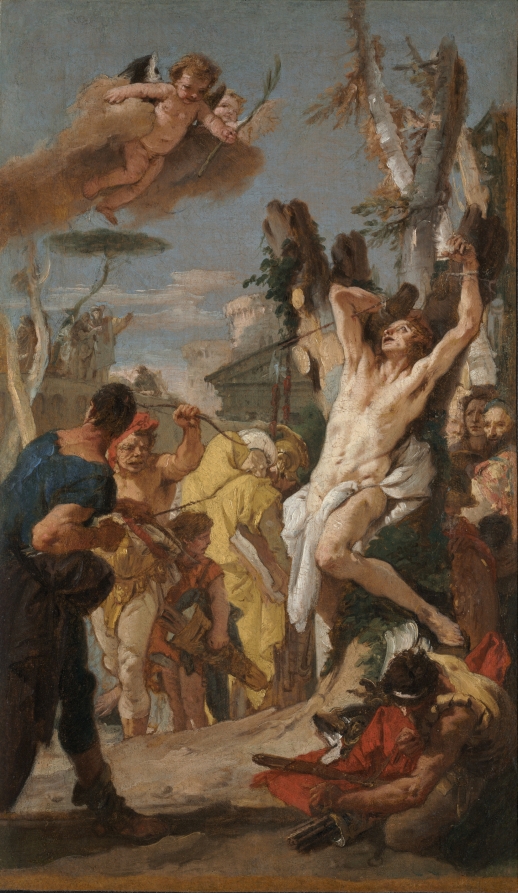
Giovanni Battista Tiepolo · The Cleveland Museum of Art · Delia E. Holden and L. E. Holden Funds · CC0
- Name
- Giovanni Battista Tiepolo
- Born
- 5 March 1696
- Birthplace
- Venice, Venetian Republic
- Died
- 27 March 1770
- Place of death
- Madrid, Spain
- Field
- Painting
- Movement
- Rococo
- Nationality
- Republic of Venice.
- Occupation
- fresco painter, printmaker, architectural drafter, painter, graphic artist, printer, etcher and visual artist.
- Movements
- Rococo and Baroque.
- Known for
- Apotheosis of Angelo della Vecchia, Apotheosis of Saint Gaetano Thieme, Scipio Africanus Freeing Massiva, Ceiling fresco in the staircase of the Würzburg Residence, Apelles Painting Campaspe and An Allegory with Venus and Time.
VALÉORINE Encyclopedia
VALÉORINE documentary reading
Documentary summary
Giovanni Battista Tiepolo (5 March 1696 – 27 March 1770), also known as Giambattista (or Gianbattista) Tiepolo, was an Italian painter and printmaker from the Republic of Venice who painted in the Rococo style, considered an important member of the 18th-century Venetian school. He was prolific, and worked not only in Italy, but also in Germany and Spain. Giovan Battista Tiepolo, together with Giambattista Pittoni, Canaletto, Giovan Battista Piazzetta, Giuseppe Maria Crespi, and Francesco Guardi are considered the traditional Old Masters of that period.
Admitted source layer · organised and presented by VALÉORINE
Reference Check
Propose documentary evidence for Giovanni Battista Tiepolo. A contribution is never written directly as fact: identity, source, rights and evidence gates still decide.
Sign in to contribute
Documentary evidence
Documentary basis
Authority files
gnd · 2160057-0 · wikidata · Q186202 · wikipedia · Giovanni Battista Tiepolo
In this article
Biography
Biography
Successful from the beginning of his career, he has been described by Michael Levey as "the greatest decorative painter of eighteenth-century Europe, as well as its most able craftsman".
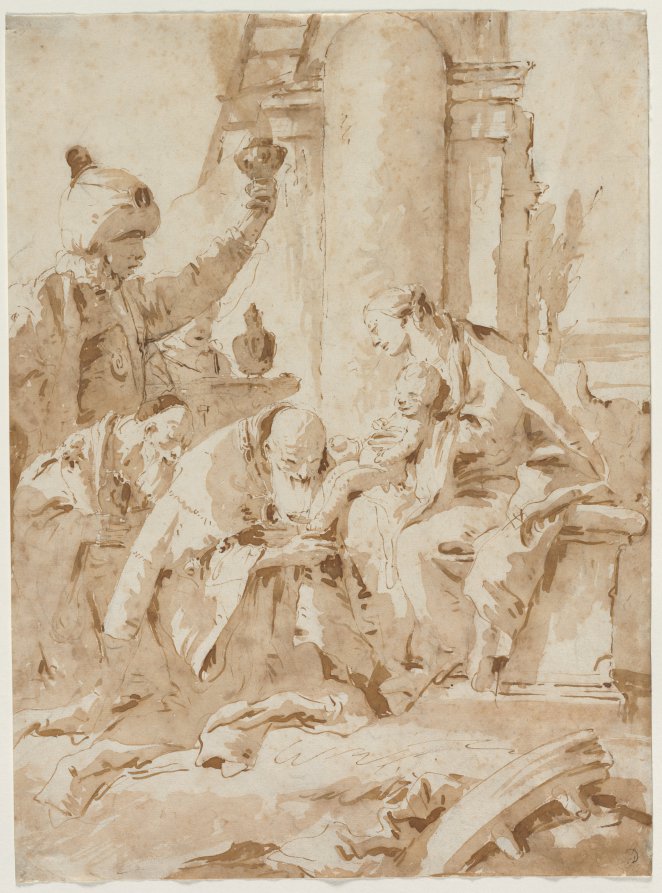
The Adoration of the Magi, c. 1740, by Giovanni Battista Tiepolo
Giovanni Battista Tiepolo · The Cleveland Museum of Art · Dudley P. Allen Fund
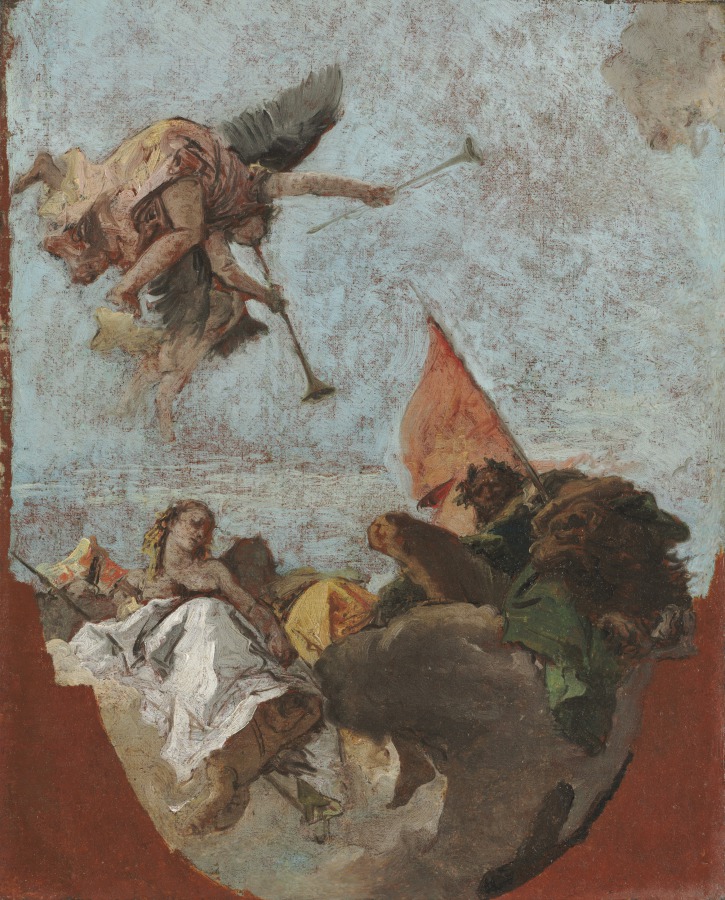
Sketch for a Ceiling, 1750s, by Giovanni Battista Tiepolo
Giovanni Battista Tiepolo · The Cleveland Museum of Art · Holden Collection
Key facts
Key facts
• Name — Giovanni Battista Tiepolo • Other Names — Gianbattista Tiepolo, Giambattista Tiepolo • Born — 5 March 1696 • Birthplace — Venice, Venetian Republic • Died — 27 March 1770 • Place of death — Madrid, Spain • Field — Painting • Movement — Rococo
Biography
Biography
• Illustration — The Glory of St. Dominic, 1723 • Illustration — Scipio Africanus Freeing Massiva shows Massiva, the nephew of a prince of Numidia, being released after capture by Scipio Africanus. Walters Art Museum. • Illustration — The Banquet of Cleopatra, 1743–44, National Gallery of Victoria, Melbourne
Early life (1696–1726)
Early life (1696–1726)
Born in Venice, he was the youngest of six children of Domenico and Orsetta Tiepolo. His father was a small shipping merchant who belonged to a family that bore the prestigious patrician name of Tiepolo without claiming any noble descent. Some of the children acquired noble godparents, and Giambattista was originally named after his godfather, a Venetian nobleman called Giovanni Battista Dorià. He was baptised on 16 April 1696 in the local church, San Pietro di Castello (then still officially the cathedral of Venice). His father died about a year later, leaving his mother to bring up a family of young children, presumably in somewhat difficult circumstances. In 1710, he became a pupil of Gregorio Lazzarini, a successful painter with an eclectic style. He was, though, at least equally strongly influenced by his study of the works of other contemporary artists such as Sebastiano Ricci, Giovanni Battista Piazzetta and Federico Bencovich, as well those of his Venetian predecessors, especially Tintoretto and Veronese. A biography of his teacher, published in 1732, says that Tiepolo "departed from [Lazzarini's] studied manner of painting, and, all spirit and fire, embraced a quick and resolute style". His earliest known works are depictions of the apostles, painted in spandrels as part of the decoration of Santa Maria dei Derelitti in Venice in 1715–6. At about the same time he became painter to the Doge, Giovanni II Cornaro, and oversaw the hanging of pictures at his palace, as well as painting many works himself, of which only two portraits have been identified. He painted his first fresco in 1716, on the ceiling of a church at Biadene, near Treviso. He probably left Lazzarini's studio in 1717, the year he was received into the Fraglia or guild of painters. In around 1719–20, he painted a scheme of frescoes for the wealthy and recently ennobled publisher Giambattista Baglione in the hall of his villa at Massanzago near Padua. Tiepolo depicted the Triumph of Aurora on the ceiling, and the Myth of Phaethon on the walls, creating the kind of fluid spatial illusion which was to become a recurring theme in his work. In 1722 he was one of twelve artists commissioned to contribute a painting on canvas of one of the apostles as part of a decorative scheme for the nave of San Stae in Venice. The other artists involved included Ricci, Piazetta, and Pellegrini.
Marriage and children
Marriage and children
• Illustration — Rinaldo Enchanted by Armida, 1742–1745 In 1719, Tiepolo married noblewoman Maria Cecilia Guardi, sister of two contemporary Venetian painters, Francesco and Giovanni Antonio Guardi. Tiepolo and his wife had nine children, of whom four daughters and three sons survived to adulthood. Two of his sons, Giovanni Domenico and Lorenzo, painted with him as his assistants and later achieved some independent recognition, in particular Giovanni Domenico Tiepolo. His children painted figures with a design similar to that of their father, but with distinctive, including genre, styles. His third son became a priest. Fabio Canal, Francesco Lorenzi, and Domenico Pasquini were among his pupils.
Early mature work (1726–1750)
Early mature work (1726–1750)
• Illustration — Juno and Luna, c. 1735–1745 • Illustration — Perseus and Andromeda, c. 1730–1731 Some major commissions came from the patrician Dolfin family. Dionisio Dolfin, the Archbishop of Udine in Friuli, employed him to decorate a chapel in Udine Cathedral, and then to paint another cycle depicting episodes from the lives of Abraham and his descendants from the Book of Genesis at his archiepiscopal palace (the "Arcivescovado") (completed 1726–1728). Despite their elevated subject matter, they are bright in colour, and light-hearted in mood: Michael Levey describes the paintings at the palace as "a shimmering set of tableaux, full of wit and elegance". Tiepolo used a much cooler palette than previous Venetian painters, in order to create a convincing effect of daylight. His first masterpieces in Venice were a cycle of ten enormous canvases painted to decorate a large reception room of Ca' Dolfin on the Grand Canal of Venice (ca. 1726–1729), depicting battles and triumphs from the history of ancient Rome. These early masterpieces, innovative amongst Venetian frescoes for their luminosity, brought him many commissions. He painted canvases for churches such as that of Verolanuova (1735–1740), for the Scuola Grande dei Carmini (1740–1747), in Cannaregio, a ceiling for the Palazzi Archinto and Palazzo Dugnani in Milan (1731), the Colleoni Chapel in Bergamo (1732–1733), a ceiling for the Gesuati (Santa Maria del Rosario) in Venice of St. Dominic Instituting the Rosary (1737–1739), Palazzo Clerici, Milan (1740), decorations for Villa Cordellina Molin, a ceiling for the Chiesa degli Scalzi (1743–1744); now destroyed (reconstitution), Villa Cordellina Molin, Montecchio Maggiore (1743–1744) and for the ballroom of the Palazzo Labia in Venice (now a television studio), showing the Story of Cleopatra (1745–1750).
Etchings
Etchings
Tiepolo produced two sets of etchings, the Capricci (c. 1740–1742) and the Scherzi di fantasia (c. 1743–1757). The ten capricci were first published by Anton Maria Zanetti, incorporated into the third edition of a compilation of woodcuts after Parmigianino. They were not published separately until 1785. The subject matter is often bizarre and fantastical, and the works owe a lot to the example of Salvator Rosa and Giovanni Benedetto Castiglione. The 23 Scherzi were etched over more than ten years and privately circulated, only being commercially published after Tiepolo's death, with numbers and titles added by his son, Giandomenico. Subjects include mysterious Eastern figures, and, in some of the later prints, scenes of necromancy. • Illustration — Apotheosis of Spain, 1762–1766, Royal Palace of Madrid • Illustration — Wealth and Benefits of the Spanish Monarchy under Charles III, 1762, National Gallery of Art
Würzburg Residenz (1750–1753)
Würzburg Residenz (1750–1753)
By 1750, Tiepolo's reputation was firmly established throughout Europe, with the help of his friend Francesco Algarotti, an art dealer, critic and collector. That year, at the behest of Prince-Bishop Karl Philipp von Greifenclau zu Vollraths, he traveled to Würzburg where he arrived in November 1750. He remained there for three years during which he executed ceiling paintings in the New Residenz palace (completed 1744). He frescoed the Kaisersaal salon in collaboration with his sons Giandomenico and Lorenzo and was then invited to deliver a design for the grandiose entrance staircase (Treppenhaus) designed by Balthasar Neumann. It is a massive ceiling fresco at 287 square feet (677 m 2), and was completed in November 1753. His Allegory of the Planets and Continents depicts Apollo embarking on his daily course; deities around him symbolize the planets; allegorical figures (on the cornice) represent the four continents. He included several portraits in the Europe section of this fresco, including a self-portrait; one of his son Giandomenico; one of the prince-bishop von Greiffenklau; one of the painter Antonio Bossi; and one of the architect, Balthasar Neumann.
Return to Venice and the Veneto (1753–1770)
Return to Venice and the Veneto (1753–1770)
• Illustration — The Immaculate Conception, 1767–1768 Tiepolo returned to Venice in 1753. He was now in demand locally, as well as abroad where he was elected President of the Academy of Padua. He went on to complete theatrical frescoes for churches; the Triumph of Faith for the Chiesa della Pietà; panel frescos for Ca' Rezzonico (which now also houses his ceiling fresco from the Palazzo Barbarigo); and paintings for patrician villas in the Venetian countryside, such as Villa Valmarana in Vicenza and an elaborate panegyric ceiling for the Villa Pisani in Stra. In some celebrated frescoes at the Palazzo Labia, he depicted two scenes from the life of Cleopatra: Meeting of Anthony and Cleopatra and Banquet of Cleopatra, as well as, in a central ceiling fresco, the Triumph of Bellerophon over Time. Here he collaborated with Girolamo Mengozzi Colonna. This connection with Colonna, who also designed sets for opera, highlights the increasing tendency towards composition as a staged fiction in Tiepolo's frescoes. The architecture of the Banquet fresco also recalls that of Veronese's Wedding at Cana. In 1757, he painted an altar piece for the Thiene family, representing the apotheosis of Saint Cajetan. It is in the church of hamlet of Rampazzo in the Camisano Vicentino.
Madrid
Madrid
• Illustration — Apollo Pursuing Daphne, 1755–1760 • Illustration — Manna in the desert In 1761, King Charles III of Spain commissioned Tiepolo to create a ceiling fresco to decorate the throne room of the Royal Palace of Madrid. The panegyric theme is the Apotheosis of Spain and has allegorical depictions recalling the dominance of Spain in the Americas and across the globe. He also painted two other ceilings in the palace, and carried out many private commissions in Spain. However, he suffered from the jealousy and the bitter opposition of the rising champion of Neoclassicism, Anton Raphael Mengs; at the instigation of Mengs' supporter, the King's confessor Joaquim de Electa, had Tiepolo's series of canvases for the church of San Pascual at Aranjuez replaced by works by his favourite.
Death
Death
Tiepolo died in Madrid on 27 March 1770. He is buried in Madonna dell'Orto in Venice. After his death, the rise of a stern Neoclassicism and the post-revolutionary decline of absolutism led to the slow decline of the Rococo style associated with his name, but failed to dent his reputation. In 1772, Tiepolo's son was sufficiently respected to be painter to Doge Giovanni II Cornaro, in charge of the decoration of Palazzo Mocenigo in the sestiere of San Polo, Venice.
Gallery
Gallery
• Illustration — Alexander the Great and Campaspe in the Studio of Apelles, 1740 • Illustration — Satyress with a Putto, c. 1740–1742, Norton Simon Museum • Illustration — The Empire of Flora, c. 1743, Fine Arts Museums of San Francisco • Illustration — Allegory of the Planets and Continents, 1752 • Illustration — The Sacrifice of Iphigenia, 1757, Villa Valmarana • Illustration — Allegory of Virtue and Nobility (Allegory of Strength and Wisdom), c. 1740–1750, Museo Poldi Pezzoli • Illustration — Sketch for Venus and Vulcan, 1765–66 • Illustration — Satyr Family (Pan and his Family), etching, c. 1743–1750 • Illustration — Caricature of a short gentleman holding a muff, pen and ink with gray wash • Illustration — Woman and infant satyr in a landscape, from the etching series 'The Capricci'
Works from 1740–1750
Works from 1740–1750
• Work — Date — Location — Link • The Virgin with 3 female Dominican Saints — 1739–1748 — Church of the Gesuati, Venice • Alexander the Great and Campaspe in the Studio of Apelles — 1740 — Getty Center, Los Angeles • The Virgin Appearing to St. Philip Neri — 1740 — Museo Diocesano, Camerino • The Gathering of Manna — 1740–1742 — Parrocchiale, Verolanuova • The Sacrifice of Melchizedek — 1740–1742 — Parrocchial church, Verolanuova • The Finding of Moses — 1740–1745 — National Gallery of Victoria, Melbourne — • Rinaldo Enchanted by Armida — 1742 — Art Institute of Chicago • Rinaldo and Armida in Her Garden — 1742 — Art Institute of Chicago • Armida Abandoned by Rinaldo — 1742 — Art Institute of Chicago • Rinaldo and the Magus of Ascalon — 1742 — Art Institute of Chicago • The Triumph of Virtue and Nobility over Ignorance — 1743 — Norton Simon Museum, (Pasadena, CA) • Empire of Flora — 1743 — The Legion of Honor, (San Francisco, CA) • Time Unveiling Truth — c. 1743 — Museo Civico Palazzo Chiericati, Vicenza • The Banquet of Cleopatra — 1743–1744 — National Gallery of Victoria, Melbourne — • Worshippers — 1743–1745 — Gallerie dell'Accademia, Venice • Apollo and Daphne — 1755–1760 — National Gallery of Art, Washington DC — • Discovery of the True Cross — c. 1745 — Gallerie dell'Accademia, Venice • Time Unveiling Truth — c. 1745–1750 — Museum of Fine Arts, Boston — • Frescoes of the story of Cleopatra — 1746 — Palazzo Labia, Venice • Saint Patrick, Bishop of Ireland — 1746 — Musei Civici di Padova, Padua • Last Communion of St. Lucy — 1747–1748 — Santi Apostoli, Venice • The Banquet of Cleopatra and Antony — 1747–1750 — North Carolina Museum of Art, Raleigh, North Carolina, USA • The Glorification of the Barbaro Family — 1749–1750 — Metropolitan Museum of Art, New York, USA • St. James the Greater Conquering the Moors — 1749–1750 — Museum of Fine Arts, Budapest, Hungary • Bacchus and Ariadne — 1743–1745 — National Gallery of Art, Washington, D.C., USA
Works after 1750
Works after 1750
• Work — Date — Location — Link • Frescoes — 1751–1753 — Residenz, Würzburg — • Collecting Manna — c. 1751 — National Museum of Serbia, Belgrade • Allegory of Planets and Continents — 1752 — Metropolitan Museum of Art, New York — • The Death of Hyacinth — 1752–1753 — Thyssen-Bornemisza Museum, Madrid • Adoration of the Magi — 1753 — Alte Pinakothek, Munich • Coronation of the Virgin — 1754 — Kimbell Art Museum, Dallas (modelo for Ospedale della Pietà) • The Entrance of the Gonfaloniere Piero Soderini into Florence in 1502 (L'ingresso di gonfaloniere Piero Soderini in Firenze nel 1502) — 1754 — Swiss Embassy, Rome, Italy — • An Allegory with Venus and Time — 1754–1758 — National Gallery, London • Frescoes from Roman mythology — 1757 — Villa Valmarana, Vicenza • A Seated Man and a Girl with a Pitcher — c. 1755 — National Gallery, London • The Theological Virtues — c. 1755 — Royal Museums of Fine Arts of Belgium, Brussels • The Martyrdom of St. Agatha — c. 1756 — Gemäldegalerie, Berlin, • Allegory of Merit Accompanied by Nobility and Virtue — 1757–1758 — Museo del Settecento Veneziano, Ca' Rezzonico, Venice • Santa Tecla prays for the Liberation of Este from the Plague — 1759 — Church of Santa Tecla, Este • Pope St. Sylvester baptises emperor Constantine the Great — 1759 — Chiesa di San Silvestro, Brescia • The Vision of St. Anne — 1759 — Gemäldegalerie Alte Meister, Dresden • Virtue and Nobility Crowning Love — 1759–1761 — Museum of Fine Arts, Boston • Modello for the Apotheosis of the Pisani Family — 1760 — Musée des Beaux-Arts d'Angers • Madonna of the Goldfinch — c. 1760 — National Gallery of Art, Washington • Woman with a Parrot — 1760–1761 — Ashmolean Museum, Oxford • Apotheosis of the Pisani Family — 1761–1762 — Villa Pisani, Stra • San Carlo Borromeo — 1767–1769 — Cincinnati Art Museum • The Immaculate Conception — 1767–1769 — Museo del Prado, Madrid • Glory of Spain — 1762–1766 — Throne Room of Royal Palace of Madrid • The Apotheosis of the Spanish Monarchy — 1762–1766 — Queen's Antechamber, Royal Palace of Madrid • Venus and Vulcan — 1762–1766 — Halberdiers' Room, Royal Palace of Madrid • The Entombment of Christ — 1769–1770 — National Museum of Ancient Art, Lisbon • The Flight to Egypt — 1765–1770 — National Museum of Ancient Art, Lisbon —
Identity and origins
Identity and origins
The authorities additionally record the headings J. Battista Tiepolo, Giovanni Battista Tiepoli, Juan Bautista Tiépolo and Dzhovanni Battista Tʹepolo. His recorded language was Italian. He was the child of Domenico Tiepolo and Orsetta Tiepolo. He married Maria Cecilia Guardi. 2 children are recorded: Giovanni Domenico Tiepolo and Lorenzo Baldissera Tiepolo.
Work and production
Work and production
Works recorded as notable number 8: Apotheosis of Angelo della Vecchia, Apotheosis of Saint Gaetano Thieme, Scipio Africanus Freeing Massiva, Ceiling fresco in the staircase of the Würzburg Residence, Apelles Painting Campaspe, An Allegory with Venus and Time, The Patron Saints of the Crotta Family and Hagar and Ishmael in the Desert. His recorded genres are fresco, religious, allegory, animal art and genre art.
Identity
Identity
Giovanni Battista Tiepolo is recorded as fresco painter, printmaker, architectural drafter and painter.
Life and career
Dated record
Life and career
The full dated record · 2 entries
1696
Giovanni Battista Tiepolo born at Venice.
1770
Giovanni Battista Tiepolo died at Madrid.
Paintings before 1740
• Work — Date — Location — Link • Scipio Africanus Freeing Massiva — between 1719 and 1721 — The Walters Art Museum, Baltimore, USA • The Martyrdom of St. Bartholomew — 1722 — San Stae, Venice • The Glory of St. Dominic — 1723 — Gallerie dell'Accademia, Venice • The Rape of Europa — c. 1725 — Gallerie dell'Accademia, Venice • Allegory of the Power of Eloquence — c. 1725 — Courtauld Institute, Modello for Palazzo Sandi, Venice • Frescoes — 1726 — Episcopal palace, Udine • Ca' Dolfin Tiepolos — 1726–1729 — Metropolitan Museum of Art, New York; Hermitage Museum, St Petersburg; Kunsthistorisches Museum, Vienna • Perseus & Andromeda — 1730 — Frick Collection • Education of the Virgin — 1732 — Santa Maria della Consolazione (Fava), Venice • Angel rescuing Hagar — 1732 — Scuola di San Rocco, Venice • John the Baptist preaching — 1732–1733 — Cappella Colleoni, Bergamo • Beheading of John the Baptist — 1732–1733 — Cappella Colleoni, Bergamo • Scourge of the Serpents — 1732–1735 — Gallerie dell'Accademia, Venice • Joseph receiving ring from pharaoh — 1732–1735 — Dulwich Picture Gallery • Triumph of Zephyr and Flora — 1734–1735 — Museo del Settecento Veneziano, Ca' Rezzonico, Venice • Jupiter and Danaë — 1736 — Universitet Konsthistoriska Institutionen, Stockholm • The Finding of Moses — 1736–1738 — National Gallery of Scotland, Edinburgh • Pope St. Clement Adoring the Trinity — 1737–1738 — Alte Pinakothek, Munich • Saint Augustin, Saint Louis of France, Saint John the Evangelist and a bishop — 1737–1738 — Palais des Beaux-Arts de Lille • Institution of the Rosary — 1737–1739 — Church of the Gesuati, Venice • Christ Carrying the Cross — 1737–1738 — Sant'Alvise, Venice • The Madonna of Mount Carmel — 1730s — Pinacoteca di Brera, Milan • Virgin with Six Saints — 1737–1740 — Museum of Fine Arts, Budapest
Legacy
In 1878, Mark Twain wrote in his diary: "Tiepolo is my artist." Roberto Calasso's Tiepolo Pink (Italian: Il Rosa Tiepolo), which takes its name from an epithet Marcel Proust uses to describe several of his female characters, is an interpretation of Tiepolo's life as the last artist of the ancien régime, depicting his work as "the last breath of happiness in Europe." It contains detailed analysis of Tiepolo's mysterious Capricci and Scherzi.
Primary material
Documents and archives
reference work
- Wikidata, structured authority record Q186202: Giovanni Battista Tiepolo
Reputable secondary · Wikimedia Foundation
- “Giovanni Battista Tiepolo”, English Wikipedia, consulted as further reading
Reputable secondary · Wikipedia
authority file
- Gemeinsame Normdatei 2160057-0, Ausstellung anläßlich des 300. Geburtstages von Giovanni Battista Tiepolo (1996-1997 : Berlin).
General reference · Deutsche Nationalbibliothek
Notes from the source article
Cited by Wikipedia
Notes from the source article
These works are cited by the source article, in its own numbering. They are recorded as its citations, not as sources VALÉORINE has verified.
- 1.Luciano Canepari. Tiepolo. DiPI Online.
- 2.Scipio Africanus Freeing Massiva.
- 3.Barcham, William L. Tiepolo. Grove Art Online. Oxford Art Online, Oxford University Press.
- 4.Treccani. Tièpolo, Giambattista.
- 5.Transport de la Sainte Maison de Lorette.
- 6.Würzburg Residenz. Residenz staircase.
- 7.Andersen, Wayne. Il Rosa Tiepolo: The Last Breath of Happiness in European Art. Toward New Paradigms. 17. 4. 517-523. 25 June 2012.
Bibliography printed in the source article · 17
- Metropolitan Museum of Art. Giambattista Tiepolo 1698–1770. 1996. 9780870998119.
- Levey, Michael. Painting in Eighteenth-Century Venice. Cornell University Press. 225–230. 1980. 9780801413315.
- Wittkower, Rudolf. Art and Architecture in Italy. 1993.
- Barcham, William L. Giambattista Tiepolo. Thames and Hudson. 1992. 0-500-08054-2.
- Baxandall, Michael. Tiepolo and the Pictorial Intelligence. Yale University Press. 1994. 9780300059786.
- Rizzi, Aldo. The etchings of the Tiepolos. Electa. 1971. 0-7148-1499-7.
- Aldo Rizzi, Il Tiepolo all'Arcivescovado di Udine, Milano 1965.
- Aldo Rizzi, Tiepolo a Udine, Milano 1969.
- Aldo Rizzi, le acqueforti dei Tiepolo, Milano, 1970.
- Aldo Rizzi, La grafica del Tiepolo: le acqueforti, Milano 1971.
- Aldo Rizzi, La mostra del Tiepolo, Milano 1971.
- Aldo Rizzi, Giambattista Tiepolo, Milano 1990.
- Aldo Rizzi, I Tiepolo a Udine, Milano 1996.
- Adelheid M. Gealt and George Knox, Domenico Tiepolo: A New Testament, Bloomington, IN, Indiana UP, 2006.
- Bostock, Sophie, "The Pictorial Wit of Domenico Tiepolo" unpublished PhD Thesis, University of Warwick, https://wrap.warwick.ac.uk/3144/
- Christiansen, Keith. Giambattista Tiepolo, 1696–1770, New York: Metropolitan Museum of Art, 1996. .
- Boorsch, Suzanne. Venetian prints and books in the age of Tiepolo, New York: Metropolitan Museum of Art, 1997. .
References
Citations
References
Each reference names the institution holding it, so a reader may go to the document itself.
authority file
Gemeinsame Normdatei 2160057-0, Ausstellung anläßlich des 300. Geburtstages von Giovanni Battista Tiepolo (1996-1997 : Berlin).Deutsche Nationalbibliothek
Secondary witnessreference work
Wikidata, structured authority record Q186202: Giovanni Battista TiepoloWikimedia Foundation
Secondary witnessreference work
Secondary witness
Further particulars
Held on the record
Further particulars
Open the remaining particulars
Giovanni Battista Tiepolo worked in painting. His work is associated with Rococo and Baroque. He worked at Venice, Milan, Würzburg and Bergamo.
Career and activity
Recognition and collections
Work by Giovanni Battista Tiepolo is
Museum Boijmans Van Beuningen, Städel Museum, Minneapolis Institute of Art and Museo del Prado
The Encyclopedia exists whether or not anything is for sale. Corrections are recorded rather than overwritten, and every version of this record is kept. Published 14 August 2026.
Elsewhere in Prints
4,138 published records in this field, each with its sources named.
- Giovanni Battista FontanaEngraver
- Giovanni Battista MercatiEngraver
- Giovanni Battista MingardiEngraver
- Giovanni Battista PalumbaEngraver
- Giovanni BoggiEngraver
- Giovanni BrancaccioEngraver
- Giovanni De MinEngraver
- Giovanni Domenico CampigliaEngraver
Best supported in this field
For owners
Own a work by Giovanni Battista Tiepolo?
A specialist will read what you send and tell you what the house can establish, what it cannot, and whether the object is suited to sale. There is no charge and no obligation. The object stays with you throughout; nothing is shipped to us unless it is arranged in writing beforehand.