
George Arnald
Illustration — Selfportrait of George Arnald in his studio, 1831 George Arnald (1763 – 21 November 1841) was a British painter who specialised in landscapes, including topographical views to illustrated county histories. He is best known for his celebrated painting depicting the Battle of the Nile.
Also recorded as Esq. A. R. A. George Arnald · George Arnauld · A. R. A. George Arnold · George Arnord
George Arnald
![The Hospital of Bethlem [Bedlam] at Moorfields,](https://iiif.wellcomecollection.org/image/V0013196/full/1280,/0/default.jpg)
George Arnald · Wellcome Collection, London · Wellcome Collection · Public Domain Mark
- Born
- 1763. · Berkshire.
- Died
- 1841. · London.
- Nationality
- Kingdom of Great Britain and United Kingdom of Great Britain and Ireland.
- Occupation
- painter.
- Fields
- painting.
- Movements
- realism.
- Languages
- English.
VALÉORINE Encyclopedia
VALÉORINE documentary reading
Documentary summary
Illustration — Selfportrait of George Arnald in his studio, 1831 George Arnald (1763 – 21 November 1841) was a British painter who specialised in landscapes, including topographical views to illustrated county histories. He is best known for his celebrated painting depicting the Battle of the Nile.
Admitted source layer · organised and presented by VALÉORINE
Reference Check
Propose documentary evidence for George Arnald. A contribution is never written directly as fact: identity, source, rights and evidence gates still decide.
Sign in to contribute
World of VALÉORINE
Documentary connections
Only confirmed graph relationships appear here. Images are shown only when their identity and reuse rights both pass the documentary gate.
Born In · outgoing
Berkshire
Place
Citizen Of · outgoing
Kingdom of Great Britain
Place
Has Genre · outgoing
landscape painting
Term

Died In · outgoing
London
Place
Pencil sketch by George Henry Harlow, 1814, http://www.npg.org.uk/collections/search/largerimage.php?mkey=mw05495
Associated With · outgoing
realism
Term
Documentary evidence
Documentary basis
Authority files
wikidata · Q3101395 · wikipedia · George Arnald
In this article
Biography
Biography
Henry William Pickersgill is recorded as having studied under George Arnald. The recorded working language is English. The field of work recorded is painting. Subjects and genres recorded for the work are landscape and marine. Work by George Arnald is recorded in the collections of Tate, Royal Museums Greenwich, National Maritime Museum, Musée Carnavalet and National Portrait Gallery.
George Arnald was born in 1763. One account places his birth in the village of Farndip (now Farndish) in Northamptonshire (now Bedfordshire), although others suggest he was born in Berkshire. There is little information about Arnald's early years, but it is believed that he began his working life as a domestic servant before turning to the study of art. He was a student of the landscape painter and engraver William Pether (c. 1738–1821). Arnald first exhibited at the Royal Academy in 1788, and eventually had 176 works exhibited there. He also exhibited 63 works at the British Institution. He was elected an associate member of the Royal Academy on 5 November 1810, but was never admitted to full membership. Speaking to Sir George Beaumont, who was influential in the founding of the British Institution and the National Gallery, William Wordsworth lamented Arnald's lack of literary education, stating that he "... would have been a better Painter, if his Genius had led him to read more in the early part of his life.... I do not think it possible to excel in landscape painting without a strong tincture of the Poetic Spirit. • Illustration — The Destruction of 'L'Orient' at the Battle of the Nile, 1 August 1798 by George Arnald, 1825–27. 1855 × 2690 mm Probably his best-known and most acclaimed work was a departure from his usual subject-matter. The Destruction of L'Orient at the Battle of the Nile, 1 August 1798 is Arnald's only known maritime work, and was one of four paintings commissioned for £500 each as part of a British Institution competition for paintings to hang in the Painted Hall of Greenwich Hospital. It was exhibited at the British Institution in 1827 and is now displayed at the National Maritime Museum in Greenwich, London. It features as a "picture within a picture" in England's Pride and Glory by Thomas Davidson, hanging alongside the famous Lemuel Abbott portrait of Lord Nelson in the gallery at Greenwich Hospital. Arnald was a friend of fellow painter John Varley, and in 1798 and 1799 the two toured Wales together. His students included the portrait painter Henry William Pickersgill, who became a full Royal Academician and whose eminent sitters included William Wordsworth, the Duke of Wellington and Sir Robert Peel. In addition to providing illustrations for a number of books, Arnald published on his own an album of views on the River Meuse in 1828 [The river Meuse: being delineations of the picturesque scenery on the river and its banks, from the city of Liége to that of Mezières. The drawings were made... in... 1818 / and are etched by George Arnald, engraved in mezzotint by S. W. Reynolds, C. Turner, W. Ward..., T. Lupton, H. Dawe, J. P. Quilley, etc.... and other eminent engravers]. In 1839 he published A practical treatise on landscape painting in oil: illustrated by various diagrams and with two original studies in oil painted on the principles given in the treatise. Arnald died in Pentonville, London on 21 November 1841.
Identity
Identity
George Arnald is recorded as a citizen of United Kingdom of Great Britain and Ireland. Classed in the genre landscape painting. Recorded with the occupation painter. Classed in the genre marine art.
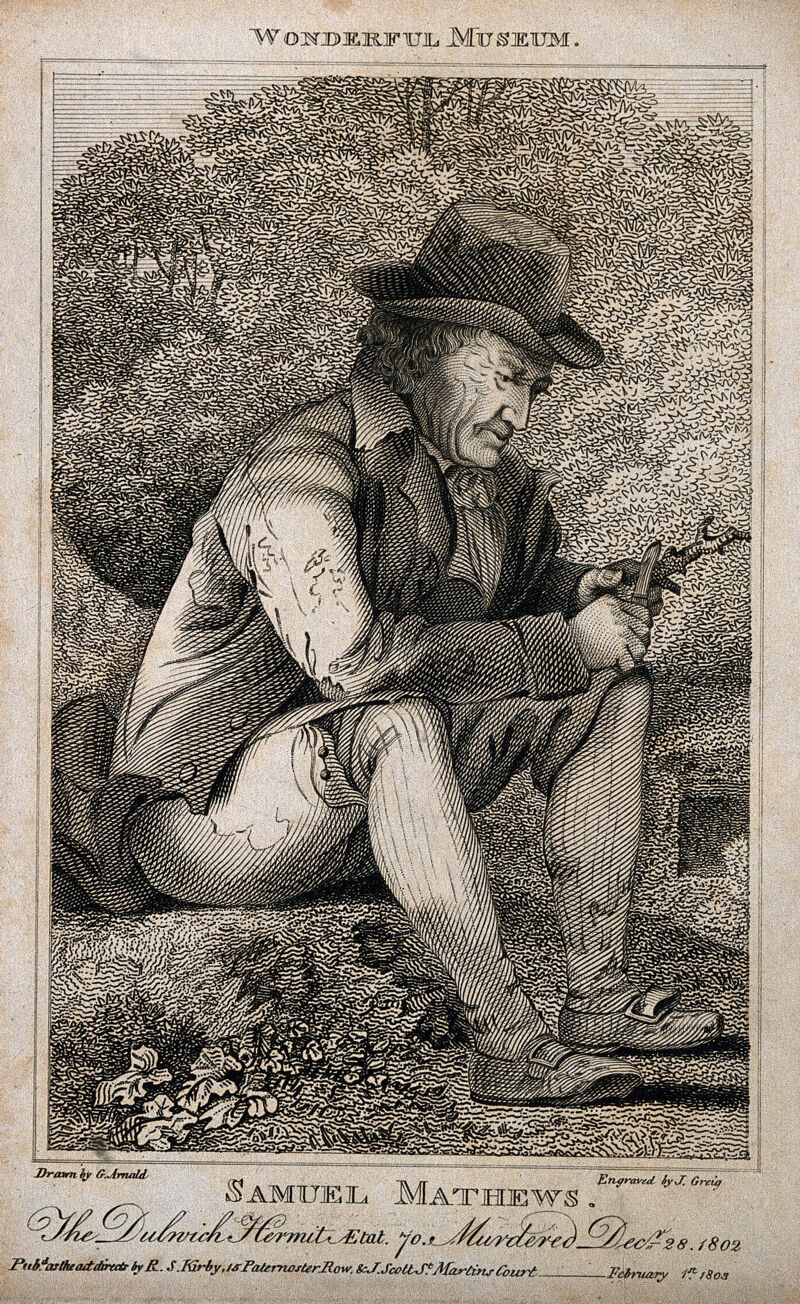
Samuel Mathews, a hermit. Engraving by J. Greig, 1803, after G. Arnald., 1 February 1803, by George Arnald
George Arnald · Wellcome Collection, London · Wellcome Collection
Life and career
Dated record
Life and career
The full dated record · 2 entries
1763
George Arnald was born on 1 January 1763.
1841
George Arnald died on 21 November 1841.
Places
Named by the record
Places
Only places the record itself states, plotted where the house gazetteer settles their coordinates. Nothing is inferred from a name or a nationality.
Berkshire.
Birth place
London.
Death place
Book illustrations
Arnald's work was used to illustrate books, including the following: • Scott, W. The Border Antiquities of England and Scotland. Edinburgh: 1814 • Dugdale, James. The New British Traveller. London: J Robins & Co, 1819 • Wright, Thomas. History and Topography of the County of Essex. London: G. Virtue, 1836
Work in public collections and galleries
Work in public collections and galleries
Arnald's work features in collections including the Tate Collection, the Royal Academy of Arts Collection, the National Portrait Gallery, London, and the collections of the University of Liège in Belgium. The Ferens Art Gallery in Kingston upon Hull has his painting of Charles I before Hull, and his scene of The Army under Cromwell marching to Winchester is in Winchester City Museum.
Documents and archives
Primary material
Documents and archives
authority record
- Wikidata, structured authority record Q3101395: George Arnald
General reference · Wikidata
reference work
- “George Arnald”, English Wikipedia, consulted as further reading
Reputable secondary · Wikipedia
Notes from the source article
Cited by Wikipedia
Notes from the source article
These works are cited by the source article, in its own numbering. They are recorded as its citations, not as sources VALÉORINE has verified.
- 1.George Arnald biography on the National Maritime Museum website.
- 2.List of Royal Academicians (A).
- 3.Altick, Richard D.,Paintings From Books: Art and Literature in Britain 1760–1900, Ohio State University Press.
- 4.Royal Observatory Greenwich. Biography of William Henry Pickersgill.
- 5.The Greenwich Hospital collection BHC 1811 at Portcities.org.uk.
- 6.List of Royal Academicians (P).
- 7.Philip Mould Ltd: Historical portraits image library.
- 8.Copy in National Art Library, V&A (issued in parts from at least 1822).
- 9.Copy in NAL; see P. Bicknell & J. Munro, Gilpin to Ruskin: Drawing Masters and their Manuals, 1800-1860 (1988), no. 49.
- 10.George Arnald's work in the Tate Collection.
- 11.George Arnald in the Royal Academy Collections.
- 12.George Arnald self-portrait in the collection of the National Portrait Gallery (London).
- 13.Engravings of George Arnald works held at the University of Liège, Belgium.
- 14.Harrington, Peter (1993). British Artists and War: The Face of Battle in Paintings and Prints, 1700-1914. London: Greenhill.
Bibliography printed in the source article · 1
- Houfe, Simon, "The Bedfordshire Prodigy: George Arnald ARA", Bedfordshire Magazine, Vol 2, (1990), pp. 135–41
References
Citations
References
Each reference names the institution holding it, so a reader may go to the document itself.
authority record
Secondary witnessreference work
Secondary witness
Further particulars
Held on the record
Further particulars
Open the remaining particulars
The authorities additionally record the headings Esq. His recorded language was English. Formation and teaching. Each of those relationships is stated by the authority record rather than inferred from style. Arnald worked in painting. His work is associated with realism. He belonged to Royal Academy of Arts.
Identity and origins
George Arnald, George Arnold, George Arnauld, A. George Arnold and George Arnord
Career and activity
Recognition and collections
Work by George Arnald is
Tate, Royal Museums Greenwich, National Maritime Museum and Musée Carnavalet
The Encyclopedia exists whether or not anything is for sale. Corrections are recorded rather than overwritten, and every version of this record is kept. Published 17 August 2026.
Elsewhere in Paintings
19,183 published records in this field, each with its sources named.
- George AleefArtist
- George Alexis WeymouthArtist
- George Ames AldrichArtist
- George AppertArtist
- George Arthur FrippArtist
- George Augustus BakerArtist
- George Augustus WallisArtist
- George Augustus WilliamsArtist
Best supported in this field
For owners
Own a work by George Arnald?
A specialist will read what you send and tell you what the house can establish, what it cannot, and whether the object is suited to sale. There is no charge and no obligation. The object stays with you throughout; nothing is shipped to us unless it is arranged in writing beforehand.