
Gene Davis
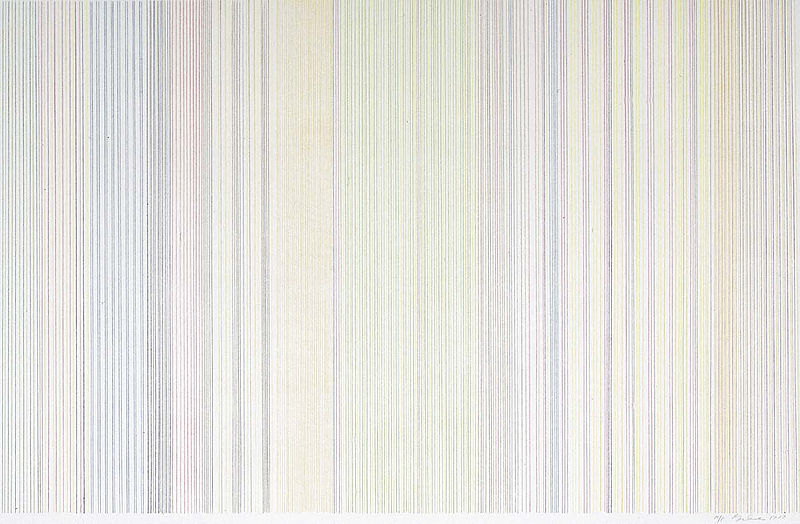
Gene Davis (August 22, 1920 – April 6, 1985) was an American Color Field painter known especially for his paintings of vertical stripes of color.
Also recorded as Gene Bernard Davis
Gene Davis

Gene Davis · Public domain
- Name
- Gene Davis
- Born
- 22 August 1920
- Birthplace
- Washington, DC, U.S.
- Died
- 6 April 1985
- Known for
- Painting
- Training
- University of Maryland
- Movement
- Washington Color School, Color Field painting, Post-painterly Abstraction
- Nationality
- United States.
- Occupation
- painter and draftsperson.
- Fields
- painting.
- Movements
- Washington Color School.
- Honours
- Guggenheim Fellowship.
VALÉORINE Encyclopedia
VALÉORINE documentary reading
Documentary summary
Gene Davis (August 22, 1920 – April 6, 1985) was an American Color Field painter known especially for his paintings of vertical stripes of color.
Admitted source layer · organised and presented by VALÉORINE
Reference Check
Propose documentary evidence for Gene Davis. A contribution is never written directly as fact: identity, source, rights and evidence gates still decide.
Sign in to contribute
World of VALÉORINE
Documentary connections
Only confirmed graph relationships appear here. Images are shown only when their identity and reuse rights both pass the documentary gate.
Documentary evidence
Documentary basis
Authority files
wikidata · Q5531163
In this article
Biography
Biography
The recorded working language is English. The field of work recorded is painting. Arshile Gorky is recorded as an influence. Work by Gene Davis is recorded in the collections of The Nelson-Atkins Museum of Art, Museum of Modern Art, Tate, San Francisco Museum of Modern Art and Metropolitan Museum of Art. Distinctions recorded are Guggenheim Fellowship.

Printer: Collector's Press Ernest de Soto, n.d.
Gene Davis · https: Persistent URL
Artist: Gene Davis, born Washington, DC 1920-died Washington, DC 1985
Smithsonian Institution
Key facts
Key facts
• Name — Gene Davis • Born — 22 August 1920 • Birthplace — Washington, DC, U.S. • Died — 6 April 1985 • Place of death — Washington, DC, U.S. • Known for — Painting • Training — University of Maryland • Movement — Washington Color School, Color Field painting, Post-painterly Abstraction
Biography
Biography
Davis was born in Washington, D.C., in 1920 and spent nearly all his life there. Before he began to paint in 1949, he worked as a sportswriter, covering the Washington Football Team and other local teams. Working as a journalist in the late 1940s, he covered the Roosevelt and Truman presidential administrations, and was often President Truman's partner for poker games. His first art studio was in his apartment on Scott Circle; later he worked out of a studio on Pennsylvania Avenue. In the 1950s, Gene Davis, with Kenneth Noland and Morris Louis was one of a small group of painters called the Washington Color School who made experimentation with colours. In Washington he closely studied works in the Phillips Collection including paintings by Pierre Bonnard and Paul Klee, to which he later attributed his heightened sense of color. • Illustration — Street in downtown Washington, D.C. painted in Davis' style Davis's first solo exhibition of drawings was at the Dupont Theater Gallery in 1952, and his first exhibition of paintings was at Catholic University in 1953. A decade later he participated in the "Washington Color Painters" exhibit at the Washington Gallery of Modern Art in Washington, D.C., which traveled to other venues around the U.S., and launched the recognition of the Washington Color School as a regional movement in which Davis was a central figure. The Washington painters were among the most prominent of the mid-century color field painters. Though, he worked in a variety of media and styles, including ink, oil, acrylic, video, and collage, Davis is best known by far for his acrylic paintings (mostly on canvas) of colorful vertical stripes, which he began to paint in 1958. The paintings typically repeat particular colors to create a sense of rhythm and repetition with variations. One of the best-known of his paintings, "Blue Freak-Out" (1966) acquired by the Pérez Art Museum Miami, and "Black Grey Beat" (1964), owned by the Smithsonian American Art Museum reinforces these musical comparisons in its title. The pairs of alternating black and grey stripes are repeated across the canvas, and recognizable even as other colors are substituted for black and grey, and returned to even as the repetition of dark and light pairs is here and there broken by sharply contrasting colors. • Illustration — Franklin's Footpath In 1972 Davis created Franklin's Footpath, which was at the time the world's largest artwork, by painting colorful stripes on the street in front of the Philadelphia Museum of Art, and the world's largest painting, Niagara (43,680 square feet), in a parking lot in Lewiston, New York. His "micro-paintings", at the other extreme, were as small as 3/8 of an inch square. Stripes are a recurrent theme in art history and he used it as a formal canon to examine various aspects of color using a reduced range of resources. • Illustration — Sun Sonata by Gene Davis. For a public work in a different medium altogether, he designed the color patterns of the "Solar Wall," a set of tubes filled with dyed water and backlit by fluorescent lights, at the Muscarelle Museum of Art at the College of William and Mary in Williamsburg, Virginia. Davis began teaching in 1966 at the Corcoran School of Art, where he became a permanent member of the faculty. His works are in the collections of, among others, the Corcoran Gallery of Art, the Solomon R. Guggenheim Museum, The Phillips Collection in Washington, D.C., the Pérez Art Museum Miami, in Florida, the Walker Art Center in Minneapolis, Minnesota, The Governor Nelson A. Rockefeller Empire State Plaza Art Collection in Albany, New York, and the Smithsonian American Art Museum. He died on April 6, 1985, in his hometown of Washington, DC.
Notes from the source article
Cited by Wikipedia
Notes from the source article
These works are cited by the source article, in its own numbering. They are recorded as its citations, not as sources VALÉORINE has verified.
- 1.Stamberg, Susan. 'Color Field' Artists Found a Different Way. NPR. 2008-03-04.
- 2.How DC Earned Its Stripes: Inside SAAM's "Hot Beat". 23 January 2017.
- 3.Smithsonian American Art Museum collection
- 4.Jennie Mcgee. Rebirth of Muscarelle's 'Solar Wall'. W&M News. December 13, 2005.
- 5.Blue Freak-Out • Pérez Art Museum Miami. Pérez Art Museum Miami.
- 6.Hollis Taggert/biography
- 7.Artnet Catalog
- 8.Artnet Catalog
Bibliography printed in the source article · 4
- G. Baro. 1982. Gene Davis Drawings. New York: Arts Publisher.
- S. W. Naifeh. Gene Davis. New York: Arts Publisher.
- D. Wall, ed. 1975. Gene Davis. New York: Praeger Publishers.
- J. D. Serwer. 1987. Gene Davis, A Memorial Exhibition. Washington, D.C.: Smithsonian Institution Press. .
References
Citations
References
Each reference names the institution holding it, so a reader may go to the document itself.
authority record
General reference
The Encyclopedia exists whether or not anything is for sale. Corrections are recorded rather than overwritten, and every version of this record is kept. Published 18 August 2026.
Elsewhere in Paintings
18,792 published records in this field, each with its sources named.
- Geliy KorzhevArtist
- Gen'ichirō InokumaArtist
- Genaro Pérez VillaamilArtist
- Gene AmondsonArtist
- Generoso PompaArtist
- Geneviève BoullogneArtist
- Geneviève Brossard de BeaulieuArtist
- Geneviève ClaisseArtist
Best supported in this field
For owners
Own a work by Gene Davis?
A specialist will read what you send and tell you what the house can establish, what it cannot, and whether the object is suited to sale. There is no charge and no obligation. The object stays with you throughout; nothing is shipped to us unless it is arranged in writing beforehand.