
Gavin Hamilton
Gavin Hamilton (1723 – 4 January 1798) was a Scottish neoclassical history painter, who is more widely remembered for his searches for antiquities in the neighbourhood of Rome. These roles in combination made him an arbiter of neoclassical taste.
Also recorded as Mr. Hamilton of Rome · G. Hamilton · Hamilton of Rome · gaven hamilton
Gavin Hamilton
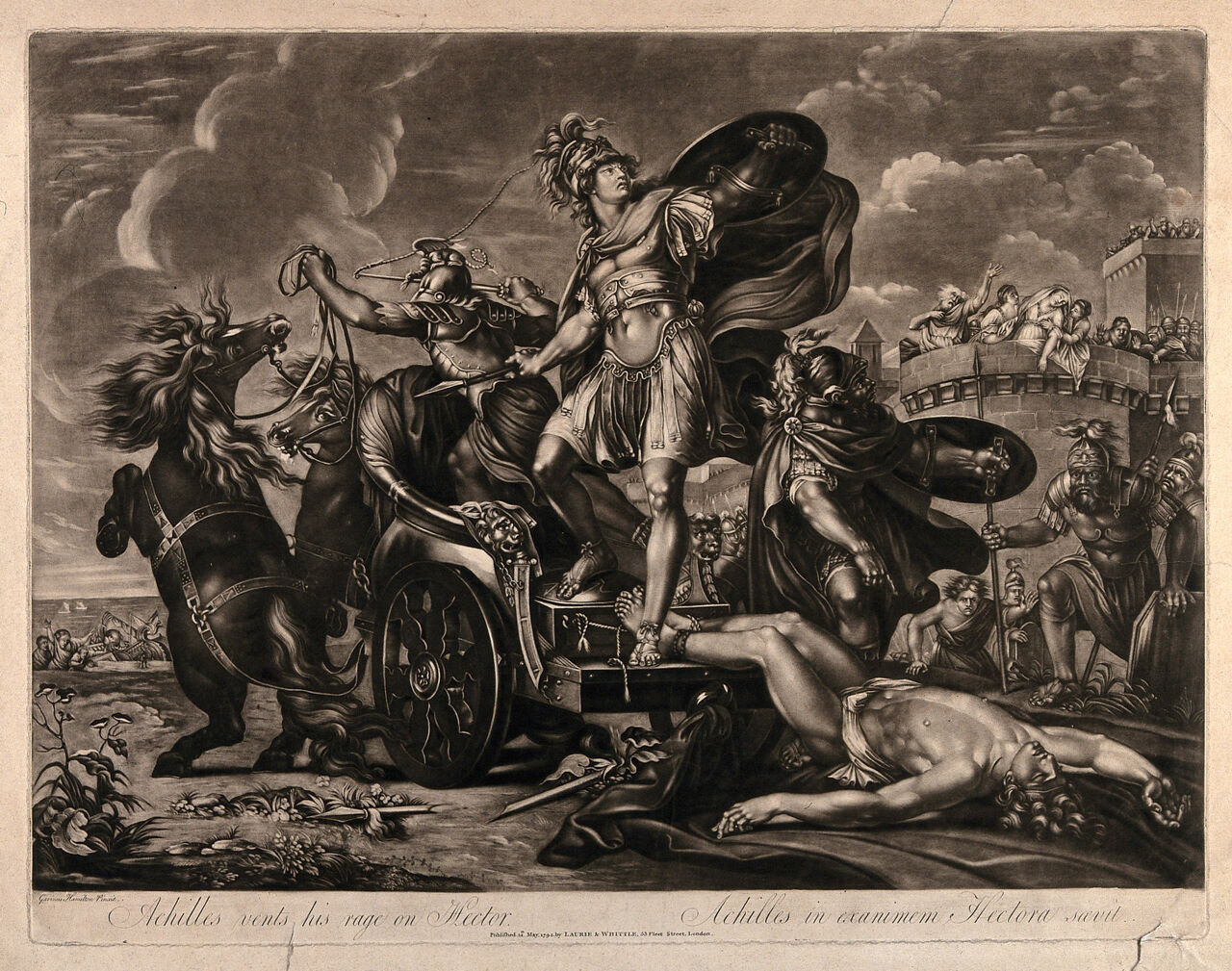
Gavin Hamilton · Wellcome Collection, London · Wellcome Collection · Public Domain Mark
- Name
- Gavin Hamilton
- Born
- 1723 ODNB
- Birthplace
- Murdostoun, Lanarkshire, Scotland
- Died
- 4 January 1798 1723
- Place of death
- Rome, Papal States
- Movement
- Neoclassicism, Scottish Enlightenment
- Nationality
- Kingdom of Great Britain.
- Occupation
- anthropologist, painter, art historian, archaeologist and art dealer.
- Fields
- history.
- Movements
- Neoclassicism.
- Education
- University of Glasgow.
- Known for
- Venus Presenting Helen to Paris.
VALÉORINE Encyclopedia
VALÉORINE documentary reading
Documentary summary
Gavin Hamilton (1723 – 4 January 1798) was a Scottish neoclassical history painter, who is more widely remembered for his searches for antiquities in the neighbourhood of Rome. These roles in combination made him an arbiter of neoclassical taste.
Admitted source layer · organised and presented by VALÉORINE
Note VALÉORINE
Gavin Hamilton (1723–1798) was an anthropologist, archaeologist and art dealer, among other activities, of British nationality. The anthropologist was born in Lanarkshire and died in Rome.
Gavin Hamilton was educated at University of Glasgow. The anthropologist was a member of Accademia delle Arti del Disegno. Gavin Hamilton was associated with Neoclassicism.
Among the works is Venus Presenting Helen to Paris. The work spans history and history painting. Languages used include English. Works are held at Cantor Arts Center at Stanford University, Detroit Institute of Arts and Hunterian Museum and Art Gallery, among others.
Composed from admitted, traceable facts · 01 October 2026
VALÉORINE
Reference Check
Propose documentary evidence for Gavin Hamilton. A contribution is never written directly as fact: identity, source, rights and evidence gates still decide.
Sign in to contribute
World of VALÉORINE
Documentary connections
Only confirmed graph relationships appear here. Images are shown only when their identity and reuse rights both pass the documentary gate.

Documentary evidence
Documentary basis
Authority files
wikidata · Q1496436
In this article
Biography
Biography
Gavin Hamilton studied at University of Glasgow. The recorded working language is English. Subjects and genres recorded for the work are history. Works named in the authority record are Venus Presenting Helen to Paris. Work by Gavin Hamilton is recorded in the collections of Tate, Städel Museum, National Galleries Scotland, Hunterian Museum and Art Gallery and Yale Center for British Art.
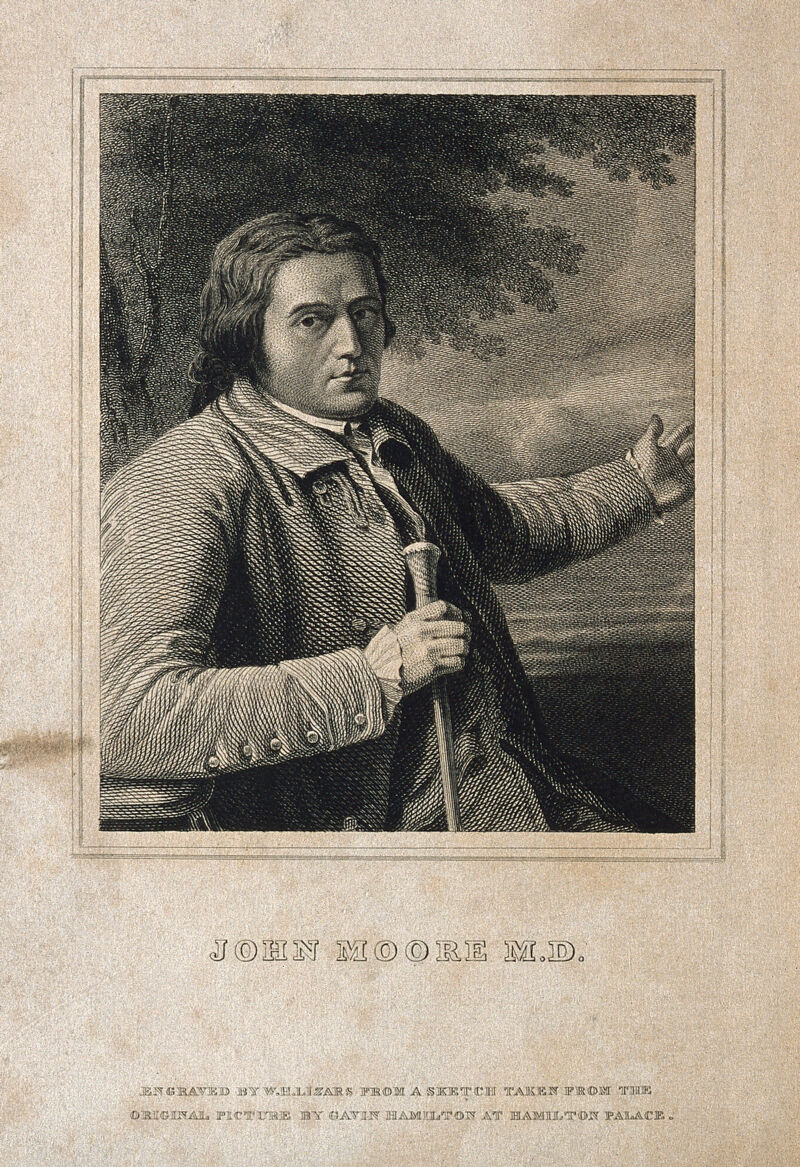
John Moore. Line engraving by W. H. Lizars, 1820, after G. Hamilton., by Gavin Hamilton
Gavin Hamilton · Wellcome Collection, London · Wellcome Collection
Key facts
Key facts
• Name — Gavin Hamilton • Born — 1723 ODNB • Birthplace — Murdostoun, Lanarkshire, Scotland • Died — 4 January 1798 1723 • Place of death — Rome, Papal States • Movement — Neoclassicism, Scottish Enlightenment • Relatives — James Hamilton (brother) James Hamilton (nephew)
Biography
Biography
Born in Lanarkshire, Scotland in 1723, he matriculated at the University of Glasgow under the Professor of Humanity at the age of 15. By 1744 he was in Italy, and probably studied in Rome in the studio of Agostino Masucci. From 1748 to 1750 he shared an apartment with James Stuart, Matthew Brettingham and Nicholas Revett, and with them visited Naples and Venice. On returning to Britain, he spent several years portrait-painting in London (1751–1756). At the end of that period, he returned to Rome. He lived there for the next four decades, until his death in 1798. Aside from a few portraits of friends, the Hamilton family, and British people on the Grand Tour, most of his paintings, many of which are very large, were of classical Greek and Roman subjects. His most famous is a cycle of six paintings from Homer's Iliad, intended to have a pictorial impact equivalent to the epic grandeur of Homer as identified by Thomas Blackwell in his An Enquiry into the Life and Writings of Homer (1735), and also influenced by George Turnbull's Treatise on Ancient Painting (1740). As engraved by Domenico Cunego and reproduced, these were disseminated widely and enormously influential. Also influential was Hamilton's Death of Lucretia (1760s), also known as the Oath of Brutus. This inspired a series of "oath paintings" by European painters, which included Jacques-Louis David's noted Oath of the Horatii (1784). Like most later paintings of the scene, it placed it over Lucretia's dead body. In Livy it is made later, after the overthrow of the Roman monarchy. • Illustration — Pastel portrait of Gavin Hamilton (detail) by Archibald Skirving, 1788 As a painter of classical subjects, Hamilton was highly regarded by Johann Joachim Winckelmann, writer Goethe, young sculptor Antonio Canova and others in Rome. He received a commission to paint the altar piece of Sant'Andrea degli Scozzesi, the Scottish national church in Rome, for which he portrayed the Martyrdom of St Andrew. He was less widely appreciated in Britain, though his patrons included the Duke of Dorset, Lord Egremont, Viscount Palmerson, Lord Shelburne, Lord Spencer, Lord Hope and Sir James Grant. Among the artists who sought his favour and advice were Anne Forbes, William Cochran, David Allan and Alexander Nasmyth. As an art dealer and archaeologist, Hamilton undertook excavations at Hadrian's Villa in Tivoli in 1769–1771, at first to acquire marble for his sculptor to restore sculptures. His excavators reopened the outlet of a low-lying swampy area and "after some weeks' work underground by lamp-light and up to the knees in muddy water" retrieved sculptures from the muck, where they had been thrown centuries before with timber when Christians levelled the sacred grove.(Smith 1901:308). From 1771 Hamilton excavated other sites in the environs of Rome: Cardinal Flavio Chigi's Tor Colombaro, 1771–72, Albano, 1772, Monte Cagnolo 1772–73, Ostia 1774–75, the Villa Fonseca on the Caelian Hill in Rome, Roma Vecchia (the Villa dei Quintili), ca 1775 Castel di Guido and Gabii. • Illustration — Gavin Hamilton by Christopher Hewetson, Hunterian Art Gallery, Glasgow In an age when restorations to Roman sculptures were broadly conceived and the refinishing of whole surfaces was still common practice, Hamilton maintained a reputation as an honest man who did not tamper unduly with the sculptures that passed through his hands. Hamilton sold many of the works of art he recovered to his British clients, most notably to Charles Townley, to whom the painter wrote: "the most valuable acquisition a man of refined taste can make, is a piece of fine Greek Sculpture"; and to William Petty, 2nd Earl of Shelburne at Shelburne, later Lansdowne House, London. In 1771 Hamilton discovered the Warwick Vase at Hadrian's Villa. He sold it to Sir William Hamilton, a connoisseur and the British envoy at Naples. Gavin Hamilton worked closely with Giovanni Battista Piranesi. He was an early advisor of Antonio Canova, a young sculptor whom he met at a dinner party in December 1779 on Canova's first visit to Rome. The painter advised the younger man to put aside his early, Rococo manner and concentrate on conflating the study of nature with the best of antiquities and a narrow range of classic modern sculptors. In 1785 Hamilton bought Leonardo da Vinci's Virgin of the Rocks and sent it to London for sale. His purchase was the version now held by the National Gallery, London. Such hunting and sale of antiquities was considered a marginally shady undertaking. Hamilton was successful in making generous offerings to the Vatican's Museo Pio-Clementino, as the Pope claimed one-third of all excavated works and had the right to forbid export of outstanding treasures. In addition, Hamilton paid landowners for excavating rights, so kept his peace with them. He died in Rome on 4 January 1798.
Gallery
Gallery
• Illustration — Elizabeth Gunning (1752/53) • Illustration — Douglas Hamilton, 8th Duke of Hamilton (1775–77) • Illustration — Venus giving Paris Helen as his wife (1782–84), held by Palazzo Braschi, Rome • Illustration — Martyrdom of St. Andrew, held by the Pontifical Scots College, Rome
Life and career
Dated record
Life and career
Explore 1723–1798
The full dated record · 4 entries
1723
Gavin Hamilton was born in 1723 at Lanarkshire.
1764
Andromache lamenting over the dead body of her husband Hector, surrounded by grieving members of the Trojan court. Engraving by D. Cunego, 1764, after Gavin Hamilton. is dated [1764?] and held by Wellcome Collection.
1767
Achilles embracing the dead body of Patroclus, surrounded by women on the left and Greek generals on the right. Engraving by D. Cunego, 1767, after Gavin Hamilton. is dated [1767?] and held by Wellcome Collection.
1798
Gavin Hamilton died in 1798 at Rome.
Places
Named by the record
Places
Only places the record itself states, plotted where the house gazetteer settles their coordinates. Nothing is inferred from a name or a nationality.
Lanarkshire.
Birth place
Rome.
Death place
Literature
Scholarly footprint
A count of publications is evidence of attention, not of standing, and is given here only as a measure.
Notes from the source article
Cited by Wikipedia
Notes from the source article
These works are cited by the source article, in its own numbering. They are recorded as its citations, not as sources VALÉORINE has verified.
- 1.A Grande História da Arte (Vol 16)
- 2.David Irwin, "Gavin Hamilton: Archaeologist, Painter, and Dealer" The Art Bulletin 44.2 (June 1962:87–102).
- 3.Skinner, Basil C. (1966), Scots in Italy in the 18th Century, National Galleries of Scotland, pp. 14 - 23
- 4.Macmillan, Duncan (1984), Scottish Painting: Ramsay to Raeburn, in Parker, Geoffrey (ed.), Cencrastus No. 17, Summer 1984, pp. 25 - 29,
- 5.A. H. Smith, "Gavin Hamilton's Letters to Charles Townley," The Journal of Hellenic Studies, 21 (1901), pp. 306–321; Irwin, David. (1962) "Gavin Hamilton: Archaeologist, Painter and Dealer", in The Art Bulletin 44:2, pp. 87–102;
- 6.Irwin 1962:89, noting J.T. Smith's assessment in Nollekins and His Times, vol. I:207f.
- 7.Quoted Irwin 1962:88.
- 8.Gavin Hamilton's long series of letters to Lord Shelburne survive. Other purchasers included the Hon. Charles Greville, Lord Temple at Stowe, James Hugh Smith-Barry of Marbury Hall, Cheshire, and, in Rome, Pope Clement XIV for his museum at the Vatican, Cardinal Alessandro Albani for his Villa Albani, and his fellow antiquities hunter, Thomas Jenkins.
- 9.Irwin 1962:87ff.
- 10.Francis Haskell and Nicholas Penny, Taste and the Antique (Yale University Press) 1981, p. 66f.
Bibliography printed in the source article · 10
- B. Cassidy, ed., The Life & Letters of Gavin Hamilton (1723–1798): Artist & Art Dealer in Eighteenth-Century Rome (2 vols., 2012)
- Ilaria Bignamini, 'British Conquerors of the Marbles, 1 Gavin Hamilton as Archaeologist', in Ilaria Bignamini and Clare Hornsby, Digging And Dealing in Eighteenth-Century Rome (2010. Yale U.P.), p. 194–207
- M. Cima, 'Gavin Hamilton a Gabii ...', in Villa Borghese: storia e gestione, ed. A. Campitelli (2005)
- B. Cassidy, 'Gavin Hamilton, Thomas Pitt and statues for Stowe', in Burlington Magazine; 146 (2004 December), p. 806–814
- A Dictionary of British and Irish Travellers to Italy, 1701–1800, Compiled from the Brinsley Ford Archive by John Ingamells (1997), p. 447
- David Irwin, 'Gavin Hamilton Archaeologist, Painter and Dealer', in The Art Bulletin; 44:2 (1962 June), p. 87–102
- Duncan Macmillan, Scottish Painting: Ramsay to Raeburn, in Parker, Geoffrey (ed.), Cencrastus No. 17, Summer 1984, pp. 25 - 29,
- Duncan Macmillan, Scotland and the Origins of Modern Art, Lund Humphries, London (2023), pp. 26 - 64,
- Basil Skinner, Scots in Italy in the 18th Century, (1966, National Galleries of Scotland)
- A. H. Smith, 'Gavin Hamilton's Letters to Charles Townley', in The Journal of Hellenic Studies; 21 (1901), p. 306–321
References
Citations
References
Each reference names the institution holding it, so a reader may go to the document itself.
reference work
Wikidata, structured authority record Q1496436: Gavin HamiltonWikimedia Foundation
Secondary witness
The Encyclopedia exists whether or not anything is for sale. Corrections are recorded rather than overwritten, and every version of this record is kept. Published 16 August 2026.
Elsewhere in Paintings
19,183 published records in this field, each with its sources named.
- Gaston OrellanaArtist
- Gaston RelensArtist
- Gatōken ShunshiArtist
- Gautam VaghelaArtist
- Gavin JantjesArtist
- Gavriil MalishArtist
- Gavril AtanasovArtist
- Gayane KhachaturianArtist
Best supported in this field
For owners
Own a work by Gavin Hamilton?
A specialist will read what you send and tell you what the house can establish, what it cannot, and whether the object is suited to sale. There is no charge and no obligation. The object stays with you throughout; nothing is shipped to us unless it is arranged in writing beforehand.