
Epitaph-altarpiece of Johann Friedrich the Magnanimous in the Weimar parish church St. Peter and Paul
Weimar Cranach Altarpiece (or Herderkirche Weimar Cranach Altarpiece) is a Lutheran winged altarpiece created by Lucas Cranach the Elder and his son Lucas Cranach the Younger between 1552 and 1555 for the Church of St. Peter und Paul in Weimar, Germany.
Also recorded as Altar in St. Peter und Paul, Weimar by Cranachs
Epitaph-altarpiece of Johann Friedrich the Magnanimous in the Weimar parish church St. Peter and Paul

Jean-Christophe BENOIST · CC BY 4.0
- Movement
- German Renaissance
- Period
- 1555.
- Region
- Germany.
- Related practice
- limewood.
VALÉORINE Encyclopedia
VALÉORINE documentary reading
Documentary summary
Weimar Cranach Altarpiece (or Herderkirche Weimar Cranach Altarpiece) is a Lutheran winged altarpiece created by Lucas Cranach the Elder and his son Lucas Cranach the Younger between 1552 and 1555 for the Church of St. Peter und Paul in Weimar, Germany.
Admitted source layer · organised and presented by VALÉORINE
Reference Check
Propose documentary evidence for Epitaph-altarpiece of Johann Friedrich the Magnanimous in the Weimar parish church St. Peter and Paul. A contribution is never written directly as fact: identity, source, rights and evidence gates still decide.
Sign in to contribute
World of VALÉORINE
Documentary connections
Only confirmed graph relationships appear here. Images are shown only when their identity and reuse rights both pass the documentary gate.
Documentary evidence
Documentary basis
Authority files
wikidata · Q117071454
In this article
Overview
Overview
It is recorded as the work of Lucas Cranach the Elder and Lucas Cranach the Younger. Materials recorded for it are limewood. Recorded constituent parts are Epitaph-altarpiece of Johann Friedrich the Magnanimous in the Weimar parish church St. Peter and Paul [left wing], Epitaph-altarpiece of Johann Friedrich the Magnanimous and Epitaph-altarpiece of Johann Friedrich the Magnanimous in the Weimar parish church St. It is associated with Germany. The record gives 1555 as its date of establishment or first appearance. Recorded genres are religious art and Lutheran art. It is recorded in the collection of St.
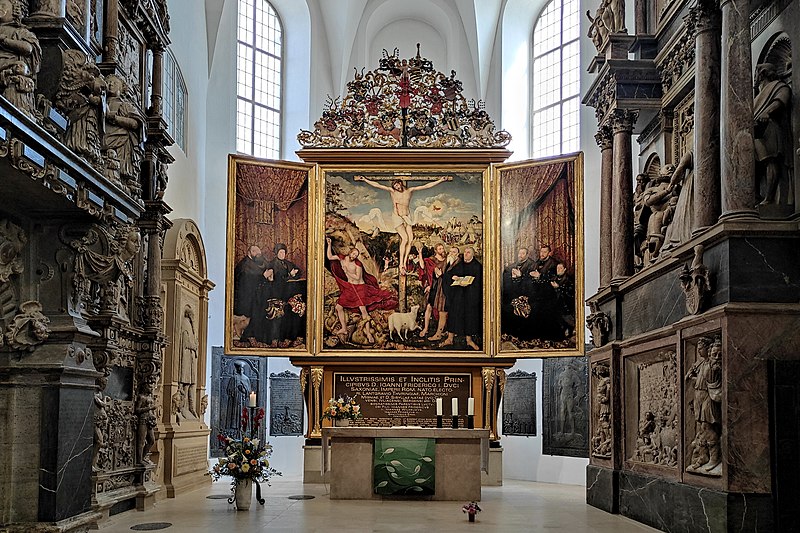
Epitaph-altarpiece of Johann Friedrich the Magnanimous in the Weimar parish church St. Peter and Paul, Herderkirche Altar
H.Helmlechner
Key facts
Key facts
• Title — Weimar Cranach Altarpiece • Artist — Lucas Cranach the Elder and Lucas Cranach the Younger • Year — 1555 • Medium — Limewood • Movement — German Renaissance • Height Metric — 370 • Width Metric — 309 • Owner — Evangelical Lutheran Parish Church of St. Peter und Paul in Weimar • City — Weimar
History and description
History and description
The triptych altarpiece was commissioned by the Elector of Saxony John Frederick I and installed at the high altar of the city parish church of St. Peter und Paul in Weimar in 1555, thus making it one of the major Protestant altarpieces of Reformation, made by Cranachs. The painting of the three-winged altarpiece was started by Lucas Cranach the Elder and upon his father's death, the task was completed by the son Lucas Cranach the Younger in 1555. It is one of the most important Thuringian masterpieces of art produced in the 16th century. The chancel area houses the authentic grave slab of Lucas Cranach the Elder, who now rests at Jacobsfriedhof. During World War II, the altarpiece was stored elsewhere, and therefore survived the air raids of 1945.
Interpretation of the altarpiece
Interpretation of the altarpiece
• Illustration — Detailed image of the central piece of altar As in almost all cases of Cranach Post-Reformation altarpieces, there is also a great deal of Christocentric Lutheran symbolism, Christian allegory and Protestant theological concept of Five solas depicted in the Weimar altarpiece, with each image referring to salvation alone in Jesus, emphasizing the sacrifice of Jesus in Solus Christus. The altarpiece is Christ-centered with main focus on the crucified Christ with John the Baptist pointing up at Jesus and index finger from his other hand to the Agnus Dei, while Lucas Cranach the Elder and Martin Luther are standing on the right side. Christ's image is repeated on the left side, he is depicted defeating Satan and conquering death. Cranach is depicted being washed by the blood of Jesus, while there is an open Bible in Luther's hand with his index finger pointing at the Bible to signify the importance of preaching of the Word of God and the doctrine of Sola scriptura. In the background, the fallen nature of mankind is depicted through a scene of the Expulsion from the Garden of Eden, along with the Old Testament narrative of the revelation of the Ten Commandments, the Brazen Serpent, Moses preaching to Israelites and Annunciation to the shepherds. When the triptych is closed, the outer sides of the wings depict the Biblical scenes of Baptism of Jesus and Resurrection.The altarpiece also serves as a grave monument to John Frederick I, his wife Sibylle of Cleves and their descendants who were laid to rest beneath the vault in front of the altar, with their names carved on the predella in the form of an epitaph and their images depicted on the outer wings of the triptych. • Illustration — Weimar altarpiece close-up • Illustration — Agnus Dei detail • Illustration — Resurrected Christ conquering death • Illustration — Chancel of the church with altar and baptismal font • Illustration — Weimar altarpiece with the sight of the ducal burial vault in the front • Illustration — Elector of Saxony John Frederick I and his wife Sibylle of Cleves in prayer
Chronology
Dated record
Chronology
The full dated record · 1 entries
1555
Epitaph-altarpiece of Johann Friedrich the Magnanimous in the Weimar parish church St. Peter and Paul first recorded.
Practice and materials
Its recorded materials are limewood. It comprises Epitaph-altarpiece of Johann Friedrich the Magnanimous in the Weimar parish church St. Peter and Paul [left wing], Epitaph-altarpiece of Johann Friedrich the Magnanimous and Epitaph-altarpiece of Johann Friedrich the Magnanimous in the Weimar parish church St. Peter and Paul [right wing].
Notes from the source article
Cited by Wikipedia
Notes from the source article
These works are cited by the source article, in its own numbering. They are recorded as its citations, not as sources VALÉORINE has verified.
References
Citations
References
Each reference names the institution holding it, so a reader may go to the document itself.
reference work
Secondary witness
The Encyclopedia exists whether or not anything is for sale. Corrections are recorded rather than overwritten, and every version of this record is kept. Published 16 August 2026.
Elsewhere in Furniture
924 published records in this field, each with its sources named.
- Entranceway at Main Street at High Park BoulevardTerminology
- Entranceway at Main Street at Lafayette BoulevardTerminology
- Entranceway at Main Street at LeBrun RoadTerminology
- Entranceway at Main Street at Westfield Road and Ivyhurst RoadTerminology
- equatorial mountTerminology
- escape chairTerminology
- Eshmunazar II sarcophagusTerminology
- European Drawer RackTerminology
Best supported in this field
For owners
Own an object connected with Epitaph-altarpiece of Johann Friedrich the Magnanimous in the Weimar parish church St. Peter and Paul?
A specialist will read what you send and tell you what the house can establish, what it cannot, and whether the object is suited to sale. There is no charge and no obligation. The object stays with you throughout; nothing is shipped to us unless it is arranged in writing beforehand.