
English concertina
Illustration — Lachenal metal-ended English concertina, c. 1895 The English concertina is a member of the concertina family of free-reed musical instruments. Invented in England in 1829, it was the first instrument of what would become the concertina family.
English concertina
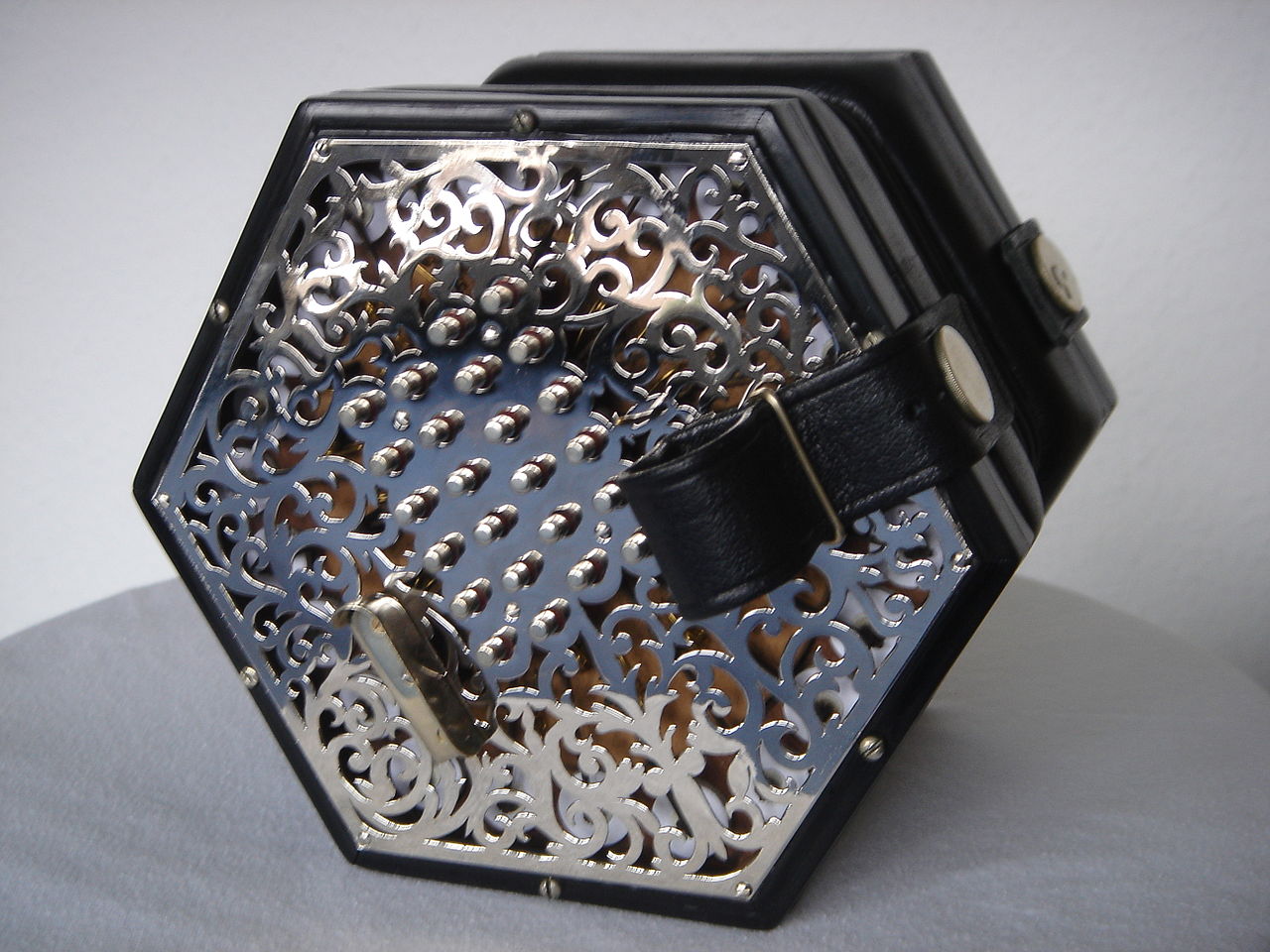
Tinaman at de.wikipedia · Tinaman · CC BY-SA 3.0
- Field
- concertina
VALÉORINE Encyclopedia
VALÉORINE documentary reading
Documentary summary
Illustration — Lachenal metal-ended English concertina, c. 1895 The English concertina is a member of the concertina family of free-reed musical instruments. Invented in England in 1829, it was the first instrument of what would become the concertina family.
Admitted source layer · organised and presented by VALÉORINE
Reference Check
Propose documentary evidence for English concertina. A contribution is never written directly as fact: identity, source, rights and evidence gates still decide.
Sign in to contribute
World of VALÉORINE
Documentary connections
Only confirmed graph relationships appear here. Images are shown only when their identity and reuse rights both pass the documentary gate.

Documentary evidence
Documentary basis
Authority files
wikidata · Q18639200 · wikipedia · English concertina
In this article
History
History
It is a fully chromatic instrument, having buttons in a rectangular arrangement of four staggered rows; its buttons are unisonoric, producing the same note on both the push and pull of the bellows. It differs from other concertinas in that the scale is divided evenly between the two hands, such that playing a scale involves both hands alternately playing each note in sequence.
The invention of the instrument is credited to Sir Charles Wheatstone; his earliest patent of a like instrument was granted 19 December 1829, No 5803 in Great Britain. The English concertina was initially used for playing classical music, virtuosic solos, and chamber music. By the 1860s and 1870s, the English concertina grew more popular in the music hall tradition. The evangelical Salvation Army adopted all systems of the concertina as a more portable and flexible alternative to brass instruments, and published a number of tutor books showing the complexity and range of the music they played on the English system.
England
England
In the English Folk Revival of the 1960s, though the English concertina had been more an art music instrument, it became popular with British folk musicians. Karl Dallas has suggested that the mere presence of 'English' in the name attracted some of the revival's demographic; however the instrument's versatility and portability were also important as factors in the instrument's adoption. Alf Edwards was a regular accompanist to both A. L. Lloyd and Ewan MacColl, and taught the instrument to Peggy Seeger. His virtuosic and reliable playing was a key element in the adoption of the English concertina by the English folk revival, featuring prominently on influential records such as The Iron Muse and on the Radio Ballads. Later in the 1960s Alistair Anderson became known for interpreting the traditional dance music of Britain, particularly that of Northumbria. The English concertina has a strong representation amongst amateur players of English folk music; modern nationally known folk performers on the English concertina include Robert Harbron, Sandra Kerr, Graham Kennett, and the Scottish musician Simon Thoumire.
Ireland
Ireland
The English concertina found limited use in Irish traditional music – significantly less than the Anglo concertina. Rick Epping plays Irish music on the harmonica whilst accompanying himself on English concertina.
South Africa
South Africa
Although the Boeremusiek of the Afrikaner people of South Africa was predominantly played on the Anglo concertina, English system players were also recorded. References in Boeremusiek to the "4-ry" (four row) concertina refer to the English system. Boer musicians used the actual word "English" to mean Anglo system instruments made by English firms such as Lachenal & Co. and Wheatstone (and, less frequently, English and Duet system instruments made by those English companies).
Latin America
Latin America
While it was primarily the bandoneon concertina which achieved success in South America, the English concertina gained some popularity in Bolivia, particularly in the Cochabamba region. It is theorized the instrument may have been brought there by foreign technicians working on the Bolivian Railway or the Patiño mines.
Play
Play
• Illustration — English concertina player using all four fingers to play notes The English concertina is typically held by placing the thumbs through thumb straps and the little fingers on metal finger rests, leaving three fingers free for playing. Many players also intermittently or continuously use the little finger to play notes, thus playing with all four fingers and relying upon the thumb straps to support the instrument. Heavier and larger instruments were often fitted with wrist straps and/or a neck sling to further support the weight of the instrument. The two innermost rows of the layout constitute a diatonic C major scale, distributed alternately between the two sides of the instrument. Thus in a given range, C-E-G-B-d is on one side, D-F-A-c-e on the other. The two outer rows consist of the sharps and flats required to complete the chromatic scale. This distribution of scale notes between sides facilitates rapid melodic play. English-system treble and tenor-treble concertinas usually span 3 1/2 or 4 octaves. Baritones are similar, but transpose down one octave. Bass concertinas transpose two octaves down, Contrabass Concertinas 3 Octaves down and piccolo concertinas play one octave up. The standard keyboard arrangement across treble, baritone and bass instruments has middle C on the button nearest the player on the second row of the left hand keyboard; tenor instruments may have that position button as the F below middle C. Tenor, baritone and bass concertinas often have an air valve in the position that would otherwise be occupied by the instrument's highest note. The air button is an essential feature of many bass concertinas which only have reeds to sound on the push bellows direction, due to the increased size of the reeds.
Definition
Definition
The following is established of the heading itself.
Performers and repertoire
Performers and repertoire
Giulio Regondi was a virtuoso performer and composer on this instrument as well as the guitar, and helped to popularize the instrument during the 19th century. In the classical style of Regondi, the little finger is used as well as the other three fingers, and the metal finger rests are used only very occasionally. This allows all eight fingers to simultaneously play the instrument so large chords are possible. In pieces such as the Bernhard Molique Concerto No 1 in G for concertina and orchestra, or Percy Grainger's Shepherd's Hey, four, five, and six note chords are not uncommon, and would be difficult or impossible to play without using all the fingers. Allan Atlas, in his book The Wheatstone Concertina in Victorian England identifies six known concertos written for this instrument.
Recorded examples
Catalogued output
Recorded examples
The following works and productions are recorded by name or by count. Institutional cataloguing adds that gesualdo Lanza. Engraving by H. Minasi, 1809, after T. Cheeseman and E.F.
Primary material
Documents and archives
authority record
- Wikidata, structured authority record Q18639200: English concertina
General reference · Wikidata
reference work
- “English concertina”, English Wikipedia, consulted as further reading
Reputable secondary · Wikipedia
Notes from the source article
Cited by Wikipedia
Notes from the source article
These works are cited by the source article, in its own numbering. They are recorded as its citations, not as sources VALÉORINE has verified.
- 1.Stiftung Kloster Michaelstein. Harmonium und Handharmonika: 20. Musikinstrumentenbau-Symposium, Michaelstein, 19. bis 21. November 1999. 184. 2002. 978-3-89512-120-3.
- 2.Helena Simonett. The Accordion in the Americas: Klezmer, Polka, Tango, Zydeco, and More!. University of Illinois Press. 22–. 2012. 978-0-252-03720-7.
- 3.Instruction Manuals for the English, Anglo, and Duet Concertina: An Annotated Bibliography.
- 4.Salvation Army Concertina Bands.
- 5.K. F. Dallas. Folk Music. 1. 1963.
- 6.The concertina as an emblem of the folk music revival in the British Isles, Stuart Eydmann concertina.com 2005.
- 7.Dave Arthur. Bert: The life and times of A L Lloyd. Pluto Press. 281. 2012. 978-0-7453325-2-9.
- 8.Fred Woods. Folk revival: the rediscovery of a national music. Blandford Press. 73. 1979. 9780713709704.
- 9.Crowell. Folk Music: More Than a Song. 9. 1 January 1976. 978-0-690-01159-3.
- 10.Dan Michael Worrall. The Anglo-German Concertina: A Social History. 190–191. 1 January 2009. 978-0-9825996-0-0.
- 11.Dan Michael Worrall. The Anglo-German Concertina: A Social History. 30–. 1 January 2009. 978-0-9825996-1-7.
- 12.Musical Instruments: Concertina.
- 13.Coloquio de la concertina . Ramón Rocha Monroy, Los Tiempos. 6 November 2012.
- 14.Geordie English concertina.
- 15.Allan Atlas, The Wheatstone Concertina in Victorian England
Bibliography printed in the source article · 3
- Atlas, Allan W. (1996). The Wheatstone English Concertina in Victorian England. Oxford: Clarendon Press.
- Henry Doktorski (1998). The Classical Concertina
- Eydmann, Stuart (2005). The Life and Times of the Concertina: the adoption and usage of a novel musical instrument with particular reference to Scotland. Chapter 5: The English Concertina: Instrument of the Victorian Middle Classes. Concertina.com
References
Citations
References
Each reference names the institution holding it, so a reader may go to the document itself.
authority record
Secondary witnessreference work
Secondary witness
Connections
Knowledge graph
Connections
Each connection was recorded deliberately, with the basis for it kept on the internal record.
Broader subject
1- concertinaTerminology
Established from a fact already recorded on a verified source.
The Encyclopedia exists whether or not anything is for sale. Corrections are recorded rather than overwritten, and every version of this record is kept. Published 16 August 2026.
Elsewhere in Collectables
20,755 published records in this field, each with its sources named.
- EngalabiTerminology
- EngareWork
- England International FootballWork
- EnglerOrganisation
- English Country TuneWork
- English guitarTerminology
- English Racing AutomobilesOrganisation
- enharmonic keyboardTerminology
Best supported in this field
For owners
Own an object connected with English concertina?
A specialist will read what you send and tell you what the house can establish, what it cannot, and whether the object is suited to sale. There is no charge and no obligation. The object stays with you throughout; nothing is shipped to us unless it is arranged in writing beforehand.