
Edward S. Curtis
Edward Sheriff Curtis (February 19, 1868 – October 19, 1952; sometimes given as Edward Sherriff Curtis) was an American photographer and ethnologist whose work focused on the American West and Native American people. Sometimes referred to as the "Shadow Catcher", Curtis traveled the United States to document and record the dwindling ways of life of various native tribes through photographs and audio recordings.
Also recorded as Edward Curtis · E. S. Curtis · E.S. Curtis · Edward Sherriff Curtis
Edward S. Curtis
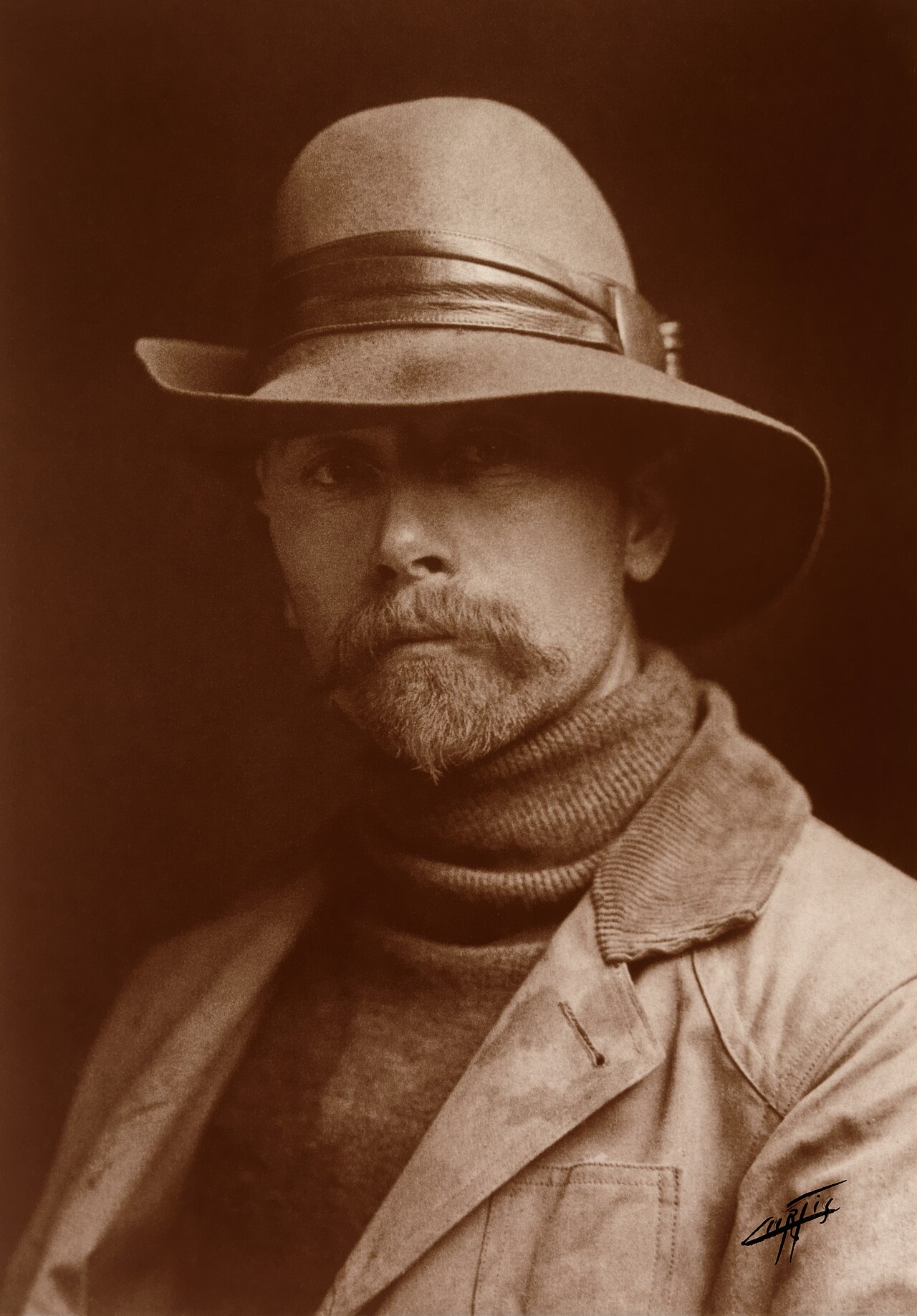
Edward S. Curtis / Adam Cuerden · Smithsonian Insititution National Portrait Gallery Object number NPG.77.49 · Public domain
- Name
- Edward S.
- Birth Name
- Edward Sheriff Curtis
- Born
- 19 February 1868
- Birthplace
- Town of Cold Spring, Wisconsin, U.S.
- Died
- 19 October 1952
- Place of death
- Los Angeles, California, U.S.
- Occupation
- Photographer, ethnologist
- Spouse
- Clara J.
- Full name
- Edward Sheriff Curtis.
- Nationality
- United States.
- Fields
- portrait.
- Known for
- Edward S. Curtis's self-portrait.
VALÉORINE Encyclopedia
VALÉORINE documentary reading
Documentary summary
Edward Sheriff Curtis (February 19, 1868 – October 19, 1952; sometimes given as Edward Sherriff Curtis) was an American photographer and ethnologist whose work focused on the American West and Native American people. Sometimes referred to as the "Shadow Catcher", Curtis traveled the United States to document and record the dwindling ways of life of various native tribes through photographs and audio recordings.
Admitted source layer · organised and presented by VALÉORINE
Reference Check
Propose documentary evidence for Edward S. Curtis. A contribution is never written directly as fact: identity, source, rights and evidence gates still decide.
Sign in to contribute
World of VALÉORINE
Documentary connections
Only confirmed graph relationships appear here. Images are shown only when their identity and reuse rights both pass the documentary gate.
Documentary evidence
Documentary basis
Authority files
wikidata · Q433128 · wikipedia · Edward S. Curtis
In this article
Biography
Biography
Curtis worked between 1868 and 1952 across photographer, anthropologist, explorer, film director and screenwriter and 1 further recorded occupations. The registers place that work in portrait. This article rests on 56 catalogued photographs, 69 published texts, 8 digitised documents and 54 scholarly references drawn from named institutional registers. Every statement below returns to a source shown in the evidence panel; where the record is silent or divided, the article says so instead of resolving it.
The recorded working language is English. Subjects and genres recorded for the work are portrait. Places of work recorded in the authority are United States and Seattle. Works named in the authority record are Edward S. Work by Edward S. Curtis is recorded in the collections of Minneapolis Institute of Art, Art Institute of Chicago, The Nelson-Atkins Museum of Art, San Francisco Museum of Modern Art and Museum of Modern Art.

The old-time warrior--Nez Percé CALL
Edward S. Curtis
Key facts
Key facts
• Name — Edward S. Curtis • Birth Name — Edward Sheriff Curtis • Born — 19 February 1868 • Birthplace — Town of Cold Spring, Wisconsin, U.S. • Died — 19 October 1952 • Place of death — Los Angeles, California, U.S. • Occupation — Photographer, ethnologist • Parents — Ellen Sherriff (1844–1912) Johnson Asahel Curtis (1840–87) • Spouse — Clara J. Phillips (1874–1932) • Children — Harold Phillips Curtis (1893–1988) Elizabeth M. Curtis Magnuson (1896–1973) Florence Curtis Graybill (1899–1987) Katherine Shirley Curtis Ingram (1909–1982) Edward Sheriff Curtis (February 19, 1868 – October 19, 1952; sometimes given as Edward Sherriff Curtis) was an American photographer and ethnologist whose work focused on the American West and Native American people. Sometimes referred to as the "Shadow Catcher", Curtis traveled the United States to document and record the dwindling ways of life of various native tribes through photographs and audio recordings.
Early life
Early life
Curtis was born on February 19, 1868, on a farm in the Town of Cold Spring north of Whitewater, Wisconsin. His father, Reverend Ashen "Johnson" Curtis (1840–1887), was a minister, farmer, and American Civil War veteran born in Ohio. His mother, Ellen Sheriff (1844–1912), was born in Pennsylvania. Curtis's siblings were Raphael, also called Ray; Edward, called Eddy; Eva; and Asahel Curtis. Weakened by his experiences in the Civil War, Johnson Curtis had difficulty in managing his farm, resulting in hardship and poverty for his family. Around 1874, the family moved from Wisconsin to Minnesota to join Johnson Curtis's father, Asahel Curtis, who ran a grocery store and was a postmaster in Le Sueur County. Curtis left school in the sixth grade and soon built his own camera.
Early career
Early career
• Illustration — Princess Angeline (Duwamish) in an 1896 photogravure by Curtis In 1885, at 17, Curtis became an apprentice photographer in St. Paul, Minnesota. In 1887 the family moved to Seattle, Washington, where he purchased a new camera and became a partner with Rasmus Rothi in an existing photographic studio. Curtis paid $150 for his 50% share in the studio. After about six months, he left Rothi and formed a new partnership with Thomas Guptill. They established a new studio, Curtis and Guptill, Photographers and Photoengravers. In 1895, Curtis met and photographed Princess Angeline, also known as Kickisomlo, the daughter of Chief Seattle. This was his first portrait of a Native American. In 1898, three of Curtis's images were chosen for an exhibition sponsored by the National Photographic Society. Two were images of Princess Angeline, "The Mussel Gatherer" and "The Clam Digger". The other was of Puget Sound, entitled "Homeward", which was awarded the exhibition's grand prize and a gold medal. In that same year, while photographing Mount Rainier, Curtis came upon a small group of scientists who were lost and in need of direction. One of them was George Bird Grinnell, considered an "expert" on Native Americans by his peers. Curtis was appointed the official photographer of the Harriman Alaska Expedition of 1899, probably as a result of his friendship with Grinnell. Having very little formal education Curtis learned much during the lectures that were given aboard the ship each evening of the voyage. Grinnell became interested in Curtis's photography and invited him to join an expedition to photograph people of the Blackfoot Confederacy in Montana in 1900.
The North American Indian
The North American Indian
• Illustration — The North American Indian, volume 1, 1907 In 1906, after seeking an introduction through Belle de Costa Greene, and with her approval, J. P. Morgan provided Curtis with $75,000 to produce a series on Native Americans. This work was to be in 20 volumes with 1,500 photographs. Morgan's funds were to be disbursed over five years and were earmarked to support only fieldwork for the books, not for writing, editing, or production of the volumes. Curtis received no salary for the project, which was to last more than 20 years. Under the terms of the arrangement, Morgan was to receive 25 sets and 500 original prints as repayment. Once Curtis had secured funding for the project, he hired several employees to help him. For writing and for recording Native American languages, he hired a former journalist, William E. Myers. For general assistance with logistics and fieldwork, he hired Bill Phillips, a graduate of the University of Washington and Alexander B. Upshaw, a member of the Apsáalooke tribe. Frederick Webb Hodge, an anthropologist employed by the Smithsonian Institution, was hired to edit the series, based on his experience researching and documenting Native American people and culture in the southwestern United States. Eventually, 222 complete sets of photographs were published. Curtis's goal was to document Native American life, pre-colonization. He wrote in the introduction to his first volume in 1907, "The information that is to be gathered... respecting the mode of life of one of the great races of mankind, must be collected at once or the opportunity will be lost." Curtis made over 10,000 wax cylinder recordings of Native American language and music. He took over 40,000 photographs of members of over 80 tribes. He recorded tribal lore and history, described traditional foods, housing, garments, recreation, ceremonies, and funeral customs. He wrote biographical sketches of tribal leaders. His work was exhibited at the Rencontres d'Arles festival in France in 1973.
In the Land of the Head Hunters
In the Land of the Head Hunters
Curtis had been using motion picture cameras in fieldwork for The North American Indian since 1906. He worked extensively with the ethnographer and British Columbia native George Hunt in 1910, which inspired his work with the Kwakwakaʼwakw, though much of their collaboration remains unpublished. At the end of 1912, Curtis decided to create a feature film depicting Native American life, partly as a way of improving his financial situation, and partly because film technology had improved to the point where it was conceivable to create and screen films more than a few minutes long. Curtis chose the Kwakwakaʼwakw, of the Queen Charlotte Strait region of the Central Coast of British Columbia, Canada, for his subject. His film, In the Land of the Head Hunters, was the first feature-length film whose cast was composed entirely of Indigenous North Americans. In the Land of the Head-Hunters premiered simultaneously at the Casino Theatre in New York and the Moore Theatre in Seattle on December 7, 1914. The silent film was accompanied by a score composed by John J. Braham, a musical theater composer who had also worked with Gilbert and Sullivan. The film was praised by critics but made only $3,269.18 in its initial run. It was however criticized by ethnographic community for its lack of authenticity. The Kwakwakaʼwakw cast was not only dressed up by the movie director himself but the plot was enriched with exaggerated elements falsifying the reality.
Later years
Later years
• Illustration — Indian Days of the Long Ago, 1915 The photographer Ella E. McBride assisted Curtis in his studio beginning in 1907 and became a friend of the family. She made an unsuccessful attempt to purchase the studio with Curtis's daughter Beth in 1916, the year of Curtis's divorce, and left to open her own studio. Around 1922, Curtis moved to Los Angeles with Beth and opened a new photo studio. To earn money he worked as an assistant cameraman for Cecil B. DeMille and was an uncredited assistant cameraman in the 1923 filming of The Ten Commandments. On October 16, 1924, Curtis sold the rights to In the Land of the Head-Hunters, including the master print and the original camera negative, to the American Museum of Natural History for $1,500. It had cost him over $20,000 to create the film. In 1927, after returning from Alaska to Seattle with Beth, Curtis was arrested for failure to pay alimony over the preceding seven years. The total owed was $4,500, but the charges were dropped. For Christmas of 1927, the family was reunited at the home of his daughter Florence in Medford, Oregon. This was the first time since the divorce that Curtis was with all of his children at the same time, and it had been 13 years since he had seen Katherine. In 1928, desperate for cash, Curtis sold the rights to his project to J. P. Morgan Jr. The concluding volume of The North American Indian was published in 1930. In total, about 280 sets were sold of his now completed masterpiece. In 1930, his ex-wife Clara was still living in Seattle operating the photo studio with their daughter Katherine. His other daughter, Florence Curtis, was still living in Medford, Oregon, with her husband, Henry Graybill. After Clara died of heart failure in 1932, his daughter Katherine moved to California to be closer to her father and Beth.
Loss of rights to The North American Indian
Loss of rights to The North American Indian
In 1935, the Morgan estate sold the rights to The North American Indian and remaining unpublished material to the Charles E. Lauriat Company in Boston for $1,000.00 plus a percentage of any future royalties. This included 19 complete bound sets of The North American Indian, thousands of individual paper prints, the copper printing plates, the unbound printed pages, and the original glass-plate negatives. Lauriat bound the remaining loose printed pages and sold them with the completed sets. The remaining material remained untouched in the Lauriat basement in Boston until they were rediscovered in 1972.
Marriage and divorce
Marriage and divorce
In 1892, Curtis married Clara J. Phillips (1874–1932), who was born in Pennsylvania to Canadian parents. Together they had four children: Harold (1893–1988); Elizabeth M. (Beth) (1896–1973), who married Manford E. Magnuson (1895–1993); Florence (1899–1987), who married Henry Graybill (1893–?); and Katherine Shirley ("Billy") (1909–1982), who married Ray Conger Ingram (1900–1954). In 1896, the family moved to a new house in Seattle. The household then included Curtis's mother, Ellen Sheriff; his sister, Eva Curtis; his brother, Asahel Curtis; Clara's sisters, Susie and Nellie Phillips; and their cousin, William. During the years of work on The North American Indian, Curtis was often absent from home for most of the year, leaving Clara to manage the children and the studio by herself. After several years of estrangement, Clara filed for divorce on October 16, 1916. In 1919 she was granted the divorce and received Curtis's photographic studio and all of his original camera negatives as her part of the settlement. Curtis and his daughter Beth went to the studio and destroyed all of his original glass negatives, rather than have them become the property of his ex-wife. Clara went on to manage the Curtis studio with her sister Nellie (1880–?), who was married to Martin Lucus (1880–?). Following the divorce, the two oldest daughters, Beth and Florence, remained in Seattle, living in a boarding house separate from their mother. The youngest daughter, Katherine, lived with Clara in Charleston, Kitsap County, Washington.
Death
Death
On October 19, 1952, at the age of 84, Curtis died of a heart attack in Los Angeles, California, in the home of his daughter Beth. He was buried at Forest Lawn Memorial Park in Glendale, California. A brief obituary appeared in The New York Times on October 20, 1952:
Northwestern University
Northwestern University
The entire 20 volumes of narrative text and photogravure images for each volume are online. Each volume is accompanied by a portfolio of large photogravure plates. The online publishing was supported largely by funds from the Institute for Museum and Library Services.
Library of Congress
Library of Congress
The Prints and Photographs Division Curtis collection consists of more than 2,400 silver-gelatin, first-generation photographic prints – some of which are sepia-toned – made from Curtis's original glass negatives. Most are 5 x although nearly 100 are 11 x and larger; many include the Curtis file or negative number in the lower left-hand corner of the image. The Library of Congress acquired these images as copyright deposits from about 1900 through 1930. The dates on them are dates of registration, not the dates when the photographs were taken. About two-thirds (1,608) of these images were not published in The North American Indian and therefore offer a different glimpse into Curtis's work with indigenous cultures. The original glass plate negatives, which had been stored and nearly forgotten in the basement of the Morgan Library, in New York, were dispersed during World War II. Many others were destroyed and some were sold as junk.
Peabody Essex Museum
Peabody Essex Museum
Charles Goddard Weld purchased 110 prints that Curtis had made for his 1905–06 exhibit and donated them to the Peabody Essex Museum, where they remain. The 14" by 17" prints are each unique and remain in pristine condition. Clark Worswick, curator of photography for the museum, describes them as:... Curtis' most carefully selected prints of what was then his life's work... certainly these are some of the most glorious prints ever made in the history of the photographic medium. The fact that we have this man's entire show of 1906 is one of the minor miracles of photography and museology.
Indiana University
Indiana University
Two hundred seventy-six of the wax cylinders made by Curtis between 1907 and 1913 are held by the Archives of Traditional Music at Indiana University. These include recordings of music of the following Native American groups: Clayoquot, Cowichan, Haida, Hesquiaht, and Kwakwakaʼwakw, in British Columbia; and Arapaho, Cheyenne, Cochiti, Crow, Klickitat, Kutenai, Nez Percé, Salish, Shoshone, Snohomish, Wishram, Yakima, Acoma, Arikara, Hidatsa, Makah, Mandan, Paloos, Piegan, Tewa (San Ildefonso, San Juan, Tesuque, Nambé), and possibly Dakota, Clallam, Twana, Colville and Nespelem in the western United States.
University of Wyoming
University of Wyoming
Toppan Rare Books Library at the University of Wyoming in Laramie, Wyoming, holds the entire 20 volume set of narrative texts and photogravure images that make up The North American Indian. Each volume of text is accompanied by a portfolio of large photogravure plates.
Revival of interest
Revival of interest
Though Curtis was largely forgotten at the time of his death, interest in his work revived and continues to this day. Casting him as a precursor in visual anthropology, Harald E.L. Prins reviewed his oeuvre in the journal American Anthropologist and noted: "Appealing to his society's infatuation with romantic primitivism, Curtis portrayed American Indians to conform to the cultural archetype of the "vanishing Indian". Elaborated since the 1820s, this ideological construct effectively captured the ambivalent racism of Anglo-American society, which repressed Native spirituality and traditional customs while creating cultural space for the invented Indian of romantic imagination. [Since the 1960s,] Curtis's sepia-toned photographs (in which material evidence of Western civilization has often been erased) had special appeal for this 'Red Power' movement and even helped inspire it." Major exhibitions of his photographs were presented at the Morgan Library & Museum (1971), the Philadelphia Museum of Art (1972), and the University of California, Irvine (1976). His work was also featured in several anthologies on Native American photography published in the early 1970s. Original printings of The North American Indian began to fetch high prices at auction. In 1972, a complete set sold for $20,000. Five years later, another set was auctioned for $60,500. The revival of interest in Curtis's work can be seen as part of the increased attention to Native American issues during this period. In 2017 Curtis was inducted into the International Photography Hall of Fame and Museum.
Image gallery
Image gallery
• Illustration — A Navajo medicine man, 1900 • Illustration — Navajo Yebichai (Yei Bi Chei) dancers, 1900 • Illustration — Chief Joseph in 1903. • Illustration — A smoky day at the Sugar Bowl—Hupa, c. 1923 alt=Hupa man with spear, standing on rock midstream, in background, fog partially obscures trees on mountainsides. • Illustration — Watching the Dancers, 1906 • Illustration — Navajo medicine man – Nesjaja Hatali, c. 1907 • Illustration — White Man Runs Him, c. 1908. Crow scout serving with George Armstrong Custer's 1876 expeditions against the Sioux and Northern Cheyenne that culminated in the Battle of the Little Bighorn. • Illustration — The old-time warrior: Nez Percé, c. 1910. Nez Percé man, wearing loin cloth and moccasins, on horseback. • Illustration — Crow's Heart, Mandan, c. 1908 • Illustration — Mandan man overlooking the Missouri River, c. 1908 • Illustration — Fishing with a Gaff-hook—Paviotso or Paiute, c. 1924 • Illustration — Mandan girls gathering berries, c. 1908 • Illustration — Mandan hunter with buffalo skull, c. 1909 • Illustration — Zuni Girl with Jar, c. 1903. Head-and-shoulders portrait of a Zuni girl with a pottery jar on her head. • Illustration — Geronimo – Apache (1905) • Illustration — Navaho medicine-man, c. 1904 (with 1913 signature) • Illustration — Youth called Shows As He Goes, c. 1907 • Illustration — Cheyenne maiden, 1930 • Illustration — Hopi mother, 1922 • Illustration — Hopi girl, 1922 • Illustration — Canyon de Chelly – Navajo. Seven riders on horseback and dog trek against background of canyon cliffs, 1904 • Illustration — Apache Scout, c. 1900s • Illustration — Apache, Morning bath, c. 1907 • Illustration — Mandan lodge, North Dakota, c. 1908 • Illustration — Food caches, Hooper Bay, Alaska, c. 1929 • Illustration — Navajo Flocks, c. 1904 • Illustration — Navajo Sandpainting, c. 1907 • Illustration — Navajo Weaver, c. 1907 • Illustration — Boys in kayak, Nunivak, 1930
Articles
Articles
• "The Rush to the Klondike Over the Mountain Pass". The Century Magazine, March 1898, pp. 692–697. • "Vanishing Indian Types: The Tribes of the Southwest". Scribner's Magazine 39:5 (May 1906): 513–529. • "Vanishing Indian Types: The Tribes of the Northwest Plains". Scribner's Magazine 39:6 (June 1906): 657–71. • "Indians of the Stone Houses". Scribner's Magazine 45:2 (1909): 161–75. • "Village Tribes of the Desert Land. Scribner's Magazine 45:3 (1909): 274–87.
Brochures
Brochures
• The North American Indian. (promotional brochure) (1914?)
Exhibitions
Exhibitions
• Edward Sheriff Curtis, Provinciaal Museum Hasselt (now House for Contemporary Art, Design & Architecture) in collaboration with TransArt Köln, Hasselt, Belgium, March 16, 1991 – May 5, 1991 • Exposition virtuelle E. S. Curtis, collection photographique du Musée du Nouveau Monde, La Rochelle, 2012 to August 31, 2019 • Rediscovering Genius: The Works of Edward S. Curtis. Depart Foundation, Los Angeles, November 18, 2016 – January 14, 2017 • Light and Legacy: The Art and Techniques of Edward Curtis Western Spirit: Scottsdale's Museum of the West, Scottsdale, Arizona, October 19, 2021 – Spring 2023
Life and work
Life and work
Curtis was born on 16 February 1868 in Whitewater. Curtis held the nationality of United States. Recorded sibling: Asahel Curtis. Curtis worked as photographer, anthropologist, explorer and film director, and the authority record catalogues a further 2 occupations under the same name, among them screenwriter and ethnologist. Curtis was active from 1896 to 1930. Curtis worked in United States and Seattle. The fields Curtis worked in include portrait. Curtis worked in English. Curtis died on 19 October 1952 in Whittier. Curtis is buried at Forest Lawn Memorial Park.
Places
Named by the record
Places
Only places the record itself states, plotted where the house gazetteer settles their coordinates. Nothing is inferred from a name or a nationality.
Whitewater.
Birth place
Whittier.
Death place
Books
Books
• The North American Indian. 20 volumes (1907–1930) • Volume 1 (1907): The Apache. The Jicarillas. The Navaho. • Volume 2 (1908): The Pima. The Papago. The Qahatika. The Mohave. The Yuma. The Maricopa. The Walapai. The Havasupai. The Apache-Mohave, or Yavapai. • Volume 3 (1908): The Teton Sioux. The Yanktonai. The Assiniboin. • Volume 4 (1909): The Apsaroke, or Crows. The Hidatsa. • Volume 5 (1909): The Mandan. The Arikara. The Atsina. • Volume 6 (1911): The Piegan. The Cheyenne. The Arapaho. • Volume 7 (1911): The Yakima. The Klickitat. Salishan tribes of the interior. The Kutenai. • Volume 8 (1911): The Nez Perces. Wallawalla. Umatilla. Cayuse. The Chinookan tribes. • Volume 9 (1913): The Salishan tribes of the coast. The Chimakum and the Quilliute. The Willapa. • Volume 10 (1915): The Kwakiutl. • Volume 11 (1916): The Nootka. The Haida. • Volume 12 (1922): The Hopi. • Volume 13 (1924): The Hupa. The Yurok. The Karok. The Wiyot. Tolowa and Tututni. The Shasta. The Achomawi. The Klamath. • Volume 14 (1924): The Kato. The Wailaki. The Yuki. The Pomo. The Wintun. The Maidu. The Miwok. The Yokuts. • Volume 15 (1926): Southern California Shoshoneans. The Diegueños. Plateau Shoshoneans. The Washo. • Volume 16 (1926): The Tiwa. The Keres. • Volume 17 (1926): The Tewa. The Zuñi. • Volume 18 (1928): The Chipewyan. The Western Woods Cree. The Sarsi. • Volume 19 (1930): The Indians of Oklahoma. The Wichita. The Southern Cheyenne. The Oto. The Comanche. The Peyote Cult. • Volume 20 (1930): The Alaskan Eskimo. The Nunivak. The Eskimo of Hooper Bay. The Eskimo of King Island. The Eskimo of Little Diomede Island. The Eskimo of Cape Prince of Wales. The Kotzebue Eskimo. The Noatak. The Kobuk. The Selawik. • Indian Days of the Long Ago (1914) • In the Land of the Head-Hunters (1915)
Writings and published texts, 1900–2009
Catalogued output
Writings and published texts, 1900–2009
These are catalogued publications carrying the name — editions and printings, distinct from the works they contain and from writing about the subject. The run opens with Edward S. Curtis portfolios and closes with The image taker: the selected stories and photographs of Edward S. The 2000s are the densest part of the run, with 24 titles, and that concentration is a fact about what the registers have catalogued rather than a judgement on the work itself. They belong to a run of 69 titles in all, from 1900 to 2009.
Indian Days of the Long Ago (Indian Life and Indian Lore)
1978
68 editions carry dates between 1900 and 2009
The entries follow Open Library
The Havasupai
1900
Customs, arts and beliefs
1900
Vanishing Indian types
1906
Prospectus of The North American Indian
1907
North American Indian
1907
The North American Indian; Supplement
1970
Portraits from North American Indian Life
1972
A selection of photographs by Edward S. Curtis
1972
The North American Indians
1972
In the land of the head-hunters
1975
The complete catalogue · 60
68 editions carry dates between 1900 and 2009
The entries follow Open Library
The Havasupai
1900
Customs, arts and beliefs
1900
Vanishing Indian types
1906
Prospectus of The North American Indian
1907
North American Indian
1907
The North American Indian; Supplement
1970
Portraits from North American Indian Life
1972
A selection of photographs by Edward S. Curtis
1972
The North American Indians
1972
In the land of the head-hunters
1975
Selected writings of Edward S. Curtis
1976
The Kwakiutl, 1910-1914
1976
The girl who married a ghost and other tales from The North American Indian
1978
Indian Days of the Long Ago (Indian Life and Indian Lore)
1978
The rush to the Klondike over the mountain passes
1981
Indian Days of Long Ago
1985
Catalogue of a collection of photographs of North American Indians
1987
The North American Indian
1988
In the Land of the Head Hunters (Indian Life and Indian Lore)
1992
Indianer Nordamerikas
1993
Native American wisdom
1993
Native nations
1993
Cal 95
1994
The art of Edward S. Curtis
1995
North American Indians (Big)
1995
Prayer to the great mystery
1995
Earth always endures
1996
Chiefs & warriors
1996
Great Plains
1996
Hidden faces
1996
Native family
1996
Cal 98 Edward S. Curtis Calendar
1997
Heart of the circle
1997
Indianische Weisheiten
1998
Chamanes y Deidades - Kwakiuyl
1999
Portraits of Native Americans
1999
Sacred Legacy
2000
Sites & structures
2000
En La Tierra de Los Cazadores de Cabezas
2000
Danzantes y Sociedades Secretas
2000
Diluvio y Otros Relatos de Los Indios Katos, Waila
2000
El Espiritu de La Llanura y El Desierto
2000
Suskia, La Giganta y Otros Relatos de Los Indios
2000
The papers of Edward S. Curtis relating to Custer's last battle
2000
Weave little stars into my sleep: Native American lullabies
2001
Native Americans =
2001
Country Churches 2002 Wall Calendar
2001
The Plains Indian Photographs of Edward S. Curtis
2001
The master prints
2001
The North American Indian - The Complete Portfolios
2001
Coyote, El Transformador, y Otros Relatos de Los Indios Nez Perces y Wishham
2003
Los Indios De Norteamerica
2003
Portraits of Native Americans 2004 Calendar
2003
Songs of the earth
2003
The great warriors
2004
Kukúsim
2004
Portraits of Native Americans 2008 Calendar
2007
Portraits Of Native Americans 2008 Wall Calendar
2007
A further 1 recorded entry stand behind this article and are held on the record.
Writings and published texts without a settled date
Catalogued output
Writings and published texts without a settled date
1 further edition are catalogued under Curtis's name without a date the collections agree on, which is why they are set apart from the dated run rather than placed in it.
Photographs and portfolios, 1899–1924
Catalogued output
Photographs and portfolios, 1899–1924
These are objects catalogued as visual works, each held or recorded by the institution named against it. 53 photographs carry dates between 1899 and 1924. The 1910s are the densest part of the run, with 42 titles, and that concentration is a fact about what the registers have catalogued rather than a judgement on the work itself. They belong to a run of 56 titles in all, from 1899 to 1924. A selection is set out below and the complete run may be opened beneath it.
The run opens with Edward S. Curtis's self-portrait and closes with A Home in the Mesquite-Chemehuevi
Middle Calf, Piegan
1900
Cañon de Chelly - Navaho
1904
Nayenezgani-Navaho
1904
Tobadzischini-Navaho
1904
Haschogan-Navaho
1904
Gaaskidi-Navaho
1904
Zahadolzha-Navaho
1904
The Vanishing Race
1904
Watching the Dancers
1906
Nakoaktok Warrior
1910
Arapaho Maiden
1910
The complete catalogue · 53
The run opens with Edward S. Curtis's self-portrait and closes with A Home in the Mesquite-Chemehuevi
Middle Calf, Piegan
1900
Cañon de Chelly - Navaho
1904
Nayenezgani-Navaho
1904
Tobadzischini-Navaho
1904
Haschogan-Navaho
1904
Gaaskidi-Navaho
1904
Zahadolzha-Navaho
1904
The Vanishing Race
1904
Watching the Dancers
1906
Nakoaktok Warrior
1910
Arapaho Maiden
1910
Untitled (Salish Type Woman)
1912
Carved Posts at Alert Bay [Plate 330]
1914
Qa'híla - Koprino [Plate 331]
1914
Mówakiu - Tsawatenok [Plate 332]
1914
Painting a Hat - Nakoaktok [Plate 329]
1914
Hamasaka in Tlu'wuláhu Costume with Speaker's Staff - Qagyuhl [Plate 333]
1914
A Nakoaktok Chief's Daughter [Plate 334]
1914
Síwit - Awaitlala [Plate 335]
1914
Coming for the Bride - Qágyuhl [Plate 337]
1914
A Chief's Party - Qágyuhl [Plate 338]
1914
On the Beach - Nakoaktok [Plate 339]
1914
In Kwakiutl Waters [Plate 340]
1914
A Koskimo House-Post [Plate 341]
1914
Gathering Abalones - Nakoaktok [Plate 342]
1914
The Wedding Party - Qágyuhl [Plate 344]
1914
Quatsino Sound [Plate 345]
1914
Yákotlus - Quatsino (Profile) [Plate 346]
1914
Yákotlus - Quatsino [Plate 347]
1914
Group of Winter Dancers - Qágyuhl [Plate 348]
1914
The Fire-Drill - Koskimo [Plate 349]
1914
Nimkish Village at Alert Bay [Plate 350]
1914
Masked Dancers in Canoes - Qágyuhl (a) [Plate 351]
1914
Rounding into Port - Qágyuhl [Plate 352]
1914
A Chief's Daughter - Nakoaktok [Plate 364]
1914
Koskimo Woman [Plate 354]
1914
Wedding Guests [Plate 357]
1914
Masked Dancers - Qágyuhl [Plate 358]
1914
Passing a Dreaded Point [Plate 359]
1914
An Inland Waterway [Plate 360]
1914
A Bridal Group [Plate 361]
1914
Tsulniti - Koskimo [Plate 363]
1914
Qágyuhl Village at Fort Rupert [Plate 353]
1914
Dancing to Restore an Eclipsed Moon - Qáagyuhl [Plate 355]
1914
Sailing - Qágyuhl [Plate 356]
1914
Masked Dancers in Canoes - Qágyuhl (b) [Plate 362]
1914
Kwakiutl House-Frame
1914
Kotsuis and Hohhuq-Nakoaktok
1914
Indian Days of the Long Ago
1914
Fish Spearing-Clayoquot
1915
The Oldest Man of Nootka
1915
A Home in the Mesquite-Chemehuevi
1924
Photographs and portfolios without a settled date
Catalogued output
Photographs and portfolios without a settled date
3 further photographs are catalogued under Curtis's name without a date the collections agree on, which is why they are set apart from the dated run rather than placed in it. They belong to a run of 56 titles in all, from 1899 to 1924. [Men on Horseback].
Wood Gatherers - Cheyenne
Among the Tules - Yokuts
Critical reception
A representative evaluation of The North American Indian is that of Mick Gidley, Emeritus Professor of American Literature, at Leeds University, in England, who has written a number of works related to the life of Curtis: Of the full Curtis opus N. Scott Momaday wrote, "Taken as a whole, the work of Edward S. Curtis is a singular achievement. Never before have we seen the Indians of North America so close to the origins of their humanity... Curtis' photographs comprehend indispensable images of every human being at every time in every place" In Shadow Catcher: The Life and Work of Edward S. Curtis, Laurie Lawlor commented that • Illustration — U.S. President Theodore Roosevelt, 1904, orotone by Curtis Theodore Roosevelt, a contemporary of Curtis's and one of his most fervent supporters, wrote the following comments in the foreword to Volume 1 of The North American Indian: Curtis has been praised as a gifted photographer but also criticized by some contemporary ethnologists for manipulating his images. Although the early twentieth century was a difficult time for most Native communities in America, not all natives were doomed to becoming a "vanishing race." At a time when natives' rights were being denied and their treaties were unrecognized by the federal government, many natives were successfully adapting to Western society. By reinforcing the native identity as the noble savage and a tragic vanishing race, some believe Curtis deflected attention from the true plight of American natives. At the time when he was witnessing their squalid conditions on reservations first-hand, some were attempting to find their place in and adapt to mainstream U.S. culture and its economy, while others were actively resisting it. In his photogravure In a Piegan Lodge, published in The North American Indian, Curtis retouched the image to remove a clock between the two men seated on the ground. He is also known to have paid natives to pose in staged scenes or dance and partake in simulated ceremonies. His models were paid in silver dollars, beef and autographed photos. For instance, one of his first subjects, Princess Angeline, was paid a dollar a photo. Curtis paid natives to pose at a time when they lived with little dignity and enjoyed few rights and freedoms. It has been suggested that he altered and manipulated his pictures to create an ethnographic, romanticized simulation of native tribes untouched by Western society.
Charles Lauriat archive
Charles Lauriat archive
Around 1970, David Padwa, of Santa Fe, New Mexico, went to Boston to search for Curtis's original copper plates and photogravures at the Charles E. Lauriat rare bookstore. He discovered almost 285,000 original photogravures as well as all the copper plates and purchased the entire collection which he then shared with Jack Loeffler and Karl Kernberger. They jointly disposed of the surviving Curtis material that was owned by Charles Emelius Lauriat (1874–1937). The collection was later purchased by another group of investors led by Mark Zaplin, of Santa Fe. The Zaplin Group owned the plates until 1982, when they sold them to a California group led by Kenneth Zerbe, the owner of the plates as of 2005. Other glass and nitrate negatives from this set are at the Palace of the Governors Photo Archives in Santa Fe, New Mexico).
Further digitised and archival material
Primary material
Further digitised and archival material
A further 36 rows were returned by the same open archives and are not shown here, because the only tie between them and this person was lexical: the name appeared in a title, a description or a series heading without the register stating any relation to Curtis. They are kept in the evidence layer and return the moment a relation is demonstrated. The register's own description is kept rather than reclassified, so a reader can see what each institution says it holds.
Sacred America Edward S. Curtis and the North American Indian
2011
Indian Life and Indian Lore
In the Land of the Head Hunters
1975
The vanishing race: selections from Edward S. Curtis' The North American Indian
1987
Curtis' The North American Indian
Bloomsbury Auctions 15 December 2016
Exhibition - The North American Indian, Photographs by Edward S. Curtis
1976
Sparrow memorial donation of Edward S. Curtis' the North American Indian
1980
Selected writings of Edward S. Curtis: excerpts from volumes I-XX of the North American Indian
1976
Documents and archives
Primary material
Documents and archives
authority record
- Wikidata, structured authority record Q433128: Edward S. Curtis
General reference · Wikidata
reference work
- “Edward S. Curtis”, English Wikipedia, consulted as further reading
Reputable secondary · Wikipedia
Literature
Further cited scholarship
15 scholarly and reference publications are cited here, each one identified by title and by the publication, publisher or institution that carried it, with its year where the register states one. The cited literature runs from 1925 to 2025, which is a measure of how long Curtis has been a subject of scholarship rather than of how much has been written.
An Interview with Edward Curtis IV, Mashriq & Mahjar: Journal of Middle East & North African Migration Studies, 2025
Authority records
Notes from the source article
Cited by Wikipedia
Notes from the source article
These works are cited by the source article, in its own numbering. They are recorded as its citations, not as sources VALÉORINE has verified.
- 1.Davis-Marks, Isis. Trove of Unseen Photos Documents Indigenous Culture in 1920s Alaska. Smithsonian Magazine. September 20, 2021.
- 2.Edward S. Curtis. The New York Times. October 20, 1952.
- 3.Laurie Lawlor (1994). Shadow Catcher: The Life and Work of Edward S. Curtis. New York: Walker.
- 4.John Graybill. Setting the Record Straight. Curtis Legacy Foundation. August 17, 2019.
- 5.American Masters. Shadow Catcher. April 24, 2001.
- 6.Makepeace, Anne. Edward S. Curtis: Coming to Light. National Geographic Society. 2001. 0-7922-6404-5.
- 7.Soul Catcher Studio. Edward S. Curtis and The North American Indian: A Detailed Chronological Biography.
- 8.Egan, Timothy. Short Nights of the Shadow Catcher. 24, 110–11, 155, 170–72.
- 9.Gidley, Mick. Edward S. Curtis (1868–1952) and The North American Indian. Library of Congress American Memory.
- 10.American Indian in 'Photo History. The New York Times. June 6, 1908.
- 11.Zamir, Shamoon. Native Agency and the Making of The North American Indian : Alexander B. Upshaw and Edward S. Curtis. The American Indian Quarterly. 31. 4. 613–653. 2007. 1534-1828.
- 12.Vaughn, Chris. Amon Carter Museum Acquires Rare 20-volume Photography Book and Portfolio Set. July 8, 2009.
- 13.Egan, Timothy. Short Nights of the Shadow Catcher: The Epic Life and Immortal Photographs of Edward Curtis. Houghton Mifflin Harcourt. 370. 2012. 978-0618969029.
- 14.Glass, Aaron. A Cannibal in the Archive: Performance, Materiality, and (In)Visibility in Unpublished Edward Curtis Photographs of the Kwakwaka'wakw Hamats. Visual Anthropology Review. 25. 2. 128–149. 2009. 10.1111/j.1548-7458.2009.01038.x.
- 15.Edward Curtis Meets the Kwakwaka'wakw: In the Land of the Head Hunters. Rutgers University.
- 16.Arnold, William. Edward Curtis' 'Head Hunters' takes another bow with film festival screening. Seattle Post-Intelligencer. July 8, 2008.
- 17.Taschen. Edward S. Curtis. The North American Indian. 18. 2005. 9783822847725.
- 18.Edward Curtis Meets The Kwakwaka'wakw, In the Land of the Head Hunters. Rutgers-New Brunswick, School of Arts and Sciences.
- 19.Martin, David M. McBride, Ella E. (1862–1965). HistoryLink.org – The Free Online Encyclopedia of Washington State History. March 3, 2008.
- 20.Greyhavens, Tim. Three Things You Might Not Know about Edward Curtis. Curtis Legacy Foundation. March 25, 2020.
- 21.Certificate of death for Clara J. Curtis, Center for Health Statistics, Department of Health, State of Washington.
- 22.Edward S. Curtis's the North American Indian. Northwestern University.
- 23.Library of Congress. Edward S. Curtis Collection. 1890.
- 24.Peabody Essex Museum. The Master Prints of Edwards S. Curtis: Portraits of Native America.
- 25.Archives of Traditional Music.
- 26.Prins, Harald E.L. American Anthropologist Vol.102 (4):891–95. 2000.
- 27.Thornton, Gene. Why Is Curtis Unknown to Photographic History?. The New York Times. October 17, 1971. 0362-4331.
- 28.Curtis, Edward S. The North American Indians: A Selection of Photographs. Aperture. 1972. 0912334347.
- 29.UC Irvine University Art Galleries.
- 30.McLuhan, T. C. Touch the Earth: A Self-Portrait of Indian Existence. Outerbridge & Dienstfrey. 1971. 9780876900383.
- 31.Solis-Cohen, Lita. Art Thieves Know the Product. Toledo Blade. 15. February 9, 1979.
- 32.Edward Curtis. International Photography Hall of Fame.
- 33.Gidley, Mick. Edward S. Curtis (1868–1952) and The North American Indian. Edward S. Curtis's The North American Indian. Northwestern University. 2001.
- 34.Momaday, N. Scott. Sacred Legacy: Edward S. Curtis and the North American Indian. Verve. 2005. 0976912716.
- 35.Lawlor, Laurie. Shadow Catcher: The Life and Work of Edward S. Curtis. University of Nebraska Press. 6. 2005. 0803280467.
- 36.Beck, David R.M. The Myth of the Vanishing Race. Edward S. Curtis's The North American Indian. Northwestern University. 2001.
- 37.King, Gilbert. Edward Curtis' Epic Project to Photograph Native Americans. Smithsonian Magazine. Library of Congress. March 21, 2012.
- 38.The Shadow Catcher.
- 39.Tess Thackara. Challenging America's Most Iconic (and Controversial) Photographer of Native Americans. Artsy. March 1, 2016.
- 40.Description by Curtis: "A well-known Navaho medicine-man. While in the Cañon de Chelly the writer witnessed a very interesting four days' ceremony given by the Wind Doctor. Nesjaja Hatali was also assistant medicine-man in two nine days' ceremonies studied – one in Cañon del Muerto and the other in this portfolio (No. 39) is reproduced from one made and used by this priest-doctor in the Mountain Chant."
- 41.Description by Curtis: "This portrait of the historical old Apache was made in March, 1905. According to Geronimo's calculation he was at the time seventy-six years of age, thus making the year of his birth 1829. The picture was taken at Carlisle, Pennsylvania, the day before the inauguration of President Roosevelt, Geronimo being one of the warriors who took part in the inaugural parade at Washington."
- 42.Description by Curtis: "The Navaho might as well be called the 'Keepers of Flocks'. Their sheep are of the greatest importance to their existence, and in the care and management of their flocks they exhibit a thrift not to be found in the average tribe."
- 43.Description by Curtis: "One of the four elaborate dry-paintings or sand altars employed in the rites of the Mountain Chant, a Navaho medicine ceremony of nine days' duration."
- 44.Description by Curtis: "The Navaho-land blanket looms are in evidence everywhere. In the winter months they are set up in the hogans, but during the summer they are erected outdoors under an improvised shelter, or, as in this case, beneath a tree. The simplicity of the loom and its product are here clearly shown, pictured in the early morning light under a large cottonwood."
Bibliography printed in the source article · 11
- Cardozo, Christopher. Native Nations: First Americans as Seen by Edward S. Curtis. Bullfinch Press. 1993. 978-0821220528.
- Curtis, Edward S. The North American Indian. Taschen. 2005. 9783822847725.
- Curtis, Edward S. Sacred Legacy: Edward S. Curtis and the North American Indian. Simon & Schuster. 2000.
- Davis, Barbara A. Edward S. Curtis: The Life and Times of a Shadow Catcher. Chronicle Books. 1985.
- Egan, Timothy. Short Nights of the Shadow Catcher: The Epic Life and Immortal Photographs of Edward Curtis. Houghton Mifflin Harcourt. 2012. 978-0-618-96902-9.
- Gidley, Mick. Edward S. Curtis and the North American Indian, Incorporated. Cambridge University Press. 1998. 0-521-77573-6.
- Gidley, Mick. Edward S. Curtis and the North American Indian Project in the Field. University of Nebraska Press. 2003. 978-0-8032-2193-2.
- Makepeace, Anne. Edward S. Curtis: Coming to Light. National Geographic. 2002. 9780792241614.
- Scherer, Joanna Cohan. Edward Sheriff Curtis. Phaidon. 2008. 978-0-7148-4176-2.
- Touchie, Roger D. Edward S. Curtis Above the Medicine Line: Portraits of Aboriginal Life in the Canadian West. Heritage House. 2010. 978-1894974868.
- Zamir, Shamoon. The Gift of the Face. Portraiture and Time in Edward S. Curtis's The North American Indian. University of North Carolina Press. 2014. 978-1-4696-1175-4.
References
Citations
References
Each reference names the institution holding it, so a reader may go to the document itself.
authority record
Secondary witnessreference work
Secondary witness
The Encyclopedia exists whether or not anything is for sale. Corrections are recorded rather than overwritten, and every version of this record is kept. Published 17 August 2026.
Elsewhere in Photography
11,392 published records in this field, each with its sources named.
- Edward OppPhotographer
- Edward Percy SealyPhotographer
- Edward QuinnPhotographer
- Edward Raymond TurnerPhotographer
- Edward Shearman RossPhotographer
- Edward WallowitchPhotographer
- Edward WestonPhotographer
- Edward William NelsonPhotographer
Best supported in this field
For owners
Own a work by Edward S. Curtis?
A specialist will read what you send and tell you what the house can establish, what it cannot, and whether the object is suited to sale. There is no charge and no obligation. The object stays with you throughout; nothing is shipped to us unless it is arranged in writing beforehand.