
E. P. Charlton & Company
Charlton & Company, also known as E. Charlton Company, E. Charlton, or simply Charlton's was an American chain of five and ten cent stores owned by Earle Perry Charlton, which merged with several associated brands to create the F. Woolworth Company in 1912.
Also recorded as Charlton's · E. P. Charlton
E. P. Charlton & Company

Old post cards. · Public domain
- Name
- E.P.
- Founded
- 1890
- Headquarters
- United States
- Activity
- retail
- Dissolved
- 1912
VALÉORINE Encyclopedia
VALÉORINE documentary reading
Documentary summary
Charlton & Company, also known as E. Charlton Company, E. Charlton, or simply Charlton's was an American chain of five and ten cent stores owned by Earle Perry Charlton, which merged with several associated brands to create the F. Woolworth Company in 1912.
Admitted source layer · organised and presented by VALÉORINE
Reference Check
Propose documentary evidence for E. P. Charlton & Company. A contribution is never written directly as fact: identity, source, rights and evidence gates still decide.
Sign in to contribute
World of VALÉORINE
Documentary connections
Only confirmed graph relationships appear here. Images are shown only when their identity and reuse rights both pass the documentary gate.
Documentary evidence
Documentary basis
Authority files
wikidata · Q24525573 · wikipedia · E. P. Charlton & Company
In this article
Key facts
Key facts
• Name — E.P. Charlton & Co. • Industry — Retail • Fate — Merged to become F.W. Woolworth Company • Founded — in Fall River, Massachusetts, United States • Founders — Earle Perry Charlton, Seymour H. Knox • Defunct — 1912
Establishment and early years
Establishment and early years
Beginning in 1890, Charlton and his partner, Seymour H. Knox, a cousin of retailer Frank W. Woolworth, established a chain of stores under the name of "Knox & Charlton Five and Ten Cent Store." The chain operated as part of a syndicate established by Woolworth, allowing for friendly competition, so long as the individual owners followed Woolworth's principles. The first store opened in Fall River, Massachusetts on February 22, 1890. Between 1892 and 1895, three more locations opened, in Hartford and New Britain, Connecticut, and Lowell, Massachusetts. In 1896, the two men decided to go their separate ways, with Knox acquiring the store in Lowell, and Charlton retaining the other three. By 1899, Charlton had opened nine more stores in New England, with new locations in Hartford, Danbury, and Meriden, Connecticut, Brockton, Fitchburg, Gloucester, Lawrence, and New Bedford, Massachusetts, and Lewiston, Maine. But realizing that continued expansion in New England would bring him into direct competition with other members of the Woolworth syndicate, Charlton sold his new stores to Frank Woolworth, using the capital to finance the opening of several stores in Canada.
Expansion in Canada and the west
Expansion in Canada and the west
• Illustration — E. P. Charlton Store on St. Joseph Street, Quebec Over the next several years, Charlton opened three stores in Montreal and one in Ottawa, followed by eight more west of the Rocky Mountains, which featured an expanded pricing scheme, of five, ten, and fifteen cent items. Beginning in 1905, Charlton opened stores in Los Angeles and San Francisco, and four more locations in California, as well as in Tacoma, Washington, and Sherbrooke, Quebec. In 1908, Charlton's headquarters moved to a new building on South Main Street in Fall River, near the location of the original store. Dubbed the "Charlton Block," the new store was lit by electric lights, and featured mahogany counters like those favored by Knox and Woolworth. The chain continued to expand in the west, with stores in Salt Lake City and Ogden, Utah, and Butte, Montana. Goods were supplied by Woolworth, and sold well due to the low, fixed pricing. By 1911, the top earning store was the South Broadway location in Los Angeles, earning $370,000 per annum, while six other stores earned over $150,000.
Consolidation with Woolworth
Consolidation with Woolworth
By 1912, E. P. Charlton & Company operated fifty-eight stores throughout the United States and Canada. That year, Frank Woolworth persuaded the other members of his syndicate to consolidate as the F. W. Woolworth Company. Frank, who owned more stores than the other five members combined, became president of the new company, while the others became directors and vice presidents. S. H. Knox & Co. contributed ninety-eight stores in the United States, and thirteen in Canada; Fred M. Kirby, who had been a business partner of Woolworth's since the 1880s, had ninety-six; Frank's brother, Charles Sumner Woolworth, had fifteen stores; while William Moore, whose stores had given Frank and Charles their start in retail, contributed two. Charlton's western holdings gave F. W. Woolworth a nationwide reach in both the United States and Canada. He became a senior vice president, and earned $6,500,000 from the merger. With the consolidation of the six brands under the Woolworth name, F. W. Woolworth & Company operated five hundred and ninety-six stores, with its headquarters at the newly constructed Woolworth Building in New York. The company prospered for most of the twentieth century, before increased competition in the discount retail market caused it to focus on specialty brands. Woolworth's-branded stores were closed throughout the 1990s, while the company focused on athletic apparel, and particularly its Foot Locker brand. The last Woolworth stores were closed in 1997, as the company changed its name, first to Venator, then Foot Locker, Inc.
Places
Named by the record
Places
Only places the record itself states, plotted where the house gazetteer settles their coordinates. Nothing is inferred from a name or a nationality.
- United States
Legacy
• Illustration — The Charlton Block, Fall River, Mass. Although the E. P. Charlton brand disappeared from retail after the creation of F. W. Woolworth & Company, the Fall River Woolworth's maintained its prominent storefront "E. P. Charlton Company" signage until 1970. Earle Charlton devoted his time and energy to the Charlton Mill, a factory he had built at Fall River in 1909, and which operated until the 1950s. Charlton died in 1930, leaving a considerable amount to the Charlton Trust, which benefited local charities in the Fall River area; today he is commemorated by the Charlton Memorial Hospital.
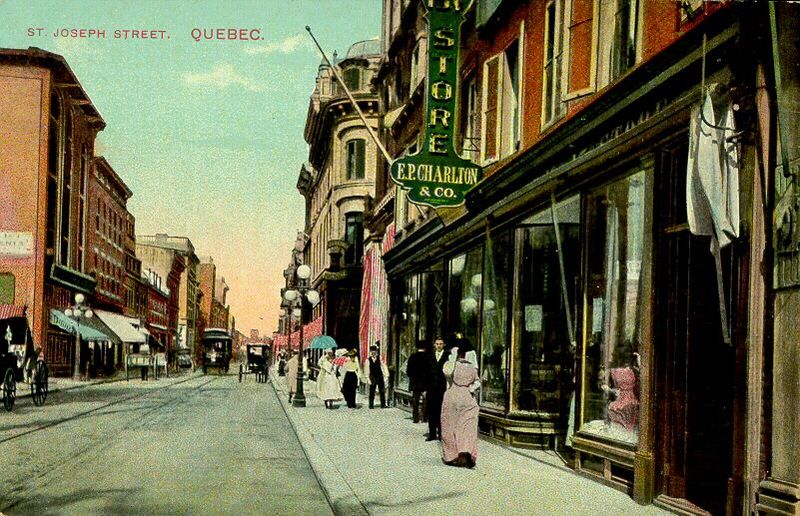
Old post card depicting St. Joseph Street in Quebec, circa 1905, with E. P. Charlton Co. store in foreground.
This image is available from the McCord Stewart Museum under the access number MP-0000.1155.18 This tag does not indicate the copyright status of the attached work. A normal copyright tag is still req

Post Card of the Portland Hotel at Sixth Street, Portland, Oregon, USA. ca. 1908
Published by E. P. Charlton Co. · Greg Henderson's post card collection.
Citations
References
Each reference names the institution holding it, so a reader may go to the document itself.
reference work
Secondary witnessreference work
Secondary witness
The Encyclopedia exists whether or not anything is for sale. Corrections are recorded rather than overwritten, and every version of this record is kept. Published 17 August 2026.
Elsewhere in Publishers and printers
5,459 published records in this field, each with its sources named.
- Dzanc BooksOrganisation
- E-medOrganisation
- E. & H. T. Anthony & Co.Organisation
- E. A. SeemannOrganisation
- E. SchweizerbartOrganisation
- E.S. Mittler & SohnOrganisation
- EAFIT UniversityOrganisation
- Earl K. Long LibraryOrganisation
Best supported in this field
For owners
Own an object connected with E. P. Charlton & Company?
A specialist will read what you send and tell you what the house can establish, what it cannot, and whether the object is suited to sale. There is no charge and no obligation. The object stays with you throughout; nothing is shipped to us unless it is arranged in writing beforehand.