
DuSable Museum of African American History
The DuSable Black History Museum and Education Center, formerly the DuSable Museum of African American History, is a museum in Chicago, Illinois, United States, dedicated to the study and conservation of African-American history, culture, and art. It was named after Jean Baptiste Point du Sable. It was founded in 1961 by Margaret Taylor-Burroughs, her husband Charles Burroughs, Gerard Lew, Eugene Feldman, Bernard Goss, Marian M. Hadley, and others.
Also recorded as DuSable Black History Museum and Education Center
DuSable Museum of African American History
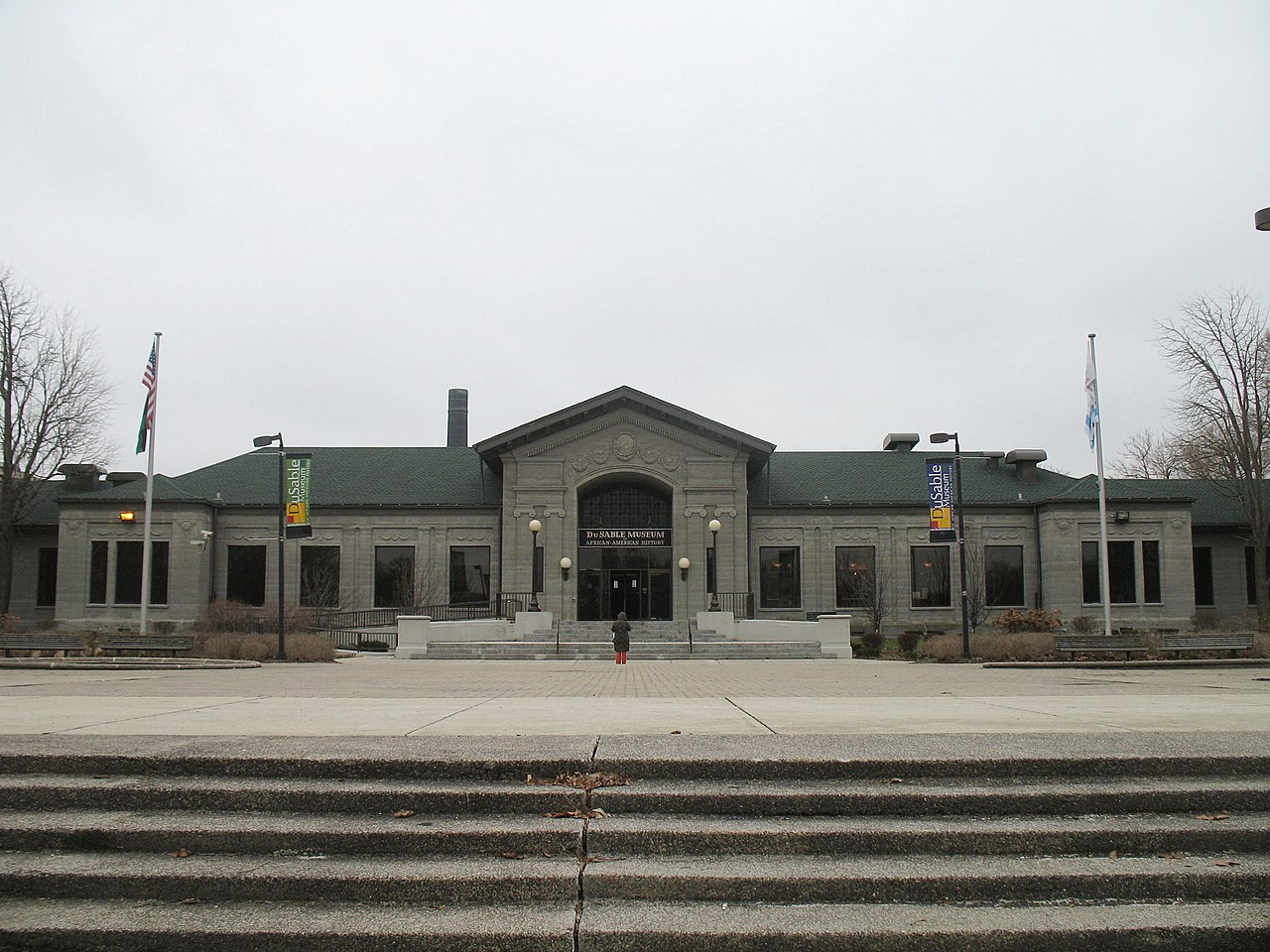
The original uploader was TonyTheTiger at English Wikipedia. (Original text: en:User:TonyTheTiger) · Self-photographed · CC BY-SA 3.0
- Name
- The DuSable
- Founded
- 1961
- Headquarters
- United States
VALÉORINE Encyclopedia
VALÉORINE documentary reading
Documentary summary
The DuSable Black History Museum and Education Center, formerly the DuSable Museum of African American History, is a museum in Chicago, Illinois, United States, dedicated to the study and conservation of African-American history, culture, and art. It was named after Jean Baptiste Point du Sable. It was founded in 1961 by Margaret Taylor-Burroughs, her husband Charles Burroughs, Gerard Lew, Eugene Feldman, Bernard Goss, Marian M. Hadley, and others.
Admitted source layer · organised and presented by VALÉORINE
Reference Check
Propose documentary evidence for DuSable Museum of African American History. A contribution is never written directly as fact: identity, source, rights and evidence gates still decide.
Sign in to contribute
World of VALÉORINE
Documentary connections
Only confirmed graph relationships appear here. Images are shown only when their identity and reuse rights both pass the documentary gate.
Documentary evidence
Documentary basis
Authority files
wikidata · Q3040299
In this article
Overview
Overview
They established the museum to celebrate black culture, at the time overlooked by most museums and academic establishments. The museum has an affiliation with the Smithsonian Institution.
Key facts
Key facts
• Name — The DuSable • Former Name — Ebony Museum of Negro History and Art • Established — February 16, 1961 (current location since 1973) • Location — 740 East 56th Place Chicago, Illinois 60637 U.S. • President — Perri L. Irmer • Leader Type — Chair • Leader — * Carol Mosely Braun • Type — History museum, Art museum • Website — www.dusablemuseum.org
Founding
Founding
The DuSable Black History Museum was chartered on February 16, 1961. Its origins as the Ebony Museum of Negro History and Art began in the work of Margaret and Charles Burroughs, Bernard Goss, and others to correct the perceived omission of black history and culture in the education establishment. The museum was originally located on the ground floor of the Burroughses' home at 3806 S. Michigan Avenue. In 1968, the museum was renamed for Jean Baptiste Point du Sable, a fur trader of black African ancestry and the first non-Native-American permanent settler in Chicago. During the 1960s, the museum and the South Side Community Art Center, which was located across the street, founded in 1941 by Taylor-Burroughs and dedicated by Eleanor Roosevelt, formed an African-American cultural corridor. This original museum site had previously been a social club and boarding house for African-American railroad workers and is now listed as a Chicago Landmark and on the National Register of Historic Places. The DuSable Black History Museum quickly filled a void caused by limited cultural resources then available to African Americans in Chicago. It became an educational resource for African-American history and culture and a focal point in Chicago for black social activism. The museum has hosted political fundraisers, community festivals, and various events serving the black community. The museum's model has been emulated in numerous other cities around the country, including Boston, Los Angeles, and Philadelphia.
Expansion
Expansion
In 1973, the Chicago Park District donated the usage of a park administration building in Washington Park as the site for the museum. The current location once served as a lockup facility for the Chicago Police Department. In 1993, the museum expanded with the addition of a new wing named in honor of the late Mayor Harold Washington, the first African-American mayor of Chicago. In 2004, the original building became a contributing building to the Washington Park United States Registered Historic District which is a National Register of Historic Places listing. The DuSable Black History Museum is the oldest, and—before the founding of the National Museum of African American History and Culture in 2016—the largest caretaker of African-American culture in the United States. Over its long history, it has expanded as necessary to reflect the increased interest in black culture. This willingness to adapt has allowed it to survive while other museums faltered due to a weakening economy and decreased public support. The museum was the eighth one located on Park District land. Although it focuses on exhibiting African-American culture, it is one of several Chicago museums that celebrates Chicago's ethnic and cultural heritage. Antoinette Wright, director of the DuSable Black History Museum, has said that African-American art has grown out of a need for the culture to preserve its history orally and in art due to historical obstacles to other forms of documentation. She also believes that the museum serves as a motivational tool for members of a culture that has experienced extensive negativity. In the 1980s, African-American museums such as the DuSable endured the controversy of whether negative aspects of the cultural history should be memorialized. In the 1990s, the African-American genre of museum began to flourish despite financial difficulties. In 2016, the museum formed an affiliation with the Smithsonian Institution.
Facilities
Facilities
The original north entrance contains the main lobby of the museum and features the Thomas Miller mosaics, which honor the institution's founders. The building was designed c. 1915 by D.H. Burnham and Company to serve as the South Park Administration Building in Washington Park on the city's South Side. The new wing is 25000 sqft. The museum has a 466-seat auditorium, which is part of the new wing, that hosts community-related events, such as a jazz and blues music series, poetry readings, film screenings, and other cultural events. The museum also has a gift shop and a research library. The museum's funding is partially dependent upon a Chicago Park District tax levy. After the 1993 expansion of the new wing, the museum contained 50000 sqft of exhibition space. The $4 million expansion was funded by a $2 million matching funds grant from city and state officials. In addition, the museum has been working on preserving and expanding facilities in a nearby architecturally significant roundhouse.
Key people
Key people
• Carol Moseley Braun, Board Chair (April 2025 -) • Perri L. Irmer, President and CEO (September 2015 -)
Institutional history
Dated record
Institutional history
Explore 1961
The full dated record · 3 entries
1961
DuSable Museum of African American History established.
1961
DuSable Museum of African American History is recorded from 1961.
1961
DuSable Museum of African American History was established or created on 16 February 1961.
Places
Named by the record
Places
Only places the record itself states, plotted where the house gazetteer settles their coordinates. Nothing is inferred from a name or a nationality.
- United States
Collection
Collection
• Illustration — The Harold Washington Wing The new wing contains a permanent exhibit on Washington with memorabilia, personal effects and surveys highlights of his political career. The museum also serves as the city's primary memorial to du Sable. Highlights of its collection include the desk of activist Ida B. Wells, the violin of poet Paul Laurence Dunbar, and the Charles Dawson Papers. The museum has a collection of 13,000 artifacts, books, photographs, art objects, and memorabilia. The DuSable collection has come largely from private gifts. It has United States slavery-era relics, nineteenth- and twentieth-century artifacts, and archival materials, including the diaries of sea explorer Captain Harry Dean. The DuSable collection includes works from scholar W. E. B. Du Bois, sociologist St. Clair Drake, and poet Langston Hughes. The African-American art collection contains selections from the South Side Community Art Center students Charles White, Richard Hunt, Archibald Motley, Jr., Gus Nall, Charles Sebree, and Marion Perkins, as well as numerous New Deal Works Progress Administration period and 1960s Black Arts Movement works. The museum also owns prints and drawings by Henry O. Tanner, Richmond Barthé, and Romare Bearden, and has an extensive collection of books and records pertaining to African and African-American history and culture.
Context
Primary material
Context
The circumstances in which DuSable Museum of African American History stands. Established in Library of Congress under n86809983. Established or created on 16 February 1961. Recorded at coordinates 41.7921, -87.6073. Situated in United States. History lies within Illinois.
Documents and archives
Primary material
Documents and archives
institutional register
- Internet Archive holdings naming DuSable Museum of African American History
General reference · Internet Archive
authority record
- Wikidata, structured authority record Q3040299: DuSable Museum of African American History
General reference · Wikidata
Notes from the source article
Cited by Wikipedia
Notes from the source article
These works are cited by the source article, in its own numbering. They are recorded as its citations, not as sources VALÉORINE has verified.
- 1.[https://dusablemuseum.org/about-us/ "In 1961, with a few dedicated colleagues and a dream, the artist/educator/writer/activist Margaret Taylor Burroughs established our nation’s first independent museum celebrating Black culture. The Ebony Museum of Negro History and Art was inaugurated that very year in the Burroughs’ home on Chicago’s iconic South Side."] DuSable Museum.
- 2.Rocksborough-Smith, Ian. Margaret T.G. Burroughs and Black Public History in Cold War Chicago. The Black Scholar. 41. 3. 26–42. Fall 2011. 10.5816/blackscholar.41.3.0026.
- 3.Johnson Publishing Company. Oldest Black Museum Celebrates 32nd Anniversary. Ebony. 50. February 1993.
- 4.Simpson, Moira G. (1966). Making Representations - Museums in the Post-Colonial Era. London: Routledge. p. 97.
- 5.The HistoryMakers. Margaret Burroughs Biography. June 12, 2000.
- 6.DuSable Museum of African American History. About DuSable Museum.
- 7.Chicago Attractions: DuSable Museum of African-American History. The New York Times.
- 8.DuSable Museum of African-American History. Chicago Tribune.
- 9.Dickerson, Amina J. DuSable Museum. Encyclopedia of Chicago. Chicago History Museum. 2005.
- 10.Wade, Betsy. Practical Traveler; Tracing the Trail Of Black History. The New York Times. July 14, 1991.
- 11.Chicago History Museum. South Side Community Art Center. Encyclopedia of Chicago. 2005.
- 12.City of Chicago Landmarks web – Landmark Details – Griffiths-Burroughs House.
- 13.National Register of Historic Places-Griffiths, John W., Mansion.
- 14.Johnson, Dirk. Chicago's Mayor Washington Dies After a Heart Attack in His Office. The New York Times. November 26, 1987.
- 15.Bachrach, Julia Sniderman. National Register of Historic Places Registration Form: Washington Park. United States Department of the Interior/National Park Service. July 2, 2004.
- 16.National Register of Historic Places. Illinois – Cook County – Historic Districts.
- 17.Rotenberk, Lori. DuSable Museum to get new look. Chicago Sun-Times. Sun-Times Media Group. February 4, 1992.
- 18.Jackson, Cheryl V. DuSable plans expansion as others falter. Chicago Sun-Times. Sun-Times Media Group. February 1, 2005.
- 19.Schmidt, William E. What's Doing In; Chicago. The New York Times. November 4, 1990.
- 20.Kinzer, Stephen. Arts in America; A Struggle to Be Seen. The New York Times. February 22, 2001.
- 21.Williams, Lena. Black Memorabilia: The Pride and the Pain. The New York Times. December 8, 1988.
- 22.DuSable Museum named as Smithsonian Institution affiliate. Crain's Chicago Business. Associated Press. March 25, 2016.
- 23.Wade, Betsy. Practical Traveler; Tracing the Trail Of Black History. The New York Times. July 14, 1991.
- 24.Schulman, Daniel. Design Journeys: Charles Dawson. AIGA. September 8, 2008.
- 25.Introduction by Courtney J. Martin. Text by John Yau, Jordan Carter, LeRonn Brooks. Interview by Adrienne Childs. Richard Hunt. Gregory R. Miller & Co. 2022. 9781941366448.
- 26.Lincoln Speaks to Freedmen on the Steps of the Capital at Richmond. CivilWarinArt.org.
- 27.Messner, Matthew. Chicago's DuSable Museum converts a horse stable into a powerful space. Architects Newspaper. December 29, 2018.
- 28.The Chicago Defender (April 8, 2025). Carol Moseley Braun Named Board Chair of DuSable Black History Museum.
- 29.Perri Irmer. The Chicago Network.
References
Citations
References
Each reference names the institution holding it, so a reader may go to the document itself.
institutional register
Secondary witnessauthority record
General reference
The Encyclopedia exists whether or not anything is for sale. Corrections are recorded rather than overwritten, and every version of this record is kept. Published 17 August 2026.
Elsewhere in Institutions
3,152 published records in this field, each with its sources named.
- Duplex Art GalleryOrganisation
- Durban Art GalleryOrganisation
- Durham University Museum of ArchaeologyOrganisation
- Durrës Archaeological MuseumOrganisation
- East Building of the National Gallery of ArtOrganisation
- East Side GalleryOrganisation
- East Slovak GalleryOrganisation
- Eastern Southland GalleryOrganisation
Best supported in this field
For owners
Own an object connected with DuSable Museum of African American History?
A specialist will read what you send and tell you what the house can establish, what it cannot, and whether the object is suited to sale. There is no charge and no obligation. The object stays with you throughout; nothing is shipped to us unless it is arranged in writing beforehand.