
Canadian fifty-cent coin
In Canada, the fifty-cent piece (pièce de cinquante cents canadienne) is a circulation coin issued by the Royal Canadian Mint worth 50 cents, equal to of a Canadian dollar. It features the Canadian coat of arms on the reverse and the effigy of the current reigning monarch on the obverse. Though it is regularly minted, it is not made in large quantities (approximate annual average production of 150,000) and, since 2004, has only been available to the public directly from the mint.
Canadian fifty-cent coin

This photograph: JosephWeeks The coin engraving: Thomas Shingles · Public domain
- Field
- coin
- Region
- Canada
VALÉORINE Encyclopedia
VALÉORINE documentary reading
Documentary summary
In Canada, the fifty-cent piece (pièce de cinquante cents canadienne) is a circulation coin issued by the Royal Canadian Mint worth 50 cents, equal to of a Canadian dollar. It features the Canadian coat of arms on the reverse and the effigy of the current reigning monarch on the obverse. Though it is regularly minted, it is not made in large quantities (approximate annual average production of 150,000) and, since 2004, has only been available to the public directly from the mint.
Admitted source layer · organised and presented by VALÉORINE
Note VALÉORINE
No house-authored Note is published until its assertions and sources pass the VALÉORINE evidence contract. The documentary article remains available in full while that enrichment is being consolidated.
Documentary enrichment in progress · no unsupported statement published
Reference Check
Propose documentary evidence for Canadian fifty-cent coin. A contribution is never written directly as fact: identity, source, rights and evidence gates still decide.
Sign in to contribute
World of VALÉORINE
Documentary connections
Only confirmed graph relationships appear here. Images are shown only when their identity and reuse rights both pass the documentary gate.
Documentary evidence
Evidence Panel
not yet certified
- Identity
- resolved
- Independent source families
- 0
- Admitted assertions
- 0
- Open conflicts
- 0
Authority files
wikidata · Q2972928 · wikipedia · Canadian fifty-cent coin
In this article
Overview
Overview
The denomination has seen limited public use since the mid-20th century due to low demand, yet it remains part of Canada's official currency system and appears in annual mint sets and commemorative releases. The mint's website lists the 2007 50-cent coin as "rarely seen yet replete with tradition".
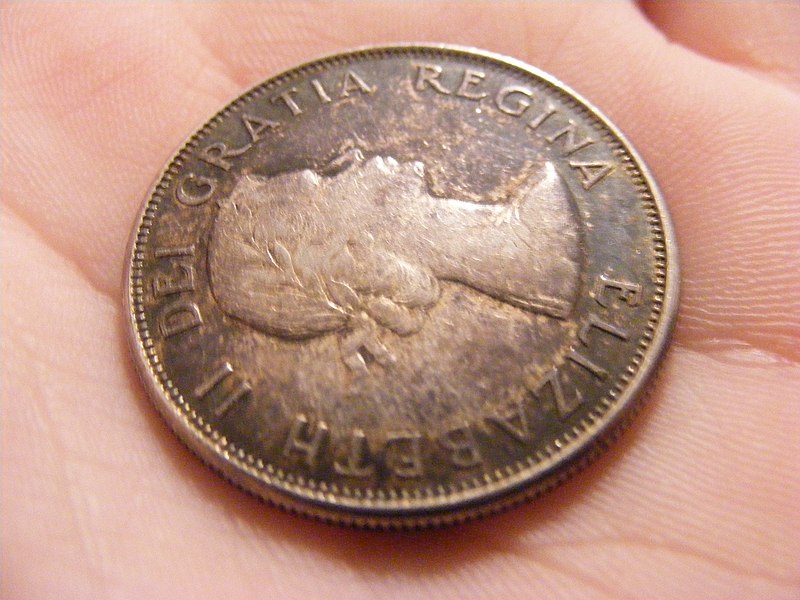
Obverse side of a Canadian 50 cent piece, dated 1959. Other side: File:50Cent1959.jpg.
JosephWeeks

50 centów kanadyjskich z 1964 roku/50 Canadian cents from 1964
Jamnik2017
Key facts
Key facts
• Country — Canada • Denomination — Fifty cents • Value — 0.50 • Unit — Canadian dollar • Mass — 6.9 • Diameter — 27.13 • Thickness — 1.95 • Edge — Milled • Composition — Nickel-plated steel 93.15% steel, 4.75% Cu, 2.1% Ni plating • Years Of Minting — 1870–present • Obverse Design — Charles III, King of Canada • Obverse Designer — Steven Rosati • Obverse Design Date — 2023 • Reverse Design — Canadian coat of arms • Reverse Designer — Cathy Bursey-Sabourin • Reverse Design Date — 1997
History
History
At the opening ceremonies for the Ottawa branch of the Royal Mint on January 2, 1908, Governor General Earl Grey struck Canada's first domestically produced coin: a silver 50-cent coin bearing the effigy of King Edward VII. The 50-cent coin bears the coat of arms given to Canada by King George V in 1921. The inscriptions included on the coin are: • A Mari usque ad Mare • Desiderantes Meliorem Patrium Demand for 50-cent coins was low during the early to mid-1920s, and only 28,000 coins were issued between 1921 and 1929. When demand increased briefly in 1929, the master of the Ottawa Mint ordered the melting of the remaining 1920 and 1921 coins, totalling 480,392 pieces. The decision was based on concerns that releasing a large number of coins dated 1920 and 1921 might lead the public to suspect counterfeits. Approximately 75 examples of the 1921 issue are believed to survive, mostly from specimen sets sold at the time. Although the denomination is rarely used in everyday transactions, it remains popular among coin collectors and within numismatic communities. In 2002, the Royal Canadian Mint made an unsuccessful attempt to promote circulation of the coin by issuing a special edition marking the 50th anniversary of the accession of Elizabeth II. After this failed promotion, the mint ceased distributing 50-cent coins to banks. They are now available only in rolls or in numismatic sets sold directly by the mint, typically at twice their face value, for example $25 per roll of 25 coins. The royal effigy of King Charles III, introduced in 2023, was designed by Canadian artist Steven Rosati.
Victoria and Edward VII
Victoria and Edward VII
• Illustration — 1871 Canadian 50-cent coin • Year — Mintage — Notes • 1870 — 450,000 • 1870 LCW • 1871 — 200,000 • 1871 H — 45,000 • 1872 H — 80,000 — This figure includes the inverted "A" for "V" in Victoria variety. • 1881 H — 150,000 • 1888 — 60,000 • 1890 H — 20,000 • 1892 — 151,000 • 1894 — 29,036 • 1898 — 100,000 • 1899 — 50,000 • 1900 — 118,000 • 1901 Victoria — 80,000 • 1902 Edward VII — 120,000 • 1903 H — 140,000 • 1904 — 60,000 • 1905 — 40,000 • 1906 — 350,000 • 1907 — 300,000 • 1908 — 128,119 • 1909 — 302,118 • 1910 Victorian leaves — 649,521 — The leaves on the reverse were slightly modified. • 1910 Edwardian leaves
George V and George VI
George V and George VI
• Year — Mintage — Notes • 1911 no "Dei gra gratia" — 209,972 — The words by the grace of God were removed from the obverse of the coin to make room for. • 1912 with "Dei gra" — 285,867 — "Dei gra" was later restored in 1912 after public backlash for "godless" coins. • 1913 — 265,889 • 1914 — 160,128 • 1916 — 459,070 • 1917 — 752,213 • 1918 — 754,989 • 1919 — 1,113,429 • 1920 — 584,691 • 1921 — Unknown — Only 75 to 100 coins are known to exist. • 1929 — 228,328 • 1931 — 57,581 • 1932 — 19,213 — As coin collecting was becoming widely popular, many of these coins were saved. • 1934 — 39,539 • 1936 — 38,550 • 1937 — 192,016 • 1938 — 192,018 • 1939 — 287,976 • 1940 — 1,996,566 • 1941 — 1,714,874 • 1942 — 1,974,164 • 1943 — 3,109,583 • 1944 — 2,460,205 • 1945 — 1,959,528 • 1946 — 950,235 — This figure includes the "hoof in 6" variety. • 1947 — 424,885 • 1947 ML — 38,433 — Obverse Emperor of India removed • 1948 — 37,784 • 1949 — 858,991 — This figure includes the "hoof over 9" variety. • 1950 — 2,384,179 — This figure includes the "lines" and "no lines" in 0 varieties. • 1951 — 2,421,730 • 1952 — 2,596,465
Elizabeth II
Elizabeth II
• Illustration — 1967 Canadian Centennial 50-cent coin (reverse side) • Year — Mintage — Notes • 1953 no strap — 1,630,429 — This variety is also called with/without shoulder fold. • 1953 strap • 1954 — 506,305 • 1955 — 753,511 • 1956 — 1,379,499 • 1957 — 2,171,689 • 1958 — 2,957,266 — Large reverse design, simple Canadian coat of arms • 1959 — 3,095,535 — Small reverse design, complete coat of arms • 1960 — 3,488,897 • 1961 — 3,584,417 • 1962 — 5,208,030 • 1963 — 8,348,871 • 1964 — 9,377,676 — 1st obverse portrait • 1965 — 12,629,974 — 2nd obverse portrait • 1966 — 7,920,496 — Last regular issue coin in silver • 1967 — 4,211,392 — Canadian Centennial; this coin features a howling wolf and is dated 1867–1967. • 1968 — 3,966,932 • 1969 — 7,113,929 • 1970 — 2,429,526 • 1971 — 2,166,444 • 1972 — 2,515,632 • 1973 — 2,546,096 • 1974 — 3,436,650 • 1975 — 3,710,000 • 1976 — 2,940,719 • 1977 — 709,839 • 1978 — 3,341,892 — This figure includes the "square" and "round" jewels varieties. • 1979 — 3,425,000 • 1980 — 1,574,000 • 1981 — 2,690,272 • 1982 — 2,236,674 — This figure includes the "small" and "large" beads varieties. • 1983 — 1,177,000 • 1984 — 1,502,989 • 1985 — 2,188,374 • 1986 — 781,400 • 1987 — 373,000 — From this date forward, 50¢ coins were generally minted in smaller amounts. • 1988 — 220,000 • 1989 — 266,419 — 2nd obverse portrait • 1990 — 207,000 — 3rd obverse portrait • 1991 — 490,000 • 1992 — 445,000 — 125th anniversary of Confederation; this coin is dated 1867–1992. • 1993 — 393,000 • 1994 — 987,000 • 1995 — 626,000 • 1996 — 458,000 • 1997 — 387,000 — Revised Canadian coat of arms on the reverse • 1998 — 308,000 • 1999 — 496,000 • 2000 — 559,000 — Struck in nickel • 2001 P — 389,000 • 2002 P (GJ) — 14,440,000 — (1952–2002) Elizabeth II Golden Jubilee • 2003 P — — — 50¢ coins minted since 2003 are not for circulation. • 2004 — 0 • 2005 — 200,000 • 2006 — 98,000 • 2007 — 250,000 • 2008 — 211,000 • 2009 — 150,000 • 2010 — 150,000 • 2011 — 175,000 • 2012 — 250,000 • 2013 — 375,000 • 2014 — 500,000 • 2015 — 625,000 • 2016 — 800,000 • 2017 — 875,000 — Includes sesquicentennial commemorative coin • 2018 — 750,000 • 2019 — 750,000 • 2020 — 750,000 • 2021 — 375,000 • 2022 — 375,000 • 2023 — Undetermined
Charles III
Charles III
• Year — Mintage — Notes • 2023 — Undetermined — First year of issue with the effigy of King Charles III on the obverse • 2024 — * Specimen 30,000 * Proof 20,000 — Available through mint rolls and sets • 2025 — Specimen 30,000 — Available through mint rolls and sets • 2026 — Undetermined — Available through mint rolls and sets
Commemoratives
Commemoratives
• Date — Mintage — Artist — Reason • William Henry James Blakemore — 90th anniversary of the Royal Canadian Mint • F.G. Peter — 110th anniversary of speed and figure skating • F.G. Peter — 100th anniversary of ski racing • Friedrich Peter — 110 years of Canadian soccer • Friedrich Peter — 20 years of Canadian auto racing • D.H. Curley — 95th anniversary of the 1904 Open Golf Championship • D.H. Curley — 125th anniversary of the first Canadian vs US Yacht Race • D.H. Curley — 100th anniversary of the first competition for the Grey Cup • D.H. Curley — 60th anniversary of the invention of basketball • Brian Hughes — 125th anniversary of the first recorded modern hockey game • Brian Hughes — 240th anniversary of the introduction of curling to North America • Brian Hughes — 160th anniversary of the first steeplechase held in North America • Brian Hughes — Birth of the first 5-pin bowling league • Thomas Shingles — Elizabeth II (Golden Jubilee; non-circulating silver proof) • Mary Gillick — Elizabeth II (Golden Jubilee) • Peter Mossman — 60th anniversary of the end of World War II – Battle of Britain • Peter Mossman — 60th anniversary of the end of World War II – Battle of Scheldt • Peter Mossman — 60th anniversary of the end of World War II – Battle of Sicily • Peter Mossman — 60th anniversary of the end of World War II – Battle of the Atlantic • Peter Mossman — 60th anniversary of the end of World War II – Liberation of the Netherlands • Peter Mossman — 60th anniversary of the end of World War II – Raid of Dieppe • William Henry James Blakemore — 100th anniversary of Royal Canadian Mint • Various — 100th anniversary of the Montreal Canadiens • William Henry James Blakemore — 100th anniversary of George V on Canadian coins • Christie Paquet — Elizabeth II (Diamond Jubilee) • Yves Bérubé — 100th anniversary of Titanic • Christie Paquet — 150th anniversary of the Cariboo Gold Rush • DC Comics — 75th anniversary of Superman • Yves Bérubé — 100th anniversary of the sinking of the Empress of Ireland • Matthew Bowen — 150th anniversary of the Charlottetown and Québec Conferences • Pierre Leduc — 50th anniversary of the Canadian flag • 150th anniversary of the Confederation of Canada (Centennial Wolf; 2017 version) • Ariana Cuvin — 150th anniversary of the Confederation of Canada (Canada 150 logo; silver proof) • 100th anniversary of the 50-cent coin • 75th anniversary of George VI on the 1943 50-cent coin • Unknown — Steve McPhee — 200th anniversary of the 49th Parallel • Thomas Shingles — 60th anniversary of the 50-cent coin (1959–2019) • George Kruger Gray — 100th anniversary of the Canadian Coat of Arms • Cathy Bursey-Sabourin — Elizabeth II (Platinum Jubilee; silver proof) • Cathy Bursey-Sabourin — Elizabeth II (Platinum Jubilee)
Collecting
Collecting
Known as the "king of Canadian coins", the 1921 Canadian 50-cent coin is rare, with a high-grade example (PCGS MS-66) having sold for US$227,546 in a January 2010 Heritage Auction. The highest-graded specimen is graded by PCGS at MS-67 and was last sold (by Diverse Equities) in the year 2000 to a private collector for the US$400,000.
Places
Named by the record
Places
Only places the record itself states, plotted where the house gazetteer settles their coordinates. Nothing is inferred from a name or a nationality.
- Canada
Named but not plotted · 1
Canadian fifty-cent coin is associated with Canada.
Country
Composition and size
• Years — Mass — Diameter — Thickness — Composition • 1870–1919 — 11.62 g — 29.72 mm — n/a — 92.5% silver, 7.5% copper • 1920–1967 — 11.66 g — 29.72 mm — n/a — 80% silver, 20% copper • 1968–2000 — 8.10 g — 27.13 mm — 1.93 mm — 99.9% nickel • 2001–present — 6.90 g — 27.13 mm — 1.95 mm — 93.15% steel, 4.75% copper, 2.1% nickel plating
Citations
References
Each reference names the institution holding it, so a reader may go to the document itself.
reference work
Partially resolvedreference work
Partially resolved
The Encyclopedia exists whether or not anything is for sale. Corrections are recorded rather than overwritten, and every version of this record is kept. Published 14 August 2026.
Elsewhere in Coins
642 published records in this field, each with its sources named.
- bullet moneyTerminology
- bullion coinTerminology
- business strikeTerminology
- California Diamond Jubilee half dollarTerminology
- Canadian Gold Maple LeafTerminology
- Canadian Palladium Maple LeafTerminology
- Canadian Platinum Maple LeafTerminology
- Canadian Silver Maple LeafTerminology
Best supported in this field
For owners
Own an object connected with Canadian fifty-cent coin?
A specialist will read what you send and tell you what the house can establish, what it cannot, and whether the object is suited to sale. There is no charge and no obligation. The object stays with you throughout; nothing is shipped to us unless it is arranged in writing beforehand.