
Atish Dipankar
Atiśa Dīpaṃkara Śrījñāna (c. 982–1054 CE) was a Buddhist religious teacher and leader from Bengal. He is generally associated with his body of work authored at Vikramaśīla Monastery in Bihar.
Also recorded as Atiśa Dīpaṃkaraśrījñāna
Atish Dipankar
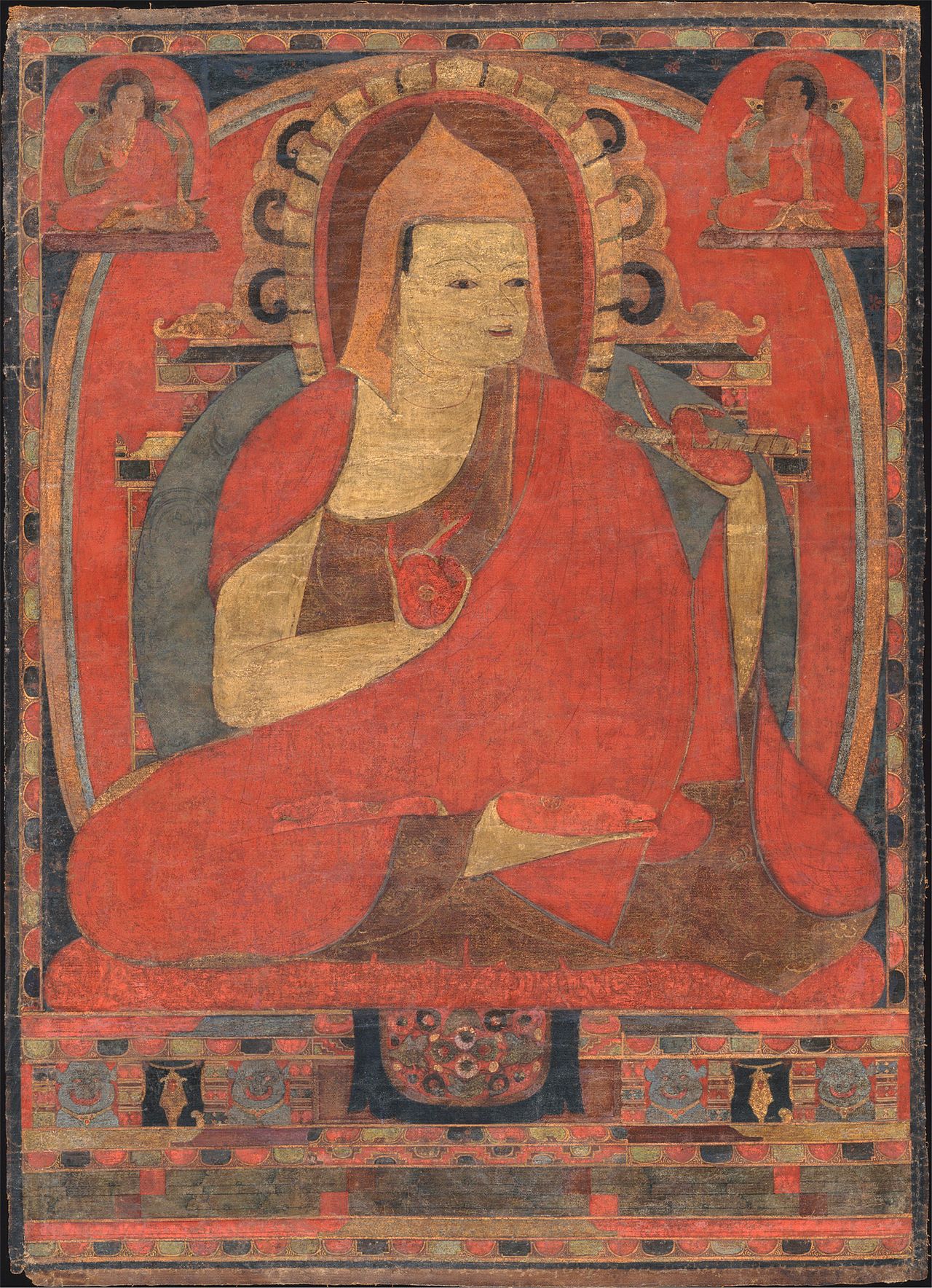
Unknown不具名 [Tibet (a Kadampa monastery)] · The Metropolitan Museum of Art · Public domain
- Name
- Atiśa
- Born
- c. 982 CE
- Birthplace
- Vikrampura, Bengal
- Died
- c. 1054 CE
- Place of death
- Nyêtang, Tibet
- Education
- * Vikramashila
- Nationality
- Pala Empire.
- Occupation
- monk, editor, writer, tertön, translator and compiler.
- Teachers
- Sa Drepa Chenpo, Jampé Naljorpa, Ku Sa Li Chungwa and Drolma Tronyer Chen.
- Known for
- Bodhipathapradīpa.
- Languages
- Sanskrit.
VALÉORINE Encyclopedia
VALÉORINE documentary reading
Documentary summary
Atiśa Dīpaṃkara Śrījñāna (c. 982–1054 CE) was a Buddhist religious teacher and leader from Bengal. He is generally associated with his body of work authored at Vikramaśīla Monastery in Bihar.
Admitted source layer · organised and presented by VALÉORINE
Reference Check
Propose documentary evidence for Atish Dipankar. A contribution is never written directly as fact: identity, source, rights and evidence gates still decide.
Sign in to contribute
World of VALÉORINE
Documentary connections
Only confirmed graph relationships appear here. Images are shown only when their identity and reuse rights both pass the documentary gate.
Documentary evidence
Documentary basis
Authority files
wikidata · Q320150
In this article
Biography
Biography
He was a major figure in the spread of 11th-century Mahayana and Vajrayana Buddhism in Asia and traveled to Sumatra and Tibet. Atiśa, along with his chief disciple Dromtön, is regarded as the founder of the Kadam school, one of the New Translation schools of Tibetan Buddhism. In the 14th century, the Kadam school was supplanted by the Gelug tradition, which adopted its teachings and absorbed its monasteries.
Training under Sa Drepa Chenpo, Jampé Naljorpa and Ku Sa Li Chungwa is recorded. Gya Lotsawa Tsöndrü Sengé, Tolungpa Rinchen Nyingpo and Padmakaravarma are recorded as having studied under Atish Dipankar. The recorded working language is Sanskrit. Works named in the authority record are Bodhipathapradīpa.
Key facts
Key facts
• Name — Atiśa • Dharma Name — Atiśa • Born — c. 982 CE • Birthplace — Vikrampura, Bengal • Died — c. 1054 CE • Place of death — Nyêtang, Tibet • Religion — Buddhism • Education — * Vikramashila • Odantapuri • Teacher — Jñanasrimitra • Students — Dromtön
Early life
Early life
Atiśa was born as Candragarbha in c. 982 CE as the second of three sons to a ruling family in Bengal most probably in the village of Vajrayogini in Vikrampura, the latter was one of the capitals of the Pala Empire. His father was a king known as Kalyānaśrī and his mother was Prabhavati Sri. The early part of his life was typical of noblemen of the period, and he was trained in various fields, including art.
Studies
Studies
As a young man, he began to study tantra in what is now Rajgir, where he was tutored by a monk named Rāhulaguhyavajra. Under Rāhulaguhyavajra, Atiśa was initiated into Hevajra and taught specific meditations. He then studied for seven years under a master named Avadhūtipā, where he focused on yoga and engaged in tantric feasts known as ganachakra. According to Tibetan sources, Atiśa was ordained into the Mahāsāṃghika lineage at the age of twenty-eight by the Abbot Śīlarakṣita in Bodh Gaya and studied almost all Buddhist and non-Buddhist schools of his time, including teachings from Vaishnavism, Shaivism, Tantric Hinduism and other practices. He also studied the sixty-four kinds of art, the art of music and the art of logic and accomplished these studies until the age of twenty-two. Among the many Buddhist lineages he studied, practised and transmitted the three main lineages were the Lineage of the Profound Action transmitted by Asaṅga and Vasubandhu, the Lineage of Profound View transmitted by Nagarjuna and Candrakīrti, and the Lineage of Profound Experience transmitted by Tilopa and Naropa. Atiśa engaged with many notable teachers during this period, including Ratnākaraśānti, Naropa and Jitari. He also studied Dharmarakṣita at the monastery of Odantapuri.
Vikramaśīla
Vikramaśīla
Atiśa rose to become a senior scholar at the monastery of Vikramaśīla at a time when it had no more than one hundred ordained monks present. Tibetan hagiographies on his life have a tendency to portray him as one of the greatest scholars to stay at Vikramaśīla, who would be noted for his strict adherence to the ethics of Mahayana Buddhism. It was during this period that the King of the Tibetan polity of Guge, Lha bla ma Ye shes 'od began to send missions to Vikramaśīla to invite scholars to visit Guge so that they could teach the "pure form of Buddhism". Atiśa finally departed Vikramaśīla in 1040 CE. The then abbot of Vikramaśīla, Ratnakara, gave his permission for Atiśa to leave but on the condition that he return in three years.
Life and career
Dated record
Life and career
The full dated record · 2 entries
982
Atish Dipankar born at Bikrampur.
1054
Atish Dipankar died at Nyêtang.
Places
Named by the record
Places
Only places the record itself states, plotted where the house gazetteer settles their coordinates. Nothing is inferred from a name or a nationality.
Bikrampur.
Birth place
Nyêtang.
Death place
Writings
His writings include: • Bodhipathapradīpa • Bodhipathapradipapanjikanama (his own commentary on Bodhipathapradīpa / byang chub lam gyi sgron ma) • Charyasamgrahapradipa contains some kirtan verses composed by Atiśa. • Satyadvayavatara • Bodhisattvamanyavali • Madhyamakaratnapradipa • Mahayanapathasadhanasangraha • Shiksasamuccaya Abhisamya • Prajnaparamitapindarthapradipa • Ekavirasadhana • Vimalaratnalekha, a Sanskrit letter to Nayapala, king of Gauda.
Teachings in Sumatra and Tibet
• Illustration — Mural of Atiśa at Ralung Monastery, 1993. Tibetan sources record that Atiśa spent 12 years in Sumatra of the Srivijaya empire, and he returned to India in 1025 CE which was also the same year when Rajendra Chola I of the Chola dynasty invaded Sumatra. Upon his return, he received much attention for his teachings and skills in debate and philosophy. On three separate occasions, Atiśa was acclaimed for defeating non-Buddhist extremists in debate. When he came into contact with what he perceived to be a misled or deteriorating form of Buddhism, he would quickly and effectively implement reforms. Soon enough he was appointed to the position of steward, or abbot, at Vikramaśīla which was established by Emperor Dharmapala. He is also said to have "nourished" Odantapuri. Atiśa's return from Suvarnabhumi, where he had been studying with Dharmakīrtiśrī, and his rise to prominence in India coincided with a flourishing of Buddhist culture and the practice of Buddhism in the region, and in many ways Atiśa's influence contributed to these developments. According to the Blue Annals, a new king of Guge by the name of Yeshe-Ö sent his academic followers to learn and translate some of the Sanskrit Buddhist texts. Among these academics was Naktso, who was eventually sent to Vikramaśīla to study Sanskrit and plead with Atiśa to come teach the Dharma in his homeland. Travelling with Naktso and Gya Lōtsawa, Atiśa journeyed through Nepal on his way to Tolung, the capital of the Purang Kingdom. (Gya Lōtsawa died before reaching Tolung.) On his way, he is said to have met Marpa Lōtsawa. He spent three years in Tolung and compiled his teachings into his most influential scholarly work, Bodhipathapradīpa, or Lamp for the Path to Enlightenment. This short text in sixty-seven verses lays out the entire Buddhist path in terms of the three vehicles: Hīnayāna, Mahāyāna, and Vajrayāna, and became the model for subsequent texts in the genre of Lamrim, or the Stages of the Path, and was specifically the basis for Tsongkhapa's Lamrim writings. Here Atiśa met Dromtön, or Dromtonpa, who would become his primary disciple, regarded as both an enforcer of later propagation ethical standards and a holder of Atiśa's tantric lineage. According to Jamgon Kongtrul, when Atiśa discovered the store of Sanskrit texts at Pekar Kordzoling, the library of Samye, "he said that the degree to which the Vajrayana had spread in Tibet was unparalleled, even in India. After saying this, he reverently folded his hands and praised the great dharma kings, translators, and panditas of the previous centuries."
Legacy
In 2004, Atiśa was ranked 18th in the BBC's poll of the greatest Bengalis of all time.
Notes from the source article
Cited by Wikipedia
Notes from the source article
These works are cited by the source article, in its own numbering. They are recorded as its citations, not as sources VALÉORINE has verified.
- 1.New York: The Metropolitan Museum of Art, 2000–. Portrait of Atiśa [Tibet (a Kadampa monastery)] (1993.479). Timeline of Art History. October 2006.
- 2.The Dalai Lama. Reincarnation. Dalailama.
- 3.Atisha: A Guide for Readers. Shambhala Pubs. 2022-06-02.
- 4.Jan Westerhoff. The Golden Age of Indian Buddhist Philosophy. Oxford University Press. 276. 2018. 978-0-19-873266-2.
- 5.POV. Tibetan Buddhism from A to Z - My Reincarnation - POV. PBS.
- 6.Kadam - The Treasury of Lives: A Biographical Encyclopedia of Tibet, Inner Asia and the Himalayan Region. The Treasury of Lives.
- 7.Dipankar Srijnan, Atish. Banglapedia.
- 8.Maha Bodhi Society, The Maha Bodhi, Volume 90, p. 238.
- 9.ATĪŚA ou ATĪSHA. Encyclopædia Universalis.
- 10.Atisa Dipamkara. The Treasury of Lives.
- 11.ATĪŚA ou ATĪSHA. Encyclopædia Universalis.
- 12.Roesler, Ulrike. Atiśa and the Bka' gdams pa Masters. Brill's Encyclopedia of Buddhism Online.
- 13.Great Kagyu Masters: The Golden Lineage Treasury by Khenpo Konchog Gyaltsen, Snow Lion Publications, pages 154-186
- 14.Encyclopedia of Buddhism Online. Ratnākaraśānti.
- 15.Atisa and Tibet: Life and Works of Dipamkara Srijnana by Alaka Chattopadhyaya p.91
- 16.Chattopadhyaya, Alaka. Atīśa and Tibet: Life and Works of Dīpaṃkara Śrījñāna in Relation to the History and Religion of Tibet. Motilal Banarsidass Publ. 126. 1981. 978-81-208-0928-4.
- 17.bstan pa'i mgon po. Blue Annals. Lokesh Chandra. 1974.
- 18.Atisa Dipamkara. The Treasury of Lives.
- 19.Dromton Gyelwa Jungne. The Treasury of Lives.
- 20.Listeners name 'greatest Bengali'. 14 April 2004.
- 21.International : Mujib, Tagore, Bose among 'greatest Bengalis of all time'. The Hindu. 17 April 2004.
- 22.The Daily Star Web Edition Vol. 4 Num 313. The Daily Star.
Bibliography printed in the source article · 6
- Buswell, Robert Jr. Princeton Dictionary of Buddhism. Princeton University Press. 2014. 9780691157863.
- Khenpo Konchog Gyaltsen, Great Kagyu Masters: The Golden Lineage Treasury, Snow Lion Publications
- Geshe Sonam Rinchen, Atiśa's Lamp for the Path to Enlightenment, Snow Lion Publications
- Khyentse, Dilgo. 'Enlightened Courage. Snow Lion Publications. 1993. 1-55939-023-9.
- Tulku, Ringu. The Ri-Me Philosophy of Jamgon Kongtrul the Great: A Study of the Buddhist Lineages of Tibet. Shambhala Publications. 2006. 1-59030-286-9.
- Apple, James B. Atisa Dipamkara: Illuminator of the Awakened Mind. Shambhala Publications. 2019. 978-1611806472.
References
Citations
References
Each reference names the institution holding it, so a reader may go to the document itself.
authority record
General reference
People, houses and institutions
Knowledge graph
People, houses and institutions
Teachers, collaborators, publishers and institutions recorded against this person, each on a stated basis.
Born at
1- BikrampurPlace
Established from a fact already recorded on a verified source.
Further particulars
Held on the record
Further particulars
Open the remaining particulars
He trained under Sa Drepa Chenpo, Jampé Naljorpa, Ku Sa Li Chungwa and Drolma Tronyer Chen. Each of those relationships is stated by the authority record rather than inferred from style.
The Encyclopedia exists whether or not anything is for sale. Corrections are recorded rather than overwritten, and every version of this record is kept. Published 14 August 2026.
Elsewhere in Books
39,015 published records in this field, each with its sources named.
- AtiliusAuthor
- Atima SrivastavaAuthor
- Atin BandyopadhyayAuthor
- Atis KronvaldsAuthor
- Atiyah al-JamriAuthor
- Atmaram Ravaji DeshpandeAuthor
- Atsuko AsanoAuthor
- Atsuro RileyAuthor
Best supported in this field
For owners
Own a work by Atish Dipankar?
A specialist will read what you send and tell you what the house can establish, what it cannot, and whether the object is suited to sale. There is no charge and no obligation. The object stays with you throughout; nothing is shipped to us unless it is arranged in writing beforehand.