
Alphonse de Neuville
Alphonse-Marie-Adolphe de Neuville (lang; 31 May 183518 May 1885) was a French academic painter who studied under Eugène Delacroix. His dramatic and intensely patriotic subjects illustrated episodes from the Franco-Prussian War (1870-71), the Crimean War (1853-56), the Second French intervention in Mexico (1861-67), the Anglo-Zulu War (1879), and portraits of soldiers. Some of his works have been collected by the Hermitage Museum in St.
Also recorded as Neuville · A. M. De Neuville · de neuville alphonse · Neuville De
Alphonse de Neuville
Alphonse de Neuville · Wellcome Collection, London · Wellcome Collection · Public Domain Mark
- Name
- Alphonse de Neuville
- Birth Name
- Alphonse-Marie-Adolphe de Neuville
- Born
- 31 May 1835
- Birthplace
- Saint-Omer, France
- Died
- 18 May 1885
- Place of death
- Paris, France
- Field
- Painting
- Movement
- Academic art
- Nationality
- France.
- Occupation
- painter and writer.
- Fields
- history.
- Movements
- academic art.
VALÉORINE Encyclopedia
VALÉORINE documentary reading
Documentary summary
Alphonse-Marie-Adolphe de Neuville (lang; 31 May 183518 May 1885) was a French academic painter who studied under Eugène Delacroix. His dramatic and intensely patriotic subjects illustrated episodes from the Franco-Prussian War (1870-71), the Crimean War (1853-56), the Second French intervention in Mexico (1861-67), the Anglo-Zulu War (1879), and portraits of soldiers. Some of his works have been collected by the Hermitage Museum in St.
Admitted source layer · organised and presented by VALÉORINE
Reference Check
Propose documentary evidence for Alphonse de Neuville. A contribution is never written directly as fact: identity, source, rights and evidence gates still decide.
Sign in to contribute
World of VALÉORINE
Documentary connections
Only confirmed graph relationships appear here. Images are shown only when their identity and reuse rights both pass the documentary gate.
Documentary evidence
Documentary basis
Authority files
wikidata · Q1494309 · wikipedia · Alphonse de Neuville
In this article
Biography
Biography
Petersburg, by the Metropolitan Museum in New York, by the Musée d'Orsay and by the Army Museum at the Invalides, both in Paris.
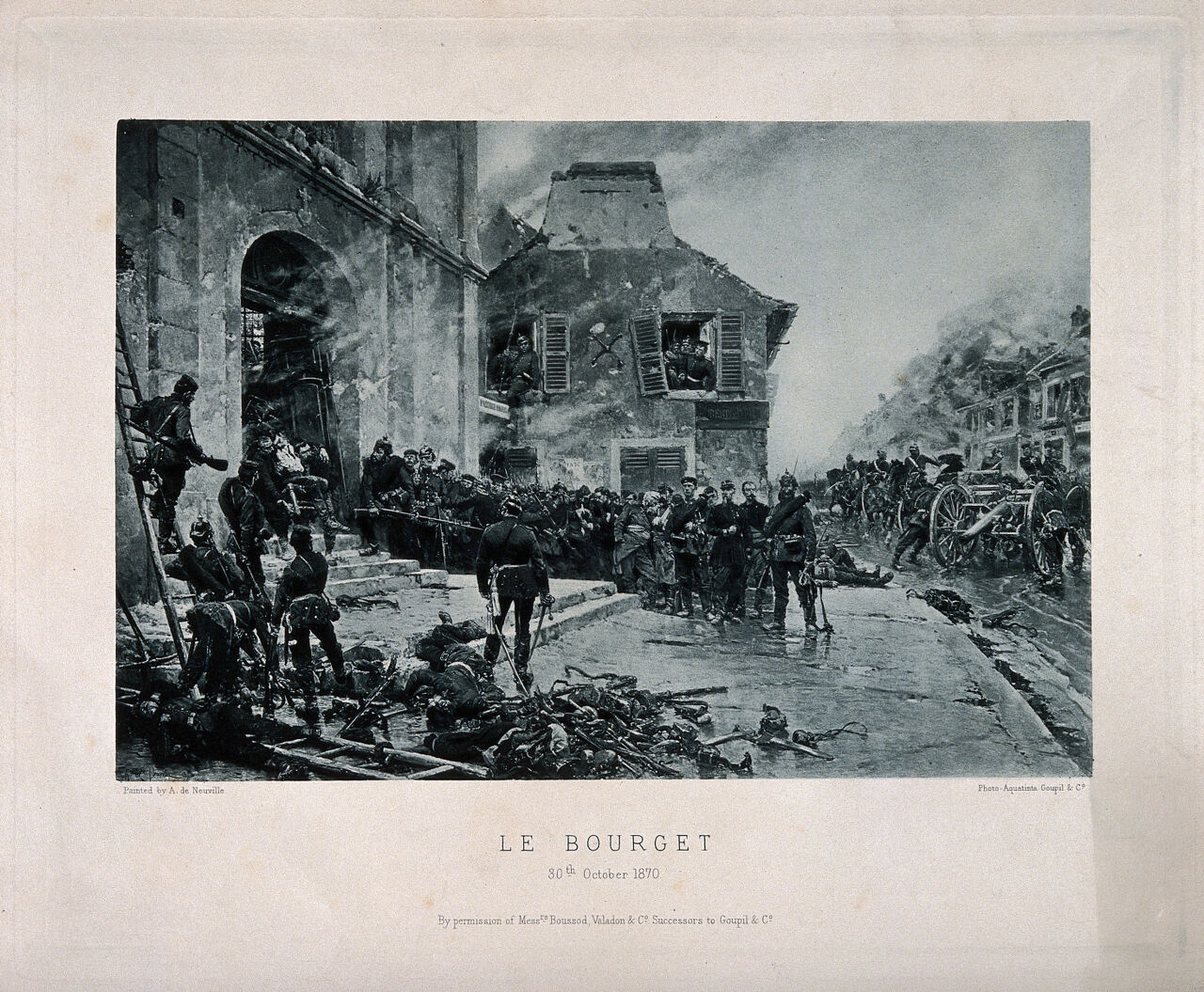
Alphonse de Neuville studied at Beaux-Arts de Paris. Training under François-Édouard Picot is recorded. The recorded working language is French. Subjects and genres recorded for the work are history. Places of work recorded in the authority are Paris. Works named in the authority record are The Last Cartridges, The Attack at Dawn, The Cemetery of Saint-Privat and Le Bourget. Work by Alphonse de Neuville is recorded in the collections of Minneapolis Institute of Art, The Nelson-Atkins Museum of Art, Metropolitan Museum of Art, Amsterdam Museum and Centraal Museum. Distinctions recorded are Knight of the Legion of Honour and Officer of the Legion of Honour.
Key facts
Key facts
• Name — Alphonse de Neuville • Birth Name — Alphonse-Marie-Adolphe de Neuville • Born — 31 May 1835 • Birthplace — Saint-Omer, France • Died — 18 May 1885 • Place of death — Paris, France • Field — Painting • Movement — Academic art
Early life
Early life
• Illustration — Neuville in a National Guard uniform in 1870–1871. Born Alphonse-Marie-Adolphe Deneuville to wealthy parents at Saint-Omer, Pas-de-Calais, he earned his degree of bachelier ès-lettres, and in 1856 entered the naval school at Lorient in spite of family opposition. It was there that his artistic instincts started. The young Alphonse de Neuville was discouraged by several painters of repute, but he was admitted to work in the studio of François-Edouard Picot. He did not remain there long. He was already painting by himself when he produced his first picture, The Fifth Battalion of Chasseurs at the Gervais Battery (Malakoff). In 1860, Neuville painted an Episode of the taking of Naples by Garibaldi for the Artists' Club in the rue de Provence in Paris. In 1861, he sent The Guard Chasseurs in the Trenches of the Mamelon Vert to the Paris Salon.
Franco-Prussian War
Franco-Prussian War
He reached the peak of his career after the Franco-Prussian War of 1870-1871. The long-term French reaction was revanchism: a deep sense of bitterness, hatred, and demand for revenge against Germany, especially because of the loss of Alsace and Lorraine. Paintings that emphasized the humiliation of the defeat were in high demand, such as The Spy by de Neuville. In response, Neuville aimed at depicting episodes of the Franco-Prussian War in his works, and began by representing the Bivouac before Le Bourget (1872). His fame spread rapidly and was increased by The Last Cartridges (1873), memorializing an episode involving the Blue Division of the French marines, in which it is easy to discern the vast difference between the conventional treatment of military subjects, as practised by Horace Vernet, and that of a man who had lived the life that he painted. Fight on a Railroad (1874) was equally successful, and was followed by the Attack on a House at Villersexel (1875) and the Railway Bridge at Styring (1877). In 1878 (but not at the Great Exhibition), the painter exhibited Le Bourget, the Surprise at Daybreak, The Intercepted Despatch-bearer, and a considerable number of drawings. He also exhibited in London some episodes of the Zulu War. Fifty thousand people paid to see his impression of The Defence of Rorke's Drift (1880), which the infant Art Gallery of New South Wales in Sydney paid a large sum to acquire. In 1881, he was made an officer of the Légion d'honneur for The Cemetery of Saint-Privat, The Despatch-bearer, and Huns in the Battle of Chalon. During these years Neuville was at work with Édouard Detaille on an important although less artistic work, Le Soir de Rezonville.
Death
Death
Neuville died in Paris on May 18, 1885. At the sale of his works the state purchased the paintings Bourget and Attack on a Barricaded House, as well as watercolor The Parley and the drawing Turco in Fighting Trim, for the purpose of displaying them at the Palais du Luxembourg.
Identity and origins
Identity and origins
Alphonse de Neuville was recorded at birth as Alphonse Marie Deneuville. The authorities additionally record the headings Neuville, A. De Neuville, de neuville alphonse, Neuville De and Alphonse-Marie de Neuville. His recorded language was French. He married Mimi Maréchal.
Identity
Identity
Alphonse de Neuville is recorded as having received Knight of the Legion of Honour and Officer of the Legion of Honour. Work and production. Works recorded as notable number 4: The Last Cartridges, The Attack at Dawn, The Cemetery of Saint-Privat and Le Bourget. His recorded genre is history.
Life and career
Dated record
Life and career
The full dated record · 2 entries
1836
Alphonse de Neuville born at Saint-Omer.
1885
Alphonse de Neuville died at rue Brémontier.
Places
Named by the record
Places
Only places the record itself states, plotted where the house gazetteer settles their coordinates. Nothing is inferred from a name or a nationality.
Saint-Omer.
Birth place
rue Brémontier.
Death place
Illustrator and military artist
Illustrator and military artist
Neuville participated in illustrating Pierre-Jules Hetzel's editions of Twenty Thousand Leagues Under the Seas by Jules Verne. He also illustrated Le Tour du monde and François Guizot's History of France. At the same time he painted a number of remarkable pictures: The Attack in the Streets of Magenta by Zouaves and the Light Horse (1864), A Zouave Sentinel (1865), The Battle of San Lorenzo (1867), and Dismounted Cavalry crossing the Tchernaia (1869). In these he showed peculiar insight into military life.
Paintings
Paintings
• Illustration — Battle of Champigny (1870) • Illustration — The Last Cartridges (1873) • Illustration — Bivouac after the Battle of Le Bourget, 21 December 1870 (1873) • Illustration — Battle at the Railway Embankment (1874) • Illustration — In the Trenches (1874) • Illustration — A Bugler of the Infantry (1876) • Illustration — The Attack at Dawn (1877) • Illustration — Defense of the Longboyau Gate, 21 October 1870 (1879) • Illustration — Last Sleep of the Brave (1879) • Illustration — The Defence of Rorke's Drift (1880) • Illustration — The Spy (1880) • Illustration — The Cemetery of Saint-Privat (1881) • Illustration — Forwards! or The Battle of Chenebier (1884) • Illustration — A Cavalryman (1884)
Illustrations
Illustrations
• Illustration — Carolingian Emperor Charlemagne presiding over the Académie palatine. • Illustration — The myth of Gyptis (or Petta) offering her cup to Protis (or Euxenus), the founding myth of Marseille. • Illustration — A legendary episode from the Sack of Rome (390 BC). • Illustration — The Battle of Aquae Sextiae (today Aix-en-Provence), 102 BC, in which Marius's Romans defeated the Ambrones and Teutons. • Illustration — An episode from Julius Caesar's Gallic Wars. • Illustration — Another episode from the Gallic Wars: "Vercingetorix surrenders himself to Caesar." alt=Épisode de la guerre des Gaules: « Vercingétorix se livre en personne à César ». • Illustration — The last druids. • Illustration — The episode of Clovis, King of the Franks, and the semi-legendary Vase of Soissons. • Illustration — The death of Roland, Frankish commander under Emperor Charlemagne, at the Battle of Roncevaux Pass. The battle is recounted in the 11th century The Song of Roland, the oldest surviving major work of French literature, and in Orlando Furioso, one of the most celebrated works of Italian literature.
Where the work is held
Recognition and collections
Alphonse de Neuville received Knight of the Legion of Honour and Officer of the Legion of Honour.
Notes from the source article
Cited by Wikipedia
Notes from the source article
These works are cited by the source article, in its own numbering. They are recorded as its citations, not as sources VALÉORINE has verified.
- 1.This cites Montrosier, Les Peintres militaires (Paris, 1881), "De Neuville," in Gazette des Beaux-Arts (Paris, 1885).
- 2.Varley, Karine. Under the Shadow of Defeat: The War of 1870-71 in French Memory. 2008.
- 3.Jay, Robert. "Alphonse de Neuville's 'The Spy' and the Legacy of the Franco-Prussian War," Metropolitan Museum Journal (1984) 19: pp. 151-162 in JSTOR
Bibliography printed in the source article · 3
- Chabert, Philippe Gérard. Alphonse de Neuville : l'épopée de la défaite, Paris, Copernic, 1979.
- Jackson, David, 'Zulu War Paintings - Alphonse De Neuville', Journal of the Society for Army Historical Research, Vol. LXIX, No. 277, Spring 1991, pp. 56–57.
- Southey, R. J., 'De Neuville and Isandhlwana', Africana Notes and News, Vol. 19, No. 6, June 1971, pp. 253–254.
References
Citations
References
Each reference names the institution holding it, so a reader may go to the document itself.
reference work
Secondary witnessreference work
Secondary witness
The Encyclopedia exists whether or not anything is for sale. Corrections are recorded rather than overwritten, and every version of this record is kept. Published 17 August 2026.
Elsewhere in Paintings
18,792 published records in this field, each with its sources named.
- Alphonse AllaisArtist
- Alphonse AsselbergsArtist
- Alphonse ColasArtist
- Alphonse De CuyperArtist
- Alphonse GirouxArtist
- Alphonse MaureauArtist
- Alphonse MonchablonArtist
- Alphonse MoutteArtist
Best supported in this field
For owners
Own a work by Alphonse de Neuville?
A specialist will read what you send and tell you what the house can establish, what it cannot, and whether the object is suited to sale. There is no charge and no obligation. The object stays with you throughout; nothing is shipped to us unless it is arranged in writing beforehand.