
Alfred Kastler
Alfred Kastler (3 May 1902 – 7 January 1984) was a German-born French physicist and Nobel laureate in Physics. He is known for the development of optical pumping.
Alfred Kastler

scanned from Polish "Problemy" monthly, April 1967, page 221 · Public domain
- Born
- 3 May 1902
- Birthplace
- Guebwiller, Alsace–Lorraine, German Empire
- Died
- 7 January 1984
- Place of death
- Bandol, Provence-Alpes-Côte d'Azur, France
- Education
- École Normale Supérieure
- Known for
- Optical pumping Nuclear acoustic resonance
- Awards
- * Holweck Prize (1954)
- Nationality
- France
- Occupation
- physicist · poet · university teacher · researcher
- Fields
- physics · spectroscopy · electronics · optics
- Honours
- Nobel Prize in Physics · CNRS Gold medal · Prix Félix-Robin · Three Physicists Prize · Holweck Prize · Wilhelm Exner Medal
- Languages
- German · French
VALÉORINE Encyclopedia
VALÉORINE documentary reading
Documentary summary
Alfred Kastler (3 May 1902 – 7 January 1984) was a German-born French physicist and Nobel laureate in Physics. He is known for the development of optical pumping.
Admitted source layer · organised and presented by VALÉORINE
Note VALÉORINE
Alfred Kastler (1902–1984) was a physicist, poet and researcher, among other activities, of French nationality. The physicist was born in Guebwiller and died in Bandol.
Alfred Kastler was educated at École Normale Supérieure and Science Faculty of Paris. The physicist worked for Science Faculty of Paris and was a member of French Academy of Sciences, German Academy of Sciences at Berlin and German Academy of Sciences Leopoldina, among others. Alfred Kastler held the position of chairperson. Activity centred on electronics, optics and physics.
Among the works are Nuclear acoustic resonance and optical pumping. Languages used include French and German. Honours include CNRS Gold medal, Holweck Prize and Nobel Prize in Physics, among others.
Composed from admitted, traceable facts · 01 October 2026
VALÉORINE
Reference Check
Propose documentary evidence for Alfred Kastler. A contribution is never written directly as fact: identity, source, rights and evidence gates still decide.
Sign in to contribute
World of VALÉORINE
Documentary connections
Only confirmed graph relationships appear here. Images are shown only when their identity and reuse rights both pass the documentary gate.
Documentary evidence
Documentary basis
Authority files
wikidata · Q71023 · wikipedia · Alfred Kastler
In this article
Biography
Biography
Alfred Kastler studied at École Normale Supérieure and Science Faculty of Paris. The recorded working language is German and French. The field of work recorded is physics, spectroscopy and electronics. Employment is recorded with Science Faculty of Paris. Positions recorded include chairperson. Works named in the authority record are optical pumping and Nuclear acoustic resonance. Distinctions recorded are Nobel Prize in Physics, CNRS Gold medal, Prix Félix-Robin and Three Physicists Prize.
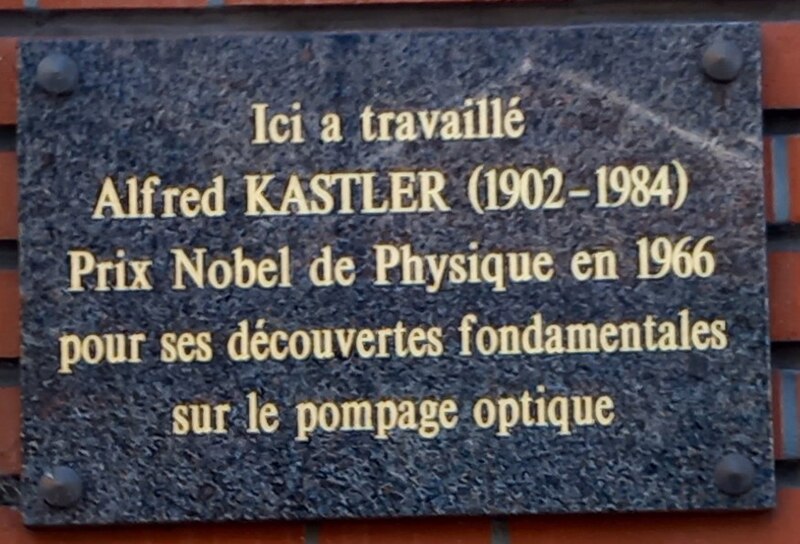
Plaque commémorative de Alfred Kastler, rue Lhomond à Paris
Ricercastorica
Key facts
Key facts
• Born — 3 May 1902 • Birthplace — Guebwiller, Alsace–Lorraine, German Empire • Died — 7 January 1984 • Place of death — Bandol, Provence-Alpes-Côte d'Azur, France • Education — École Normale Supérieure • Known for — Optical pumping Nuclear acoustic resonance • Awards — * Holweck Prize (1954) • CNRS Gold medal (1964) • Nobel Prize in Physics (1966) • Fields — Physics • Workplaces — University of Bordeaux • Doctoral Advisor — Pierre Daure • Doctoral Students — Claude Cohen Tannoudji
Biography
Biography
Kastler was born in Guebwiller (Alsace, at the time part of the German Empire), and became a French citizen when Alsace reverted to France at the end of World War I. He attended the Lycée Bartholdi in Colmar, Alsace, and then École Normale Supérieure in Paris in 1921. After his studies, he began teaching physics at the Lycée of Mulhouse in 1926, and then taught at the University of Bordeaux, where he was a university professor until 1941. Georges Bruhat asked him to come back to the École Normale Supérieure, where he finally obtained a chair in 1952. Collaborating with Jean Brossel, he researched quantum mechanics, the interaction between light and atoms, and spectroscopy. Kastler, working on combination of optical resonance and magnetic resonance, developed the technique of "optical pumping". Those works led to the completion of the theory of lasers and masers. In 1962, he received the first C.E.K Mees Medal from the Optical Society of America, and he was elected an Honorary member of the Society. The following year, he was elected a Fellow. He won the Nobel Prize in Physics in 1966 "for the discovery and development of optical methods for studying Hertzian resonances in atoms". He was president of the board of the Institut d'optique théorique et appliquée and served as the first chairman of the non-governmental organization (NGO) Action Against Hunger. Kastler also wrote poetry (in German). In 1971 he published Europe, ma patrie: Deutsche Lieder eines französischen Europäers (i.e. Europe, my fatherland: German songs of a French European). In 1976, Kastler was elected to the American Philosophical Society. In 1978 he became foreign member of the Royal Netherlands Academy of Arts and Sciences. In 1979, Kastler was awarded the Wilhelm Exner Medal.
Laboratoire Kastler-Brossel
Laboratoire Kastler-Brossel
• Illustration — Kastler ca. 1967 Professor Kastler spent most of his research career at the Ecole Normale Supérieure in Paris where he started after the war a small research group on spectroscopy with his student, Jean Brossel. Over the forty years that followed, this group trained many young physicists, including Nobel laureates Claude Cohen Tannoudji and Serge Haroche, and had a significant impact on the development of atomic physics in France. The Laboratoire de Spectroscopie hertzienne was renamed Laboratoire Kastler-Brossel in 1994. It has part of its laboratories in Université Pierre et Marie Curie but mainly at the École Normale Supérieure.
Global policy
Global policy
He was one of the signatories of the agreement to convene a convention for drafting a world constitution. As a result, for the first time in human history, a World Constituent Assembly convened to draft and adopt the Constitution for the Federation of Earth.
Personal life
Personal life
In December 1924, Kastler married Elise Cosset, a teacher. They had three children, Daniel, Claude-Yves, and Mireille. His sons became teachers, and Mireille became a doctor.
Death
Death
Professor Kastler died on 7 January 1984, in Bandol, France.
Identity and origins
Identity and origins
His recorded languages were German and French. 2 children are recorded: Claude Kastler and Daniel Kastler.
Career and activity
Career and activity
Alfred Kastler worked in physics, spectroscopy, electronics and optics. He was employed by Science Faculty of Paris. Recorded position is chairperson. He belonged to German Academy of Sciences at Berlin, German Academy of Sciences Leopoldina, French Academy of Sciences, Hungarian Academy of Sciences and Royal Netherlands Academy of Arts and Sciences.
Identity
Identity
Alfred Kastler is recorded as having received Nobel Prize in Physics, CNRS Gold medal and Prix Félix-Robin.
Life and career
Dated record
Life and career
The full dated record · 2 entries
1902
Alfred Kastler born at Guebwiller.
1984
Alfred Kastler died at Bandol.
Places
Named by the record
Places
Only places the record itself states, plotted where the house gazetteer settles their coordinates. Nothing is inferred from a name or a nationality.
Guebwiller.
Birth place
Bandol.
Death place
Where the work is held
Recognition and collections
Alfred Kastler received Nobel Prize in Physics, CNRS Gold medal, Prix Félix-Robin, Three Physicists Prize, Holweck Prize and Wilhelm Exner Medal.
Notes from the source article
Cited by Wikipedia
Notes from the source article
These works are cited by the source article, in its own numbering. They are recorded as its citations, not as sources VALÉORINE has verified.
- 1.Happer, William. Obituary: Alfred Kastler. Physics Today. 37. 5. 101–102. May 1984. 10.1063/1.2916219.
- 2.APS Member History. search.amphilsoc.org.
- 3.Royal Netherlands Academy of Arts and Sciences. A.H.F. Kastler (1902 - 1984).
- 4.Editor, ÖGV. (2015). Wilhelm Exner Medal. Austrian Trade Association. ÖGV. Austria.
- 5.American Foundation for the Blind. Letters from Thane Read asking Helen Keller to sign the World Constitution for world peace. 1961. Helen Keller Archive.
- 6.American Foundation for the Blind. Letter from World Constitution Coordinating Committee to Helen, enclosing current materials. Helen Keller Archive.
- 7.Preparing earth constitution Global Strategies & Solutions The Encyclopedia of World Problems. The Encyclopedia of World Problems Union of International Associations (UIA).
- 8.Weber, Robert L. Pioneers of science: Nobel Prize winners in physics. Adam Hilger. 207-209. 1988. 9780852742679.
- 9.Sullivan, Walter. Dr. Alfred Kastler, 81, Nobel Prize-Winner, Dies. The New York Times. 8 January 1984.
References
Citations
References
Each reference names the institution holding it, so a reader may go to the document itself.
reference work
Secondary witnessreference work
Secondary witness
Further particulars
Held on the record
Further particulars
Open the remaining particulars
Alfred Kastler studied at École Normale Supérieure and Science Faculty of Paris. The record notes the qualification doctorate in France.
The Encyclopedia exists whether or not anything is for sale. Corrections are recorded rather than overwritten, and every version of this record is kept. Published 17 August 2026.
Elsewhere in Books
39,529 published records in this field, each with its sources named.
- Alfred HocheAuthor
- Alfred JarryAuthor
- Alfred JensenAuthor
- Alfred Jules Émile FouilléeAuthor
- Alfred KerrAuthor
- Alfred KolleritschAuthor
- Alfred KossmannAuthor
- Alfred KreymborgAuthor
Best supported in this field
For owners
Own a work by Alfred Kastler?
A specialist will read what you send and tell you what the house can establish, what it cannot, and whether the object is suited to sale. There is no charge and no obligation. The object stays with you throughout; nothing is shipped to us unless it is arranged in writing beforehand.