
Alessandro Vittoria
Illustration — Alessandro Vittoria portrayed by Paolo Veronese, c. 1580 • Illustration — Alessandro Vittoria funerary monument, San Zaccaria, Venice Alessandro Vittoria (1525 – 27 May 1608) was an Italian Mannerist sculptor of the Venetian school, "one of the main representatives of the Venetian classical style" and rivalling Giambologna as the foremost sculptors of the late 16th century in Italy, producing works such as Annunciation (Art Institute of Chicago).
Also recorded as Alessandro Vitorio · allesandro vittoria · aless. vittoria · alessandro vitto
Alessandro Vittoria
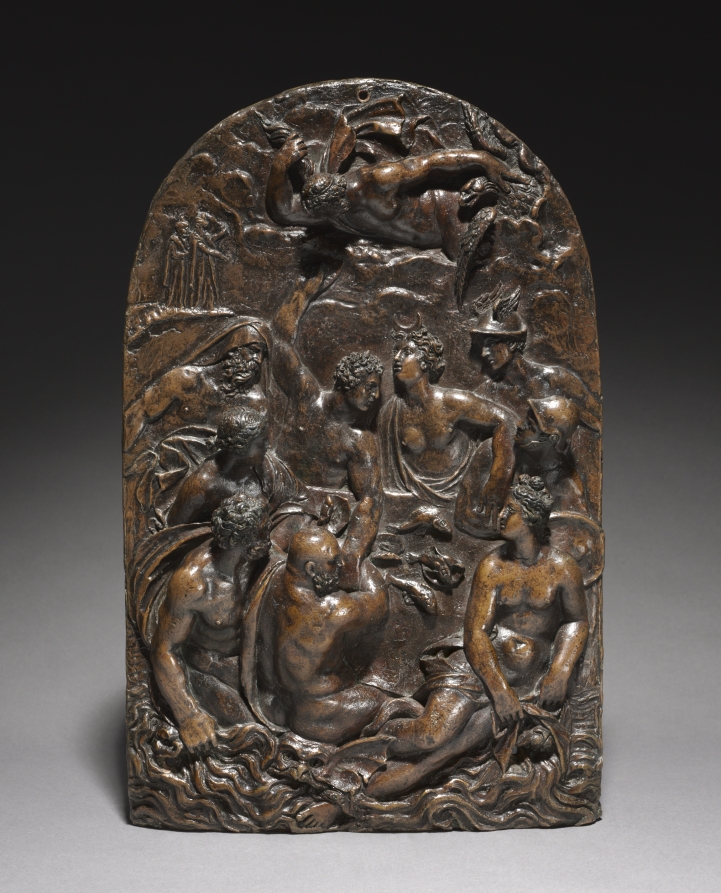
Alessandro Vittoria · The Cleveland Museum of Art · John L. Severance Fund · CC0
- Born
- 1525 · Trento.
- Died
- 1608 · Venice.
- Nationality
- Republic of Venice
- Occupation
- sculptor
- Fields
- art of sculpture
- Teachers
- Jacopo Sansovino
- Known for
- Santi Apostoli · Palazzo Balbi · Bust of Tommaso Rangone
- Languages
- Italian
VALÉORINE Encyclopedia
VALÉORINE documentary reading
Documentary summary
Illustration — Alessandro Vittoria portrayed by Paolo Veronese, c. 1580 • Illustration — Alessandro Vittoria funerary monument, San Zaccaria, Venice Alessandro Vittoria (1525 – 27 May 1608) was an Italian Mannerist sculptor of the Venetian school, "one of the main representatives of the Venetian classical style" and rivalling Giambologna as the foremost sculptors of the late 16th century in Italy, producing works such as Annunciation (Art Institute of Chicago).
Admitted source layer · organised and presented by VALÉORINE
Reference Check
Propose documentary evidence for Alessandro Vittoria. A contribution is never written directly as fact: identity, source, rights and evidence gates still decide.
Sign in to contribute
World of VALÉORINE
Documentary connections
Only confirmed graph relationships appear here. Images are shown only when their identity and reuse rights both pass the documentary gate.
Documentary evidence
Documentary basis
Authority files
gnd · 1163244783 · wikidata · Q1347426 · wikipedia · Alessandro Vittoria
In this article
Biography
Biography
Training under Jacopo Sansovino is recorded. Johan Gregor van der Schardt is recorded as having studied under Alessandro Vittoria. The recorded working language is Italian. The field of work recorded is art of sculpture. Places of work recorded in the authority are Venice. Works named in the authority record are Santi Apostoli, Palazzo Balbi and Bust of Tommaso Rangone. Work by Alessandro Vittoria is recorded in the collections of Minneapolis Institute of Art, Art Institute of Chicago, The Nelson-Atkins Museum of Art, J. Paul Getty Museum and National Gallery of Canada.
Vittoria was born Alessandro Vittoria di Vigilio della Volpa, in Trento, Italy, in what is now northern Italy, and was the son of a tailor. Vittoria was trained in the atelier of the architect-sculptor Jacopo Sansovino; he was a contemporary of Titian whose influence can be detected in his compositions. He was a virtuoso in terracotta, often presented with gilded surfaces, marble and bronze. Like all Italian sculptors of his generation, Vittoria was influenced also by Michelangelo and by the Florentine Mannerist, Bartolomeo Ammannati. The closeness of his associations in projects by architects Sansovino, Sanmicheli and Palladio, working with painters Titian, Tintoretto and Veronese placed him squarely among the protagonists of the art world in late 16th-century Venice.
Career
Career
• Illustration — Bust of Marino Grimani, after 1599, terracotta with paint (Walters Art Museum) Vittoria was first trained in his native city, Trento, then moved to Venice on 25 July 1543, where he trained and worked with Jacopo Sansovino. His long artistic relationship with Sansovino was a stormy one. After one quarrel with Sansovino, he removed from Venice and worked in Vicenza, where he collaborated with Veronese on the decorations of the Villa Barbaro at Maser (1560–62) before returning. The two masters worked jointly on great sculptural commissions until Sansovino's death. Vittoria took up his studio and completed Sansovino's unfinished commissions. His pupils included Camillo Mariani and Andrea di Alessandro. Vittoria joined the Scuola Grande di San Marco on 24 January 1563 and the Accademia del Disegno, Florence, c. 1567. He died at Venice on 27 May 1608. His tomb, with his self-portrait bust, is in the church of San Zaccaria. Vittoria is known for his classicising portrait busts, a genre that scarcely existed in Venice before him, and for medals as well as for his full-length figures, some of which surmount Sansovino's Biblioteca Marciana.
Gallery
Gallery
• Illustration — San Zaccaria, San Zaccaria, Venice • Illustration — Anthony the Great, San Francesco della Vigna, Venice • Illustration — Saint Roch, San Francesco della Vigna, Venice • Illustration — Saint Roch, San Salvador, Venice • Illustration — Saint Sebastian, San Francesco della Vigna, Venice • Illustration — Saint Sebastian, San Salvador, Venice • Illustration — John the Evangelist, San Zanipolo, Venice • Illustration — Virgin of pain, San Zanipolo, Venice • Illustration — Cast of Vittoria's bust of Apollonio Massa
Life and career
Dated record
Life and career
The full dated record · 2 entries
1525
Alessandro Vittoria born at Trento.
1608
Alessandro Vittoria died at Venice.
Places
Named by the record
Places
Only places the record itself states, plotted where the house gazetteer settles their coordinates. Nothing is inferred from a name or a nationality.
Trento.
Birth place
Venice.
Death place
Primary material
Documents and archives
reference work
- Wikidata, structured authority record Q1347426: Alessandro Vittoria
Reputable secondary · Wikimedia Foundation
- “Alessandro Vittoria”, English Wikipedia, consulted as further reading
Reputable secondary · Wikipedia
authority file
- Gemeinsame Normdatei 1163244783, Alessandro Vittoria.
General reference · Deutsche Nationalbibliothek
Literature
Literature
Literature
Vittoria, Alessandro, Benezit Dictionary of Artists, 2011
Vittoria, Alessandro, Oxford Art Online, 2003
Alessandro Vittoria and the Art of Carving, Making and Moving Sculpture in Early Modern Italy, 2017
The House of Alessandro Vittoria Reconstructed, Sculpture Journal, 2001
Scholarly footprint
Literature
Scholarly footprint
A count of publications is evidence of attention, not of standing, and is given here only as a measure.
Notes from the source article
Cited by Wikipedia
Notes from the source article
These works are cited by the source article, in its own numbering. They are recorded as its citations, not as sources VALÉORINE has verified.
- 1.Federico Zeri and Elizabeth E, Gardner, Italian Paintings: Venetian School (Metropolitan Museum of Art) 1973, p. 87, Portrait of Alessandro Vittoria by Paolo Veronese, acc. no. 46.31 (on-line catalogue); the sculptor poses with a model of his Saint Sebastian for the Montefeltro altar in the Church of San Francesco della Vigna, Venice, of which small bronzes exist (e.g. Metropolitan Museum, acc. no. 40.24)
- 2.Thomas Martin, Alessandro Vittoria and the Portrait Bust in Renaissance Venice: Remodelling Antiquity (Oxford University Press) 1998.
- 3.Veronese's portrait with a model of his Saint Sebastian, ca 1570, is at the Metropolitan Museum of Art (On-line catalog).
- 4.Victoria Charles. 1000 Masterpieces of Decorative Art. Parkstone International. 194. 24 Nov 2014. 9781783104604.
- 5.Martin 1998; there exists no adequate monograph on Vittoria or catalogue of his works
- 6.Giuseppe Gerola, "Nuove documenti veneziani su Alessandro Vittoria" Atti del Reale Instituto Veneto di Scienze, Lettere ed Arti 84 (1925:349-50).
References
Citations
References
Each reference names the institution holding it, so a reader may go to the document itself.
authority file
Gemeinsame Normdatei 1163244783, Alessandro Vittoria.Deutsche Nationalbibliothek
Secondary witnessreference work
Wikidata, structured authority record Q1347426: Alessandro VittoriaWikimedia Foundation
Secondary witnessreference work
Secondary witness
Further particulars
Held on the record
Further particulars
Open the remaining particulars
He trained under Jacopo Sansovino. Each of those relationships is stated by the authority record rather than inferred from style.
Alessandro Vittoria died in 1608 at Venice.
Alessandro Vittoria was born in 1525 at Trento. Recorded as sculptor.
The Encyclopedia exists whether or not anything is for sale. Corrections are recorded rather than overwritten, and every version of this record is kept. Published 16 August 2026.
Elsewhere in Sculpture
6,174 published records in this field, each with its sources named.
- Aleksandr ShevchenkoArtist
- Aleksandra BriedeArtist
- Aleksandra KašubienėArtist
- Aleš VeselýArtist
- Aleth Guzman-NageotteArtist
- Alex ChinneckArtist
- Alex MylonaArtist
- Alex VermeulenArtist
Best supported in this field
For owners
Own a work by Alessandro Vittoria?
A specialist will read what you send and tell you what the house can establish, what it cannot, and whether the object is suited to sale. There is no charge and no obligation. The object stays with you throughout; nothing is shipped to us unless it is arranged in writing beforehand.