
Akseli Gallen-Kallela
Akseli Gallen-Kallela (born Axel Waldemar Gallén; 26 April 1865 – 7 March 1931) was a Finnish painter and a leading figure of Finnish romantic nationalism around the turn of the 20th century. He is considered a pioneer of a distinctly Finnish national art, and his work is regarded as a very important aspect of Finnish national identity. Gallen-Kallela began his career as a realist painter influenced by Jules Bastien-Lepage before turning, in the 1890s, towards symbolism and a stylised national-romantic idiom.
Also recorded as Axel Waldemar Gallén · Axel Gallén · Axel Gallén-Kallela · Akseli Valdemar Gallén-Kallela
Akseli Gallen-Kallela
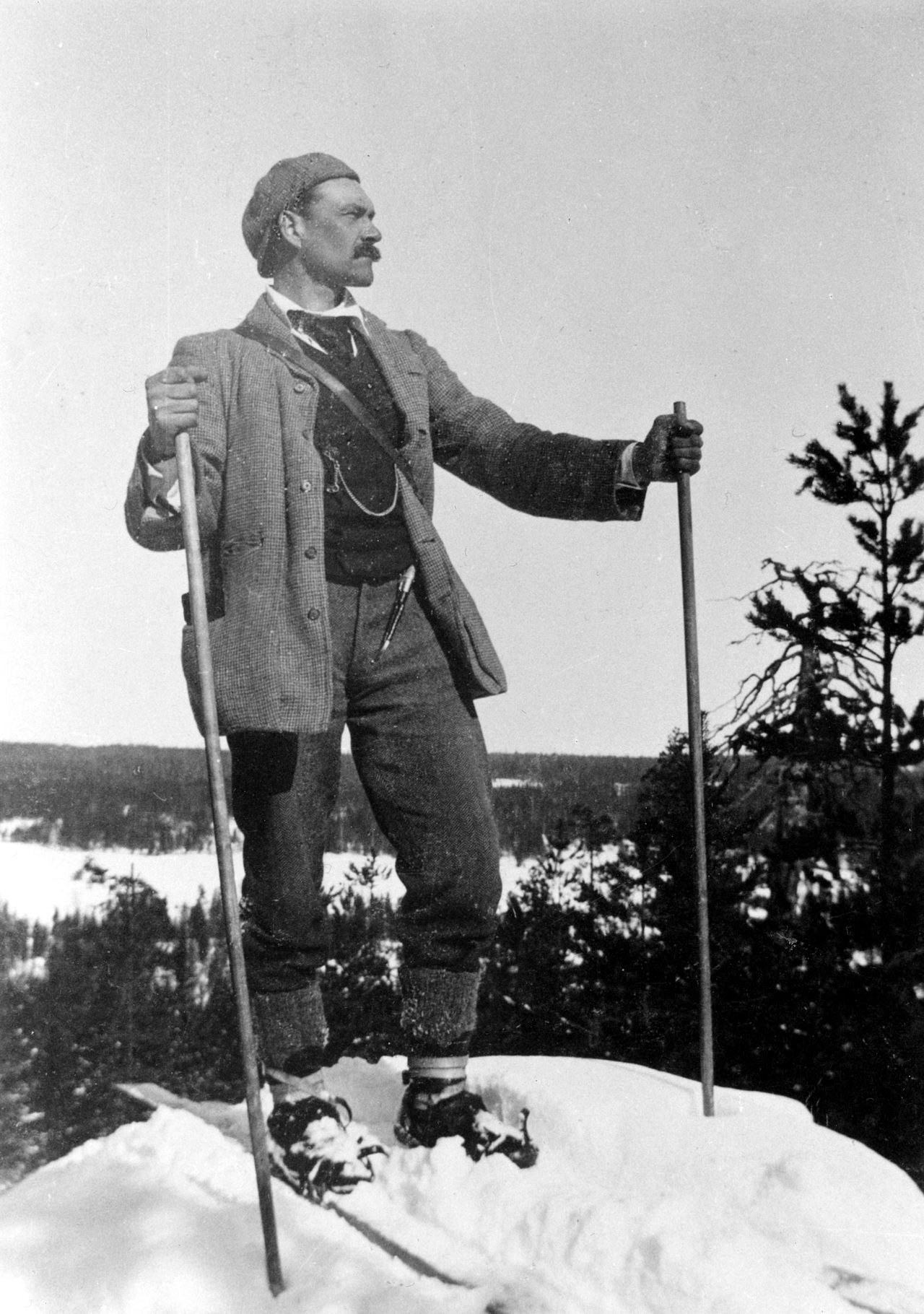
K. O. Lindeqvist (1858–1927) · Suomen historia (Third Edition, published in 1926 in Finland · Public domain
- Birth Name
- Axel Waldemar Gallén
- Born
- 26 April 1865
- Birthplace
- Pori, Grand Duchy of Finland, Russian Empire
- Died
- 7 March 1931
- Place of death
- Stockholm, Sweden
- Movement
- Romantic nationalism, Realism, Symbolism
- Known for
- Illustrations of the Kalevala
- Nationality
- Finland · Grand Duchy of Finland
- Occupation
- painter · printmaker · illustrator · architect · designer · graphic artist · exlibrist · draftsperson
- Fields
- portrait · history painting · landscape painting · Impressionism · photography · work of art
- Movements
- Romanticism · Symbolism · romantic nationalism
VALÉORINE Encyclopedia
VALÉORINE documentary reading
Documentary summary
Akseli Gallen-Kallela (born Axel Waldemar Gallén; 26 April 1865 – 7 March 1931) was a Finnish painter and a leading figure of Finnish romantic nationalism around the turn of the 20th century. He is considered a pioneer of a distinctly Finnish national art, and his work is regarded as a very important aspect of Finnish national identity. Gallen-Kallela began his career as a realist painter influenced by Jules Bastien-Lepage before turning, in the 1890s, towards symbolism and a stylised national-romantic idiom.
Admitted source layer · organised and presented by VALÉORINE
Reference Check
Propose documentary evidence for Akseli Gallen-Kallela. A contribution is never written directly as fact: identity, source, rights and evidence gates still decide.
Sign in to contribute
Documentary evidence
Documentary basis
Authority files
gnd · 6103395-9 · wikidata · Q170068 · wikipedia · Akseli Gallen-Kallela
In this article
Biography
Biography
He is best known for his depictions of the Kalevala, the Finnish national epic, including The Defense of the Sampo, Lemminkäinen's Mother and the Aino Triptych, as well as for his illustrations to the Kalevala and to Aleksis Kivi's novel Seven Brothers. He was also active as a graphic artist, designer and fresco painter, executing monumental works for the Finnish pavilion at the Paris World Fair of 1900 and the Jusélius Mausoleum in Pori. He finnicized his name from Gallén to Gallen-Kallela in 1907.

Själporträtt skiss av Akseli Gallen-Kallela
Akseli Gallen-Kallela · Home: Info: Pic
Key facts
Key facts
• Birth Name — Axel Waldemar Gallén • Born — 26 April 1865 • Birthplace — Pori, Grand Duchy of Finland, Russian Empire • Died — 7 March 1931 • Place of death — Stockholm, Sweden • Movement — Romantic nationalism, Realism, Symbolism • Known for — Illustrations of the Kalevala
Early life
Early life
Gallen-Kallela was born on 26 April 1865, in Pori, to a Swedish-speaking family. His father, Peter Wilhelm Gallén, worked as police chief, lawyer, and bank cashier. His mother was Anna Mathilda Wahlroos, daughter of the sea captain and shipowner Bror Mathias Wahlroos from Pori. The Gallén family traces its origins to Kallela farm in the parish of Lemu, near Turku. Gallen-Kallela was the third of what would become twelve siblings. His mother was an enthusiastic amateur painter who took an active interest in her son's artistic ambitions. Gallen-Kallela was raised in Tyrvää, where the family had moved in 1867 after his father had bought a farm there. Gallen-Kallela was educated at home until 1876, when he, at the age of 11, was sent to Helsinki to study at the Swedish Normal Lyceum, together with two of his brothers, because his father opposed his ambition to become a painter. He studied concurrently at the evening programme of the Finnish Art Society's drawing school (1878–1881) and at the School of Arts and Crafts (1880–1881). After completing his studies at the lyceum, he began full-time studies at the Finnish Art Society's drawing school in autumn 1881, receiving private instruction from Sigrid August Keinänen (1881–1882) and Albert Edelfelt (1883–1884), and later studied privately under Adolf von Becker (1882–1884).
Paris
Paris
• Illustration — Self-Portrait at the Easel, 1885 In 1884, he moved to Paris, to study at the Académie Julian and the Atelier Cormon until 1889. In Paris he became friends with the Finnish painter Albert Edelfelt, the Norwegian painter Carl Dørnberger, and the Swedish writer August Strindberg. During this period he traveled back and forth between Finland and Paris. During his Paris years Gallen-Kallela was strongly influenced by the naturalist plein air painting of Jules Bastien-Lepage, whose memorial exhibition he saw in 1885. His painting Old Woman with a Cat (1885), executed in the southern Finnish coastal village of Salo and completed in Paris, provoked controversy when shown at the Finnish Art Society exhibition in 1886: conservative critics rejected the work for its perceived ugliness, while more progressive voices praised its uncompromising realism. The painting marked a breakthrough for a new realist tradition in Finnish art.
Marriage and Karelianism
Marriage and Karelianism
• Illustration — Problem (Symposium) depicting Gallen-Kallela himself, Oskar Merikanto, Robert Kajanus and Jean Sibelius, 1894 (fi) • Illustration — Self-Portrait in Fresco, 1894 He married Mary Helena Slöör in 1890. The couple had three children: Impi Marjatta (1891–1895), Kirsti (1896–1980) and Jorma (1898–1939). The eldest child died in infancy, while son Jorma was killed in the Winter War.On their honeymoon to Kuhmo in 1890, Gallen-Kallela traveled together with the Swedish painter Louis Sparre to East Karelia (Far Karelia) to collect material for his Kalevala depictions. The journey has come to be seen as the starting point of the artistic interest in Karelia later known as karelianism, a current that became central to Finnish national romanticism.
Monumental works and recognition
Monumental works and recognition
For the Paris World Fair in 1900, Gallen-Kallela painted frescoes for the cupola of the Finnish Pavilion, with motifs including The Forging of the Sampo, The Defense of the Sampo, Ilmarinen Plowing the Field of Vipers and The Departure of Väinämöinen. In the fresco Ilmarinen Plowing the Field of Vipers there was a hidden political message: one of the vipers is wearing a small Romanov crown, reflecting Gallen-Kallela's wish for an independent Finland at the time of the Russification of Finland. He also designed the so-called Iris Room for the Friends of Finnish Handicraft. The pavilion was a major international success for Gallen-Kallela, who was awarded two gold medals and two silver medals at the exposition. The Paris Exposition secured Gallen-Kallela's stature as the leading Finnish artist. In 1901, he was commissioned to paint the fresco, Kullervo Sets Off for War, for the concert hall of the Helsinki Student's Union. Between 1901 and 1903, he painted the frescoes for the Jusélius Mausoleum in Pori, memorializing the 11-year-old daughter of the industrialist Fritz Arthur Jusélius. (The frescoes however were soon damaged by dampness, and were completely destroyed by fire in December 1931. Jusélius assigned the artist's son Jorma to repaint them from the original sketches. The reconstruction was completed just before Jorma's death in 1939.) Gallen-Kallela officially finnicized his name to Akseli Gallen-Kallela in 1907. In 1907, Gallen-Kallela also made his first trip to Hungary, where he was awarded a large gold medal at an international exhibition. The following year he arranged an exhibition of drawings and sketches in Budapest. His idea for a 700-page Great Kalevala was fully formed in 1909 with a publication of his plan in the Valvoja magazine.
Africa and Tarvaspää
Africa and Tarvaspää
• Illustration — Akseli Gallen-Kallela After Returning From Africa by Sigurd Wettenhovi-Aspa in 1911 • Illustration — Self-Portrait for the Uffizi Gallery, 1916 In 1908, with renewal in mind, Gallen-Kallela and his family moved to Paris. However the city and the new direction art was being taken didn't feel as hospitable as he had hoped, and so in May 1909 they moved much further away to Nairobi in Kenya. He was the first Finnish artist to paint south of the Sahara, and produced over 150 expressionistic works. Although artistically the paintings are of fluctuating quality, their colors and the synergy of the colors are remarkable. They returned to Finland in February 1911. Based on this period, he later wrote and had published his Afrikka-kirja (Africa Book) in 1931. Between 1911 and 1913, he designed and built a studio and house for his family at Tarvaspää, approximately 10 km northwest of the centre of Helsinki.
Independent Finland
Independent Finland
• Illustration — Gallen-Kallela in his lieutenant uniform during the civil war, 1918 • Illustration — Portrait of A. Gallen-Kallela, Ilya Repin, 1920 The family moved back from Tarvaspää to Kalela in 1915 to escape the turmoil of the First World War. In 1918, Gallen-Kallela and his son Jorma took part in the fighting at the front of the Finnish Civil War. When the regent, General Mannerheim, heard about that, he invited Gallen-Kallela to design the flags, official decorations and uniforms for the newly independent Finland. For the flag, Gallen-Kallela proposed a white-blue cross flag, with colors inverted (white cross on blue), but it was considered too similar to the Swedish flag and particularly the era's Greek flag. In 1919, he was appointed aide-de-camp to Mannerheim. In 1920, he made an agreement with the publishing company WSOY for the eventual publication of Great Kalevala, with the less decorative Koru-Kalevala being published first in 1922. He was granted a professorship in 1919, and from 1919 to 1931 he was the Vice-Chairman of the Kalevala Society.
New Mexico, later life, and death
New Mexico, later life, and death
• Illustration — Gallen-Kallela in the National Museum of Finland in front of his fresco version of The Defense of the Sampo, 1928 In December 1923, he moved to the United States, where his family followed him in autumn 1924. He first spent time in Chicago, and an exhibition of his work toured several cities. In Chicago, he was impressed by Native American art and moved to Taos, New Mexico, at the art colony there to study it further. During his time in the United States, he began sketching out the Great Kalevala in much more detail. In May 1926, the family returned to Finland. In 1924, Gallen-Kallela had published Kallela-kirja. 1. Iltapuhde-jutelmia, which was translated into Swedish by Bertel Gripenberg in 1932. In 1928, together with his son Jorma he painted the Kalevala frescoes at the lobby of the National Museum of Finland. In 1930, he made an agreement to paint a gigantic fresco for the bank Kansallis-Osake-Pankki, but on 7 March 1931, while returning from a lecture in Copenhagen, he suddenly died of pneumonia in Stockholm.
Websites
Websites
* * * * * * * * * * * * * * *
Identity and origins
Identity and origins
Akseli Gallen-Kallela was recorded at birth as Axel Waldemar Gallén. The authorities additionally record the headings Axel Waldemar Gallén, Axel Gallén, Axel Gallén-Kallela, Akseli Valdemar Gallén-Kallela and Akseli Valdemar Gallen-Kallela. His recorded languages were Swedish and Finnish. He married Mary Gallen-Kallela. 2 children are recorded: Kirsti Gallen-Kallela and Jorma Gallen-Kallela.
Life and career
Dated record
Life and career
Explore 1865–1931
The full dated record · 3 entries
1865
Akseli Gallen-Kallela was born in 1865.
1906
“The Lovers” By Akseli Gallen-Kallela (1906) is digitised and catalogued by Internet Archive.
1931
Akseli Gallen-Kallela died at Stockholm.
Books
* * * *
Berlin and the Kalevala paintings
• Illustration — Self-Portrait ’en face’, 1897 In December 1894, Gallen-Kallela moved to Berlin to oversee the joint exhibition of his works with the works of Norwegian painter Edvard Munch. At the time Gallen-Kallela also designed a grand cabin called Kalela for his family far from everything on the shore of Lake Ruovesi. It was built from dead standing pine by 13 local carpenters in a year from 1894 to 1895. In March 1895, the trip was cut short when he received a telegram that his daughter Impi Marjatta had died from diphtheria, a loss which would prove to be a turning point in his work. His works had been romantic, but after his daughter's death, Gallen-Kallela's works became more aggressive. From 1896 to 1899, he painted what are considered his most famous works: The Defense of the Sampo, Lemminkäinen's Mother, Joukahainen's Revenge and Kullervo's Curse. In May 1895, Gallen and Mary visited London, with his intent being the purchase of a graphic art press. There, he also learned about stained glass. At the end of 1897 the family took a trip to Florence, also visiting Pompeii, where he studied the art of frescoes.
Legacy
Gallen-Kallela is regarded as one of the most important Finnish artists of his era and a pioneer of a distinctly Finnish national art. The national-romantic style is essentially considered his creation, and his Kalevala imagery has decisively shaped the visual identification of the epic in Finland. He was also a forerunner in graphic art and applied arts, and his work brought new impulses to Finnish architecture and design. His reputation was contested in the 1920s, when modernist critics did not share the nationalist circles' view of him as the greatest Finnish artist. His standing has since been re-evaluated, first for his realist works and later for his symbolist production, and he is today appreciated above all for his versatility and for shaping the national-romantic style. His studio and house at Tarvaspää was opened as the Gallen-Kallela Museum in 1961 and houses some of his works and research facilities on him. • Illustration — Gallen-Kallela Museum in Tarvaspää
Recognition and collections
Where the work is held
Recognition and collections
Akseli Gallen-Kallela received Knight of the Legion of Honour, Ducat Prize, Commander of the Order of the White Rose of Finland, Commander First Class of the Order of the White Rose of Finland, Cross of Liberty, 3rd Class and Knight Grand Officer of the Order of Saint Olav.
Documents and archives
Primary material
Documents and archives
reference work
- Wikidata, structured authority record Q170068: Akseli Gallen-Kallela
Reputable secondary · Wikimedia Foundation
- “Akseli Gallen-Kallela”, English Wikipedia, consulted as further reading
Reputable secondary · Wikipedia
authority file
- Gemeinsame Normdatei 6103395-9, Akseli Gallen-Kallela 125th Anniversary Exhibition (1990 : Espoo; Turku).
General reference · Deutsche Nationalbibliothek
Notes from the source article
Cited by Wikipedia
Notes from the source article
These works are cited by the source article, in its own numbering. They are recorded as its citations, not as sources VALÉORINE has verified.
- 1.Cite Biografiskt lexikon för Finland
- 2.Writers in Finland 1917-1944
References
Citations
References
Each reference names the institution holding it, so a reader may go to the document itself.
authority file
Gemeinsame Normdatei 6103395-9, Akseli Gallen-Kallela 125th Anniversary Exhibition (1990 : Espoo; Turku).Deutsche Nationalbibliothek
Secondary witnessreference work
Wikidata, structured authority record Q170068: Akseli Gallen-KallelaWikimedia Foundation
Secondary witnessreference work
Secondary witness
Further particulars
Held on the record
Further particulars
Open the remaining particulars
Akseli Gallen-Kallela studied at Académie Julian, Gymnasiet Svenska normallyceum and Academy of Fine Arts of Helsinki. He trained under Carl Jahn, Fredrik Ahlstedt, Adolf von Becker and Fernand Cormon. Each of those relationships is stated by the authority record rather than inferred from style.
Akseli Gallen-Kallela worked in painting. His work is associated with Romanticism, Symbolism and romantic nationalism. He worked at Helsinki, Kalela and Paris. Work and production. Works recorded as notable number 3: The Artist's Mother, Lemminkäinen's Mother and The Defense of the Sampo. His recorded genres are portrait, history, landscape, Impressionism and photography.
Career and activity
The Encyclopedia exists whether or not anything is for sale. Corrections are recorded rather than overwritten, and every version of this record is kept. Published 14 August 2026.
Elsewhere in Prints
4,138 published records in this field, each with its sources named.
- Aisa TulugaEngraver
- Akbar PadamseeEngraver
- Akesuk TudlikEngraver
- Akkitham NarayananEngraver
- Alacie TullaugaqEngraver
- Alain HuckEngraver
- Alanis ObomsawinEngraver
- Alashua AningmiuqEngraver
Best supported in this field
For owners
Own a work by Akseli Gallen-Kallela?
A specialist will read what you send and tell you what the house can establish, what it cannot, and whether the object is suited to sale. There is no charge and no obligation. The object stays with you throughout; nothing is shipped to us unless it is arranged in writing beforehand.