
Ahmad Lahori
Ustad Ahmad Lahori (Master Ahmad of Lahore; c.1580–1649), also known as Ahmad Mi'mar (Ahmad the Architect), was an architect and engineer of the Mughal Empire who served as the chief architect during the reign of Shah Jahan. He is credited with designing the Red Fort in Delhi and may have also been responsible for the design of the Taj Mahal in Agra, along with Mir Abd-ul Karim and Makramat Khan. He is regarded as one of the greatest architects of the 17th-century.
Also recorded as Ahmad Lahori Mi'mar · Master Ahmad of Lahore
Ahmad Lahori

Blog website of Chughtai Museum, via: http: blog.chughtaimuseum.com · Public domain
- Name
- Ahmad Lahori
- Born
- c. 1580
- Died
- c. 1649
- Place of death
- Shahjahanabad, Mughal Empire
- Nationality
- Mughal Empire
- Occupation
- architect
- Known for
- Taj Mahal · Red Fort
VALÉORINE Encyclopedia
VALÉORINE documentary reading
Documentary summary
Ustad Ahmad Lahori (Master Ahmad of Lahore; c.1580–1649), also known as Ahmad Mi'mar (Ahmad the Architect), was an architect and engineer of the Mughal Empire who served as the chief architect during the reign of Shah Jahan. He is credited with designing the Red Fort in Delhi and may have also been responsible for the design of the Taj Mahal in Agra, along with Mir Abd-ul Karim and Makramat Khan. He is regarded as one of the greatest architects of the 17th-century.
Admitted source layer · organised and presented by VALÉORINE
Reference Check
Propose documentary evidence for Ahmad Lahori. A contribution is never written directly as fact: identity, source, rights and evidence gates still decide.
Sign in to contribute
Documentary evidence
Documentary basis
Authority files
wikidata · Q2551253
In this article
Biography
Biography
He was also one of the leading architects responsible for the establishment of the imperial city of Shahjahanabad. His architecture is a combination of Indo-Islamic and Persian architectural styles, and thus, a major instance of Indo-Persian culture.

Taj Mahal, Agra, India.
Dhirad, picture edited by J. A. Knudsen · Dhirad · see permission
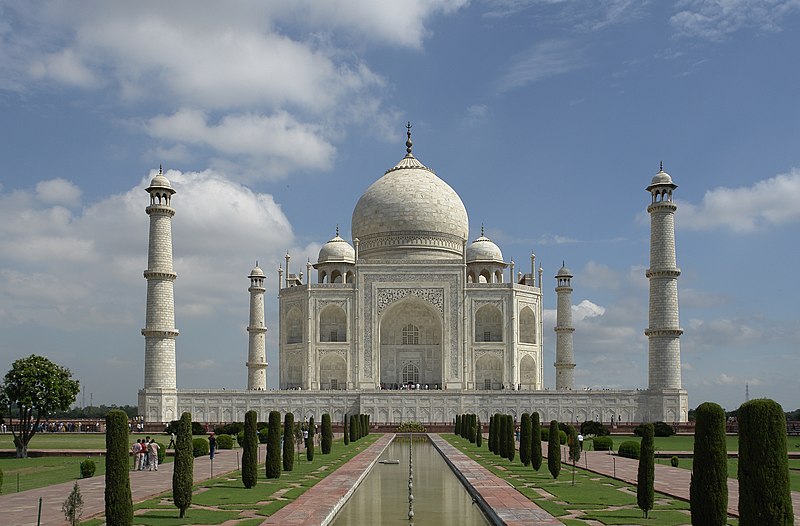
Taj Mahal, Agra, India, south face.
Yann (talk) · This file is not in the public domain. Therefore you are requested to use the following next to the image if you reuse this file: © Yann Forget / Wikimedia Commons
Key facts
Key facts
• Name — Ahmad Lahori • Born — c. 1580 • Died — c. 1649 • Place of death — Shahjahanabad, Mughal Empire • Significant Buildings — Red Fort • Significant Projects — Shahjahanabad • Honorific Prefix — Ustad
Life
Life
• Illustration — Ustad Ahmad Lahori's deposit of "Five Qasidas" in Kitab Khana Amrao Ustad Ahmad Lahori hailed from the city of Lahore, as his nisba indicates. Lahori was from a family of Timurid architects, originally from Herat. Even after his family's migration to Delhi, his family is still referred to by the epithet "Lahori". He was a skilled engineer who later in life was given the title of Nadir-ul-Asar ("wonder of the age") by Shah Jahan. Two of his three sons, Ataullah Rashidi and Lutfullah Muhandis, also became architects, as did some of his grandsons, Shah Kalim Allah Jahanabadi one among them. Ahmad Lahori was learned also in the arts of geometry, arithmetic and astronomy, and according to his son Lutfullah was familiar with the Euclid's Elements and Ptolemy's Almagest.
Career
Career
In 1631, Shah Jahan appointed him for the construction of Taj Mahal. The construction project employed some 20,000 artisans under the guidance of a board of architects led by Ahmad Lahori. The project took twelve years to manifest into reality. Afterwards, he was relocated to Delhi where the emperor commissioned him for the construction of the new imperial city, Shahjahanabad, in 1639. The building of the city, including the Red Fort, was complete by 1648. In 1648, Ahmad Lahori started working on the project of the imperial mosque in Delhi, now known as Jama Masjid, Delhi. He died in 1649, before the foundations of mosque were laid. In writings by Lahori's son, Lutfullah Muhandis, two architects are mentioned by name: Ustad Ahmad Lahori and Mir Abd-ul Karim. Ustad Ahmad Lahori laid the foundations of the Red Fort at Delhi, which was built between 1638 and 1648. Mir Abd-ul Karim counted as the favourite architect of the previous emperor, Jahangir, and is mentioned as a supervisor, together with Makramat Khan, for the construction of the Taj Mahal. • Illustration — Red Fort's Lahori Gate in Delhi • Illustration — Covered bazaar in Old Delhi
Life and career
Dated record
Life and career
Explore 1580–1649
The full dated record · 3 entries
1580
Ahmad Lahori was born in 1580.
1631
Taj Mahal is dated 1631.
1649
Ahmad Lahori died at Old Delhi.
Notes from the source article
Cited by Wikipedia
Notes from the source article
These works are cited by the source article, in its own numbering. They are recorded as its citations, not as sources VALÉORINE has verified.
- 1.Curl, James Stevens. Ahmad, Ustad. Oxford University Press. 2006. 978-0-19-860678-9.
- 2.Balasubramaniam, R. New insights on architects of Tāj. Indian Journal of History of Science. National Institute of Sciences of India. 44. 3. 391. 2009. 2454-9991.
- 3.Kanwar, H. I. S. Ustad Ahmed Lahori. Islamic Culture. Islamic Culture Board. 48. 11–32. 1974. 0021-1834.
- 4.Necipoğlu, Gülru. The Topkapi Scroll: Geometry and Ornament in Islamic Architecture. Getty Publications. 155. 1996-03-01. 978-0-89236-335-3.
- 5.American Philosophical Society. Census of the Exact Sciences in Sanskrit Series A. 1. 39. 1970.
- 6.Dadlani, Chanchal. Histories of Ornament: From Global to Local. Princeton University Press. 183. 2016. 9780691167282.
- 7.Khan, I. N. Black Taj Mahal: The Emperor's Missing Tomb. Black Taj Project. 38. 2015. 978-81-927479-0-3.
- 8.Taj Mahal Description and Profile (Ahmad Lahori, architect of the emperor) UNESCO.org website, Retrieved 17 November 2021
- 9.Begley, Wayne E. Taj Mahal - The Illumined Tomb. University of Washington Press. 65. 1989. 978-0-295-96944-2.
- 10.Asher, Catherine Ella Blanshard. The New Cambridge History of India, Vol I:4 - Architecture of Mughal India. Cambridge University Press. 212. 1992. 0-521-26728-5.
Bibliography printed in the source article · 2
- Begley, Wayne E. Four Mughal Caravanserais Built during the Reigns of Jahangir and Shah Jahan. Muqarnas Volume I: An Annual on Islamic Art and Architecture. Yale University Press (Newhaven). 167–180. 1983.
- Koch, Ebba. The Complete Taj Mahal: And the Riverfront Gardens of Agra. Thames & Hudson Ltd. 288 pages. 2006. 0-500-34209-1.
References
Citations
References
Each reference names the institution holding it, so a reader may go to the document itself.
Institutional database
Wikidata, structured authority record Q2551253: Ahmad LahoriWikimedia Foundation
Institutional witness
Further particulars
Held on the record
Further particulars
Open the remaining particulars
2 children are recorded: Ataullah Rashidi and Lutfullah Muhandis.
Identity and origins
The Encyclopedia exists whether or not anything is for sale. Corrections are recorded rather than overwritten, and every version of this record is kept. Published 14 August 2026.
Elsewhere in Design
11,558 published records in this field, each with its sources named.
- Agustín GoovaertsDesigner
- Agustín Landa VerdugoDesigner
- Aharon AvniDesigner
- Ahmad JafariDesigner
- Ahmad MadanDesigner
- Ahmad Reza MamduhiDesigner
- Ahmad ZohadiDesigner
- Ahmed AbukhaterDesigner
Best supported in this field
For owners
Own a work by Ahmad Lahori?
A specialist will read what you send and tell you what the house can establish, what it cannot, and whether the object is suited to sale. There is no charge and no obligation. The object stays with you throughout; nothing is shipped to us unless it is arranged in writing beforehand.