
8×63mm cartridge m/32
The 8×63mm patron m/32 was a bottlenecked centrefire cartridge with a slightly (0.25 mm) rebated rim for Swedish heavy and medium machine guns. It was used from 1932 to the finalisation of the re-chambering process of these machine guns to 7.62×51mm NATO in 1975.
Also recorded as 8×63mm M/32
8×63mm cartridge m/32
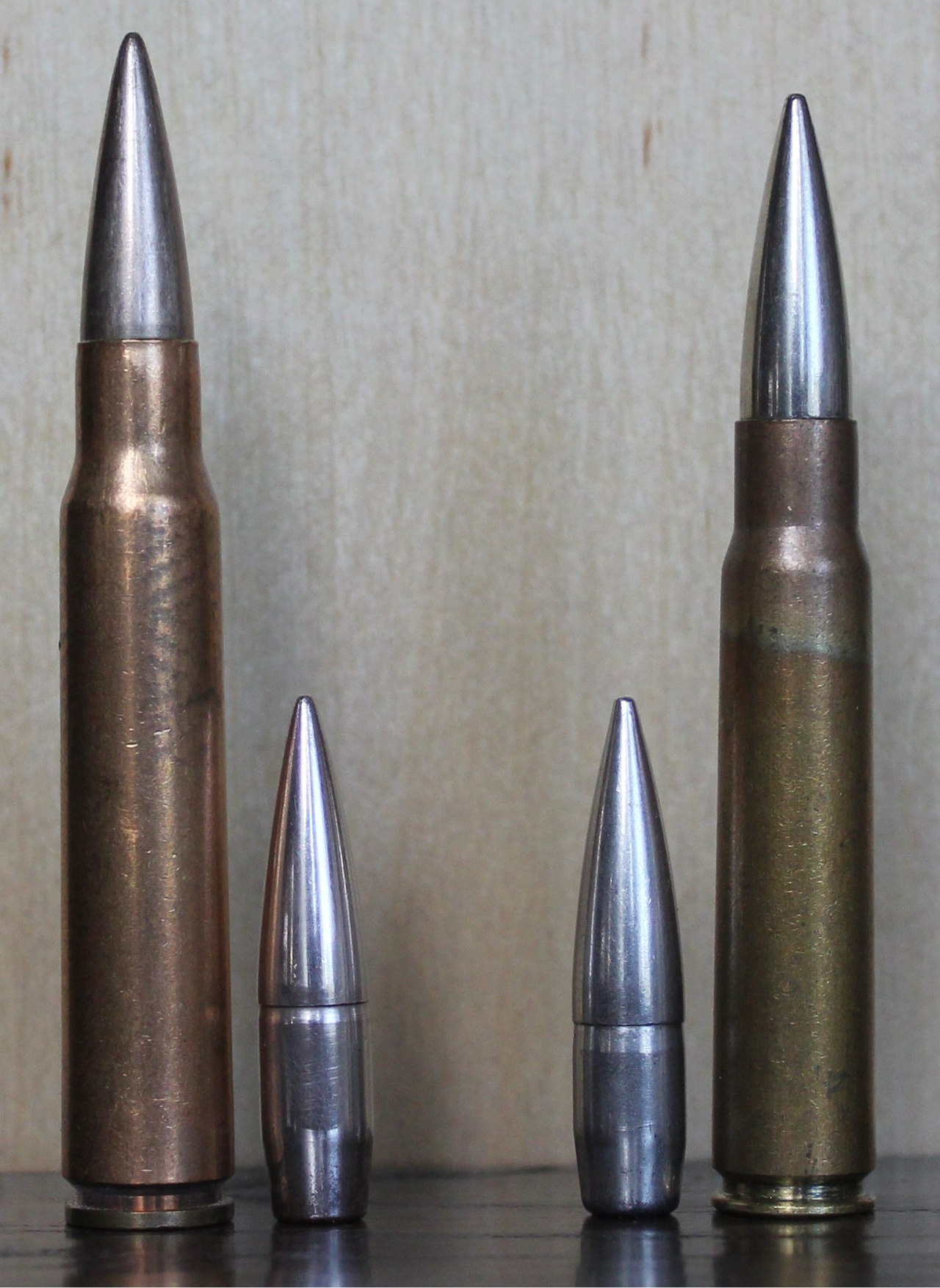
Volhv944 · CC BY-SA 4.0
- Name
- 8×63mm
- Field
- rifle cartridge
- Period
- 1932
- Region
- Sweden
VALÉORINE Encyclopedia
VALÉORINE documentary reading
Documentary summary
The 8×63mm patron m/32 was a bottlenecked centrefire cartridge with a slightly (0.25 mm) rebated rim for Swedish heavy and medium machine guns. It was used from 1932 to the finalisation of the re-chambering process of these machine guns to 7.62×51mm NATO in 1975.
Admitted source layer · organised and presented by VALÉORINE
Reference Check
Propose documentary evidence for 8×63mm cartridge m/32. A contribution is never written directly as fact: identity, source, rights and evidence gates still decide.
Sign in to contribute
World of VALÉORINE
Documentary connections
Only confirmed graph relationships appear here. Images are shown only when their identity and reuse rights both pass the documentary gate.

Documentary evidence
Documentary basis
Authority files
wikidata · Q6380646
In this article
Key facts
Key facts
• Name — 8×63mm • Origin — Sweden • Type — Rifle • Service — 1932–1975 • Used By — Sweden • Wars — UN intervention in Kongo 1960-1964 • Designer — Kungliga Armétygförvaltningen (KAF) AktieBolaget Bofors • Design Date — 1927–1932 • Manufacturer — AB Bofors • Is Si Specs — yes • Case Type — Rebated, bottleneck • Bullet — 8.20 • Neck — 9.10 • Shoulder — 11.51 • Base — 12.43 • Rim Dia — 12.18 • Rim Thick — 1.42 • Case Length — 62.81 • Length — 84.62 • Primer — Berdan, Large rifle • Is Si Ballistics — yes • Bwunit — gram • Bw1 — 14.2 • Btype1 — m/32 FMJ • Vel1 — 760 • En1 — 4101 • Test Barrel Length — 609 mm (24 in)
History
History
Given the experiences of the devastating effect of small arms fire, including the long-range, even indirect fire of the machine guns, in the Russo-Japanese War and World War I, as well as a revolution in terminal ballistic calculations, calibre-related concerns occupied a lot of attention worldwide in military establishments. Sweden was no exception, and series of trials in calibres 6mm-12mm were conducted until the late 1920s. At this time, the standard service cartridge in Swedish use was the 6.5×55mm Swedish skarp patron m/94 projektil m/94 (live cartridge m/94 projectile m/94) service ammunition loaded with a 10.1 g long round-nosed m/94 (B-projectile) bullet. After study-travels by Lieutenant Colonel de Laval along with Captains Nygren and Holmgren, mainly to Germany and the Netherlands in October 1930, Royal Swedish Army Materiel Administration (Kungliga Armétygförvaltningen (KAF) appointed a commission that conducted a series of tests with calibres 6,5 mm to 7,2 – 7,5 – 7,9 mm, and bullet weights between 8.4 grams and 17.0 grams, with the intention to either recommend a new calibre for the kulspruta m14-29 or retain the 6.5×55mm but with a new boat tailed spitzer bullet, as the old blunt nosed projectile m/94 had inferior ballistics. The commission found that at ranges below 2400 m, no recommendation could be given without indepth analysis of intended tasks within the tactical doctrine. Past this, the 14.2 gram bullet in calibre 7.9mm had superior performance in precision and penetration while not causing excessive barrel wear as well as fulfilling the requirement of 20 kilogram-metres impact force up to a range of 3600 m. Based on this, KAF tasked AB Bofors to develop and manufacture the larger rifle cartridge to meet these needs.
Design
Design
The patron m/32 round had the same overall length as the.30-06 Springfield cartridge, which allowed it to fit in the standard Browning receiver, but used a larger diameter case and share the 6.5×55mm 12.2 mm diameter bolt face. Compared to the 1928 pattern.30-06 Springfield M1 Ball the 8×63mm patron m/32 was loaded with 8.20 mm S bore 14.2 g bullets and had more muzzle energy. The 8×63mm patron m/32 had a muzzle velocity of 760 m/s and an operating pressure of 330 MPa. The patron m/32's aerodynamically refined boat tailed spitzer bullet had a useful range of approximately 3600 m on which the impact energy was 20 kilogram-meters (196 J / 145 ft⋅lbf), and a maximum range of approximately 5500 m when fired from a kulspruta m/36. Reverse engineering the trajectory from the previous sentence indicates a ballistic coefficient (G1 BC) of approximately 0.63. Available with armour piercing bullets, patron m/32 was used in the UN-forces' KP-bil during the Congo-crisis against the separatists' armoured cars. The 8×63mm patron m/32 cartridge was used in the following machine guns: • Kulspruta m/14-29 • Flygplanskulspruta m/22 • Kulspruta m/36 • Kulspruta m/39 • Kulspruta m/42 The 8×63mm patron m/32 was also used in the gevär / pansarvärnsgevär m/40 bolt-action rifle, Karabiner 98k's re-chambered in Sweden for the patron m/32. Originally purchased as the pvg m/39 in 8×57 IS as a stop-gap anti-tank rifle (despite being unsuited for the role), the re-chambered 8×63 rifles were designated m/40, and later issued to machine gun crews so their rifles would fire the same round as their machine guns. Besides the rechambering a muzzle brake was added necessitated by the additional recoil produced by the more powerful 8×63mm patron m/32 cartridge.
Military ammunition
Military ammunition
• Designation — Type — Weights (gram) — Propellant type — Projectile material(s) — Muzzle velocity V 0 or V 25 — Burning range — Marking — Remarks • Cartridge — Projectile — Propellant • 8 mm sk ptr m/32 — FMJ — 32.1 g — 14.13 g — 3.6 g — Kspkr 1/0,55 — Lead core, Nickel jacket — 750 m/s (V 25) — None — Standard Ball. • 8 mm sk ptr m/32 "For peacetime only" — FMJ — 32,17 — 14,2 — 3,6 — Kspkr 1/0,55 — Lead core, Nickel jacket — 760 m/s — Blue tip — Ammunition of inferior quality. Used in peacetime. • 8 mm sk ptr m/32 "Not for machine guns" — FMJ — 32,17 — 14,2 — 3,6 — Kspkr 1/0,55 — Lead core, Nickel jacket — 760 m/s — Green tip — Same as above but has green marking. This means "Not for machine guns" • 8 mm sk ptr m/32 pprj m/39 — AP — 29,7 — 11,8 — 3,6 — Kspkr 1/0,55 pbr — 3,2 g steel core — 780-810 m/s — Black tip — Ordinary armor-piercing cartridge. Penetration of ~10 mm at 50 m • 8 mm sk ptr m/32 pprj m/40 or 8 mm pbr ptr m/32-40 — AP — 31,14 — 15,7 — 3,6 — Kspkr 1/0,55 pbr — Tungsten core — 725 m/s — Top half black — Tungsten-cored ammunition. Penetration of ~20 mm at 0 m Only used in machine guns. • 8 mm sk ptr m/32 slprj m/39 — Tracer — 28,9 — 11,01 — 3,6 — Kspkr 1/0,55 — Projectile contains phosphorus, no boat tail — 780-824 m/s — red 100-800 m — Red tip — First marking of slprj m/39 • White tip — Second marking of slprj m/39. • 8 mm sk ptr m/32 slprj m/39 "with a different primer" — Tracer — 28,9 — 11,01 — 3,6 — Kspkr 1/0,55 — Projectile contains phosphorus, no boat tail — 780-824 m/s — Red 100-800 m — Red tip — The primer is dark gray and non-magnetic. Likely manufactured in Germany. • 8 mm sk ptr m/32 brandprj m/40 — Incendiary — 11,55 — Phosphorus and lead — Yellow tip — Incendiary ammunition from Hungary. Trubbkula. • 8 mm sk ptr m/32 brandprj m/41 — Incendiary/AP — 27,7 — 9,8-9.9 — 3,6 — Kspkr 1/0,55 pbr — Has an internal steel core surrounderd by fuel — 835-930 m/s — Orange tip — The ammunition is primarily for aircraft and is a semi-armor piercing projectile • 8 mm Tysk B patron "Observation cartridge" — High-explosive incendiary — Bottom halve black — German B bullet loaded in a Swedish 8×63 cartridge. • 8 mm sk blindptr m/32 — Dummy — None — Early marking. • 8 mm sk blindptr m/32 — Dummy — Green tip — Late marking. The operating pressures of the various ammunition types varied between 330 -.
Places
Named by the record
Places
Only places the record itself states, plotted where the house gazetteer settles their coordinates. Nothing is inferred from a name or a nationality.
- Sweden
Notes from the source article
Cited by Wikipedia
Notes from the source article
These works are cited by the source article, in its own numbering. They are recorded as its citations, not as sources VALÉORINE has verified.
- 1.8x63 Swedish / 8x63 Bofors (in Russian)
- 2.The useful maximum range is defined by the maximum range of a small-arms projectile while still maintaining the minimum kinetic energy required to put unprotected personnel out of action, which is generally believed to be 15 kilogram-meters (147 J / 108 ft⋅lbf).
- 3.The Practical Range of Small Arms. The American Rifleman. 40–44.
- 4.Swedish Kulspruta m/36 at forgottenweapons.com
- 5.Arméplanch för utbildning fotograferad av Göta Vapenhistoriska Sällskap (in Swedish)
- 6.Sammanfattning av rapport Till Kungl. Arméförvaltningens artilleridepartement (in Swedish)
References
Citations
References
Each reference names the institution holding it, so a reader may go to the document itself.
reference work
Secondary witness
Connections
Knowledge graph
Connections
Each connection was recorded deliberately, with the basis for it kept on the internal record.
Broader subject
1- rifle cartridgeTerminology
Established from a fact already recorded on a verified source.
Place
1- SwedenPlace
Established from a fact already recorded on a verified source.
The Encyclopedia exists whether or not anything is for sale. Corrections are recorded rather than overwritten, and every version of this record is kept. Published 16 August 2026.
Elsewhere in Militaria
6,095 published records in this field, each with its sources named.
- 8×52mmR MannlicherTerminology
- 8×56mmRTerminology
- 8×58mmRTerminology
- 8×59mm RB BredaTerminology
- 8×68mm STerminology
- 80 cm K (E)Terminology
- 81 KRH 71 YTerminology
- 81 mm mortarTerminology
Best supported in this field
For owners
Own an object connected with 8×63mm cartridge m/32?
A specialist will read what you send and tell you what the house can establish, what it cannot, and whether the object is suited to sale. There is no charge and no obligation. The object stays with you throughout; nothing is shipped to us unless it is arranged in writing beforehand.