
130 mm air defense gun KS-30
The KS-30 is a Soviet L/65 caliber anti-aircraft gun first introduced into Soviet service in 1955. An interim design intended to provide medium-altitude air defense of strategic infrastructure, it was used until 1960−1962, when they were phased out in favor of surface-to-air missiles, but several were retained in strategic reserve as late as of 1988. The gun saw service in the Vietnam War, Iran–Iraq War, and Gulf War, remaining in service in Iraq and Vietnam as late as 2002.
130 mm air defense gun KS-30
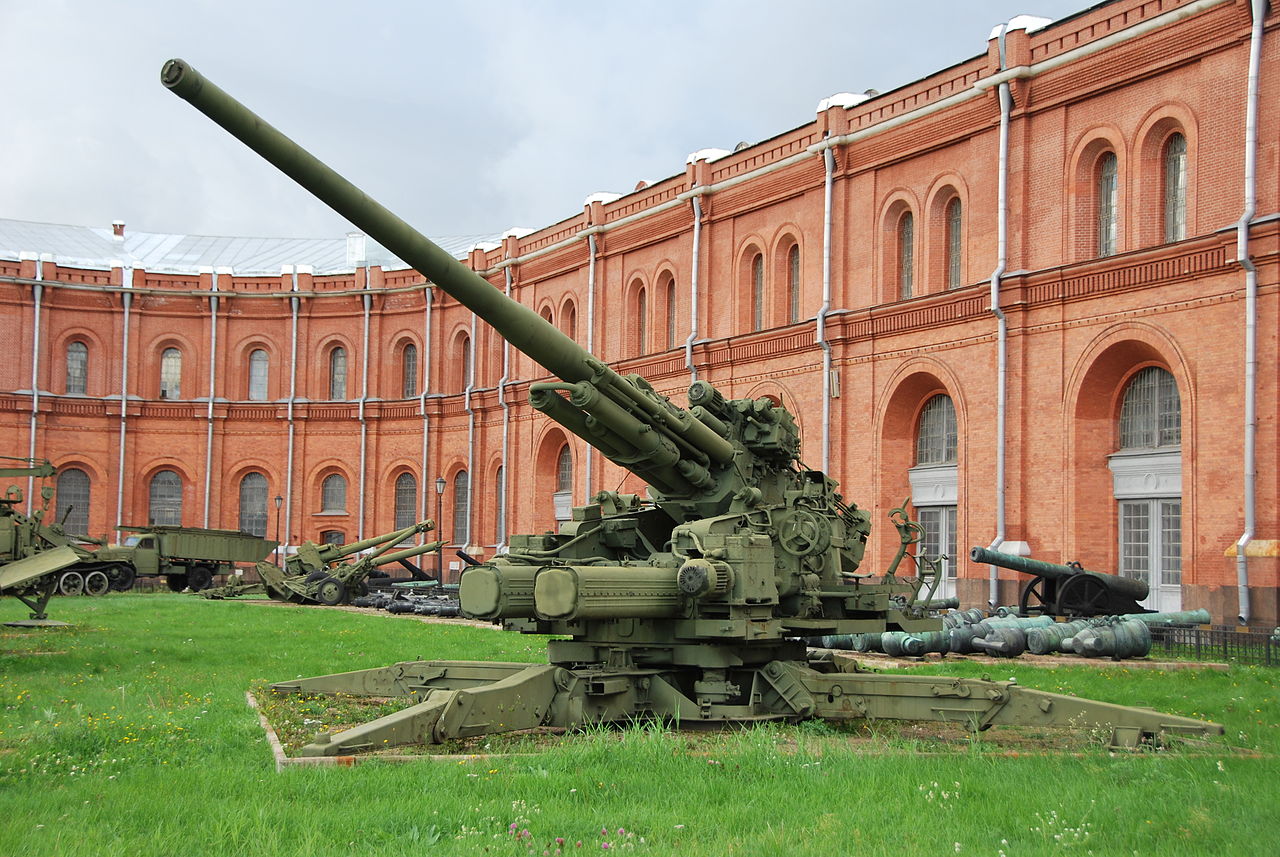
One half 3544 · Public domain
- Name
- 130 mm air defense gun KS-30
- Field
- anti-aircraft gun
- Region
- Soviet Union
VALÉORINE Encyclopedia
VALÉORINE documentary reading
Documentary summary
The KS-30 is a Soviet L/65 caliber anti-aircraft gun first introduced into Soviet service in 1955. An interim design intended to provide medium-altitude air defense of strategic infrastructure, it was used until 1960−1962, when they were phased out in favor of surface-to-air missiles, but several were retained in strategic reserve as late as of 1988. The gun saw service in the Vietnam War, Iran–Iraq War, and Gulf War, remaining in service in Iraq and Vietnam as late as 2002.
Admitted source layer · organised and presented by VALÉORINE
Reference Check
Propose documentary evidence for 130 mm air defense gun KS-30. A contribution is never written directly as fact: identity, source, rights and evidence gates still decide.
Sign in to contribute
World of VALÉORINE
Documentary connections
Only confirmed graph relationships appear here. Images are shown only when their identity and reuse rights both pass the documentary gate.

Documentary evidence
Documentary basis
Authority files
wikidata · Q4028706 · wikipedia · 130 mm air defense gun KS-30
In this article
Key facts
Key facts
• Name — 130 mm air defense gun KS-30 • Origin — Soviet Union • Type — Anti-aircraft gun • Is Artillery — yes • Service — 1955–1962 (Soviet Union) • Used By — See users • Wars — * Vietnam War • Iran–Iraq War • Gulf War • 2003 invasion of Iraq • Designer — M. N. Loginov • Design Date — 1946–1954 • Weight — * (combat) • (traveling) • Length — ftin (traveling) • Part Length — ftin • Width — (traveling) • Height — (traveling) • Crew — 15–20 • Cartridge — * High-explosive fragmentation (HE-FRAG) • Armour-piercing high explosive (APHE) • Rate — 10–12 rpm • Max Range — * (horizontal) • (vertical) • Breech — Semi-automatic horizontal sliding-wedge • Recoil — Hydraulic • Elevation — −5°/+80 • Traverse — 360°
Development
Development
Development of the 130 mm KS-30 began in 1946 at the Zavod no. 9 at Kalinin under a team led by M. N. Loginov. While the gun provided a 25% increase in effective ceiling over the KS-19 100 mm anti-aircraft gun, development was slow since the Soviets were focused on the development of surface-to-air missiles. After it became clear that it would take time to develop and deploy an effective SAM network, work on the KS-30 gun and associated fire control systems resumed as a stopgap measure. The Soviets greatly benefited from captured German operational and technical expertise following the end of World War II, as well from American and British technologies, with the KS-30 making use of radar and fire control systems copied from United States-supplied Lend-Lease equipment and automatic rammers taken from the British QF 3.7-inch AA gun. According to Cullen and Foss, the KS-30 was equivalent of the American 120 mm gun M1 and may have been based on a 130 mm naval gun.
Design
Design
Like other Soviet field artillery pieces, the KS-30 was a simple and rugged design, using a hydraulic recoil system and fixed-charge separate-loading ammunition. The weapon also benefited from the use of adapted Western technologies. The KS-30 used a L/65 caliber barrel; the gun was carried on a two-axle, eight-wheeled carriage. When readied for firing, the axles were removed and the carriage was folded into a firing platform. It was towed either by a AT-T tracked artillery tractor or a Ural-375 6×6 truck. While the carriage had in-built fire-control systems, the gun was usually used in conjunction with the PUAZO director and the SON-9 (NATO reporting name: "Fire Can") fire-control radar which was derived from the US-made SCR-584 radar, supplied under Lend-Lease. It was a medium-altitude weapon. The fire control radars had difficulty acquiring targets flying low and the gun weight and bulk made tracking fast moving aircraft difficult. At high-altitudes, accuracy suffered from increased shell dispersion. Like other Soviet large caliber anti-aircraft guns, the KS-30 could also be used against ground targets.
Ammunition
Ammunition
Ammunition used were of the fixed-charge, separate-loading type that was not interchangeable with the 130 mm towed field gun M1954 (M-46) or the 130 mm gun SM-4-1 coastal gun. It could fire high-explosive fragmentation (HE-FRAG) or armour-piercing high explosive (APHE) rounds. • Type — Weight || colspan="2" | Muzzle velocity || colspan=" 2" |Penetration at 0° • Source: — Isby — Cullen & Foss — Isby — Cullen & Foss — Isby — Cullen & Foss • HE-FRAG — N/A — N/A • APHE — N/A — N/A — N/A
History
History
The KS-30 was introduced in the Soviet Army and Soviet Air Defence Forces service in 1955. It was intended to provide medium-alititude protection high-priority targets such as bridges, factories, transportation hubs, and cities. Large caliber anti-aircraft guns were widely used until 1960–1962, when they were phased out in favor of surface-to-air missiles, but several were retained in strategic reserve as late as 1988, presumably to be deployed by anti-aircraft units after their stockpile of missiles were exhausted in a prolonged conflict. These guns were to be accompanied by a cadre of gun-trained reserve officers. • Illustration — The ALQ-71 ECM pod was effective against the KS-30 radars North Vietnam also used a small number of guns during the Vietnam War. During the conflict, the fire-control radars of Soviet-made AA guns were constantly jammed by American chaffs and the ALQ-71/72 electronic countermeasure pods, which contributed in making the guns effectively obsolete. The gun was also used by Iraq during the Iran–Iraq War. Prior to the Gulf War in 1991, it was estimated that Iraq had 200 guns in service. An unknown number of guns survived the conflict and would remain in service with the Iraqi Army until the 2003 invasion of Iraq.
Users
Users
• Ba'athist Iraq * • − Remained in service as late As of 2002
Comparable weapons
Comparable weapons
• 12.8 cm FlaK 40 – Nazi Germany • 120 mm M1 gun – United States
Literature
Scholarly footprint
A count of publications is evidence of attention, not of standing, and is given here only as a measure.
Notes from the source article
Cited by Wikipedia
Notes from the source article
These works are cited by the source article, in its own numbering. They are recorded as its citations, not as sources VALÉORINE has verified.
Bibliography printed in the source article · 3
- Cullen. Jane's Land-based Air Defence 1992−93. Jane's Information Group. 1992. 978-0-7106-0979-3.
- Isby, David C. Weapons and Tactics of the Soviet Army. Jane's Publishing Company Limited. 1988. 978-0-7106-0352-4.
- O'Halloran. Jane's Land-Based Air Defense 2002−2003. Janes Information Group. 2002. 978-0-7106-2437-6.
References
Citations
References
Each reference names the institution holding it, so a reader may go to the document itself.
reference work
Secondary witnessreference work
Secondary witness
The Encyclopedia exists whether or not anything is for sale. Corrections are recorded rather than overwritten, and every version of this record is kept. Published 16 August 2026.
Elsewhere in Militaria
6,095 published records in this field, each with its sources named.
- 13.5 cm K 09Terminology
- 13"/35 gunTerminology
- 130 53 TKTerminology
- 130 K 90-60Terminology
- 130 mm/50 B13 Pattern 1936 gunTerminology
- 130 mm/55 B7 Pattern 1913 gunTerminology
- 14 cm/40 11th Year Type gunTerminology
- 14 cm/50 3rd Year Type gunTerminology
Best supported in this field
For owners
Own an object connected with 130 mm air defense gun KS-30?
A specialist will read what you send and tell you what the house can establish, what it cannot, and whether the object is suited to sale. There is no charge and no obligation. The object stays with you throughout; nothing is shipped to us unless it is arranged in writing beforehand.